
Credentialing Checklist: Initial File and Recredentialing Dates

A provider credentialing checklist has two parts. Initial credentialing collects and verifies the license, DEA registration, education, board certification, malpractice cover and history, work history and exclusion checks. Recredentialing repeats it on fixed clocks: CAQH attestation every 120 days, NCQA recredentialing every three years and Medicare revalidation every five years.
You are onboarding a new clinician, or a payer has just asked for a recredentialing packet you did not know was due. The documents live in five places and every clock runs on a different cycle. This checklist lists every item, cites the rule behind each date and shows you how to track them in a spreadsheet this week.
Key takeaways
- Credentialing is verification, not paperwork. NCQA describes it as review of a practitioner's "license, medical education, history of sanctions, prior malpractice cases and other information" before they join a network.
- Plan for 90 to 180 days. MGMA puts the time between application and approval at 90 to 180 days, so start before the provider's first day.
- CAQH is now DataSpring. Profiles in the CAQH Provider Data Portal are kept on a 120-day attestation cycle.
- NCQA requires recredentialing every three years for the organizations it accredits; many payers use the same cycle.
- Medicare revalidation is every 5 years. You have 60 days to respond once CMS contacts you, and CMS does not grant extensions.
- Hospitals must query the NPDB (National Practitioner Data Bank) at appointment and every 2 years.
- Small changes have short deadlines. Medicare wants a new practice location reported within 30 days, and NPI record changes are due within 30 days.
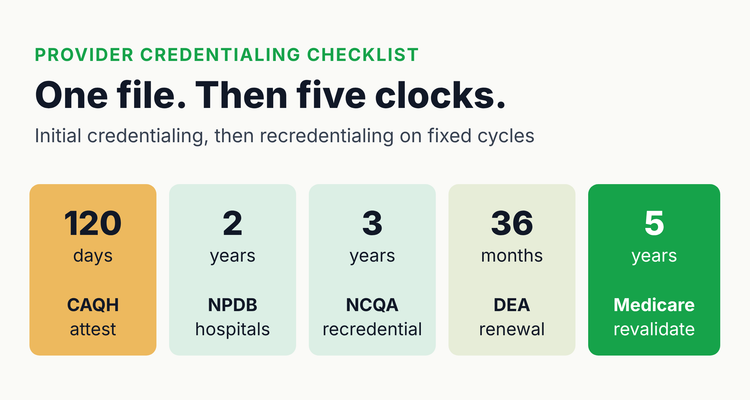 One credentialing file, then five clocks that run on different cycles (rules checked 12 October 2026).
What goes on a provider credentialing checklist?
A provider credentialing checklist lists every document a payer, hospital or your own committee will verify, with the source used to verify it. Collect these before you submit anything. Payers and hospitals add their own forms, so treat this as the core file, not the whole of every application.
Initial credentialing checklist: the core file
- ✓
Current CV with month and year for every position (add a short explanation for any gap)
- ✓
State license for every state of practice, verified on the state board's own lookup
- ✓
DEA registration for each state where the provider handles controlled substances, plus any state controlled substance registration
- ✓
Board certification, or eligibility, verified with the certifying board
- ✓
Medical or professional school diploma, and residency and fellowship certificates
- ✓
Malpractice certificate of insurance (limits, policy dates, claims-made or occurrence) and claims history
- ✓
Hospital privileges letter, or a coverage arrangement if the provider has no privileges
- ✓
NPI (National Provider Identifier) and the matching NPPES record
- ✓
CAQH Provider Data Portal (DataSpring) profile, complete and attested, with your organization authorized to view it
- ✓
Exclusion and sanction checks: OIG List of Excluded Individuals/Entities (LEIE) and state Medicaid lists
- ✓
NPDB query result (required for hospitals; many groups query too)
- ✓
Government photo ID, signed attestation and release forms for each payer
- ✓
Medicare enrollment through PECOS, and each commercial payer's application
Payer applications are only half the job. If you also grant privileges or employ the provider, your own medical staff or credentialing committee needs the same file. Our guide to provider credentialing explains how credentialing, privileging and payer enrollment fit together.
What are the steps in initial credentialing?
Initial credentialing runs in seven steps, and the clock starts when the file is complete, not when you first ask for it. MGMA puts the time between application and approval at 90 to 180 days, so the steps below are worth starting before the offer letter is signed.
- Collect the file. Send the checklist above to the provider on day one and set a return date. Missing items are the usual cause of delay.
- Update the CAQH profile. The provider completes and attests the DataSpring profile, then authorizes each payer to view it.
- Run primary source verification. Check each license, DEA registration, board status and education with the issuing body, and save a dated screenshot or letter.
- Run the background checks. Query the NPDB and the LEIE, and note the date of each search on the file.
- Committee review. Your credentialing committee or medical director signs off, with the date recorded.
- Enroll with payers. Submit Medicare through PECOS and each commercial application. Log the submission date and reference number for each payer.
- Confirm effective dates. Record each payer's effective date before the provider sees that payer's patients. Medicare allows retrospective billing of up to 30 days before the effective date only "if circumstances precluded enrollment in advance" (42 CFR 424.521).
How often is recredentialing required?
Recredentialing is not one date. Each body sets its own cycle, so a provider can be current with one payer and overdue with another. The table compiles the cycles we verified from the official sources, with the rule behind each.
Credentialing and recredentialing clocks (last verified 12 Oct 2026)
| Clock | Cycle | Rule or source | What to track |
|---|---|---|---|
| CAQH / DataSpring attestation | Every 120 days | DataSpring: profiles "actively maintained on a 120-day attestation cycle" (dataspring.com) | Last attested date + 120 days |
| NCQA recredentialing | Every 3 years | "NCQA requires recredentialing every three years" (ncqa.org, applies to NCQA-accredited organizations) | Last credentialing decision + 36 months |
| Payer recredentialing | Set by each payer | Many follow 3 years; Blue Cross Blue Shield of Michigan states three years (bcbsm.com) | Each payer's own notice date |
| Medicare revalidation | Every 5 years (DMEPOS 3) | 42 CFR 424.515; respond within 60 days of CMS's notice; CMS posts due dates 7 months ahead (cms.gov) | Due date from the Medicare Revalidation List |
| Medicare changes | 30 or 90 days | 42 CFR 424.516(d): ownership, adverse legal action or practice location within 30 days; other changes within 90 | Date of each change |
| NPI record (NPPES) | Within 30 days of a change | 45 CFR 162.410(a)(4) | Date of each change |
| DEA registration | 36 months after the first period | 21 CFR 1301.13(d); separate registration per state (DEA Diversion FAQ) | Expiry on the certificate |
| Hospital NPDB query | At appointment, then every 2 years | 45 CFR 60.17; confirmed by npdb.hrsa.gov | Date of last query + 24 months |
| Hospital medical staff appraisal | "Periodically" | 42 CFR 482.22(a)(1); the cycle is in your bylaws | Reappointment date in bylaws |
| State license, malpractice policy | Varies | State board rules; the policy term | Expiry on the document |
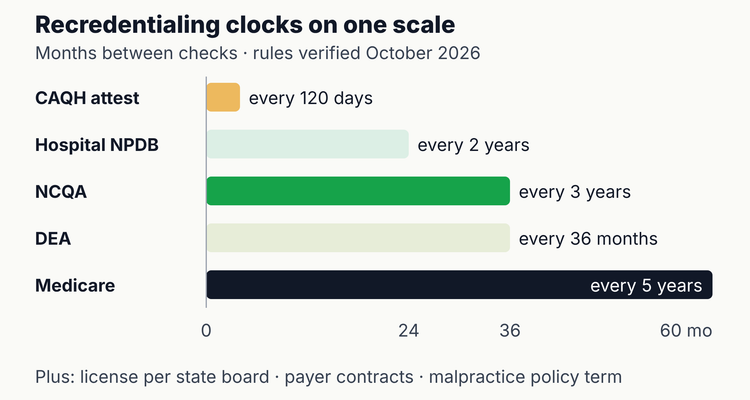 The five recurring credentialing clocks on one scale, from the sources in the table above.
Licenses are the exception: renewal cycles and continuing education rules are set by each state board. Look them up on the board's own site and copy the expiry date from the license itself. For controlled substances, see how long a DEA registration lasts.
What does a recredentialing checklist include?
A recredentialing checklist re-verifies everything that can change and confirms nothing new has happened. You do not re-verify a diploma, but you do re-verify every license, registration, certificate and claim.
Recredentialing checklist (start 120 days before the due date)
- ✓
CAQH profile re-attested and current documents uploaded
- ✓
Every state license re-verified on the board lookup; note any new state
- ✓
DEA and state controlled substance registrations re-verified
- ✓
Board certification status re-verified (maintenance of certification where applicable)
- ✓
New malpractice certificate; claims since the last cycle listed and explained
- ✓
Hospital privileges re-confirmed
- ✓
NPDB re-queried and LEIE and state exclusion lists re-checked
- ✓
Any change of practice location, ownership or adverse legal action reported to Medicare within 30 days
- ✓
Quality or complaint data reviewed if your committee or the payer requires it
- ✓
Committee decision dated and the next recredentialing date set
Malpractice cover deserves its own record. A claims-made policy that ends without tail cover can leave a gap that shows up at the next recredentialing; our guide to malpractice insurance tracking covers what to log.
What happens if you miss a credentialing deadline?
⚠️What happens if you miss it: Medicare can deactivate billing privileges if you do not furnish complete information within 90 days of CMS's notice, or fail to report a change on time (42 CFR 424.540). CMS says Medicare "won't reimburse you for any services during the period that you were deactivated," and it does not grant revalidation extensions. If a provider is excluded by OIG, no federal health care program pays for items or services they furnish (42 CFR 1001.1901). A hospital that skips its NPDB query "is presumed to have knowledge" of anything reported there (45 CFR 60.17).
Do this now: a credentialing tracker in one afternoon
You can set up a working tracker in a spreadsheet today. Use one row per provider per state, because licenses and DEA registrations are state by state. These columns and formulas work in Excel, Google Sheets and LibreOffice.
Credentialing tracker layout (row 2 shown)
| Column | Header | Formula or entry |
|---|---|---|
| A | Provider, state | Text, one row per provider per state |
| B | License expiry | Copied from the board lookup |
| C | DEA expiry | Copied from the certificate |
| D | CAQH last attested | Date from the portal |
| E | CAQH next attestation | =IF(D2="","",D2+120) |
| F | Last credentialing decision | Committee date |
| G | Recredentialing due | =IF(F2="","",EDATE(F2,36)) |
| H | Start recredentialing packet | =IF(G2="","",G2-120) |
| I | Medicare revalidation due | From the Medicare Revalidation List; do not calculate |
| J | Last NPDB query | Date of query |
| K | Next NPDB query (hospitals) | =IF(J2="","",EDATE(J2,24)) |
| L | Next date due | =MIN(B2,C2,E2,H2,I2,K2) |
| M | Status | =IF(L2<TODAY(),"OVERDUE",IF(L2-TODAY()<=30,"Due 30 days",IF(L2-TODAY()<=90,"Due 90 days","OK"))) |
Format columns B to L as dates and sort by column L every Monday. Column H uses our suggestion of a 120-day start; that is planning advice, not a rule. Medicare revalidation is copied rather than calculated because CMS sets the due date, and posts it seven months ahead.
Time estimates for a 2-hour first pass (about 20 providers): 30 minutes to list providers and states, 45 minutes to copy license, DEA and CAQH dates from the online lookups, 30 minutes to add committee and NPDB dates from the files, and 15 minutes to sort and flag anything due within 90 days. These are our estimates; your first pass may take longer if files are scattered.
How can you make credentialing faster next time?
- Pick one attestation day a month. Ask every provider to re-attest CAQH on the same day so 120-day cycles never drift into a busy week.
- Keep a verification log. Save each primary source check as a dated PDF named provider-item-date. Recredentialing then starts from last cycle's evidence.
- Ask for expiring documents before they expire. Request the new malpractice certificate 30 days before renewal, not after.
- Track payer effective dates separately from approval dates. A signed contract is not the same as being able to bill.
- Review the tracker monthly with the practice manager. New hires, new locations and departures are what break credentialing; catch them while the 30-day Medicare clock is still running.
💡 Pro Tip
Give every date on the tracker an owner and a backup by name. Credentialing tends to sit with one person, and the 30-day reporting deadlines keep running while that person is on leave. A backup who can see the same list is the cheapest fix there is.
Practices credentialing dentists and hygienists have a few extra steps; see our dental credentialing checklist.
Spreadsheet or software for credentialing?
A spreadsheet works when one person runs credentialing for a small group, in one or two states, and checks it every week. Researcher Raymond Panko reviewed audits of business spreadsheets and found "errors in 94% of the spreadsheets studied" (Panko), so test your date formulas each quarter. A spreadsheet also cannot remind anyone; someone has to open it.
A tracking tool earns its place when you have several states, many payers or more than one person sharing the work. ExpiryEdge keeps each credential as a record with an owner and a backup, sends reminders at 90, 60, 30 and 7 days by email, SMS, Slack or Teams, and can send providers a document request link for renewed certificates. It does not do primary source verification or payer enrollment; a credentials verification organization (CVO) or your own team still does that.
Frequently asked questions
What documents are on a provider credentialing checklist?
The core file is a CV, every state license, DEA and state controlled substance registrations, board certification, education and training certificates, malpractice certificate and claims history, hospital privileges, NPI, an attested CAQH profile, exclusion checks, an NPDB query and each payer's application. Payers and hospitals may add their own forms.
How long does provider credentialing take?
MGMA puts the time between application and approval at 90 to 180 days. The clock effectively starts when the file is complete, so collecting documents on day one is the biggest time saver.
How often is recredentialing required?
NCQA requires recredentialing every three years for the organizations it accredits, and many payers use the same cycle. Separately, CAQH profiles are attested every 120 days, Medicare revalidation is every five years and hospitals query the NPDB every two years.
How often do providers attest in CAQH?
Every 120 days. CAQH is now called DataSpring, and it says clinician profiles in the CAQH Provider Data Portal are maintained on a 120-day attestation cycle. Track the last attestation date and add 120 days.
How do I know when Medicare revalidation is due?
Search the Medicare Revalidation List on the CMS website. CMS posts due dates seven months in advance and contacts each provider when it is time; you then have 60 days to submit (42 CFR 424.515). CMS does not grant extensions.
Can a provider see patients before credentialing is complete?
They can, but a payer may not pay for those visits until the provider's effective date. Medicare allows retrospective billing of up to 30 days before the effective date only if circumstances prevented enrollment in advance. Check each commercial payer's contract.
Sources
- NCQA, NCQA's credentialing standards ensure safety and integrity of practitioner networks (19 Nov 2024; accessed 12 Oct 2026).
- DataSpring, Clinicians and office staff and CAQH Provider Data dental FAQs (accessed 12 Oct 2026).
- eCFR, 42 CFR 424.515, 424.516, 424.521 and 424.540 (up to date as of 8 Oct 2026).
- CMS, Revalidations (renewing your enrollment) (accessed 12 Oct 2026).
- eCFR, 45 CFR 60.17 and NPDB, Hospitals (accessed 12 Oct 2026).
- eCFR, 45 CFR 162.410 (NPI updates).
- eCFR, 21 CFR 1301.13 and DEA Diversion Control, Registration FAQ.
- eCFR, 42 CFR 482.22 and 42 CFR 1001.1901; HHS-OIG, Exclusions.
- Blue Cross Blue Shield of Michigan, Credentialing and recredentialing (accessed 12 Oct 2026).
- MGMA, Navigating the credentialing gauntlet.
- Raymond R. Panko, What We Don't Know About Spreadsheet Errors Today.
- Last reviewed: 12 October 2026
Frequently asked questions
MGMA puts the time between application and approval at 90 to 180 days. The clock effectively starts when the file is complete, so collecting documents on day one is the biggest time saver.
NCQA requires recredentialing every three years for the organizations it accredits, and many payers use the same cycle. Separately, CAQH profiles are attested every 120 days, Medicare revalidation is every five years and hospitals query the NPDB every two years.
Every 120 days. CAQH is now called DataSpring, and it says clinician profiles in the CAQH Provider Data Portal are maintained on a 120-day attestation cycle. Track the last attestation date and add 120 days.
Search the Medicare Revalidation List on the CMS website. CMS posts due dates seven months in advance and contacts each provider when it is time; you then have 60 days to submit (42 CFR 424.515). CMS does not grant extensions.
They can, but a payer may not pay for those visits until the provider's effective date. Medicare allows retrospective billing of up to 30 days before the effective date only if circumstances prevented enrollment in advance. Check each commercial payer's contract.


