
Malpractice Insurance Tracking: Claims-Made, Tail, Certificates

Malpractice insurance tracking means keeping one record per clinician per policy: carrier, policy number, limits, coverage form, retroactive date, expiry and every payer or hospital holding a certificate. The coverage form matters most. A claims-made policy covers claims reported while it is in force, so leaving it without tail coverage can leave past care uninsured.
Your face sheets live in a shared drive, the renewal arrives in the owner's inbox, and nobody can say whether the departing associate's policy is claims-made. This guide explains the terms in plain English, lists which states set minimum limits, and gives you a tracking sheet and renewal plan you can use this week.
Key takeaways
- Claims-made covers claims reported during the policy. Occurrence covers events that happen during the policy, whenever they are reported (NAIC definitions).
- Tail coverage is an extended reporting period. It covers claims reported after a claims-made policy ends. Record who pays for it before anyone resigns.
- The retroactive date is the number to protect. When you switch claims-made carriers, prior acts cover keeps it; losing it leaves a gap.
- Some states make cover a licensing condition. Colorado, Kansas and Wisconsin each set minimum limits in statute (table below).
- Payers want the face sheet and continuous cover. One Delta Dental application asks for a face sheet showing expiration dates, limits and the provider's name, and immediate notice of any lapse.
- Malpractice payments are reported to the NPDB within 30 days. Hospitals see them when they query every 2 years.
- Track five fields most trackers miss: coverage form, retroactive date, tail terms, certificate holders and the date each holder got the new certificate.
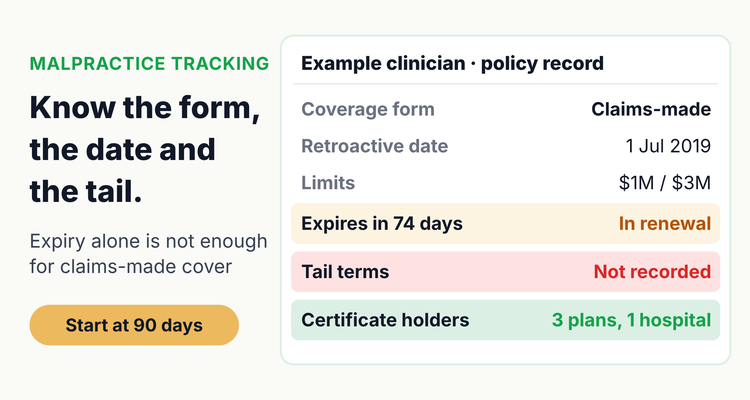 A malpractice record that shows the coverage form, retroactive date and certificate holders answers the questions that matter at renewal and at resignation.
Claims-made vs occurrence: what is the difference?
The difference is what triggers cover. The National Association of Insurance Commissioners (NAIC), the standard-setting body for state insurance regulators, defines occurrence policies as covering "insured events that occur within the effective dates of the policy" and claims-made policies as covering "insured events that are reported (as defined in the policy) within the effective dates of the policy."
Claims-made vs occurrence malpractice cover: what to track
| Question | Claims-made | Occurrence |
|---|---|---|
| What triggers cover? | The claim is reported while the policy is in force | The incident happened while the policy was in force |
| Is there a retroactive date? | Usually. Incidents before it are not covered | No |
| Do you need tail when you leave? | Yes, unless the next policy covers prior acts | No |
| What can go wrong? | Policy lapses or is cancelled, and a later claim has no policy to report to | Limits too low for a large claim years later |
| Extra fields to track | Retroactive date, tail terms, who pays for tail | Policy period for each year you were covered |
Neither form is better in every case. The point for tracking is that a claims-made policy creates a future obligation (tail or prior acts) that must be decided and paid for at the moment someone leaves, and that is when nobody is looking at the file.
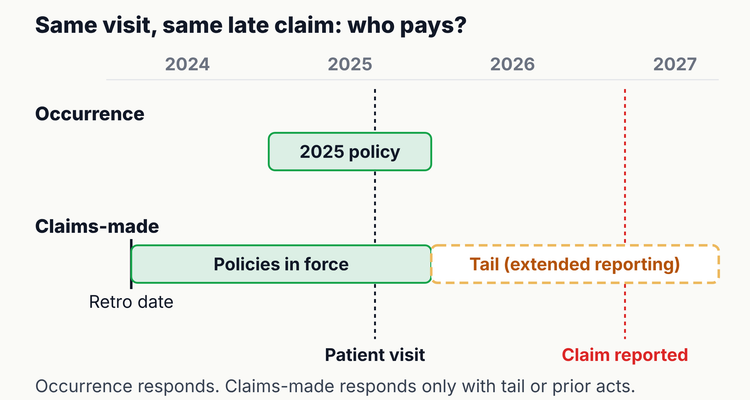 Same visit, same late claim: occurrence cover responds; claims-made cover responds only if the policy, prior acts or a tail is in place when the claim is reported.
What are tail coverage and prior acts coverage?
Tail coverage extends the time you can report claims after a claims-made policy ends. NAIC calls it an extended reporting option and notes that "the extended reporting feature is commonly referred to as 'tail coverage'". It can run for a defined period or indefinitely, depending on the policy.
Prior acts coverage works the other way. When you buy a new claims-made policy, it can keep your existing retroactive date, so incidents from your earlier years stay covered under the new carrier. Practitioners often call this "nose" coverage; it is an industry term, not a regulator's. If the new policy sets a fresh retroactive date, you need tail from the old carrier instead.
Use this decision tree when a clinician on a claims-made policy gives notice:
- Is the policy claims-made? If occurrence, record the end date and stop. If unsure, read the declarations page.
- Who owns the policy? The practice (group policy) or the clinician (individual policy).
- What does the employment contract say about tail? Record who pays: the practice, the clinician, or shared.
- Will the next carrier cover prior acts? Get it in writing, with the retroactive date stated.
- If not, request the tail quote. Ask the carrier how long you have to buy it after the policy ends, and put that date on the record.
- Store the tail endorsement or prior acts confirmation on the clinician's record before their last day.
Which states require malpractice insurance?
Most states do not make malpractice insurance a condition of licensure, but some do, with minimum limits written into statute. The rows below are verified from the statutes themselves. If your state is not listed, it does not mean there is no rule; check your licensing board.
Malpractice insurance requirements by state: verified rows (last verified 12 Oct 2026)
| State | Who | Minimum limits | Notes | Official source |
|---|---|---|---|---|
| Colorado | Physicians and physician assistants | $1,000,000 per incident / $3,000,000 annual aggregate | Condition of active licensure; public employees excepted | C.R.S. 13-64-301(1)(a.5) |
| Colorado | Dentists and dental therapists | $500,000 per incident / $1,500,000 annual aggregate | Condition of active licensure; board may set lesser standards for some classes | C.R.S. 13-64-301(1)(a) |
| Colorado | Dental hygienists | $50,000 per claim / $300,000 aggregate per calendar year | Condition of active licensure | C.R.S. 13-64-301(1)(a)(I)(B) |
| Kansas | Resident healthcare providers as defined, including people licensed in the healing arts, podiatrists and nurse anesthetists | $500,000 per claim / $1,500,000 annual aggregate for policies new or renewing on or after 1 Jan 2022 | Condition of active licensure; basic cover is a claims-made policy; occurrence allowed for some residents in training and nonresident locum tenens | K.S.A. 40-3402; 40-3401 definitions |
| Wisconsin | Physicians and advanced practice registered nurses under ch. 655 | $1,000,000 per occurrence or claim / $3,000,000 per policy or reporting year | Occurrence or claims-made allowed | Wis. Stat. 655.23(4)(b)2; 655.002 |
Official texts: Colorado Revised Statutes title 13 (PDF, 2024 edition), K.S.A. 40-3402, Wis. Stat. 655.23. These figures are minimums. A payer, hospital or employer can ask for more, so record each holder's requirement separately.
Who asks for your malpractice certificate, and what do they want?
Payers, hospitals and your own credentialing file all want current proof of cover, usually the policy face sheet (the declarations page or certificate showing the insured, limits and dates).
Who needs malpractice proof, and when
| Who | What they ask for | When | Source |
|---|---|---|---|
| Dental and health plans | Face sheet showing expiration dates, limits and the provider's name; continuous, uninterrupted cover; immediate notice of cancellation, lapse, reduced limits or claims | Initial credentialing, recredentialing, and each renewal | Delta Dental credentialing application |
| CAQH Provider Data profile (DataSpring) | A copy of the professional insurance face sheet | When you build the profile and at each 120-day attestation | Northeast Delta Dental CAQH checklist; DataSpring |
| Hospitals and surgery centers | Proof of cover set by medical staff bylaws; NPDB report history | Appointment and periodic reappraisal; NPDB query at least every 2 years | 42 CFR 482.22; 45 CFR 60.17 |
| State licensing board (some states) | Cover at or above the statutory minimum | Continuously, as a licensure condition | State statutes above |
| Employers and contracted groups | Evidence of cover and tail terms | Hiring, renewal and departure | Your contract |
Claims history travels too. An insurer that pays a malpractice claim for a practitioner must report it to the National Practitioner Data Bank and the state licensing board (45 CFR 60.7) within 30 days (45 CFR 60.5). One Delta Dental application asks about malpractice claims, settlements and judgments in the past 10 years, so keep claim dates on the same record as the policy.
How do you track malpractice insurance renewals?
Track each policy from 90 days before expiry, and treat the renewal as finished only when every certificate holder has the new face sheet. This is our working plan, not a legal rule:
- 90 days out: request renewal terms. Ask the broker or carrier for the quote and confirm the coverage form and retroactive date are unchanged.
- 75 days out: check limits against every holder. Compare the quoted limits with your state minimum and each payer's and hospital's requirement.
- 60 days out: list changes in the practice. New clinicians, departures, new locations, new procedures such as sedation. Send them to the carrier.
- 30 days out: approve and bind. Get the binder or confirmation in writing.
- On receipt: replace the face sheet. Upload it to each clinician's record and to the CAQH profile, then attest.
- Within 7 days: send to every holder. Plans and hospitals that need the new sheet, with the date sent recorded.
- Departures: settle tail first. Use the decision tree above before the last day.
Do this now: a malpractice tracking sheet in 45 minutes
Pull every face sheet and build this sheet in about 45 minutes for a practice of up to 15 clinicians (our estimate). One row per clinician per policy.
Copy-paste malpractice insurance tracking layout (row 2 formulas)
| Column | Header | What goes in it |
|---|---|---|
| A | Clinician | Name, role, state |
| B | Carrier and policy no. | From the face sheet |
| C | Policy owner | Practice or clinician |
| D | Coverage form | Claims-made or Occurrence (dropdown) |
| E | Retroactive date | From the declarations page (claims-made only) |
| F | Limits | Per claim / aggregate, e.g. 1M/3M |
| G | Expiry | Policy end date |
| H | Tail terms | Who pays and any deadline to buy, from the contract |
| I | Certificate holders | Plans, hospitals, employer |
| J | Holders sent new sheet | Date the last holder received it |
| K | Days left | =G2-TODAY() |
| L | Status | =IF(K2<0,"Expired",IF(K2<=30,"Bind now",IF(K2<=90,"In renewal","OK"))) |
| M | Tail check | =IF(AND(D2="Claims-made",H2=""),"Record tail terms","") |
| N | Certificates done | =IF(J2="","Send certificates",IF(J2<G2-365,"Send certificates","Done")) |
Format E, G and J as dates. Add red fill for =$K2<=30 and amber for =AND($K2>30,$K2<=90). Column N assumes a one-year policy: it flags the row until a certificate has gone out within the current term. Our free provider credential matrix includes malpractice expiry and coverage form next to license, DEA and CAQH dates.
💡 Pro Tip
Practices we work with keep license, DEA and malpractice dates on one provider record, and they record the coverage form and retroactive date on the malpractice entry, not just the expiry. When a clinician gives notice, they add a separate record for the tail decision with its own owner and deadline, so it cannot be lost in the exit paperwork.
How can you improve beyond renewing on time?
- Review limits once a year against every holder, not only when a plan rejects a certificate.
- Match the policy name to the license name. Plans check that the face sheet shows the provider's name.
- Keep old face sheets. For claims-made cover, prior years prove continuous cover and the retroactive date.
- Write tail terms into every contract before the start date, not at resignation.
- Ask for proof of cover from locum and contract clinicians before their first shift, with the same fields.
⚠️What happens if you miss it: in Colorado and Kansas, carrying the statutory minimum is a condition of active licensure, so a lapse affects the license itself (C.R.S. 13-64-301; K.S.A. 40-3402). One Delta Dental application requires "continuous, uninterrupted coverage" and immediate notice of any lapse. And because a claims-made policy covers only claims reported while it is in force (NAIC), a lapse with no tail or prior acts can leave earlier care with no policy to respond.
Spreadsheet or software for malpractice insurance tracking?
A spreadsheet works for a small practice with one group policy and a few clinicians, if one person owns it and reviews it monthly. It struggles when each clinician holds an individual policy on a different date, several plans and hospitals each need a certificate, and departures happen while the owner is busy. Spreadsheets also fail quietly: in Raymond Panko's review of field audits, 94% of spreadsheets studied contained errors.
Software earns its place when you need reminders that reach the clinician and the manager, the face sheet stored on the record, and a log of who was sent what. ExpiryEdge treats each policy as a record with an owner and backup, reminders at 90, 60, 30 and 7 days by email, SMS, Slack or Teams, and an audit trail. For the full picture, see the dental credentialing checklist, the provider credentialing checklist and the guide to healthcare credentialing software. For business policies such as property and general liability, see insurance policy tracking for businesses.
Frequently asked questions
What is the difference between claims-made and occurrence malpractice insurance?
An occurrence policy covers incidents that happen during the policy period, whenever the claim is reported. A claims-made policy covers claims reported while the policy is in force, usually only for incidents after its retroactive date. That is why claims-made cover needs tail or prior acts cover when you change jobs or carriers.
What is malpractice tail coverage?
Tail coverage is an extended reporting period added to a claims-made policy. It lets you report claims after the policy ends for incidents that happened while it, or its prior acts cover, was in force. Your contract should say who pays for it, and your carrier will say how long you have to buy it.
What is prior acts coverage?
Prior acts coverage means a new claims-made policy keeps your existing retroactive date, so incidents from earlier years stay covered under the new carrier. It is the alternative to buying tail from your old carrier. Get the retroactive date in writing on the new declarations page.
Which states require malpractice insurance?
Some states make it a licensing condition. Colorado requires $1 million / $3 million for physicians and physician assistants and $500,000 / $1.5 million for dentists. Kansas requires $500,000 / $1.5 million for resident healthcare providers, and Wisconsin requires $1 million / $3 million for physicians and APRNs under chapter 655. Check your own board for others.
What is a malpractice face sheet?
It is the declarations page or certificate that summarizes your policy: insured name, carrier, policy number, coverage form, limits and dates. Plans ask for one showing expiration dates, limits and the provider's name, and the CAQH profile asks for a copy.
How far ahead should I start a malpractice renewal?
Start 90 days before expiry. That leaves time to confirm the coverage form and retroactive date, check limits against every payer and hospital, bind at least 30 days out, and send the new face sheet to each holder before the old one expires.
Sources
- NAIC Statutory Issue Paper No. 65, Property and Casualty Contracts (PDF)
- Colorado Revised Statutes 2024, title 13, section 13-64-301 (PDF)
- Kansas Statutes 40-3402 and 40-3401 definitions
- Wisconsin Statutes 655.23 and 655.002
- Delta Dental: instructions for the confidential credentialing application (PDF)
- Northeast Delta Dental: CAQH ProView profile document checklist (PDF)
- DataSpring: CAQH Provider Data dental FAQs
- eCFR: 45 CFR 60.7, reporting medical malpractice payments
- eCFR: 45 CFR 60.5, when information must be reported
- eCFR: 45 CFR 60.17, hospital NPDB queries
- eCFR: 42 CFR 482.22, hospital medical staff
- Panko, What We Don't Know About Spreadsheet Errors Today (arXiv)
Last reviewed: 12 October 2026
Frequently asked questions
Tail coverage is an extended reporting period added to a claims-made policy. It lets you report claims after the policy ends for incidents that happened while it, or its prior acts cover, was in force. Your contract should say who pays for it, and your carrier will say how long you have to buy it.
Prior acts coverage means a new claims-made policy keeps your existing retroactive date, so incidents from earlier years stay covered under the new carrier. It is the alternative to buying tail from your old carrier. Get the retroactive date in writing on the new declarations page.
Some states make it a licensing condition. Colorado requires $1 million / $3 million for physicians and physician assistants and $500,000 / $1.5 million for dentists. Kansas requires $500,000 / $1.5 million for resident healthcare providers, and Wisconsin requires $1 million / $3 million for physicians and APRNs under chapter 655. Check your own board for others.
It is the declarations page or certificate that summarizes your policy: insured name, carrier, policy number, coverage form, limits and dates. Plans ask for one showing expiration dates, limits and the provider's name, and the CAQH profile asks for a copy.
Start 90 days before expiry. That leaves time to confirm the coverage form and retroactive date, check limits against every payer and hospital, bind at least 30 days out, and send the new face sheet to each holder before the old one expires.


