
Dental Credentialing Checklist: Documents, Dates and Timeline

Dental credentialing is how dental plans, Medicaid programs and hospitals verify a dentist before the dentist can treat their patients in network. Have a current license, NPI, DEA and state controlled-substance certificates, a malpractice face sheet and a CV ready, re-attest your CAQH profile every 120 days, and start months ahead of the first patient.
Sound familiar? A new associate starts in six weeks, three plans still say "pending", and the malpractice face sheet in the file expired last month. This checklist lists every document plans ask for, which ones expire and how often, and a no-software tracking sheet you can set up this afternoon.
Key takeaways
- Plans want the same core file. One Delta Dental application asks for every current state license, DEA and state controlled-substance certificate, a malpractice face sheet showing expiration dates, limits and the provider's name, a CV with 5 years of work history, and diplomas.
- CAQH is now DataSpring. Dentists can share one free profile with participating dental plans and should review and attest to it every 120 days.
- Not every plan uses CAQH. UnitedHealthcare Dental credentials through the Skygen Dental HUB, so keep a list of which portal each plan uses.
- DEA registration is per state. Each state where a dentist handles controlled substances needs its own DEA registration, renewed every 3 years after the first period.
- Your NPI never expires, but it must stay accurate. Changes go to NPPES within 30 days.
- Allow months, not weeks. MGMA puts provider credentialing at 90–180 days from application to approval.
- One record per clinician. License, DEA, malpractice and CAQH dates on one row, with an owner, is the whole system.
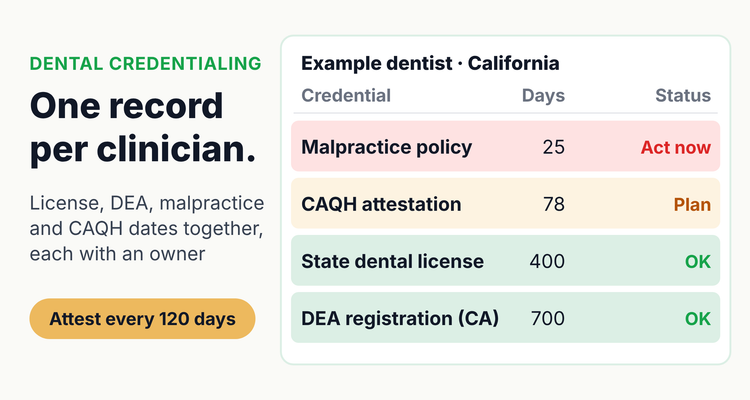 One provider record holds every dated credential a dental plan checks, so the next expiry is visible months ahead.
What is dental credentialing, and who asks for it?
Dental credentialing is the check an organization runs on a dentist's qualifications and history before letting that dentist treat its members or patients. Four groups usually ask:
- Dental plans (payers). To join a network, each plan reviews your application and documents, then repeats the review at recredentialing.
- State Medicaid programs. Enrollment is separate from commercial plans. Federal rules require the state to revalidate every enrolled provider at least every 5 years (42 CFR 455.414).
- Hospitals and surgery centers. Oral surgeons and dentists with privileges are appraised by the medical staff, and hospitals must query the National Practitioner Data Bank (NPDB) at appointment and every 2 years (45 CFR 60.17).
- Your own practice. Before an associate or hygienist sees a patient, someone should confirm the license is active and the file is complete.
One detail catches growing practices. As ADA News explains, credentialing is tied to the individual dentist, but in-network status is tied to a tax ID or business. A dentist who changes jobs, adds a location or buys a practice may need new participation even though their credentials have not changed. The cluster guide to healthcare credentialing software covers the full medical side; this page focuses on dental practices.
What documents do you need for dental credentialing?
You need proof of licensure, controlled-substance authority, insurance, identity and training. The list below combines what a Delta Dental application, a Northeast Delta Dental checklist for the ADA credentialing service powered by CAQH, and UnitedHealthcare Dental's 2026 guidelines ask for. Collect it once, scan it, and keep it current.
Dental credentialing checklist: documents to keep on file
- ✓
Copy of every current state dental license (and hygienist license for hygienists)
- ✓
National Provider Identifier (NPI), individual and billing NPI for each location
- ✓
DEA registration for each state where you prescribe controlled substances (if applicable)
- ✓
State controlled-substance (CDS) certificate, where your state issues one
- ✓
Professional liability (malpractice) face sheet showing expiration dates, limits and your name
- ✓
CV or resume with at least 5 years of dental work history, or date of graduation
- ✓
Dental school diploma and any specialty or residency certificate
- ✓
Board certification, if you are board certified
- ✓
Anesthesia or sedation permit, if you hold one
- ✓
BLS and, where required, ACLS certification
- ✓
Hospital affiliation details, if you have privileges
- ✓
Medicare and Medicaid numbers, if enrolled
- ✓
Signed provider agreement, W-9 and plan summaries for each plan you join
- ✓
CAQH Provider Data Portal login and ID
- ✓
Government-issued ID and professional references
Keep each file as a dated PDF named the same way every time, for example "Lastname_DEA_CA_exp2028-03-31.pdf". When a plan emails at 4 p.m. asking for a face sheet, you can send it in a minute.
Which dental credentials expire, and how often?
Most dental credentials expire on their own clocks, which is why files go stale. The table below compiles the cycles from official sources. Where a cycle is set by your state or your plan contract, it says so instead of guessing.
Dental credentialing reference table: what expires and how often (last verified 12 Oct 2026)
| Credential | Who issues it | How often | Official source |
|---|---|---|---|
| State dental license | State dental board | Set by each state (California and Florida 2 years; New York 3-year registration) | Your state board; see the next table |
| DEA registration | U.S. Drug Enforcement Administration | First period 28–39 months, then every 36 months; separate registration per state | 21 CFR 1301.13; DEA registration FAQ |
| State controlled-substance certificate | State agency, where issued | Set by each state | Your state board or pharmacy board |
| NPI | CMS (NPPES) | Does not expire; report changes within 30 days | 45 CFR 162.410(a)(4) |
| CAQH profile (DataSpring) | DataSpring, formerly CAQH | Review and attest every 120 days | DataSpring dental FAQ |
| Malpractice policy | Your insurer | Policy term on the face sheet; plans may require continuous cover | Plan application; your policy |
| Plan recredentialing | Each dental plan | Set by the plan; NCQA requires every 3 years for organizations it accredits | Plan notice; NCQA |
| Medicaid enrollment | State Medicaid agency | Revalidated at least every 5 years | 42 CFR 455.414 |
| Medicare enrollment (if enrolled) | CMS | Revalidate every 5 years | 42 CFR 424.515 |
| Hospital privileges (if held) | Hospital medical staff | Periodic appraisal; NPDB queried every 2 years | 45 CFR 60.17 |
| BLS / CPR | Training provider | Card expiry; required for renewal in Florida and New York | State board pages below |
For DEA timing in detail, including the 28–39 month first period, see how long a DEA license lasts.
Dental license renewal in three large states
State boards set very different cycles. These three are verified from the boards' own pages; check yours the same way.
Dental license renewal snapshot (last verified 12 Oct 2026)
| State | Cycle | Continuing education (CE) | Deadline | Also required |
|---|---|---|---|---|
| California (dentist) | 2 years | 50 hours every two years; none at first renewal | Last day of birth month, in even or odd years to match birth year | Mandatory courses included in the 50 hours |
| Florida (dentist) | 2 years | 30 hours (28 general + 2 medical errors); first renewal only 2 prescribing + 2 HIV/AIDS | Feb 28 of even years; current licenses expire Feb 28, 2028 | Current CPR at BLS level; 2 hours controlled-substance prescribing every renewal |
| New York (dentist) | 3-year registration | 60 contact hours; none in first registration period | End of your registration period | CPR certification; infection control course every 4 years |
| New York (dental hygienist) | 3-year registration | 24 contact hours | End of your registration period | Infection control course every 4 years |
Official pages: Dental Board of California renewal, Florida Board of Dentistry dentist renewal, New York dentistry CE questions and answers.
How long does dental credentialing take?
Plan on three to six months. MGMA puts provider credentialing at 90–180 days between submission of an application and verification and approval, and ADA News notes that Medicaid enrollment "can take months". Each plan sets its own pace, so the slowest plan sets your start date.
Work back from the first day the dentist will see plan patients. The timeline below is our working plan, not a rule:
- 120 days before start: open the file. Collect every document on the checklist and confirm each expiry date is at least 6 months away. Renew anything that is not.
- 110 days: complete and attest CAQH. Update the DataSpring profile, upload the face sheet and license, attest, and authorize each plan to view it.
- 100 days: submit to every plan. Use each plan's own route: CAQH, Skygen Dental HUB or a paper application. Log the submission date and reference number.
- 90 days: start Medicaid enrollment if the practice accepts it, since state processes can run longer.
- Every 2 weeks: follow up in writing. Ask each plan for status and any missing item. Note the date and the answer.
- On approval: record the effective date and the plan's provider ID for each location and tax ID.
- Start date: schedule only approved plans. Patients on pending plans need an out-of-network conversation first.
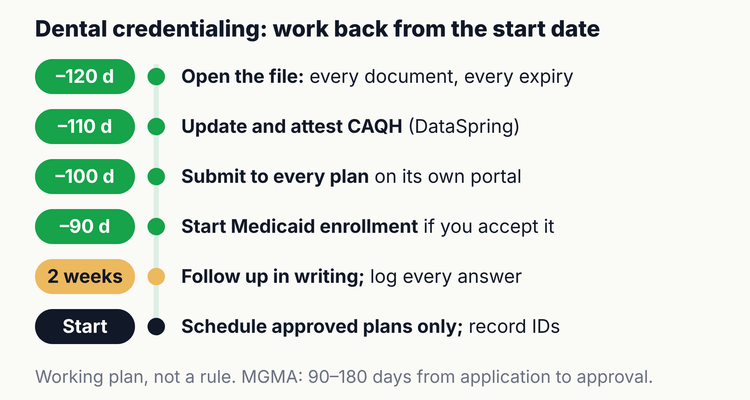 Work back from the start date. The slowest plan decides when the dentist can see its members in network.
Delays cost money. In an MGMA Stat poll, 54% of medical practices said credentialing-related denials increased in 2021 (n=425). Dental claims follow the same logic: a claim from a provider the plan has not approved is a claim at risk.
Do this now: a 60-minute dental credentialing audit
You can find every gap in an afternoon with a spreadsheet. Time estimates are ours, for a practice with up to 10 clinicians.
- Build the sheet (10 minutes). One row per clinician per state. Use the columns below.
- Fill dates from the source, not memory (25 minutes). License dates from the state board lookup, DEA from the certificate, malpractice from the face sheet, CAQH from the portal.
- Sort by days left (5 minutes). Anything under 90 days gets an owner and a task today.
- List plans per location (15 minutes). For each tax ID and location: plan, portal, provider ID, recredentialing date.
- Book the calendar (5 minutes). Set one fixed day each month to check CAQH attestation and the sheet.
Copy-paste dental credentialing tracker layout (row 2 formulas)
| Column | Header | What goes in it |
|---|---|---|
| A | Clinician | Name and role (dentist, hygienist) |
| B | State | One row per state of practice |
| C | License expiry | Date from the state board lookup |
| D | DEA expiry | Date on the DEA certificate (blank if none) |
| E | Malpractice expiry | Date on the face sheet |
| F | CAQH last attested | Date shown in the portal |
| G | CAQH due | =IF(F2="","",F2+120) |
| H | Next due | =MIN(C2:E2,G2) |
| I | Days left | =H2-TODAY() |
| J | Status | =IF(I2<0,"Expired",IF(I2<=30,"Act now",IF(I2<=90,"Plan renewal","OK"))) |
| K | Owner | One named person, plus a backup |
Format C to H as dates and I as a number. Add conditional formatting: red for =$I2<=30 and amber for =AND($I2>30,$I2<=90). MIN ignores blank cells, so a hygienist without a DEA registration still works. Our free provider credential matrix does this for nine credentials per row, with a dashboard.
💡 Pro Tip
Dental groups we work with keep license, DEA and malpractice dates on one provider record per clinician, with the practice manager as owner and the clinician as backup. When the malpractice carrier issues the renewal, the new face sheet goes onto the same record and up to CAQH on the same day, so the plan and the practice see the same date.
How can you make dental credentialing faster next time?
Most of the delay is waiting on missing or expired documents, which you control. These habits help beyond bare compliance:
- Keep CAQH current between hires. A profile attested last week can be shared the day a plan asks. The portal also prompts when a license or other document is about to expire.
- Ask the carrier for the renewal face sheet before the old one expires. Plans check that the dates on the face sheet are current.
- Record which portal each plan uses. CAQH for most, Skygen Dental HUB for UnitedHealthcare Dental, paper for some regional plans.
- Track participation by tax ID and location. When you add a location or change ownership, re-check every plan.
- Start hygienists' files too. Their licenses, CE and BLS expire on their own dates even when they are not credentialed individually with plans.
⚠️What happens if you miss it: in California, practicing on an expired dental license is practicing without a license, which the Dental Board calls a criminal offense, and there is no grace period. One Delta Dental application requires dentists to keep "continuous, uninterrupted coverage" and to notify the plan immediately of any cancellation, lapse or reduction in malpractice cover. Federal rules require NPI changes to reach NPPES within 30 days, and a Medicaid program must revalidate every provider at least every 5 years.
Spreadsheet or software for dental credentialing?
A spreadsheet is enough for a single practice with a handful of clinicians in one state, if one person owns it and opens it every week. It stops being enough when the number of dates outgrows that person's attention: several locations, associates who work across states, hygienists and assistants with their own permits, and a dozen plans each recredentialing on their own date.
At that point you need reminders that go to the clinician and the manager without anyone opening a file, a history of who uploaded which certificate, and one screen for every location. ExpiryEdge does that for dental practices: each license, DEA registration, malpractice policy and CAQH attestation is a record with an owner, a backup, the document attached and reminders at 90, 60, 30 and 7 days. The planned malpractice insurance tracking guide and provider credentialing checklist cover the next steps.
Frequently asked questions
What is dental credentialing?
Dental credentialing is the review a dental plan, Medicaid program or hospital carries out on a dentist's license, controlled-substance registrations, malpractice cover, education and history before the dentist can treat its members in network. It is repeated at recredentialing, on a cycle each plan sets.
How long does dental credentialing take?
Plan on three to six months. MGMA puts provider credentialing at 90–180 days from application to approval, and Medicaid enrollment can take longer. Start at least 120 days before the dentist's first day and follow up with each plan every two weeks.
Do dentists need a CAQH profile?
Many dental plans accept the CAQH Provider Data profile, now run by DataSpring, and it is free for dentists. Dentists should review and attest to it every 120 days. Not every plan uses it: UnitedHealthcare Dental uses the Skygen Dental HUB.
What documents do dental plans ask for?
Expect every current state license, DEA and state controlled-substance certificates if applicable, a malpractice face sheet showing expiration dates, limits and your name, a CV with 5 years of work history, your diploma and any specialty certificate, your NPI, and signed contracting forms such as a W-9.
Do dental hygienists need to be credentialed?
Hygienists hold their own state license, CE and usually BLS, and those need tracking whether or not a plan credentials them individually. Ask each plan whether it enrolls hygienists, and keep their license and CPR dates on the same tracker as the dentists.
How often do dentists have to recredential?
Each plan sets its own cycle in its contract. NCQA requires recredentialing every three years for the organizations it accredits. Separately, a state Medicaid agency must revalidate every enrolled provider at least every 5 years.
Sources
- DataSpring: CAQH Provider Data dental FAQs
- DataSpring: clinicians (CAQH is now DataSpring)
- Delta Dental: instructions for the confidential credentialing application (PDF)
- Northeast Delta Dental: CAQH ProView profile document checklist (PDF)
- UnitedHealthcare Dental: credentialing guidelines, 2026 (PDF)
- ADA News: Credentialing 101, what new dentists need to know (2026)
- eCFR: 21 CFR 1301.13, DEA registration periods
- DEA Diversion Control: registration FAQ
- eCFR: 45 CFR 162.410, NPI requirements for providers
- eCFR: 42 CFR 455.414, Medicaid revalidation
- eCFR: 42 CFR 424.515, Medicare revalidation
- eCFR: 45 CFR 60.17, hospital NPDB queries
- NCQA: credentialing standards (blog, 2024)
- MGMA: navigating the credentialing gauntlet
- MGMA Stat: credentialing-related denials, 2021
- Dental Board of California: license renewal
- Florida Board of Dentistry: dentist renewal
- NYSED Office of the Professions: dentistry CE questions and answers
- NPPES NPI Registry
Last reviewed: 12 October 2026
Frequently asked questions
Plan on three to six months. MGMA puts provider credentialing at 90–180 days from application to approval, and Medicaid enrollment can take longer. Start at least 120 days before the dentist's first day and follow up with each plan every two weeks.
Many dental plans accept the CAQH Provider Data profile, now run by DataSpring, and it is free for dentists. Dentists should review and attest to it every 120 days. Not every plan uses it: UnitedHealthcare Dental uses the Skygen Dental HUB.
Expect every current state license, DEA and state controlled-substance certificates if applicable, a malpractice face sheet showing expiration dates, limits and your name, a CV with 5 years of work history, your diploma and any specialty certificate, your NPI, and signed contracting forms such as a W-9.
Hygienists hold their own state license, CE and usually BLS, and those need tracking whether or not a plan credentials them individually. Ask each plan whether it enrolls hygienists, and keep their license and CPR dates on the same tracker as the dentists.
Each plan sets its own cycle in its contract. NCQA requires recredentialing every three years for the organizations it accredits. Separately, a state Medicaid agency must revalidate every enrolled provider at least every 5 years.


