
How to Set Up a Property Compliance Calendar That Works

How to Set Up a Property Compliance Calendar That Works

A property compliance calendar setup done right means every regulatory deadline, inspection, and filing is mapped to a named owner, a due date, a buffer window, and a document link — not just a date on a shared Google Calendar. Start today by running a property-wide audit, listing your top five highest-risk obligations, and assigning a responsible person to each one before you do anything else.
Day-one must-dos:
- Walk every property and list every permit, license, inspection, and filing currently in effect
- Identify the three obligations most likely to trigger a penalty or life-safety violation if missed
- Enter those three items into whatever system you use right now, with a due date and an owner’s name
- Set at least one reminder at 30 days out for each
That is the minimum viable start. Everything below shows you how to build it into a full, audit-ready compliance tracking system.
Key Takeaways
A property compliance calendar only works when every entry carries a named owner, a buffer reminder, and a timestamped document link — a date alone is not a compliance record.
| Point | Details |
|---|---|
| Audit first | Walk every property and list all active obligations before building the calendar. |
| Risk-based priority | Schedule life-safety items first, then insurance-related, then administrative filings. |
| Metadata per entry | Every entry needs an owner, status, reminder windows, and an uploaded document link. |
| Governance layer | Define owner, backup, and approver roles with written escalation rules. |
| Expiryedge | Automates reminders, escalations, and audit trails across multi-property portfolios. |
What is a property compliance calendar — and what isn’t one?
A property compliance calendar is a structured record of every regulatory obligation tied to a property, where each entry carries the due date, the responsible party, the governing rule or authority, the current status, and a link to timestamped evidence. It is not a list of dates in Outlook or a sticky note on a lease expiration.
The difference matters in practice. A basic digital calendar tells you when something is due. A compliance calendar tells you who is doing it, what proof is required, which regulation demands it, and whether it was done on time. That last part is what makes it defensible in an audit or a dispute.
What a real compliance calendar entry covers:
- The specific obligation (e.g., annual fire sprinkler inspection per NFPA 25)
- The governing authority (local fire marshal, state agency, federal rule)
- The assigned owner and a backup contact
- The current status (scheduled, in progress, completed, overdue)
- A link to the uploaded certificate, report, or permit
- A timestamped record of when the task was completed and by whom.
For U.S. properties, obligations typically span three layers: federal rules (IRS filings, ADA accessibility requirements, FinCEN beneficial ownership reporting), state licensing and habitability codes, and local municipal requirements. New York City, for example, publishes city-specific compliance deadlines that go well beyond state minimums, covering building safety inspections, energy benchmarking, and housing registrations on their own schedules. Your calendar must reflect all three layers for each property.
How to set up a property compliance calendar from scratch
Step 1: Run a property-wide compliance audit
Walk every property and pull every active permit, license, certificate, and filing. Check the physical building (fire suppression, elevators, electrical panels), the lease and ownership structure (business licenses, entity filings), and any environmental or habitability requirements. Record what you find, when it expires or recurs, and what documentation currently exists.
Prioritize during the audit, not after. Life-safety items (fire suppression, egress lighting, elevator certifications) go to the top of the list immediately. Missing a compliance deadline can trigger legal delinquency status, penalties, and in serious cases, loss of operating permits.
Step 2: Build a master inventory of obligations
For each obligation you find, capture: the obligation name, the governing regulation or authority, the property or unit it applies to, the frequency (annual, semiannual, quarterly), the next due date, the responsible party, and the document or certificate required as proof. This inventory becomes the source of truth for every calendar entry.
Step 3: Map frequencies and next-due rules
Some deadlines are fixed-month (e.g., annual fire inspection every October per local ordinance). Others are anniversary-based (e.g., elevator certification 12 months from the last inspection date). Distinguish between the two when you enter them, because a fixed-month deadline shifts if you miss it, while an anniversary deadline does not.
Step 4: Assign owners and escalation paths
Every obligation needs a named owner, not a team or a department. If the owner is unavailable, a named backup takes over. Define the escalation path in writing: who gets notified if the owner misses the 30-day reminder, and who has authority to approve the completed task.
Step 5: Set reminders and buffer windows
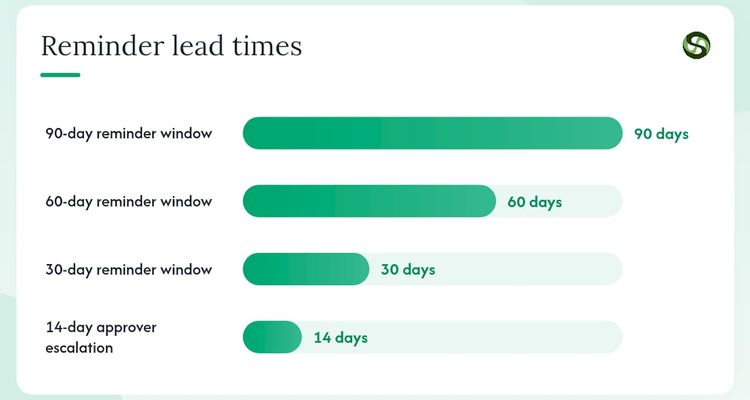
For annual obligations, set reminders at 90, 60, and 30 days out. For quarterly items, a single 30-day reminder is usually sufficient. For high-risk or hard-to-schedule items (elevator inspections, environmental testing), use 90 days as the first trigger so you have time to book a certified vendor.
Step 6: Test and validate
Before you call the calendar live, run a dry audit drill. Pull up the next 30 days of obligations and verify that every entry has an owner, a reminder set, and a document link or a note explaining where the certificate will be uploaded. Any entry missing those three things is not ready.
Pro Tip: Never rely on email reminders alone. Email gets buried, filtered, or ignored. Use a system that sends reminders through at least two channels — email plus SMS or an in-app notification — and escalates automatically if the owner does not acknowledge the alert.
What fields does every calendar entry need?
Each entry in your compliance calendar should carry enough information that a new team member could pick it up and complete the task without asking anyone a question. The table below is a ready-to-use metadata template.
| Field | Definition | Example Value |
|---|---|---|
| Obligation Name | Short, specific label for the task | Annual Fire Sprinkler Inspection |
| Property / Unit | Address or unit identifier | Maple St, Unit B |
| Governing Authority | Regulation, code, or agency | NFPA 25 / Local Fire Marshal |
| Frequency | How often it recurs | Annual |
| Next Due Date | Calendar date the task must be completed | October 15, 2026 |
| Owner | Named responsible person | Maria Chen, Facilities Manager |
| Backup Owner | Named alternate if owner is unavailable | James Park, Operations Lead |
| Status | Current state of the task | Scheduled |
| Reminder Windows | Days before due date that alerts fire | 90 / 60 / 30 days |
| Document Required | Certificate, permit, or report needed | Inspection certificate from licensed vendor |
| Document Link | URL or file path to uploaded proof | /docs/maple-fire-2026.pdf |
| Completion Date | Date task was marked complete | October 12, 2026 |
| Completed By | Name of person who confirmed completion | Maria Chen |
| Notes | Any relevant context or vendor info | Vendor: ABC Fire Protection |
Why each field earns its place: The owner and backup fields prevent the “I thought you handled it” gap. The document link and completion date fields create the timestamped audit trail that regulators and insurers want to see. Status keeps the calendar actionable rather than just informational.
How to prioritize obligations and schedule by risk
Not every compliance item carries the same weight. A missed elevator inspection can result in an immediate shutdown order. A late annual report filing typically triggers a fine. Treating them the same way wastes attention on low-risk items while high-risk ones slip.
A practical risk-based ordering:
- Life-safety first: Fire suppression systems, egress lighting, elevator certifications, gas line inspections. These carry the highest penalty severity and the greatest liability exposure. Schedule these with the longest buffer windows and the most escalation layers.
- Insurance-related second: Any inspection or certification that a property insurance policy requires. Missing these can void coverage mid-term, which is a financial exposure that compounds quickly.
- Licensing and permits third: Business licenses, rental permits, short-term rental compliance filings. Penalties are real but usually curable. Short-term rental compliance requirements vary sharply by city and county, so check local rules carefully.
- Administrative filings last: Annual entity reports, tax filings with the IRS, and similar paperwork. Important, but rarely life-safety critical.
To rank obligations within a tier, use a simple impact-times-likelihood score. Rate the impact of a missed deadline (1 = minor fine, 5 = permit revocation or safety hazard) and the likelihood of missing it without a reminder (1 = low, 5 = high). Multiply the two scores and sort descending. Items scoring 15 or above get 90-day lead reminders and a named escalation contact.
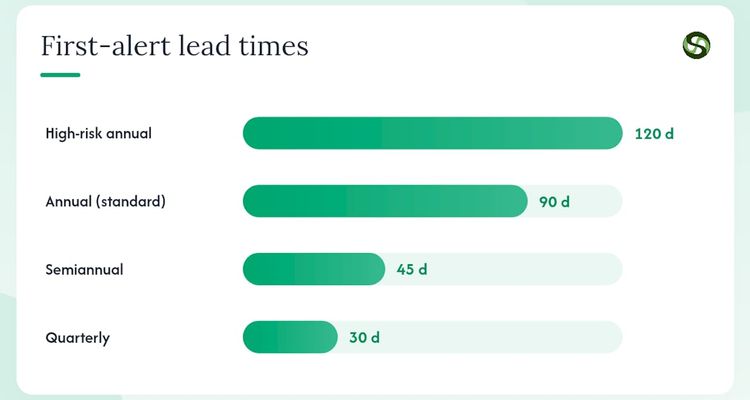
For recurring cycles, the standard buffer windows are: annual obligations at 90/60/30 days, semiannual at 45/30 days, and quarterly at 30/14 days. High-risk annual items with long vendor lead times warrant a 120-day first alert.
Spreadsheets, PMS modules, or dedicated tracking software: which one fits?
The right tool depends on your portfolio size, the complexity of your regulatory environment, and how seriously you need to defend your compliance record in an audit.
Spreadsheets work for a single property or a small portfolio of two to three units with straightforward obligations. They cost nothing and are flexible. The problem is fragility: a formula breaks, a cell gets overwritten, and no one notices until a deadline passes. Spreadsheets also have no native escalation logic, no audit trail, and no way to attach documents in a way that survives a file reorganization.
Property management system (PMS) modules are a reasonable middle ground when your compliance tasks are tightly tied to leasing and maintenance workflows already living in the PMS. If your PMS tracks lease expirations and maintenance work orders, adding compliance reminders in the same system reduces context-switching. The limitation is depth: most PMS compliance modules handle basic date reminders but lack timestamped audit trails, multi-channel escalations, and document collection workflows.
Dedicated deadline-tracking platforms are the right call when you manage multiple properties, face layered federal/state/local obligations, need an audit-ready record, or have compliance tasks assigned across several team members. Centralized expiry tracking gives you a single source of truth across every property, with automated escalations and document storage that a spreadsheet cannot replicate.
Decision checklist:
- More than three properties or five active compliance obligations per property? Move past spreadsheets.
- Need to prove compliance to an insurer, regulator, or lender? You need timestamped evidence and document storage.
- Multiple team members responsible for different obligations? You need role-based assignments and escalation rules.
- Regulatory environment changes frequently (local ordinances, federal reporting rules)? You need a system that supports bulk updates and versioned records.
Tax compliance complexity creates measurable administrative overhead. A dedicated tracking system reduces that overhead by automating the reminder and documentation workflow rather than leaving it to manual calendar management.
A practical 30/60/90 implementation checklist and sample entries
The 30/60/90 onboarding workflow
- Days 1–30 (Audit): Complete the property-wide compliance audit. List every active obligation. Identify the top five by risk score. Enter all five into your chosen system with owners and due dates assigned.
- Days 31–60 (Populate): Enter the full obligation inventory. Set reminder windows for every item. Upload any existing certificates or permits as baseline documents.
- Days 61–90 (Automate and validate): Configure escalation rules. Run a dry audit drill on the next 30 days of obligations. Confirm every entry has a document link or a scheduled vendor appointment. For inspection deadline automation, verify that reminders fire correctly by checking a test entry.
Pro Tip: At the end of your onboarding session, before you close the system, schedule the next three highest-risk obligations that fall within 90 days. Do not leave the session without those three items fully entered and assigned.
Sample calendar entries
These entries follow the metadata template from Section 4. Copy them into a CSV or your tracking platform as starting points, then adjust dates and owners to match your actual portfolio.
Ownership, escalations, and keeping an audit trail
A compliance calendar with no governance structure is just a list. The governance layer is what makes it reliable.
Define roles clearly:
- Owner: The person responsible for completing or coordinating the task. One named individual, not a team.
- Backup owner: Takes over automatically if the primary owner is unavailable or unresponsive after the first reminder.
- Approver: The person who marks the task complete and confirms the document has been uploaded. Often a manager or compliance lead.
Escalation rules should be written down, not assumed. A practical default: if the owner does not acknowledge the 30-day reminder within 48 hours, the system notifies the backup owner and the approver simultaneously. If the task is still unacknowledged at 14 days out, it escalates to senior management. Automated compliance tracking handles this logic without requiring anyone to manually chase down a response.
Audit-ready recordkeeping checklist:
- Every completed task has a timestamped completion record
- The certificate or report is uploaded to the task record, not stored in a separate folder
- Any vendor-related work has the vendor’s name, license number, and contact information attached
- Status changes (scheduled → in progress → completed) are logged with the date and the user who made the change
- Notes field captures any deviations, delays, or corrective actions taken
Pro Tip: When a vendor completes an inspection, photograph the certificate on-site and upload it to the task record before the vendor leaves. Waiting until you are back at a desk means the document sits in an email or a phone camera roll for days — and sometimes disappears entirely.
How to keep your calendar current with regulatory changes
Regulations change. The Federal Register published a Final Rule revision and deadline extension for beneficial ownership information reporting in 2025, which means any property owner tracking BOI obligations had to update their calendar mid-cycle. That kind of change happens at the federal, state, and local level throughout the year.
A practical monitoring workflow:
- Subscribe: Sign up for RSS feeds or email alerts from the Federal Register, your state’s regulatory agency, and your city’s building or housing department.
- Validate: When an alert arrives, read the actual rule change before touching the calendar. Not every notice changes a deadline — some are proposed rules, not final ones.
- Map: Identify which calendar entries the change affects. A federal reporting deadline change may affect one entry; a state fire code revision may affect dozens.
- Update: Assign the calendar update to a named person with a completion deadline. Do not let regulatory notices sit in an inbox without a clear owner.
Authoritative U.S. sources to monitor:
- Federal Register for federal rulemaking and deadline revisions
- FinCEN for beneficial ownership information reporting guidance
- IRS for federal tax filing dates and guidance
- Usa as a portal for finding agency-specific subscription options
- Your state’s department of housing, labor, or licensing (varies by state)
- Your city or county’s building department website
Set a quarterly calendar review as a standing meeting. Even without a regulatory change, obligations shift: a property gets sold, a new lease triggers a different inspection requirement, or a vendor changes the inspection cycle. The calendar needs a human review at least four times a year.
How Expiryedge supports a property compliance calendar
Expiryedge is built specifically for deadline-driven work, which makes it a natural fit for the compliance calendar structure described throughout this article.
Relevant Expiryedge capabilities:
- Automated multi-channel reminders (email, SMS, in-app) at configurable lead times
- Role-based task assignments with named owners, backup owners, and approvers
- Timestamped audit trail for every status change, document upload, and completion event
- Document collection with e-signature support, so certificates and permits attach directly to the task record
- Escalation workflows that trigger automatically when a reminder goes unacknowledged
- Real-time dashboards showing upcoming deadlines, overdue items, and completion rates across the full portfolio
- Recurring obligation management so annual and quarterly items auto-regenerate without manual re-entry
A four-step implementation using Expiryedge:
- Import your inventory: Upload your obligation list (CSV or manual entry) with property, obligation name, frequency, and next due date.
- Map reminder rules: Set the 90/60/30-day reminder windows for each obligation category. High-risk items get all three; quarterly items get a single 30-day alert.
- Assign owners: Assign a primary owner and a backup to each obligation. Configure the escalation path so the approver is notified automatically at the 14-day mark if the task is unacknowledged.
- Automate and go live: Activate the reminder workflows. Expiryedge sends the first alerts, tracks acknowledgments, and logs every action with a timestamp.
Start tracking compliance deadlines with Expiryedge to move from a manual calendar to a fully governed, audit-ready system.
Expiryedge makes compliance calendar management practical
Property compliance tracking gets complicated fast, especially across multiple properties with layered federal, state, and local obligations. Expiryedge removes the manual overhead by centralizing every deadline, reminder, and document in one place.

With Expiryedge, you get automated multi-channel reminders, a full timestamped audit trail, role-based task assignments, and document collection built into every compliance entry. No more chasing vendors for certificates or digging through email threads to prove a task was completed on time. The platform handles escalations automatically, so nothing falls through the gap between a missed email and a regulatory deadline.
Start your free trial at ExpiryEdge and go from a manual compliance list to a governed, audit-ready calendar in your first session.
What practitioners get wrong about compliance calendars
Most property managers build a compliance calendar once and then treat it as a static document. That is the single most common failure mode. Regulations change, vendors change inspection cycles, and properties change hands, but the calendar stays frozen at its original setup date. Within 18 months, it is unreliable.
The fix is not a better spreadsheet. It is treating the calendar as a living operational system with a quarterly review, a named owner for the calendar itself (not just for individual tasks), and a clear process for incorporating regulatory updates when they arrive. The Federal Register publishes rule changes that can shift a filing deadline by months. If no one in your organization is watching that feed and mapping changes to the calendar, you are operating on outdated information.
There is also a tendency to underweight the audit trail requirement until it is too late. An insurer denying a claim, a city inspector questioning whether an annual inspection was completed, or a lender reviewing a property acquisition will all ask for timestamped proof. “We did it, we just don’t have the paperwork” is not a defensible answer. The industry principle holds: if it is not recorded, it did not happen. Build the documentation habit from day one, not after the first dispute.
Sources
Staying current with regulatory changes requires watching the right sources on a consistent schedule.
FAQ
What is a property compliance calendar?
A property compliance calendar is a structured record of every regulatory obligation tied to a property, where each entry includes the due date, responsible owner, governing authority, current status, and a link to timestamped proof of completion.
How do you create a compliance calendar?
Run a property-wide audit to list all active obligations, assign a named owner and due date to each, set reminder windows at 30, 60, and 90 days out, and upload required documents to each entry as proof of completion.
What should a property compliance checklist include?
A property compliance checklist should cover fire and life-safety inspections, elevator and mechanical certifications, rental permits, environmental testing, insurance-required inspections, entity filings, and any applicable federal or local reporting obligations such as IRS filings or BOI reporting.
How often should you review a compliance calendar?
Review the full calendar at least quarterly to catch regulatory changes, update vendor schedules, and verify that all upcoming obligations have named owners and reminder windows set.
Can Expiryedge manage a property compliance calendar?
Yes. Expiryedge supports automated multi-channel reminders, role-based task assignments, escalation workflows, timestamped audit trails, and document collection, making it a practical platform for managing a full property compliance calendar across single or multi-property portfolios.
Recommended
Frequently asked questions
Run a property-wide audit to list all active obligations, assign a named owner and due date to each, set reminder windows at 30, 60, and 90 days out, and upload required documents to each entry as proof of completion.
A property compliance checklist should cover fire and life-safety inspections, elevator and mechanical certifications, rental permits, environmental testing, insurance-required inspections, entity filings, and any applicable federal or local reporting obligations such as IRS filings or BOI reporting.
Review the full calendar at least quarterly to catch regulatory changes, update vendor schedules, and verify that all upcoming obligations have named owners and reminder windows set.
Yes. Expiryedge supports automated multi-channel reminders, role-based task assignments, escalation workflows, timestamped audit trails, and document collection, making it a practical platform for managing a full property compliance calendar across single or multi-property portfolios.