
Prioritize Upcoming Critical Deadlines: A Team Playbook

Prioritize Upcoming Critical Deadlines: A Team Playbook

TL;DR:
Building a centralized master plan with explicit deadlines and owners ensures reliable delivery. Using backward scheduling, impact scoring, buffers, and daily monitoring keeps critical deadlines on track. Expiryedge automates this process, reducing manual effort and preventing missed dates.
To protect critical delivery dates, build a one-page prioritized master plan, lock owners and milestones, and treat it as your single source of truth. That plan has five components: capture every deadline, score by impact and urgency, schedule backward from each due date, descope anything that threatens the critical path, and monitor daily until delivery.

The fastest way to prioritize upcoming critical deadlines is to stop working from memory and start working from a ranked list with owners attached. Three tools ground this approach: the Eisenhower Matrix (urgency vs. importance), the Critical Path Method (which tasks have zero float), and a centralized platform like Expiryedge (automated alerts and escalation when tasks slip). Together, they convert a pile of competing dates into a sequence you can actually defend.
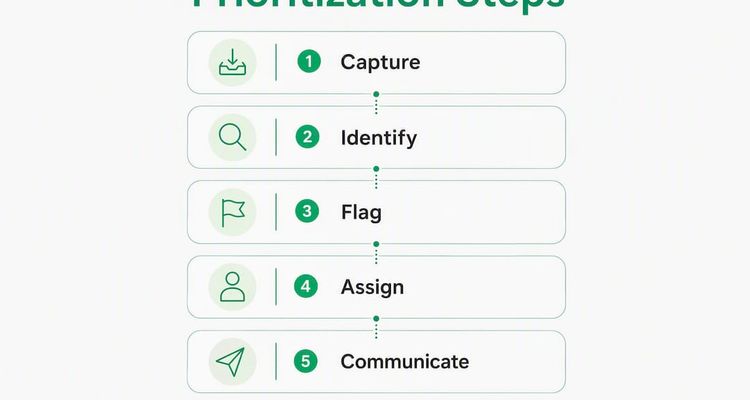
Run this five-step checklist right now, before you open another email:
- Capture: List every upcoming deadline, its owner, and its hard dependencies in one place.
- Identify the critical path: Flag which tasks, if delayed, push the final delivery date.
- Assign owners: Every task gets one named person accountable for completion.
- Set milestone buffers: Build 20–30% buffer time into each milestone estimate, not just the final date.
- Communicate: Send one-line status updates to stakeholders before they ask.
Pro Tip: If you cannot name the owner of a task in under three seconds, that task is already at risk.
What should you do in the first 60 minutes when deadlines are piling up?
When three deadlines land at once and your team is already stretched, the instinct is to call a meeting and talk through everything. Resist it. A structured 60-minute triage, split into three timeboxed buckets, gets you further than two hours of open discussion.

Minutes 1–10: Capture everything
Open a blank spreadsheet or whiteboard. Write down every deadline your team is carrying, including the ones that feel “under control.” Next to each one, note the due date, the current owner, and any task that must finish before this one can start. Do not filter yet. The goal is a complete master list, because hidden dependencies are where schedules collapse.
Minutes 11–30: Prioritize fast
Scan the list for critical-path tasks: anything that, if delayed, moves a final delivery date. Flag those first. Then apply a quick urgency-vs.-impact check. Anything due within five business days with high business impact goes to the top. Lock your top three priorities. Everything else gets a rank, not a promise.
Minutes 31–60: Assign, buffer, and communicate
For each top-three item: confirm the owner, set the next milestone with a specific date, and add a buffer. Then send one message to each key stakeholder. Keep it to two sentences.
Pro Tip: Your first stakeholder message should follow this script: “We’ve locked our top priorities for the week. [Task X] is on track for [date]; I’ll flag you immediately if anything changes.” That’s it. Stakeholders want certainty, not detail.
How do you build a repeatable prioritization method for any deadline portfolio?
Ad-hoc triage works once. A repeatable method works every quarter. Here is a six-step process you can apply to any set of competing deadlines, whether you are managing three projects or thirty.
- Build the master list with constraints. Capture every deadline, its contractual or regulatory basis, its owner, and its upstream dependencies. Note which deadlines are fixed (a regulatory filing date, a contract renewal) versus soft (an internal review). Fixed dates anchor the schedule; soft dates flex. For teams managing contractual deadlines and renewal obligations, capturing the contractual basis at this stage prevents surprises later.
- Work backward from each final date. For every deadline, start at the due date and work left. Identify the latest date each predecessor task must finish. This technique, drawn from Critical Path Method thinking, reveals hidden schedule pressure that forward estimates routinely miss. A deliverable due March 28 that requires a three-day legal review means the draft must land by March 24, which means writing must start by March 19 at the latest.
- Score each task: impact × urgency × risk. Use a simple 1–3 scale for each dimension. A task with high business impact (3), due within five days (3), and dependent on an external vendor with a history of delays (3) scores 27. A task with moderate impact (2), due in three weeks (2), and fully within your control (1) scores 4. Tasks scoring 12 or above are immediate priorities. Tasks below 6 can be scheduled or delegated.
- Identify zero-float tasks. After scoring, map which tasks have no schedule slack at all. These are your critical-path items. A one-day slip on any of them moves the final delivery date by at least one day. They get daily monitoring and the first claim on any freed-up resource.
- Estimate effort and add explicit buffers. For each milestone, estimate the realistic effort in hours or days, then add 20–30% as a buffer. A task you estimate at four days becomes a five-day slot in the schedule. This is not pessimism; it is a practical hedge against variability in cross-functional work, where handoffs, approvals, and reviews almost always take longer than planned.
- Lock owners and acceptance criteria. Every milestone needs one named owner and a clear definition of “done.” Not “draft complete” but “draft reviewed and approved by [name] by [date].” Milestone-based signoffs prevent the late-stage rework that kills schedules, because everyone agrees upfront on what good looks like.
Mini case: A compliance team has a regulatory submission due in 21 days. Working backward: final review takes 2 days (latest start: day 19), legal sign-off takes 3 days (latest start: day 16), document assembly takes 4 days with a 25% buffer, so 5 days (latest start: day 11), data collection takes 5 days with buffer (latest start: day 6). The team realizes data collection must start tomorrow, not next week. Without the backward pass, they would have lost six days before noticing the problem.
Which prioritization framework fits your situation?
No single framework covers every scenario. The right choice depends on how many people are involved, how fixed the deadline is, and how much scope flexibility you have.
| Framework | Core question it answers | Best for | When to skip it |
|---|---|---|---|
| Eisenhower Matrix | Is this urgent AND important, or just one of the two? | Solo triage, daily task sorting | Cross-functional projects with dependencies |
| MoSCoW | Must have, Should have, Could have, Won’t have? | Sprint planning, scope negotiation | When all items are Must-Have by default |
| Critical Path Method | Which tasks have zero float? | Multi-task projects with dependencies | Simple, single-owner tasks |
| 1–3–5 Rule | What are my 1 big, 3 medium, and 5 small tasks today? | Daily personal planning | Team-level or multi-week planning |
A few rules of thumb worth keeping close:
Descope when the score of a task drops below 6 and removing it does not break a contractual or regulatory commitment. Ask: “What is the smallest outcome that satisfies the stakeholder?” before cutting anything.
Add buffer when a task crosses a team boundary, involves an external vendor, or requires an approval step. Internal tasks rarely need more than 20%; cross-functional ones often need 30%.
Escalate when a critical-path task slips more than two days, a resource is pulled, or a dependency is blocked by someone outside your authority. Waiting to see if it resolves itself is how a two-day slip becomes a two-week one.
The Eisenhower Matrix is particularly useful as a diagnostic: if nearly every task lands in the “urgent and important” quadrant, the problem is not prioritization. The problem is planning. Teams stuck in permanent crisis mode need to move work into the “important but not urgent” quadrant before the next cycle starts.
How do you run a fast team prioritization meeting that actually produces decisions?
A 45-minute meeting with the right structure produces more alignment than a two-hour open discussion. Here is an agenda that works.
Suggested agenda (45 minutes total):
- 0–5 min (Context): Facilitator states the objective in one sentence: “We leave this meeting with a ranked list, named owners, and the next milestone for each top-three item.”
- 5–20 min (Capture and score): Each team member names their active deadlines. Facilitator records them on a shared screen. Group applies the impact × urgency × risk score to each item. No debate yet.
- 20–35 min (Decide): Sort by score. Identify critical-path items. Resolve ties using the rule: whichever item has the earlier latest-start date wins. Record decisions in a shared doc as you go.
- 35–45 min (Actions): Assign owners, confirm next milestones, and set calendar entries before the meeting ends.
Facilitator script lines to keep things moving:
- “We’re not solving this now, we’re ranking it. Put it in the parking lot and we’ll address it after.”
- “Does this task move the final delivery date if it slips? Yes or no.”
- “Who owns this? One name.”
Roles and responsibilities:
- Facilitator: Keeps time, enforces the agenda, records decisions.
- Task owners: Come prepared with current status and next milestone date.
- Stakeholder rep (if present): Provides business-impact context for tie-breaking.
- Note-taker: Captures the decision log in real time.
Post-meeting checklist:
- Decision log shared within one hour of the meeting.
- Each owner confirms their milestone date by end of day.
- Calendar entries created for all milestone check-ins.
- Stakeholder communications sent within 24 hours.
Pro Tip: End every prioritization meeting with a 60-second “blockers round.” Each owner states one thing that could prevent their milestone. If it takes longer than 60 seconds, it is a separate conversation.
A structured triage protocol with a clear agenda consistently reduces firefighting time and improves team alignment when multiple deadlines compete. The meeting format above is designed to produce a decision, not a discussion.
What do you do when everything is urgent and the deadline is at risk?
This is the scenario where most teams make their worst decisions: they add resources, call emergency meetings, and start working nights, all before confirming whether any of those actions will actually help. The better move is a structured pause.
Descope checklist (run this before any other action):
- What is the minimum outcome that satisfies the commitment? Start there, not with the full scope.
- Which features or deliverables are contractual versus aspirational?
- What can be deferred to a follow-up release or phase without breaking the core promise?
- Who has the authority to approve a scope reduction, and how fast can you get that approval?
- What is the cost of delivering late versus delivering a reduced scope on time?
The 24-hour triage audit:
When a deadline is threatened, resist adding resources or overtime for 24 hours. Use that window to determine: Is the delay on the critical path? Is it a scope problem, a resource problem, or a dependency problem? The answer changes the response entirely. A blocked dependency needs escalation, not more hours. A scope problem needs a stakeholder conversation, not an all-nighter.
“Start with the outcome, not the functional scope. Aggressively descope to the smallest possible outcome that satisfies the customer when timelines are tight. The first milestone you select should be the one that delivers that outcome, nothing more.” — Maarten Dalmijn
Stakeholder scripts for scope reduction:
For an internal milestone change: “We’ve identified a risk to the [date] delivery. To protect the commitment, we’re proposing to defer [specific item] to [next phase]. This keeps the core delivery intact. Can we confirm this by [time]?”
For a contractual deadline: “We want to flag a risk early. The current scope puts [date] at risk. We have two options: [Option A: reduced scope on time] or [Option B: full scope with a [X]-day extension]. Which do you prefer?”
Getting written confirmation of any scope change is non-negotiable. A verbal agreement that a feature is deferred becomes a dispute when the project closes. A two-line email with a reply confirmation is enough.
When should you move from spreadsheets to a centralized deadline system?
Spreadsheets work until they don’t. The signals that you’ve passed that threshold are usually obvious in hindsight and invisible in the moment.
Upgrade signals to watch for:
- Your team is managing more than three concurrent projects with overlapping deadlines.
- A deadline was missed because someone didn’t know it existed or thought someone else owned it.
- Dependencies between tasks are tracked in someone’s head, not in a shared system.
- Escalations happen manually, by someone remembering to send a message.
- You spend more than two hours per week chasing status updates.
- Compliance or contractual deadlines are tracked separately from operational ones, creating blind spots.
When those signals appear, the right response is a centralized system with a specific feature set. Not every project management tool qualifies. For deadline-driven work, the features that actually reduce risk are:
- A centralized master list of all deadlines with owner, due date, and status visible to everyone.
- Automated multi-channel alerts that escalate when a deadline approaches or a task slips.
- Dependency mapping so the system surfaces downstream risk when an upstream task is delayed.
- Real-time dashboards showing percent of milestones on schedule and open blockers.
- Audit trails and approval workflows for compliance-sensitive deadlines.
For procurement teams specifically, expiry tracking across vendor agreements and certifications is the category where manual methods fail fastest, because the volume of dates is high and the consequences of a miss are immediate.
Running a 30-day pilot:
Pick one project or one deadline category. Load all relevant deadlines into the system. Measure three things at the end of the pilot: the number of missed deadlines (target: zero), the number of last-minute escalations avoided, and the hours saved on coordination. Those three metrics tell you whether the system is earning its keep. A well-designed pilot with clear success metrics removes the guesswork from the upgrade decision.
How do you keep prioritized deadlines reliable after the plan is set?
A plan that is not monitored is a wish list. The monitoring cadence is what converts a prioritized schedule into a reliable commitment.
| Cadence | Owner | Activity | Expected output |
|---|---|---|---|
| Daily | Task owner | Check critical-path task status; flag any slip immediately | Updated task status; blocker flagged with ETA |
| Weekly (30 min) | Team lead | Review milestone progress; confirm next week’s priorities; reassign if needed | Updated ranked list; escalations initiated if needed |
| Milestone check | Project lead | Confirm milestone acceptance criteria are met before moving forward | Signed-off milestone; next phase unlocked |
| Escalation trigger | Any team member | Task slips more than 2 days; resource pulled; dependency blocked | Immediate escalation to decision-maker with options |
Escalation triggers and immediate actions:
A task slipping two or more days on the critical path is an automatic escalation, not a “let’s see how it goes.” The escalation message should include: what slipped, why, whether it affects the final delivery date, and two options for the decision-maker. Keep it to five lines.
For fixed-deadline workflows, the daily check is the most important routine. Teams that skip daily status checks in favor of weekly reviews consistently discover problems a week too late to fix them without heroics.
Dashboard metrics worth tracking:
- Percentage of critical-path milestones on schedule (target: 100%; alert at anything below 90%).
- Number of open blockers with a named owner and a committed ETA.
- Number of tasks with no owner assigned (target: zero).
- Days until the next hard deadline for each active project.
The escalation workflow matters as much as the monitoring cadence. A team that knows what triggers an escalation and who receives it will surface problems faster than one that relies on individuals to decide when something is “bad enough” to mention.
Key Takeaways
Prioritizing upcoming critical deadlines reliably requires a ranked master plan with named owners, backward-scheduled milestones, explicit 20–30% buffers, and a daily monitoring cadence that escalates automatically when tasks slip.
| Point | Details |
|---|---|
| Build a master list first | Capture every deadline, owner, and dependency before scoring or scheduling anything. |
| Score by impact × urgency × risk | Tasks scoring 12 or above on a 1–3 scale per dimension are immediate priorities; below 6 can be scheduled or delegated. |
| Add 20–30% buffer to milestones | Buffer time is a practical hedge against variability, not pessimism; apply it to every milestone, not just the final date. |
| Upgrade when signals appear | Move to a centralized system when you manage more than three concurrent projects or when manual escalations start failing. |
| Expiryedge centralizes deadline tracking | Expiryedge provides automated alerts, escalation workflows, and real-time dashboards to convert deadlines from aspirational to binding. |
The part of deadline management most teams get wrong
There is a version of this problem that no checklist fully solves, and it is worth naming directly. Most teams fail at deadline management not because they lack a method but because they start with the wrong question. They ask, “What do we need to build?” instead of “What is the smallest outcome that satisfies the commitment?”
That distinction matters more than any framework. A team that scores tasks correctly, builds a beautiful critical-path schedule, and then tries to deliver the full original scope under a compressed timeline will still miss the deadline. The method only works if the scope is honest. Outcome-first thinking, the principle Maarten Dalmijn describes in his guide to impossible deadlines, is not a last resort for crisis situations. It should be the first question in every prioritization session: what is the minimum that counts as a win?
The “work backward” scheduling technique reinforces this. When you start at the due date and work left, you stop negotiating with yourself about whether there is enough time. The math either works or it doesn’t. If it doesn’t, you have two choices: reduce scope or move the date. Both are legitimate. Pretending there is a third option, where the team just works harder and the original plan holds, is how organizations end up in permanent crisis mode.
Milestone-based acceptance criteria are the other piece most teams skip. A milestone without a clear definition of “done” is not a milestone; it is a checkpoint that everyone interprets differently. When the definition is written down and agreed to before work starts, late-stage rework drops significantly, because disagreements about quality happen at the planning stage, not the delivery stage.
Expiryedge turns this method into a system your team can run without heroics
The method in this guide works on a spreadsheet for one project. It breaks down fast when you are tracking fifteen deadlines across compliance, procurement, HR, and contracts simultaneously, and the person who built the spreadsheet is on vacation.

Expiryedge is built specifically for that problem. It is not a general project management tool adapted for deadlines; it is a deadline-first platform where every feature exists to make sure a critical date does not slip past unnoticed. The centralized master list holds every deadline, owner, and status in one place. Automated multi-channel alerts fire before a deadline is at risk, not after. Escalation workflows route the right message to the right person when a task slips, without anyone having to remember to send it. Dashboards show, in real time, which milestones are on track and which blockers have no owner.
The features map directly to the method: the master list replaces the spreadsheet, the automated alerts replace the daily manual chase, the audit trail replaces the email thread that proves a scope change was approved.
To pilot Expiryedge, load one deadline category (contracts, certifications, or compliance obligations) and run it for 30 days. Measure missed deadlines, last-minute escalations avoided, and hours saved on coordination. Those three numbers will tell you whether the system earns its place. Start your free trial at Expiryedge and run the pilot with your next critical deadline cycle.
Useful sources
- Deadline Management: Strategies for Delivering Projects on Time — Atlassian’s guide to combining urgency, impact, and dependency management for reliable project delivery.
- Deadline Management Best Practices — Covers intentional buffering and milestone planning for complex workflows.
- Project Deadline Management: Triage Audit — Explains the 24-hour structured pause before adding resources to a threatened deadline.
- Top 5 Project Management Softwares for Productivity — Overview of PM tools with pilot measurement frameworks and success metrics.
FAQ
How do you prioritize deadlines when everything feels urgent?
Apply the Eisenhower Matrix to separate tasks that are genuinely urgent and important from those that only feel that way. Score each task by impact × urgency × risk on a 1–3 scale; tasks scoring 12 or above get immediate attention, and anything below 6 gets scheduled or delegated.
What is the 1–3–5 rule for prioritizing tasks?
The 1–3–5 rule is a daily planning method where you commit to completing one big task, three medium tasks, and five small tasks in a single day. It works well for individual daily planning but is less suited to multi-week team projects with dependencies.
What does a priority deadline mean?
A priority deadline is a fixed date where a slip directly affects a contractual obligation, regulatory requirement, or downstream deliverable. Unlike soft internal milestones, priority deadlines have consequences (penalties, lost revenue, compliance failures) that make them non-negotiable anchors in any schedule.
What are the top three priorities at work for managing critical deadlines?
First, identify which tasks are on the critical path and have zero schedule float. Second, confirm that every critical task has a single named owner and a clear definition of done. Third, monitor daily and escalate immediately when any critical-path task slips more than two days. Expiryedge automates the monitoring and escalation steps so teams catch slippage before it compounds.
When should a team switch from spreadsheets to a deadline tracking platform?
The clearest signal is managing more than three concurrent projects where dependencies, owners, and escalations are tracked manually. When a deadline is missed because no one knew it existed or assumed someone else owned it, the spreadsheet has already failed. A platform like Expiryedge provides automated alerts, dependency visibility, and audit trails that manual tracking cannot replicate at scale.
Recommended
Frequently asked questions
The 1–3–5 rule is a daily planning method where you commit to completing one big task, three medium tasks, and five small tasks in a single day. It works well for individual daily planning but is less suited to multi-week team projects with dependencies.
A priority deadline is a fixed date where a slip directly affects a contractual obligation, regulatory requirement, or downstream deliverable. Unlike soft internal milestones, priority deadlines have consequences (penalties, lost revenue, compliance failures) that make them non-negotiable anchors in any schedule.
First, identify which tasks are on the critical path and have zero schedule float. Second, confirm that every critical task has a single named owner and a clear definition of done. Third, monitor daily and escalate immediately when any critical-path task slips more than two days. Expiryedge automates the monitoring and escalation steps so teams catch slippage before it compounds.
The clearest signal is managing more than three concurrent projects where dependencies, owners, and escalations are tracked manually. When a deadline is missed because no one knew it existed or assumed someone else owned it, the spreadsheet has already failed. A platform like Expiryedge provides automated alerts, dependency visibility, and audit trails that manual tracking cannot replicate at scale.