Meraki License Expiration: What Happens and How to Renew in Time

When a Meraki license expires, you get a 30-day grace period. What happens next depends on your licensing model. Under co-termination, every Meraki device in the organization shuts down. Under per-device licensing, only the expired device does. Under subscription licensing, management is disabled, but devices keep forwarding traffic.
Your Meraki dashboard has a date on it, and you are not sure if it means a warning banner or a dark office. The answer changed when Cisco added subscription licensing, and many guides still describe only the old model. This guide sets out all three models from Cisco Meraki's own documentation, with the renewal steps and a tracking sheet you can build today.
Key takeaways
- Meraki has three licensing models: co-termination (one date for the whole organization), per-device (a date on each device) and subscription (a date on each subscription).
- Each model gives a 30-day grace period after expiry. During co-term grace, "network clients will not see a difference."
- Co-term: after 30 days, "all Cisco Meraki devices will be shutdown until licensing is returned to compliance." Recovery needs new licensing for all active devices.
- Per-device: only the expired device shuts down, and any grace days you use are taken off the next license.
- Subscription: after 30 days, management is disabled, but devices "continue to function and forward data traffic."
- Subscription customers get no email reminders. Notices appear in the dashboard up to 120 days before expiry.
- A co-term renewal key starts counting down from the date you buy it. Holding it back gains nothing.
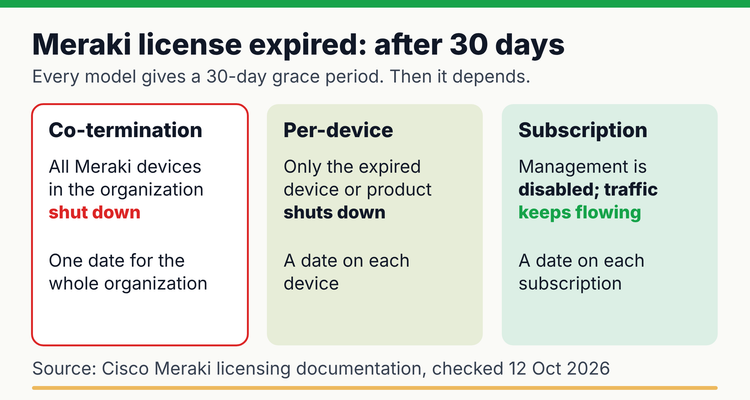 What each Meraki licensing model does after the 30-day grace period, from Cisco Meraki documentation (checked 12 October 2026).
Which Meraki licensing model do you have?
Check the license page in your dashboard. Co-term and per-device organizations use Organization > Configure > License info. Subscription organizations use Organization > Subscriptions & license info, where each subscription has a Subscription ID.
The model matters more than anything else on this page, because it decides what an expiry switches off. Cisco has stopped new per-device conversions: "Conversions to PDL will no longer be accepted" (Cisco Meraki). Subscription licensing is now offered to new and renewing customers in most regions (Cisco Meraki), so many organizations will meet it at their next renewal.
Meraki license expiration: what happens in each model?
All three models give 30 days of grace, then act very differently. We compiled the official rules into one table.
Meraki license expiration by licensing model (Cisco Meraki documentation, last verified 12 October 2026)
| Co-termination | Per-device (PDL) | Subscription | |
|---|---|---|---|
| What expires | One co-term date for every license in the organization | Each device's own license | Each subscription (bound to one or more networks) |
| Grace period | 30 days after the co-term date | 30 days after the device's license expires | 30 days after the subscription end date |
| After the grace period | All Meraki devices in the organization shut down | Only that device or product shuts down | Management disabled; devices keep their last configuration and keep forwarding traffic |
| How to recover | Buy new licensing for all active devices | Apply a new license; grace days used are deducted from it | Renew through your partner; after a longer lapse a new subscription is needed |
| Reminders | Email when out of compliance; status on License info page | Customer is notified when out of compliance | No email reminders; dashboard notices up to 120 days before |
| Official page | Co-Termination Licensing Overview | Per-Device Licensing Overview | Subscription Licensing Renewals and License Compliance |
Sources: Co-termination, per-device, subscription renewals and subscription compliance.
Co-termination: one date, one switch
Co-term licensing averages every license in the organization into a single expiry date. If that date passes, the whole organization enters the 30-day grace period. Cisco says the only way back after the co-term date has passed is "the purchase of all new licensing for active devices." After 30 days, the dashboard shows "This network has been disabled for non-payment" and an email arrives with the subject "Your Meraki networks are now inactive" (Cisco Meraki).
Per-device: one device at a time
Per-device licensing puts an expiry date on each device. Cisco says "Meraki will only shut down that device or product (after the 30 grace period)" and the rest of the organization keeps working. The catch is in the grace period. If you are 10 days into grace and apply a 1-year license, it expires 355 days later, not 365 (Cisco Meraki).
Subscription: traffic flows, management stops
Subscription licensing ties a subscription to networks, not to the whole organization. When a subscription ends, its networks enter a 30-day grace period, then a "disabled management state." Devices keep their last compliant configuration and keep forwarding traffic. But administrators cannot change configuration, see monitoring data, push firmware or get support for those devices (Cisco Meraki). The network stays up while you lose control of it.
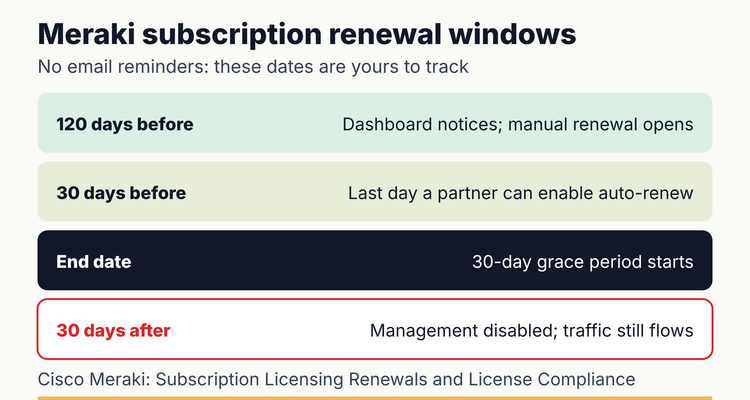 Subscription renewal windows, from Cisco Meraki's Subscription Licensing Renewals and License Compliance pages.
How does the Meraki co-term date work?
The co-term date is a weighted average of all the license time in the organization, divided across the licensed device count. Cisco's own example shows the method (Cisco Meraki).
- Take each license's days and multiply by its device count. A 1-year license for 2 APs is 365 x 2 = 730 device-days. A 5-year license for 1 AP is 1,825 x 1 = 1,825 device-days.
- Add them up: 730 + 1,825 = 2,555 device-days.
- Divide by the number of licensed devices: 2,555 / 3 = about 851 days. All three APs share a co-term date 851 days from the start.
- If one license is applied part-way through another, only the remaining time counts. Cisco's example of the 5-year key applied halfway through the 1-year key gives 730 days.
This is why adding one device with a long license barely moves the date, and why a renewal key that covers fewer devices than you run can leave you out of compliance.
How do you renew a Meraki license step by step?
Renewal works differently in each model. Start about 120 days out, which is when subscription renewals open (our planning advice for co-term and per-device too).
Co-termination renewals
- Count the devices in your networks against your license limit on the License info page. Devices only in inventory do not count.
- Buy one renewal key that covers all devices for the term you want. Cisco calls this "the recommended practice."
- Go to Add licenses, enter the key and choose Renew my Dashboard license. Choose License more devices only for extra devices.
- Apply the key straight away. "Holding onto a license does not delay its activation date."
- Confirm the new co-term date and that no device type shows red.
Picking the wrong claim type is a common mistake. A renewal key resets your license limit to match only that key, so a short key can push you out of compliance. Cisco's undo license claim tool can reverse it.
Per-device renewals
- Buy licenses for the devices you are renewing; you can renew all or some.
- Queue the new license on each device before its 90-day pre-activation window ends, so it starts when the current one expires.
- To bring several devices to one date, use one-day licenses to "true-up" the earlier dates.
Subscription renewals
- Find the Subscription ID under Organization > Subscriptions & license info > View Details.
- Send it to your partner. Manual renewal can be set up from 120 days before the end date and lets you change SKUs, tiers and term.
- For auto-renewal, the partner must enable it at least 30 days before expiry. It renews for one year on the same terms.
- Either way, the renewal takes effect the day after the current end date, with no key to claim. Check Recent Changes on the subscription to confirm.
One note on timing after expiry: Cisco's renewal page refers to a 30-day grace period, and also to a 90-day period in which an expired subscription can still be renewed manually; after that "a new subscription will be needed" (Cisco Meraki). Plan around the 30 days.
Do this now: a 20-minute Meraki license check
You can know exactly where every organization stands in about 20 minutes per organization (our estimate). Do it now, then put the dates somewhere that reminds you.
Meraki license check
- ✓
Note the licensing model of each organization (2 minutes)
- ✓
Record the co-term date, each device's expiry, or each subscription's end date and ID (5 minutes)
- ✓
Compare device counts with license limits, by device type (5 minutes)
- ✓
Check who receives dashboard alerts and email, and add a shared mailbox where you can (3 minutes)
- ✓
Write down your partner contact and the renew-by date (90 to 120 days before expiry) (5 minutes)
Copy-paste spreadsheet layout
- Columns: A Organization or client, B Licensing model, C Network or device, D Subscription ID or license key, E Expiry or co-term date, F Devices in use, G License limit, H Renew-by date, I Days left, J Status, K Owner, L Backup, M Partner.
- Renew-by (120 days before expiry): =IF(E2="","",E2-120)
- Days left: =IF(E2="","",E2-TODAY())
- Shutdown or lockout date (30-day grace): =IF(E2="","",E2+30)
- Status: =IF(E2="","CHECK",IF(F2>G2,"OVER LIMIT",IF(I2<0,"IN GRACE OR EXPIRED",IF(TODAY()>=H2,"RENEW NOW","OK"))))
Managing many organizations? The Meraki Dashboard API endpoint GET /organizations/{organizationId}/licenses/overview returns the status and expiration date for co-term organizations, and counts of expiring licenses for per-device ones (Cisco Meraki Developer Hub). A short script can fill column E for every client. Or start from our free software, domain and SSL renewal tracker.
How can you make Meraki renewals easier?
A few habits go beyond avoiding an outage.
- Do not rely on email. Subscription customers get none, and co-term emails go to whoever is on the account. Put the date in a shared calendar or tracker.
- Renew early under co-term. Time on a renewal key counts from purchase, so there is no cost to applying it early.
- Watch device counts all year. Adding an unlicensed device starts its own 30-day grace period, long before the renewal date.
- Line up Meraki with your other network renewals. If you also run FortiGate firewalls, see our FortiGate license renewal guide.
What happens if you miss a Meraki renewal?
⚠️What happens if you miss it: under co-termination, once licensing has been invalid for more than 30 days, "all Cisco Meraki devices will be shutdown until licensing is returned to compliance", and the only fix is new licensing for all active devices (Co-Termination Licensing Overview). Under per-device licensing, the expired device shuts down after 30 days. Under subscription licensing, management of the affected networks is disabled after 30 days: no configuration changes, monitoring, firmware updates or support (License Compliance Cloud Experience).
💡 Pro Tip
Under co-term, a device added to a network counts against your license limit, but one left in inventory does not. If you are over the limit, you can move the extra device out of its network and back into inventory which brings the organization back into compliance while the new license is ordered (Co-Termination Licensing Overview).
Spreadsheet or software?
A spreadsheet works for one organization on co-term licensing: one date, one owner, checked monthly. It gets harder with per-device or subscription licensing, where every device or network can have its own date, and with several client organizations. And a spreadsheet cannot send a reminder, which matters when Cisco does not send one for subscriptions.
In ExpiryEdge, each Meraki organization, subscription or device group is a record with an owner and a backup and reminders at 90, 60, 30 and 7 days by email, SMS, Slack or Teams. ExpiryEdge does not connect to your Meraki dashboard; you enter or import the dates. MSPs can see how this works per client on our managed service providers page. For the rest of your IT renewals, see our domain, SSL and IT renewal tracking hub and software license tracking guide.
Frequently asked questions
Is there a grace period when a Meraki license expires?
Yes, 30 days in all three licensing models. During co-term grace, Cisco says network clients will not see a difference. After 30 days, co-term organizations shut down, per-device licensing shuts down the expired device, and subscription networks lose management.
Will my Meraki network stop working if the license expires?
It depends on the model. Under co-termination, all Meraki devices in the organization shut down after the 30-day grace period. Under per-device licensing, only the expired device does. Under subscription licensing, devices keep forwarding traffic, but you cannot manage, monitor or update them.
Does Meraki send license expiration reminders?
Not for subscription licensing: Cisco says those customers "will not receive email reminders" and see dashboard notices up to 120 days before expiry instead. For co-term, Cisco documents emails when an organization is out of compliance. Do not rely on either as your only reminder.
How do I renew a Meraki co-term license?
Buy one renewal key that covers all the devices in your organization, then go to License info > Add licenses and claim it as Renew my Dashboard license. Apply it as soon as you have it, because the time counts from purchase.
Should I wait until my Meraki license is about to expire before renewing?
No. Cisco says a co-term renewal license starts counting down from the date purchased, and "there is no time benefit gained from delaying a renewal." Under per-device licensing, queue the new license on the device so it starts when the current one ends.
Can I move from co-term to subscription licensing?
Subscription keys can only be claimed by an expired organization, one in a grace period, or a new one, not by an organization with active co-term or per-device licensing. Talk to your partner about timing before your co-term date.
Sources
- Cisco Meraki, Co-Termination Licensing Overview
- Cisco Meraki, Per-Device Licensing Overview
- Cisco Meraki, Cisco Networking Subscription Licensing overview
- Cisco Meraki, Subscription - Licensing Renewals
- Cisco Meraki, Subscription - License Compliance Cloud Experience
- Cisco Meraki Developer Hub, Get Organization Licenses Overview
- Last reviewed: 12 October 2026
Frequently asked questions
It depends on the model. Under co-termination, all Meraki devices in the organization shut down after the 30-day grace period. Under per-device licensing, only the expired device does. Under subscription licensing, devices keep forwarding traffic, but you cannot manage, monitor or update them.
Not for subscription licensing: Cisco says those customers "will not receive email reminders" and see dashboard notices up to 120 days before expiry instead. For co-term, Cisco documents emails when an organization is out of compliance. Do not rely on either as your only reminder.
Buy one renewal key that covers all the devices in your organization, then go to License info > Add licenses and claim it as Renew my Dashboard license. Apply it as soon as you have it, because the time counts from purchase.
No. Cisco says a co-term renewal license starts counting down from the date purchased, and "there is no time benefit gained from delaying a renewal." Under per-device licensing, queue the new license on the device so it starts when the current one ends.
Subscription keys can only be claimed by an expired organization, one in a grace period, or a new one, not by an organization with active co-term or per-device licensing. Talk to your partner about timing before your co-term date.