
Top 5 Insurance Policy Management Software Alternatives 2026

Two kinds of insurance policy software, five products

Pick by who you are. If you're an insurer, MGA or program administrator, you need a core system that quotes, issues and bills policies: Guidewire, Insuresoft Diamond, BindHQ or OWLS. If you're a business, broker or property manager who needs to know when the policies you hold (or your contractors hold) expire, you need an expiry tracker. That's where ExpiryEdge fits.
Both groups search for "insurance policy management software", which is why so many comparisons feel off. A carrier replacing its policy admin system is buying a long project with an implementation partner. A facilities manager chasing a roofer's lapsed liability certificate wants something working by Friday.
Each product below gets the same treatment: what it does, who it suits, where it falls short and what it costs. Vendor figures are the vendors' own claims, linked so you can check them. And yes, we make ExpiryEdge, so read our section with that in mind.
ExpiryEdge: for tracking the policies you hold

What it does
ExpiryEdge tracks dates on contracts, licences, permits and certificates, and insurance policies and certificates of insurance (COIs) are among the most common things people put in it. It doesn't quote, bind or bill anything. Its job is narrower: make sure the right person hears about a renewal early, and that the renewed document ends up on file.
Core features
Every policy gets a record with its expiry date, a named owner and the document attached. Reminders go to that owner by email, SMS, WhatsApp, Slack or Microsoft Teams. If nobody acts, the item escalates to a manager.
For policies other people hold, such as a subcontractor's general liability cover, ExpiryEdge can send the request for the renewed certificate and collect the upload. Each step lands in an audit trail you can export when a client, auditor or insurer asks.
Where it differs
It's built around one outcome: nothing expires without someone noticing. That's a much smaller job than the insurer platforms below, and it's the point. A general contractor with 40 subcontractors, each carrying liability and workers' comp on different renewal dates, needs reminders and follow-up. It doesn't need a rating engine.
Limits
- It isn't a policy administration system. An insurer can't use it to quote, bind, bill or handle claims.
- You'll spend some time in the first week deciding reminder schedules and who escalations go to, especially if you import hundreds of records at once.
Who it's for
Teams that hold lots of policies or collect them from others. Think general contractors checking subcontractor COIs, property managers tracking building and vendor cover, clinics tracking clinicians' malpractice insurance, and brokers who want a second net under client renewals. Our page on certificate of insurance tracking shows the COI workflow in detail.
Example
A care home holds employers' liability, public liability and buildings cover, and each staffing agency it uses must send a current certificate. The registered manager gets an email 60 days before each renewal and a WhatsApp message at 14 days. If an agency's certificate runs out with no replacement, the operations director hears about it the next morning, not at the next inspection.
Pricing
Annual plans run from $290 a year (Personal: 50 tracked items, one user) to $1,990 a year (Power: 2,500 items, 50 users), with Enterprise priced on request, according to the ExpiryEdge pricing page. Every plan starts with a 14-day free trial, no credit card needed, and after that you choose a paid plan.
Website: expiryedge.com
Guidewire: the core system for large P&C insurers
What it does
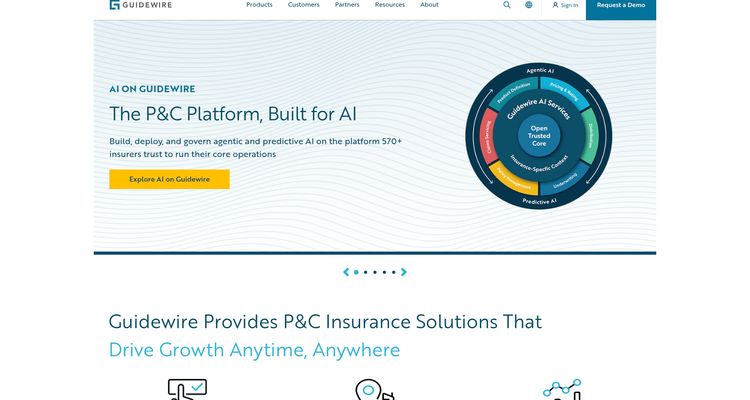
Guidewire sells the systems a property and casualty insurer runs on. InsuranceSuite covers policy administration, claims and billing (PolicyCenter and ClaimCenter are its best-known parts), and InsuranceNow is an all-in-one cloud platform. The Guidewire homepage says more than 570 insurers use its software.
Where it differs
Depth. Guidewire is the system of record for the whole policy lifecycle, from first quote to final claim payment, with analytics and customer portals around it. You build an insurer's operations on it. You don't switch it on over a weekend.
Limits
- Implementations are big programmes, with long configuration and testing phases and usually a systems integrator alongside.
- Pricing isn't published. For a small carrier, the total cost can be hard to justify against lighter platforms.
Who it's for
Mid-sized and large P&C insurers replacing legacy core systems or pulling several product lines onto one platform. If you aren't an insurer, it's the wrong category entirely.
Pricing
Not published. Guidewire quotes cloud subscriptions by module and scope, and implementation is priced on top.
Website: guidewire.com
OWLS: one platform for South African insurers

What it does
OWLS puts policy administration, quoting, claims, reinsurance and finance in one cloud-native system. Its website says it works with all the leading South African insurers, across both short-term and long-term insurance.
Where it differs
One ledger for policy, claims and finance means fewer month-end reconciliations between systems. It also offers SMS and email communication with policyholders, a rate engine for testing tariffs, and links to banking gateways, CRMs and accounting packages.
Limits
- It's designed for medium and large insurers. A small broker who mainly needs renewal reminders would pay for modules they never open.
- Pricing isn't published, so expect a sales quote plus implementation fees.
When it may not fit
A single-product startup or micro insurer will probably find it too heavy. So will any team without someone to own integrations, because the value comes from wiring OWLS into your bank, CRM and accounts.
Who it's for
Insurers in South Africa and nearby markets that want a single system for the policy lifecycle and have an IT team to own the integrations.
Website: owlssoftware.com
BindHQ: a launch platform for MGAs and wholesalers

What it does
BindHQ is for specialty insurance: MGAs, program administrators and wholesale brokers. Its pitch on bindhq.com is launching programs in weeks rather than years, starting from prebuilt templates for lines such as liquor liability and commercial property.
Core features
Underwriting rules, policy forms, commissions and rating tables are all configurable, and they sit next to billing, tax, accounting and reporting. Submissions come in through automated intake and get routed to approve, refer or decline. APIs connect to carriers, payment platforms and analytics tools.
Limits
- BindHQ's own FAQ says most customers go live in 45 to 90 days, and heavily customised programs take longer.
- Moving off older agency systems and Excel raters is real work, even with the vendor's migration help.
When it may not fit
If you write one simple product, or your legacy system is so customised that every rule needs rebuilding, the template approach saves less time. Budget for data migration either way.
Example
BindHQ says a Florida-based MGA launched a habitational program on the platform in four months, and that wholesale brokerage QuoteWell went live in weeks after leaving Applied Epic. Both are vendor-reported stories, so ask for references if they matter to your decision.
Pricing
Not published. Quotes depend on business size, premium volume and the modules you choose.
Website: bindhq.com
Insuresoft Diamond: all-in-one core for regional carriers

What it does
Diamond runs policy administration, billing and claims for P&C carriers, across personal, commercial, workers' compensation, farm, specialty and non-standard auto lines. On its website, Insuresoft says it has served the P&C industry for over 33 years, offers more than 150 pre-built third-party integrations, and that every implementation it has run has gone to production.
Where it differs
Diamond Composer lets the carrier's own staff change rates, rules and workflows without waiting on vendor development. You can deploy Diamond one module at a time or as a full suite, which helps if you're replacing legacy systems in stages.
Limits
- You'll need dedicated technical staff or an implementation partner for configuration.
- Pricing is quoted per client, so side-by-side comparison takes a sales cycle.
When it may not fit
Carriers without spare IT capacity will struggle with the first configuration phase. If you want a narrow, out-of-the-box policy engine for one line, Diamond's breadth is more than you'll use.
Who it's for
Regional and mid-size P&C carriers, MGAs and third-party administrators that want one core system instead of several stitched together.
Website: insuresoft.com
How the five compare
| Product | What it is | Built for | Go-live | Pricing |
|---|---|---|---|---|
| ExpiryEdge | Expiry and renewal tracker for policies, COIs, licences and contracts | Businesses, brokers, contractors and property managers that hold or collect policies | Same day for a small list; import a spreadsheet to start | Published: $290 to $1,990 a year, Enterprise on quote |
| Guidewire | Core system: policy, claims, billing | Mid-sized and large P&C insurers | Multi-phase programme, usually with a partner | On quote |
| OWLS | Core system: policy, claims, reinsurance, finance | Short-term and long-term insurers, mainly in South Africa | Project with integration work | On quote |
| BindHQ | Program platform with templates, rating and accounting | MGAs, program administrators, wholesale brokers | 45 to 90 days for most customers, per BindHQ | On quote |
| Insuresoft Diamond | Core system: policy, billing, claims | Regional and mid-size P&C carriers, MGAs, TPAs | Module by module or full suite | On quote |
The fastest way to shortlist is one question: must the software issue and bill the policy? If yes, you're choosing between the four core platforms, and the deciding factors are your lines of business, your market and how much implementation you can absorb. If the policies already exist and the problem is that renewals slip, you need an expiry tracker.
Our view
For an insurer, ExpiryEdge is no substitute for the other four. For a business, broker or property manager whose real risk is a lapsed policy or an out-of-date COI, a core insurance platform is far more system than you need. A tracker that reminds, chases and files is the better fit, and it costs a fraction as much.
Signs you're shopping in the wrong category
Most unhappy buyers picked a good product for somebody else. Three mismatches come up again and again.
You're a broker and the demo spends an hour on rating tables. Core platforms are sold to risk-bearing insurers and MGAs. A retail brokerage normally runs an agency management system for client records, and adds a tracker only if renewals keep slipping through it.
You're a contractor or landlord and the vendor asks about your lines of business and premium volume. That's a carrier conversation. Your question is simpler: which of the 60 certificates on file expire next month, and who is chasing them?
You're an MGA and someone suggests a spreadsheet with conditional formatting. It'll hold dates. It won't bind a policy, calculate premium tax or produce the reports your carrier expects, and those are the jobs that hurt when they go wrong.
Questions to settle before you book demos
- Who holds the policies? Your own cover, your subcontractors' cover and your clients' cover each need a different workflow.
- How early do renewals need to start? For most commercial cover, 60 to 90 days gives your broker time to market the risk.
- Who gets told when nothing happens? Name the person an overdue renewal escalates to before you configure any tool.
- What counts as done? Usually the new certificate or declarations page on file, not an email saying it's renewed.
Our commercial insurance renewal checklist walks through the full timeline, step by step.
If you're on the tracking side, the quickest test is to import the spreadsheet you already have into ExpiryEdge and see what the next 90 days look like. The 14-day trial needs no credit card.
Frequently asked questions
They solve different problems. Guidewire is a core system for property and casualty insurers that runs policy administration, claims and billing. ExpiryEdge is for organisations that hold or collect policies and need them renewed on time. An insurer might issue a policy in Guidewire, while a contractor's office manager uses ExpiryEdge to make sure the certificate for that policy is renewed before it lapses.
Of the five products here, ExpiryEdge is the one built around internal renewal reminders. It sends them by email, SMS, WhatsApp, Slack and Microsoft Teams, and escalates overdue items to a manager. The insurer platforms handle policyholder communication too (OWLS lists SMS and email), but that's an insurer talking to customers, not a team tracking its own renewals.
Yes. ExpiryEdge tracks contracts, licences, permits and certificates together, so a business can keep its liability policy, its trade licence and its lease break date on one list. Each item gets its own owner and reminder schedule, and the exportable audit trail covers all of them, which helps when a client or auditor asks for proof.
Annual plans run from $290 a year for 50 tracked items and one user, up to $1,990 a year for 2,500 items and 50 users, with Enterprise priced on request. Check the pricing page for current figures. Every plan starts with a 14-day free trial with no credit card, and you move to a paid plan once the trial ends.