
Commercial Insurance Renewal Checklist: 120-Day Plan and Emails

A commercial insurance renewal checklist starts 120 days before expiration: send updated exposures and request loss runs at 120 days, choose to renew or market at 90, compare quotes line by line at 60, and approve, bind and reissue certificates by 30. Some states set deadlines inside that window, such as 15 days for Florida loss runs.
If your renewals start when the broker’s quote lands two weeks before expiry, you are choosing between one price and a lapse. This plan gives every week a job, cites the state rules that matter and includes four emails you can send today.
Key takeaways
- Start at 120 days. Exposure data and loss runs take weeks to gather, and some insurers can send a nonrenewal notice as late as 30 days out.
- Ask for loss runs in writing. Florida insurers must provide a loss run statement within 15 calendar days of a written request; Maine insurers must provide loss information within 30 calendar days.
- Florida’s 45-day notice rule has a condition. It applies only if you have furnished the information the insurer needs to price the renewal.
- Compare quotes line by line. Limit, deductible, key exclusions and premium, expiring against renewal, with the change calculated.
- Bind in writing, then log the binder. Record the binder number and date, then reissue every certificate you have given out.
- Write each decision into your tracker. Who approved what, and when, is the first question after any coverage dispute.
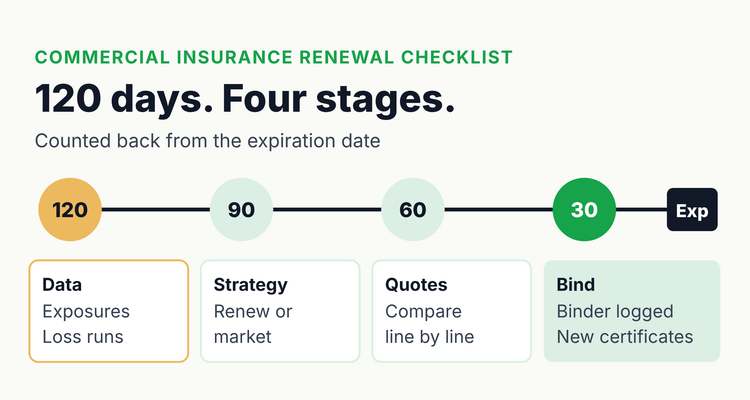 The 120-day commercial insurance renewal plan: one job for each stage.
What goes on a commercial insurance renewal checklist?
A commercial insurance renewal checklist covers four stages: data, strategy, quotes and binding. Each has a deadline counted back from the expiration date and an owner. Copy this list into your calendar for every policy, or every program if your layers share a date.
Commercial insurance renewal checklist (days before expiration)
- ✓
120: Update payroll, revenue, headcount and subcontractor costs for the coming year
- ✓
120: Update vehicle, equipment and property schedules (statement of values)
- ✓
120: List new locations, products, services and contracts with insurance requirements
- ✓
120: Request 5 years of loss runs for every line, in writing
- ✓
120: Note open claims and any safety or risk improvements made this year
- ✓
90: Decide with the broker: renew as is, market the account, or restructure
- ✓
90: Confirm the minimum limits your leases, loans and customer contracts require
- ✓
60: Receive quotes; compare limits, deductibles, exclusions and premium with the expiring policy
- ✓
60: Ask the broker about every change the comparison shows
- ✓
30: Approve in writing and confirm the bind; log the binder number and date
- ✓
30: Arrange premium payment or financing before the effective date
- ✓
After binding: update your tracker and reissue certificates to every holder
- ✓
After binding: check the issued policy against the binder when it arrives
If you track many policies, our guide to insurance policy tracking for businesses shows the spreadsheet columns and formulas that drive these dates.
What should you do 120 days before a commercial insurance renewal?
Send the insurer what it needs to price next year, and ask for your claims history. Underwriters price commercial cover from exposures (payroll, revenue, vehicles, property values) and losses. Stale figures mean a quote built on guesses, or a quote that arrives late.
- Workers’ compensation: payroll by job classification for the coming year.
- General liability: revenue or payroll, subcontractor costs, and any new products, services or locations.
- Auto: a current vehicle schedule with VINs, garaging addresses and a driver list.
- Property: a statement of values with building, contents and business income figures. Check replacement costs, not book values.
- Contracts: any new lease, loan or customer contract that sets insurance requirements.
Florida makes timely data matter in law. Under Fla. Stat. §627.4133(1)(a), an insurer must give at least 45 days’ written notice of nonrenewal or of the renewal premium, but “this requirement applies only if the insured has furnished all of the necessary information so as to enable the insurer to develop the renewal premium prior to the expiration date of the policy to be renewed.”
How do you get loss runs, and how fast must the insurer send them?
Ask the insurer in writing, through your broker or directly, and note the date. A loss run is the insurer’s report of claims on your policy. Some states set a deadline for providing it. The table below compiles the rules we verified, with the nonrenewal notice minimums that frame the same window.
Renewal deadlines set by law: loss runs and nonrenewal notice (last verified 12 Oct 2026)
| State or program | Rule | Citation | Official source |
|---|---|---|---|
| Florida: loss runs | Insurer provides a loss run statement within 15 calendar days of a written request; 5 years of claims history; one free statement a year; agent of record notified | Fla. Stat. §627.444 | leg.state.fl.us (2026 Statutes) |
| Maine: loss information | Insurer provides loss information within 30 calendar days of a written request; an agent passes the request on within 4 working days | 24-A M.R.S. §2910 | legislature.maine.gov |
| Florida: notice | At least 45 days’ written notice of nonrenewal or renewal premium, if the insured furnished the information needed; late notice keeps cover in force until 45 days after notice or replacement cover, whichever first | Fla. Stat. §627.4133(1) | leg.state.fl.us (2026 Statutes) |
| New York: notice | Nonrenewal or conditional renewal notice 60 to 120 days before expiration; 30 to 120 days for excess liability policies and jumbo risks | N.Y. Ins. Law §3426(e)(3) | nysenate.gov |
| Ohio: notice | Commercial property, fire and casualty: nonrenewal notice mailed at least 30 days before expiration, copy to the agent | Ohio Rev. Code §3937.26 | codes.ohio.gov |
| Washington: notice | Nonrenewal notice at least 60 days before expiration, with the insurer’s actual reason (90 days for medical malpractice) | RCW 48.18.2901 | app.leg.wa.gov |
| North Carolina: notice | Nonrenewal notice at least 45 days before expiration (one-year term), with the precise reason; 30 days’ notice of lower limits, higher deductibles or premium rates not requested | N.C.G.S. §58-41-20 | ncleg.gov |
| Federal flood (NFIP) | Policy expires 12:01 a.m. on the last day of the term; renewal premium must be received within 30 days of expiration | 44 CFR Part 61, App. A, Sec. E | ecfr.gov |
These are minimums for the lines each statute covers. Check the scope wording for your state and line before relying on a figure. For statute wording and scope notes, see our nonrenewal notice reference for brokers.
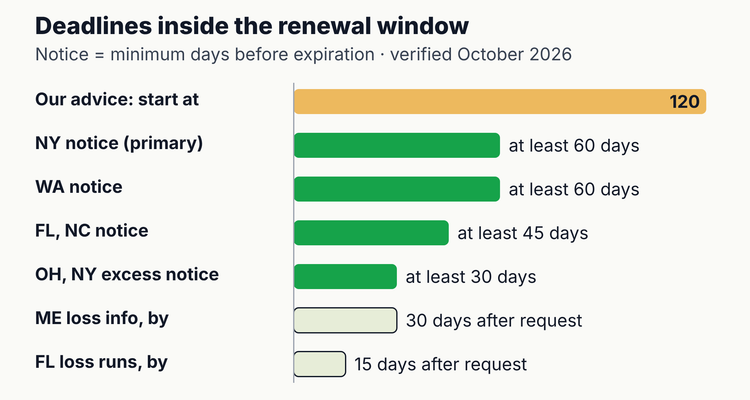 Deadlines the law sets inside the renewal window, against a 120-day start (verified October 2026).
How do you decide whether to renew or market the account at 90 days?
Market the account when something has changed; renew when nothing has and the terms are fair. Use these questions with your broker:
- Has the business changed? New locations, products, contracts or a big payroll swing usually justify a fresh look.
- Has the loss record changed? A large claim may push the incumbent to raise rates; a clean record is leverage.
- Did the insurer signal a problem? A conditional renewal notice or talk of reduced limits is a reason to market early.
- Do limits still meet your contracts? If a new lease or customer requires higher limits, price them now.
- When did you last test the market? Agree a policy with your broker, for example every two or three years for stable accounts. That is our suggestion, not a rule.
How should you compare renewal quotes at 60 days?
Put the expiring terms and the renewal terms side by side, and calculate the change. A quote summary that shows only the premium hides changes in limits, deductibles and exclusions. Copy this layout into a sheet, one row per term:
Renewal quote comparison sheet (row 2)
| Column | Header | What goes in it |
|---|---|---|
| A | Term | Each occurrence limit, aggregate, deductible, premium, key exclusion, additional insureds |
| B | Expiring | From the current policy or declarations page |
| C | Renewal quote | From the quote or proposal |
| D | Change | =IF(ISNUMBER(B2),C2-B2,IF(B2=C2,"Same","Changed")) |
| E | Change % | =IF(AND(ISNUMBER(B2),B2<>0),(C2-B2)/B2,"") |
| F | Question for broker | Anything that changed and was not explained |
Format column E as a percentage. Any row showing “Changed” or a non-zero number gets a question in column F. North Carolina insurers, for example, must give 30 days’ written notice when they lower limits or raise deductibles or rates without your request, so a change you did not ask for should never be a surprise.
What should happen 30 days before renewal?
Approve in writing, confirm the bind, and record the evidence. A binder is temporary evidence of cover until the policy is issued. Log its number, the carrier and the effective date in your tracker. Then send every certificate holder a new certificate; partners holding last year’s dates will chase you otherwise.
⚠️What happens if you miss it: notice rules protect you when the insurer is late, not when you are. In Florida, the 45-day notice duty applies only if you furnished the information needed to price the renewal (Fla. Stat. §627.4133). If nothing is bound by expiration, cover ends; an NFIP flood policy expires at 12:01 a.m. on the last day of the term, and the renewal premium must be received within 30 days (44 CFR Part 61).
Do this now: four emails for your commercial insurance renewal
Copy, fill the brackets and send. Keep each sent email with the policy record.
Email 1: 120 days, renewal data to your broker
Subject: [Business] renewal [expiration date]: updated exposures and loss runs
Hi [Name], our [lines] renew on [date]. Attached are next year’s payroll by class, revenue, the vehicle schedule and the statement of values. New since last year: [locations, products, contracts]. Please request 5 years of loss runs for each line from every carrier, and confirm when the submission will go to market.
Email 2: loss run request to the insurer
Subject: Written request for loss runs, policy [number]
This is a written request for a loss run statement for policy [number], [named insured], covering the last 5 years. [In Florida, add: “Under Fla. Stat. §627.444, please provide it within 15 calendar days.” In Maine: “Under 24-A M.R.S. §2910, please provide loss information within 30 calendar days.”] Please copy our agent, [Name].
Email 3: 60 days, questions on the quote
Subject: [Business] renewal quote: questions before we approve
Thanks for the quote. Comparing it with the expiring policy, these terms changed: [list from column F]. For each, can you tell us why, and what alternatives exist? We would also like a price for [higher limit or different deductible]. We plan to decide by [date, 30 days before expiry].
Email 4: 30 days, approval to bind and certificates
Subject: Approval to bind [lines], effective [date]
We approve binding [carrier] for [lines] as quoted on [quote date], premium [amount]. Please send the binder and confirm the policy number. Then please issue updated certificates to the holders on the attached list. Payment will be made by [method] before [date].
How can you get more out of each renewal than a new policy?
Use the renewal to improve terms over time, not just to roll the policy over.
- Show your risk improvements. Safety programs, new sprinklers, telematics or driver training belong in the submission, with dates.
- Test deductibles. Ask for prices at two deductible levels and compare the premium saved with your claims history.
- Co-term your policies. Aligning lines and layers to one date means one submission and one decision meeting.
- Hold a mid-term review. Six months in, check exposures and contracts so next year’s data is ready early.
- Keep a renewal log. Premium, limits and decisions year by year turn the next negotiation into evidence.
Running renewals for a charity or association? Our nonprofit insurance renewal checklist adds board reporting and D&O review.
Spreadsheet or software for commercial insurance renewals?
A spreadsheet and a shared calendar are enough for a handful of policies with one owner. They fail when renewals overlap, owners change or nobody opens the file in the week that matters. Researcher Raymond Panko compiled audits of business spreadsheets and reported that “these studies found errors in 94% of the spreadsheets studied,” so check the date formulas once a quarter. Our free contract renewal tracker template works for policies too if you add the loss-run and binder columns above.
💡 Pro Tip
Brokers we work with keep carrier, policy number, deductible, limit and premium as fields on every policy record, so the renewal submission and the quote comparison pull from the same place instead of last year’s email. You can do the same in a spreadsheet: one row per policy, with columns that never change meaning.
When reminders need to reach several people on time, ExpiryEdge turns each policy into a record with an owner, a backup, this checklist as a reusable workflow and reminders at 90, 60, 30 and 7 days; see insurance renewal tracking software.
Frequently asked questions
What is a commercial insurance renewal checklist?
It is a dated list of tasks for renewing a business policy: update exposures and request loss runs at about 120 days, agree a strategy at 90, compare quotes at 60, and bind and reissue certificates by 30. Each task has an owner and a deadline counted back from the expiration date.
How early should I start a commercial insurance renewal?
We suggest 120 days before expiration. That is advice, not a legal rule. It leaves time to gather data and loss runs before any nonrenewal notice could arrive; Ohio’s minimum for commercial property and casualty is 30 days before expiration.
How long does an insurer have to send loss runs?
It depends on the state. Florida requires a loss run statement within 15 calendar days of a written request (Fla. Stat. §627.444), and Maine requires loss information within 30 calendar days (24-A M.R.S. §2910). Make the request in writing and note the date.
How much notice must an insurer give before nonrenewing a commercial policy?
State law sets the minimum. Examples we verified: Florida 45 days, New York 60 to 120 days (30 to 120 for excess liability and jumbo risks), Ohio 30 days, Washington 60 days and North Carolina 45 days. Check the scope of your state’s rule for your line of cover.
What documents do I need for a commercial insurance renewal?
Typically next year’s payroll by class, revenue, a vehicle schedule, a statement of values for property, details of new locations, products and contracts, and 5 years of loss runs. Your broker will tell you which apply to each line.
What is a binder in insurance?
A binder is temporary evidence that cover has been placed, used until the policy is issued. Record its number, carrier and effective date, and check the issued policy against it when it arrives.
Sources
- Florida Legislature, 2026 Florida Statutes §627.444, Loss run statements (accessed 12 Oct 2026).
- Florida Legislature, 2026 Florida Statutes §627.4133 (accessed 12 Oct 2026).
- Maine Legislature, 24-A M.R.S. §2910, Loss information to be supplied (data extracted 5 Oct 2026; accessed 12 Oct 2026).
- New York State Senate, Insurance Law §3426 (revision of 4 Mar 2022; accessed 12 Oct 2026).
- Ohio Revised Code, Section 3937.26 (accessed 12 Oct 2026).
- Washington State Legislature, RCW 48.18.2901 (accessed 12 Oct 2026).
- North Carolina General Assembly, G.S. 58-41-20 (accessed 12 Oct 2026).
- eCFR, 44 CFR Part 61 (Appendix A, Section E; accessed 12 Oct 2026).
- Raymond R. Panko, What We Don’t Know About Spreadsheet Errors Today, arXiv:1602.02601.
- Last reviewed: 12 October 2026
Frequently asked questions
We suggest 120 days before expiration. That is advice, not a legal rule. It leaves time to gather data and loss runs before any nonrenewal notice could arrive; Ohio’s minimum for commercial property and casualty is 30 days before expiration.
It depends on the state. Florida requires a loss run statement within 15 calendar days of a written request (Fla. Stat. §627.444), and Maine requires loss information within 30 calendar days (24-A M.R.S. §2910). Make the request in writing and note the date.
State law sets the minimum. Examples we verified: Florida 45 days, New York 60 to 120 days (30 to 120 for excess liability and jumbo risks), Ohio 30 days, Washington 60 days and North Carolina 45 days. Check the scope of your state’s rule for your line of cover.
Typically next year’s payroll by class, revenue, a vehicle schedule, a statement of values for property, details of new locations, products and contracts, and 5 years of loss runs. Your broker will tell you which apply to each line.
A binder is temporary evidence that cover has been placed, used until the policy is issued. Record its number, carrier and effective date, and check the issued policy against it when it arrives.


