Centralized Vendor Management: What Ops Teams Need to Know

Centralized Vendor Management: What Ops Teams Need to Know
Hand organizing vendor binder in office
Centralized vendor management works by creating a single governed source of vendor truth and embedding approvals, onboarding, performance monitoring, and renewal workflows into one operating layer. Every vendor interaction, from initial due diligence to offboarding, runs through that structure rather than scattered across departments or spreadsheets.
The elements that make it work:
- Central vendor master record — one authoritative profile per supplier, no duplicates
- Governed onboarding workflows — document collection, W-9s, certificates of insurance, validation rules
- Role-based access controls — segregation of duties between record creation and payment authorization
- ERP and AP integrations — two-way data sync to prevent duplicate records and vendor-master fraud
- Performance and risk monitoring — SLA tracking, financial health signals, and compliance status
- Automated renewal and expiry alerts — multi-channel reminders before contracts and certifications lapse
The sections below cover each component in depth, including how to build the governance model, what KPIs to track, and how to roll it out in phases.
Key Takeaways
Centralized vendor management works when a single governed vendor record, clear role ownership, integrated technology, and automated deadline tracking operate as one connected system.
| Point | Details |
|---|---|
| Single source of truth | One vendor master record, linked to contracts and risk data, eliminates duplicates and audit gaps. |
| Segregation of duties | The person who creates a vendor record must never be the same person who approves payments to that vendor. |
| Integration priority | ERP and AP two-way sync is the highest-stakes technical requirement; get it right before scaling. |
| Renewal and expiry tracking | Automated alerts at 90, 60, and 30 days before expiry prevent missed renewals and service disruptions. |
| Expiryedge for deadline tracking | Expiryedge centralizes contract, certification, and compliance deadline tracking with automated multi-channel alerts and audit trails. |
How centralized vendor management works: definition and scope
Centralized vendor management consolidates vendor master data, onboarding, contract storage, and governance into a single operating layer, typically owned by a Vendor Management Office (VMO) or a central procurement and AP function. The alternative, letting each business unit manage its own vendors, produces fragmented records, inconsistent controls, and gaps that auditors and regulators find quickly.
When does centralizing make sense? A few reliable indicators:
- Multiple offices or business units using the same vendor under different names or IDs
- Missed contract renewals causing service interruptions or auto-renewals at unfavorable terms
- Audit findings tied to inconsistent onboarding documentation
- Regulatory requirements (SOX, HIPAA, state licensing) that demand a documented approval chain
- Duplicate payments traced to duplicate vendor records
The trade-off is real. Centralization adds governance overhead and can slow local purchasing if the process is poorly designed. A central team that becomes a bottleneck will push business units to work around it, which defeats the purpose. The goal is consistent controls, not a procurement bureaucracy.
Pro Tip: Write your vendor management policy in 3–4 pages maximum. Policies that name specific job titles rather than vague role categories are far easier to audit and actually get followed. A 20-page policy document tends to sit unread.
A hybrid model often works well for growing organizations: the VMO sets standards and owns the vendor master, while business units retain sourcing authority within defined thresholds. That balance keeps speed local and controls central.
What technology components does a centralized program need?
A vendor management system (VMS) centralizes vendor data, automates onboarding and compliance workflows, and provides visibility into vendor relationships. The technology stack underneath that description has several distinct layers, and getting the architecture right matters more than picking any single tool.
The core components and their roles:
| Component | Primary Purpose | Critical Integration Points |
|---|---|---|
| Vendor master / SIM | Single authoritative supplier record | ERP, AP, identity/access systems |
| Contract repository | Centralized storage with version control | CLM, e-signature, renewal tracking |
| Onboarding workflow engine | Document collection, validation, approvals | Supplier portal, W-9/COI validation, ERP |
| Risk and compliance feeds | Sanctions screening, financial health, insurance | OFAC, D&B, insurance verification services |
| Performance dashboard | SLA tracking, KPIs, spend analytics | ERP, AP, procurement platform |
| Renewal and expiry tracking | Automated alerts before key dates lapse | Contract repository, email/SMS/calendar |
| Payment rails integration | Preferred electronic payment routing | AP, banking, virtual card programs |
The vendor master is the foundation. Best-in-class platforms link supplier information, risk signals, performance KPIs, and contracts into one unified record so every decision is governed and auditable. Without that unified record, the other layers produce data that cannot be trusted.
Two-way ERP integration is where most implementations stumble. The vendor master setup stage is the highest-stakes control point in the whole lifecycle. An out-of-band validation step, confirming banking changes using a phone number sourced from the original contract rather than the change request, is one of the most effective fraud controls available.

Contract lifecycle management tools connect directly to the vendor master and feed renewal dates into the alerting layer. That connection is what turns a static contract repository into an active compliance control.
What does the centralized vendor lifecycle look like step by step?
Vendor management covers the full lifecycle from identification through offboarding, with AP typically owning the post-contract stages. Here is how each stage works in a centralized model, and who owns it.
Ordered lifecycle stages:
- Identification and selection — Business unit submits a vendor request; procurement evaluates against preferred supplier list and category strategy.
- Due diligence and onboarding — VMO or AP collects W-9, certificate of insurance, banking details, and any required compliance certifications. Supplier portal reduces transcription errors.
- Contracting — Procurement or legal drafts and executes the agreement. Contract terms, SLAs, and renewal dates are captured in the repository.
- Vendor master setup — AP creates the vendor record in the ERP. Dual approval required for banking details. Record is linked to the executed contract.
- Ongoing performance, invoicing, and payment — AP processes invoices against purchase orders; VMO tracks SLA compliance and escalates issues. Electronic payment rails preferred.
- Renewals and contract management — Automated alerts fire 90, 60, and 30 days before expiration. Procurement reviews terms; business unit confirms continued need.
- Offboarding — Vendor record is deactivated in ERP and identity/access systems. Final payments reconciled. Contract expiry risks are documented and closed.
Operational ownership split:
- Procurement owns sourcing, category strategy, and contracting
- AP and VMO own onboarding, vendor master data, ongoing payment, and performance review
- InfoSec provides access control gates and reviews vendor system permissions
- Legal reviews non-standard terms and owns the contract repository governance
Pro Tip: Supplier portals for onboarding, where vendors enter their own data directly, cut transcription errors and create a cleaner audit trail than email-based document collection. The portal submission itself becomes a timestamped record.
Reviewing vendor contract terms before the master setup stage catches gaps in SLA definitions, liability caps, and termination clauses that are expensive to fix after the relationship is live.
Who owns what? Roles and governance in a centralized program
A centralized program without clear role ownership collapses into the same confusion it was meant to fix. A dedicated VMO or central team provides consistent oversight, clearer ownership of high-risk relationships, and common standards for approvals and risk assessment.
Core roles and their boundaries:
| Role | Core Responsibilities | Approval Boundaries |
|---|---|---|
| VMO / Central vendor team | Vendor master governance, policy, performance reviews, audit readiness | Approves new vendor setup; escalates banking changes |
| Procurement category owners | Sourcing, RFP, contract negotiation, preferred supplier lists | Approves vendor selection up to category spend threshold |
| AP staff | Invoice processing, payment execution, master data entry | Executes payments; cannot approve own vendor records |
| Legal | Contract review, non-standard terms, IP and liability clauses | Approves contracts above defined risk threshold |
| InfoSec | Vendor system access, data-sharing agreements, security assessments | Approves vendors with system or data access |
| Business unit owners | Define requirements, confirm vendor performance, approve renewals | Approves continued use within budget authority |
Segregation of duties is the governance control that auditors check first. The person who creates or edits a vendor record must not be the same person who approves payments to that vendor. Banking changes require dual approval and out-of-band confirmation using a phone number from the original contract, not from the change request itself.
Governance artifacts the program needs to pass audit and scale:
- A vendor management policy (3–4 pages, named job titles, not generic “manager” labels)
- An approval threshold matrix (who can approve what spend level)
- A vendor risk tier classification (critical, preferred, standard, spot)
- A quarterly review cadence for tier-one and tier-two vendors
- An audit trail for every record change, approval, and banking update
What are the real benefits of centralization, and what are the trade-offs?
The benefits of centralized vendor management are measurable, but they take several months to show up in the numbers. Here is what actually moves:
Benefits:
- Enterprise visibility — one dashboard shows all active vendors, spend by category, contract status, and risk flags. No more calling three departments to answer a basic audit question.
- Reduced duplicate payments — a clean vendor master with deduplication rules eliminates the most common AP error category.
- Faster onboarding — structured workflows with supplier portals cut onboarding time compared to ad-hoc email chains.
- Improved compliance — documented approval chains and automated certificate tracking reduce audit findings.
- Supplier enablement to electronic payments — moving vendors to electronic payment rails reduces per-payment processing cost and, in some programs, generates rebate income through virtual card programs.
- Cost reductions — consolidated spend data reveals consolidation opportunities and supports better contract negotiations.
Trade-offs to plan for:
- Bottleneck risk — a central team that is understaffed relative to vendor volume will slow purchasing and drive workarounds.
- Change management effort — business units accustomed to managing their own vendors will resist the new process. Communication and training are not optional.
- Integration cost — connecting the VMS to ERP, AP, and identity systems takes time and budget. Underestimating this is the most common implementation mistake.
- Governance overhead — policy maintenance, role reviews, and audit prep are ongoing costs, not one-time setup.
Pro Tip: Build hybrid guardrails rather than a hard central gate. Let business units approve routine reorders from preferred vendors without VMO sign-off, but require central approval for new vendor additions and any contract above your defined threshold. That keeps speed local and controls central.
Automated compliance tracking addresses one of the most persistent trade-off complaints: the manual overhead of keeping certificates, licenses, and insurance documents current across a large vendor base.
Which KPIs should you track to measure program health?
KPIs fall into two categories: program health metrics that tell you whether the centralized structure is working, and vendor performance metrics that tell you whether individual suppliers are delivering.
Program health KPIs:
- Percent of active vendors with complete onboarding documentation (target: 95%+)
- Duplicate vendor rate in the ERP master (target: below 1%)
- Average days to onboard a new vendor (track trend, not just absolute)
- Percent of payments processed on preferred electronic rails
- Number of banking-change incidents requiring escalation per quarter
- Open audit findings related to vendor controls
Vendor performance KPIs:
- On-time delivery rate by vendor and category
- SLA compliance rate (invoiced vs. contracted terms)
- Invoice dispute rate (high dispute rates signal contract or process gaps)
- Defect or return rate for goods-based vendors
- Supplier financial health score (updated at least annually for critical vendors)
Dashboard structure: Build three views. The VMO gets the full program health view with all KPIs and exception queues. Procurement leaders get a category-level spend and performance view. Finance gets a payment-rail mix, duplicate-payment rate, and rebate capture summary. Threshold-based alerts fire automatically when a metric crosses a defined limit, so the dashboard is a management tool, not just a reporting artifact.
Supplier compliance tracking integrates directly with these KPIs, particularly for certificate and license expiry monitoring where manual tracking fails at scale.
How do you implement centralized vendor management? A practical roadmap
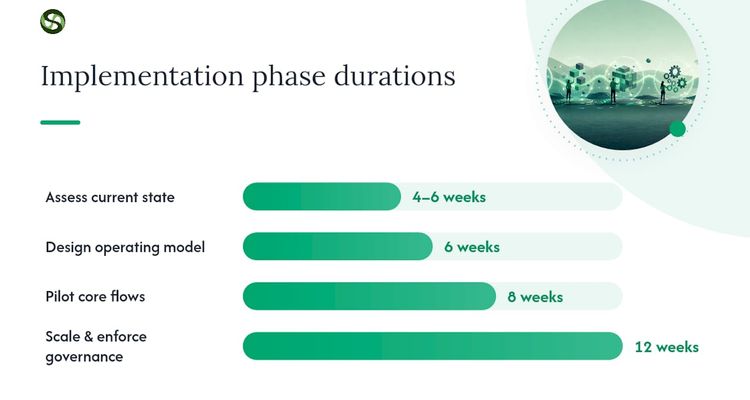
Implementation follows five phases. The timeline varies by organization size, but the sequence is consistent.
| Phase | Key Milestones | Typical Duration |
|---|---|---|
| 1. Assess current state | Vendor master audit, duplicate count, policy gap analysis | 4–6 weeks |
| 2. Design operating model | Policy draft, role matrix, approval thresholds, VMS selection | 6 weeks |
| 3. Pilot core flows | Onboarding workflow, ERP integration, supplier portal for one category | 8 weeks |
| 4. Scale and enforce governance | Full rollout, training, deactivate shadow processes | 12 weeks |
| 5. Continuous improvement | Quarterly KPI reviews, annual policy refresh, master data cleanup | Ongoing |
Cost considerations:
- Tooling — VMS licensing ranges from departmental SaaS subscriptions to enterprise platform contracts. Scope to your vendor volume and integration requirements.
- Integration — ERP and AP integration is typically the largest cost item. Budget for both initial build and ongoing maintenance.
- VMO staffing — a mid-market organization typically needs 1–2 dedicated vendor management staff at launch; enterprise programs need more.
- Change management — training, communication, and process documentation are often underbudgeted. Plan for at least one full-time equivalent during rollout.
Renewal alert strategy should be designed during Phase 2, not retrofitted after go-live. Alert timing, escalation paths, and stakeholder assignments need to align with your internal approval windows before the first contract renewal cycle runs through the new system.
Disconnected point tools fail to make lifecycle decisions at scale. The implementation roadmap should prioritize integrations that connect onboarding, performance, risk, and contract actions into one continuous workflow rather than stitching together separate systems with manual handoffs.
Pro Tip: Frame the VMS as an operating expense, not a capital project, if your organization’s budget process allows it. SaaS subscriptions are easier to approve incrementally, and rebate income from supplier enablement to electronic payment rails can offset a meaningful portion of the annual cost once the program matures.
How deadline tracking strengthens centralized vendor management
The weakest link in most centralized programs is not the onboarding workflow or the governance model. It is what happens between contract execution and renewal. Contracts sit in a repository, certificates expire quietly, and the first signal that something lapsed is a service disruption or an audit finding.
A deadline-driven tracking layer closes that gap. The workflow looks like this: contract stored in the repository → renewal date detected → automated multi-channel alerts fire at 90, 60, and 30 days → escalation triggers if no action is taken → task assigned to the responsible owner with a documented completion record.
Operational outcomes from that structure:
- Fewer missed renewals and the auto-renewal traps that come with them
- Cleaner vendor master data because expired certificates trigger deactivation workflows
- Better audit trails because every alert, escalation, and task completion is timestamped
- Fewer service interruptions because the team acts before expiry, not after
Expiryedge is built specifically for this layer. It tracks contract renewals, vendor certifications, insurance certificates, licenses, and compliance obligations from a centralized platform, with automated reminders delivered through email, SMS, and in-app channels. Escalation rules fire when a deadline approaches without a confirmed action, and every step generates an audit trail.
Pro Tip: Configure your renewal alerts to fire at least 30 days before your internal approval window closes, not 30 days before the contract expires. If your procurement review takes three weeks, a 30-day alert is already too late. Build the lead time into the alert schedule, not the response process.
Deadline prevention systems work by detecting upcoming dates, triggering workflows, and escalating until the action is confirmed. That loop is what separates proactive vendor management from reactive firefighting.
What successful centralization actually looks like day to day
The operational difference between a centralized and a decentralized program shows up in the small things, not the big ones.
Before centralization: a business unit manager emails AP to add a new vendor, AP creates a record from the email, the contract lives in someone’s inbox, and the renewal date exists only in the account manager’s memory.
After centralization: the business unit submits a vendor request through the portal, the VMO reviews it against the preferred supplier list, AP creates the record only after dual approval, the contract is stored with a renewal date that triggers alerts 90 days out, and the procurement owner gets a task to review terms before the window closes.
Cultural and operational signals that the program is working:
- Business units stop maintaining their own vendor spreadsheets
- AP exception queues shrink because onboarding documentation is complete at setup
- Audit prep takes hours instead of days because the trail is already documented
- Procurement leaders can answer “how many active vendors do we have in this category?” without running a report
Pro Tip: Schedule a quarterly vendor master cleanup and a yearly policy review on the calendar before the program launches. Both will slip without a fixed date. The cleanup catches deactivated vendors still sitting as active records; the policy review catches job title changes that break your segregation-of-duties controls.
Expiryedge keeps your vendor deadlines from slipping through the cracks
Most centralized vendor programs are well-designed on paper and leaky in practice. The gap is almost always the same: no one owns the space between contract execution and renewal, and manual tracking does not scale past a few dozen vendors.
Expiryedge fills that gap directly. The platform tracks contract renewals, vendor certifications, insurance certificates, compliance obligations, and licenses from a single dashboard, with automated reminders delivered through email, SMS, and in-app alerts. Escalation rules fire when a deadline approaches without a confirmed response. Every alert, task assignment, and completion is logged in an audit trail that procurement and compliance teams can pull for any review.
For operations and procurement teams managing vendor programs at scale, Expiryedge reduces the administrative overhead of certificate and renewal tracking, improves renewal rates, and gives auditors a clean timestamped record of every action taken. No missed renewals. No scrambling when an auditor asks for documentation.
Start a free trial at Expiryedge and see how deadline-driven tracking fits into your centralized vendor program.
Sources
The following sources informed this article and offer additional depth for teams building or improving a centralized vendor management program:
- Vendor Management Best Practices for AP Teams: The Lifecycle, Controls, and Tools for 2026 | Corpay
- What Is a Vendor Management System? | SAP
- Vendor Management Solution: Definition and 2026 Guide | Ivalua
- Centralizing Vendor Management: What Does the Team …
- Mastering vendor management for business success — JPMorgan
FAQ
How does a vendor management system work?
A VMS digitizes vendor profiles, automates onboarding and compliance workflows, integrates performance and risk signals, and delivers reporting that supports sourcing and contract decisions. It replaces manual, email-based processes with governed, auditable workflows connected to ERP and AP systems.
What is an example of centralized vendor management?
A company with multiple offices consolidates all vendor records into a single ERP-linked master, routes every new vendor request through a VMO approval workflow, and uses automated alerts to manage contract renewals across all locations from one dashboard.
What are the disadvantages of centralized procurement?
The main risks are bottlenecks when the central team is understaffed, change management friction as business units adjust to new approval processes, and up-front integration costs for connecting the VMS to ERP and AP systems.
What are the four stages of vendor management?
The core stages are onboarding and due diligence, contracting and vendor master setup, ongoing performance and payment management, and renewal or offboarding. AP typically owns the post-contract stages, while procurement owns sourcing and contracting.
How does Expiryedge support centralized vendor management?
Expiryedge tracks contract renewals, vendor certifications, insurance certificates, and compliance obligations from a centralized platform, with automated multi-channel alerts, escalation workflows, and audit trails that keep procurement and operations teams ahead of every critical deadline.
Recommended
Frequently asked questions
A company with multiple offices consolidates all vendor records into a single ERP-linked master, routes every new vendor request through a VMO approval workflow, and uses automated alerts to manage contract renewals across all locations from one dashboard.
The main risks are bottlenecks when the central team is understaffed, change management friction as business units adjust to new approval processes, and up-front integration costs for connecting the VMS to ERP and AP systems.
The core stages are onboarding and due diligence, contracting and vendor master setup, ongoing performance and payment management, and renewal or offboarding. AP typically owns the post-contract stages, while procurement owns sourcing and contracting.
Expiryedge tracks contract renewals, vendor certifications, insurance certificates, and compliance obligations from a centralized platform, with automated multi-channel alerts, escalation workflows, and audit trails that keep procurement and operations teams ahead of every critical deadline.