
Expiration Date Management: A Guide for Ops Teams

Expiration Date Management: A Guide for Ops Teams

TL;DR:
Expiration date management involves tracking product expiry dates to reduce waste and ensure compliance. It relies on batch-level tracking, automated FEFO rotation, and tiered alert thresholds for proactive handling. Centralized platforms with real-time alerts and audit trails improve accuracy and help teams act before products expire.
Expiration date management is defined as the systematic process of tracking, organizing, and acting on product expiration dates to minimize waste, maintain compliance, and protect operational margins. Known in regulated industries as shelf-life management, this discipline covers everything from batch-level inventory tracking to automated alert workflows and regulatory audit trails. Poor expiry management costs grocery retailers alone about $90 billion annually. That figure reflects only one sector. For operations and compliance professionals in pharmaceuticals, food service, medical devices, and logistics, the stakes are equally high. Core techniques like FEFO (First Expired, First Out) and batch-level lot tracking form the foundation of any effective expiration date control program.
What is expiration date management and why does it matter?
Expiration date management is the practice of recording, monitoring, and acting on the expiry dates assigned to every product batch or lot in your inventory. The industry term “shelf-life management” is often used interchangeably, particularly in regulated sectors like food, pharma, and medical devices. Both terms describe the same core discipline: knowing exactly when each unit expires and taking the right action before that date arrives.
The operational importance is direct. A missed expiry date can mean a regulatory violation, a product recall, a customer health incident, or a write-off that hits your margin. Shelf-life management is a risk-mitigation discipline that protects brand integrity and prevents financial and health risks from expired goods. That framing matters because it shifts the conversation from “inventory housekeeping” to a core compliance function.
Regulated industries add another layer of urgency. The FDA, FSMA, and equivalent health department standards require documented batch histories and audit trails. Without a structured expiration management process, your team cannot produce those records on demand. That gap creates compliance exposure that no spreadsheet can reliably close at scale.
What are the core components of expiration date management?
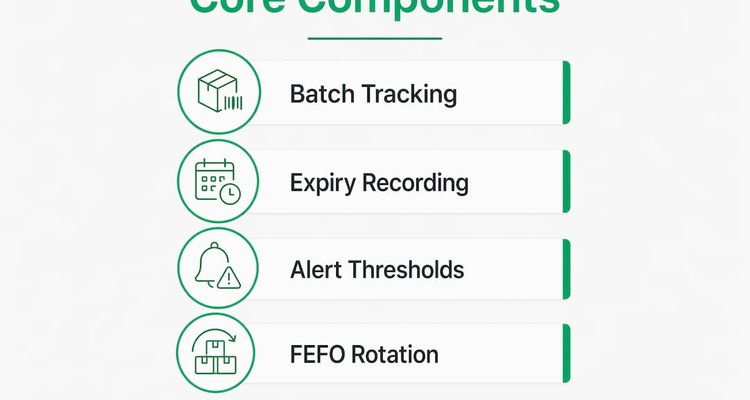
Effective expiration date management runs on four interconnected components: batch and lot tracking, expiry date recording, stock rotation rules, and alert thresholds. Each one feeds the next. Skip any component and the whole system develops blind spots.
Batch and lot tracking
Batch-level tracking is the foundation because SKUs frequently arrive in multiple lots with different expiry dates. Product-level tracking alone is ineffective. If you receive three pallets of the same SKU on the same day but from different production runs, each pallet may carry a different expiration date. Your system must record and act on those differences individually.

Every batch receives a unique lot number at the point of receipt. That number links the physical product to its recorded manufacturing date, expiry date, supplier, and quantity. This linkage is what makes recalls traceable and audits passable.
Recording expiry dates at receipt
The expiry date must be captured at the moment goods arrive, not retroactively. Operations teams that log expiry dates days or weeks after receipt introduce errors that compound downstream. The correct workflow records the lot number, manufacturing date, and expiry date simultaneously during goods receipt, before the stock enters any picking location.
Setting alert thresholds
Alert thresholds define when your team receives a warning before a product expires. FEFO best practices recommend a tiered approach: 90/60/30-day notifications for long-life items and 30/14/7-day notifications for fresh goods. Each threshold triggers a different response. A 90-day alert might prompt a promotional push. A 7-day alert demands immediate action such as markdown, transfer, or disposal.
- Record lot number, manufacturing date, and expiry date at goods receipt
- Assign unique batch identifiers to every incoming shipment
- Configure alert thresholds by product category (long-life vs. fresh)
- Schedule routine physical audits of near-expiry stock locations
- Document all disposal, markdown, and return actions at the batch level
Pro Tip: Set your first alert threshold earlier than you think you need. Teams that trigger at 90 days for long-life products consistently recover more value through promotions than teams that first notice expiry risk at 30 days.
Why does FEFO outperform FIFO for expiration control?
FIFO (First In, First Out) and FEFO (First Expired, First Out) are both stock rotation methods, but they solve different problems. FIFO moves the oldest received inventory first. FEFO moves the inventory with the earliest expiry date first. The distinction matters enormously when batches of the same SKU carry different shelf lives.
FIFO rules prioritize inventory by receipt date, but they often misalign with the earliest expiry date in complex supply chains. A batch received last week may expire before a batch received last month if the supplier changed production runs. FIFO would pick the older receipt first, leaving the shorter-dated batch to expire unnoticed.
| Criterion | FIFO | FEFO |
|---|---|---|
| Rotation basis | Date of receipt | Expiration date |
| Risk in mixed batches | High spoilage risk | Low spoilage risk |
| Compliance suitability | Limited for regulated goods | Required for pharma, food, medical |
| Automation dependency | Low | High |
| Recommended for perishables | No | Yes |
FEFO is the gold standard for any operation handling perishable or regulated products. The catch is that FEFO only works reliably when your system enforces it automatically. Manual batch selection undermines FEFO because pickers default to physical convenience rather than expiry order. True FEFO requires the system to direct each pick to the correct batch without human judgment in the loop.
Pro Tip: Audit your pick confirmations monthly. If pickers are overriding system-suggested batches, your FEFO enforcement has a gap. That gap is where expiry losses accumulate silently.
What technology features support expiration date compliance?
The right technology turns expiration date management from a reactive cleanup task into a proactive daily workflow. The core features your platform needs are batch and lot entry fields, expiry date recording at receipt, configurable alert thresholds, POS expiry blocking, and audit trail generation.
Spreadsheets and manual calendars become liabilities at scale. They cannot enforce FEFO automatically, cannot generate real-time alerts across multiple locations, and cannot produce the batch histories that FDA and FSMA audits require. Centralized platforms with real-time alerts and audit capabilities are the recommended standard for accuracy and continuity.
The POS expiry block is a feature that compliance teams often underestimate. A hard POS block prevents the sale of expired stock at the point of transaction, with a manager override option and a logged audit trail for every exception. That log is your evidence of due diligence if a regulator asks why an expired unit was sold or why it was not.
Key technology features for expiration date compliance:
- Batch and lot number fields linked to each inventory receipt
- Expiry date entry with automatic FEFO pick sequencing
- Configurable alert thresholds by product category and location
- POS expiry block with manager override and exception logging
- Audit trail export for FDA, FSMA, and health department reviews
- Integration with deadline escalation workflows for compliance teams
Regulated industries require regular audits within six months before expiry and comprehensive batch histories for compliance. Your platform must generate those records automatically, not on request after the fact. For teams managing structured data and traceability requirements, tools that support record-keeping standards can complement your compliance documentation process.
How do operations teams manage near-expiry stock proactively?
Near-expiry management should be a daily operational task, not a monthly cleanup. The teams that recover the most value from expiring inventory treat each alert threshold as a trigger for a specific, pre-planned action. Reactive teams discover expired stock during physical counts. Proactive teams have already moved, discounted, or returned it.
A structured near-expiry workflow runs in stages:
- 90-day alert (long-life items): Flag the batch for promotional planning. Brief the sales or marketing team on available volume and pricing flexibility.
- 60-day alert: Activate markdown pricing or bundle the near-expiry product with a faster-moving SKU. Notify the supplier if your contract includes return windows at this stage.
- 30-day alert: Escalate to operations leadership. Initiate supplier return claims if applicable. Consider donation to compliant charitable channels where regulations permit.
- 7-day alert (fresh goods): Execute immediate markdown, transfer to a high-velocity location, or begin disposal documentation. No further delay is acceptable.
- Post-expiry: Complete write-off documentation at the batch level. Record disposal method, quantity, and responsible party. Retain records for the audit window required by your regulatory body.
Successful expiration management treats near-expiry stock as an active workflow with multi-stage alerts and automated markdowns or reallocations. The difference between a team that recovers 60% of near-expiry value and one that writes off 80% is almost always process discipline at the 90-day and 60-day stages.
Pro Tip: Build supplier return clauses into your procurement contracts before you need them. Negotiating a return window after a batch is already near expiry gives you almost no leverage. Negotiate it at the purchase order stage.
The discipline most operations teams underestimate
Expiration date management looks simple on paper. Record the date, set a reminder, act before the deadline. The reality is that most operational failures happen not because teams lack awareness but because they rely on manual processes that break down under volume and complexity.
I have seen well-run warehouses lose significant margin to expiry waste not because they lacked a system but because their system tracked at the product level instead of the batch level. One SKU, three batches, three different expiry dates. The system showed “in stock” and the team assumed “safe to sell.” That assumption is where the loss lives.
The other consistent failure point is FIFO inertia. Teams that have used FIFO for years resist switching to FEFO because the change requires system reconfiguration and retraining. But FIFO in a mixed-batch environment is not a conservative choice. It is an active source of expiry risk that compounds with every new supplier relationship and every new product line.
The fix is not complicated. It requires batch-level tracking, automated FEFO enforcement, tiered alert thresholds, and a daily near-expiry review built into your operations cadence. None of those elements are technically difficult. The difficulty is organizational: making expiry management a standing workflow rather than a periodic response to a problem that has already materialized.
— Kuldeep
How Expiryedge helps teams stay ahead of expiration deadlines
Expiration date management works best when the tracking, alerting, and escalation happen automatically rather than through manual calendar checks or spreadsheet reviews.

Expiryedge is built specifically for deadline-driven work. Teams use it to track contract renewals, compliance obligations, certifications, licenses, and product expiration dates from a single platform. Automated multi-channel alerts, configurable reminder windows, and escalation workflows mean your team acts before a deadline arrives rather than after it passes. Audit trails are generated automatically, giving compliance teams the documentation they need without manual assembly. Start tracking expiration deadlines with Expiryedge and replace reactive cleanup with a proactive, auditable process your regulators will accept.
FAQ
What is expiration date management?
Expiration date management is the systematic process of recording, monitoring, and acting on product expiry dates to reduce waste, maintain compliance, and protect operational margins. It includes batch tracking, stock rotation rules like FEFO, alert thresholds, and audit trail documentation.
Why is batch-level tracking required for expiry management?
The same SKU often arrives in multiple batches with different expiry dates, making product-level tracking unreliable. Batch-level tracking ensures each lot is managed individually so FEFO rotation and recall traceability are accurate.
What is the difference between FIFO and FEFO?
FIFO rotates stock by receipt date; FEFO rotates by expiration date. FEFO is the required standard for perishable and regulated products because it prevents earlier-expiring batches from being overlooked when receipt dates and expiry dates do not align.
How often should near-expiry stock be audited?
Regulated industries require audits within six months before expiry as a minimum. Operations best practice calls for a daily near-expiry review triggered by automated alert thresholds, not a scheduled monthly count.
When do spreadsheets become inadequate for expiration tracking?
Manual methods work only for small, early-stage operations. As product variety, batch complexity, and regulatory requirements grow, centralized platforms with real-time alerts and automated audit trails become necessary for reliability and compliance.
Key takeaways
Effective expiration date management requires batch-level tracking, automated FEFO enforcement, tiered alert thresholds, and daily near-expiry workflows to protect compliance and recover inventory value before deadlines arrive.
| Point | Details |
|---|---|
| Batch tracking is non-negotiable | Track every lot individually because the same SKU can carry multiple expiry dates across batches. |
| FEFO beats FIFO for perishables | FEFO prevents earlier-expiring batches from being skipped; FIFO creates silent expiry risk in mixed-batch environments. |
| Tiered alerts drive proactive action | Set 90/60/30-day thresholds for long-life items and 30/14/7-day thresholds for fresh goods to trigger staged responses. |
| Automation enforces what humans miss | Manual batch selection undermines FEFO; system-driven pick sequencing is required for reliable compliance. |
| Near-expiry review is a daily task | Teams that treat near-expiry management as a standing daily workflow recover significantly more value than reactive teams. |
Recommended
Frequently asked questions
The same SKU often arrives in multiple batches with different expiry dates, making product-level tracking unreliable. Batch-level tracking ensures each lot is managed individually so FEFO rotation and recall traceability are accurate.
FIFO rotates stock by receipt date; FEFO rotates by expiration date. FEFO is the required standard for perishable and regulated products because it prevents earlier-expiring batches from being overlooked when receipt dates and expiry dates do not align.
Regulated industries require audits within six months before expiry as a minimum. Operations best practice calls for a daily near-expiry review triggered by automated alert thresholds, not a scheduled monthly count.
Manual methods work only for small, early-stage operations. As product variety, batch complexity, and regulatory requirements grow, centralized platforms with real-time alerts and automated audit trails become necessary for reliability and compliance.