
What Is Contract Renewal Management: A 2026 Guide

What Is Contract Renewal Management: A 2026 Guide

Contract renewal management is the structured process organizations use to monitor, evaluate, and execute contract renewals before expiration dates arrive. Without it, up to 9% of annual revenue leaks away through missed obligations and unfavorable auto-renewals. The formal industry term is contract lifecycle management, and renewal management sits at its most financially exposed phase. Tools like Expiryedge and platforms like ZiaSign exist specifically because this phase fails most often when left to manual tracking. Getting it right protects revenue, reduces compliance risk, and keeps vendor and customer relationships intact.
What is contract renewal management and how does it work?
Contract renewal management is the end-to-end process of tracking contract expiration dates, assessing performance, negotiating updated terms, and confirming continuation or termination. It covers every contract type, from SaaS subscriptions and vendor agreements to insurance policies and employee certifications. Renewal processes include tracking deadlines, managing communications, evaluating terms, negotiating changes, and confirming continuation. Each phase requires coordination across legal, finance, and operations teams.

The process begins long before a contract expires. Waiting until the final weeks removes all negotiating leverage and forces rushed decisions. A well-run renewal process treats each contract as a recurring business decision, not a paperwork formality. That shift in thinking is what separates organizations that protect revenue from those that lose it quietly.
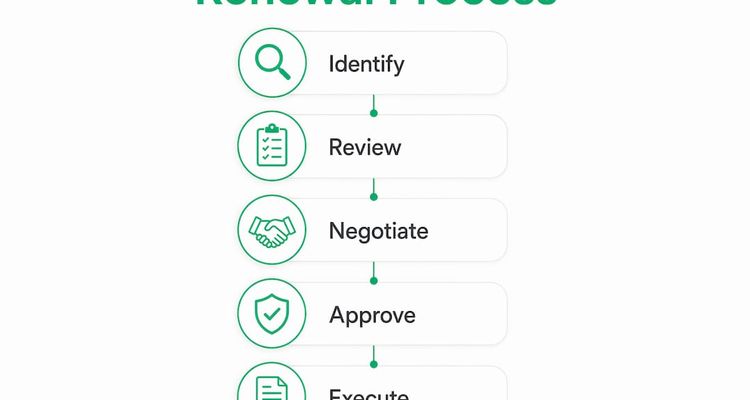
The five core steps in contract renewal management
- Centralize contract data. Store all contracts, metadata, and renewal dates in one system. Scattered spreadsheets create blind spots that cost money.
- Identify renewal dates and auto-renewal clauses. Flag contracts that renew automatically without action. These are the highest-risk items in any portfolio.
- Assess performance and risk. Review KPIs, SLA compliance, usage data, and vendor performance before deciding to renew, renegotiate, or exit.
- Route approvals and communicate. Send renewal notices to counterparties and route internal approvals through legal, finance, and business owners on a defined schedule.
- Execute and confirm. Process amendments, collect signatures, confirm payment terms, and document the completed renewal for audit purposes.
Pro Tip: Start renewal reviews 120 to 180 days before expiration. That window gives your team enough time to gather usage data, negotiate terms, and route approvals without pressure.
What does renewal management maturity mean?
Renewal management maturity describes how far an organization has progressed from reactive, calendar-based renewal handling toward proactive, data-driven, and automated workflows. Most organizations start at the lowest maturity level, where someone checks a spreadsheet and sends a reminder email a few weeks before a contract expires. That approach fails regularly.
The maturity progression looks like this:
- Level 1 (Reactive): Renewals are handled when someone notices an upcoming date. No system, no ownership, no audit trail.
- Level 2 (Calendar-driven): Teams use shared calendars or spreadsheets to track dates. Ownership is informal, and reminders are manual.
- Level 3 (System-driven): A dedicated platform tracks contracts, sends automated alerts, assigns ownership, and logs every action.
- Level 4 (Data-integrated): Renewal decisions incorporate usage metrics, health scores, and risk signals. The system triggers interventions based on contract data, not just dates.
The biggest shift in renewal management is from date-based reactions to integrated systems that trigger actions based on contract data and usage health. That shift produces measurable results. Automated workflows integrating data and risk models increase retention rates to 95% or higher. Acquiring a new customer costs 5 to 7 times more than retaining an existing one, so every missed renewal is far more expensive than it appears on a single invoice.
Organizations at higher maturity levels also detect at-risk contracts early enough to run save plays, meaning targeted outreach or renegotiation before a customer or vendor decides to exit.
What is contract renewal risk and how can you reduce it?
Contract renewal risk is the financial, legal, operational, or security exposure that results from poor renewal management. The risks fall into four distinct categories, and each one has a direct cost.
| Risk Category | Description | Mitigation |
|---|---|---|
| Revenue leakage | Missed renewals or unfavorable auto-renewals erode margins | Automated alerts with 120-day lead time |
| Compliance failure | Missing documentation creates audit gaps | Documented workflows with full audit trails |
| Security exposure | Unmanaged access persists after contracts end | Link renewals to access and permission reviews |
| Operational disruption | Expired vendor contracts interrupt services | Centralized tracking with ownership assignment |
Renewal management is a governance control linking renewal decisions to ownership, usage, and security risk, not just invoice dates. That framing matters. When a SaaS contract renews automatically, the software licenses, user permissions, and API credentials often continue without review. Non-human identities and dormant accounts accumulate, creating security vulnerabilities that auditors flag and attackers exploit.
Pro Tip: Treat every auto-renewal clause as a governance checkpoint. Before the renewal executes, confirm that the contract still reflects active usage and that access permissions align with current business need.
Manual renewal tracking via spreadsheets risks single points of failure and creates compliance gaps that automated platforms eliminate through documented audit trails. A single missed renewal in a regulated industry can trigger penalties that dwarf the contract’s annual value.
How can technology improve the contract renewal process?
Renewal management software transforms the process from a manual calendar exercise into an auditable, automated workflow. The difference is not just convenience. It is accuracy, accountability, and proof.
The core features of a purpose-built renewal management system include:
- Centralized contract repository with metadata, renewal dates, and ownership records
- Automated multi-channel alerts sent to contract owners, legal teams, and approvers at defined intervals
- Approval routing that moves renewal decisions through the right stakeholders without manual follow-up
- E-signature integration for executing amendments and renewals without printing or scanning
- Audit trail documentation that records every action, timestamp, and decision for compliance purposes
Renewal management systems centralize contract data, automate alerts, enforce ownership, and provide proof of compliance with documented workflows. That last point matters most in regulated industries where auditors require evidence that renewals were reviewed and approved, not just executed.
SaaS renewals present unique challenges like usage-based pricing and multi-year agreements that require distinct workflows. A monthly SaaS subscription and a three-year enterprise software agreement need different approval chains, different lead times, and different performance metrics. A capable renewal management system handles both without requiring separate processes.
The distinction between a renewal management system and full contract lifecycle management software is worth understanding. Full CLM platforms manage the entire contract from drafting through execution and renewal. Renewal management systems focus specifically on the expiration and renewal phase. For organizations that already have contracts in place and need to manage their renewal cycles, a focused renewal management tool often delivers faster results than a full CLM implementation.
Pro Tip: When evaluating renewal management tools, prioritize audit trail depth over feature count. The ability to prove that a renewal was reviewed, approved, and executed correctly is worth more than any dashboard feature.
Key Takeaways
Effective contract renewal management protects revenue, reduces compliance risk, and requires automated systems that connect renewal decisions to usage data, ownership, and security governance.
| Point | Details |
|---|---|
| Start early | Begin renewal reviews 120 to 180 days before expiration to preserve negotiating leverage. |
| Automate tracking | Manual spreadsheets create compliance gaps; dedicated systems provide audit trails and accountability. |
| Assess risk, not just dates | Link renewal decisions to usage data, health scores, and security access reviews. |
| Maturity drives retention | Organizations with data-integrated renewal workflows achieve significantly higher retention rates. |
| Governance matters | Treat renewals as lifecycle governance controls, not administrative tasks. |
Why most renewal failures are self-inflicted
The organizations I see struggle most with contract renewals share one trait: they treat renewal management as a calendar problem. They set a reminder, send an email, and hope the right person acts in time. That approach works until it doesn’t, and when it fails, the cost is rarely just one missed contract.
The 120-to-180-day review window is not arbitrary. It reflects the actual time required to pull usage data, assess vendor performance, route approvals through legal and finance, negotiate amended terms, and collect signatures. Compressing that into two weeks means skipping steps, and skipped steps become audit findings or revenue losses.
The security dimension of renewal management is the most underappreciated risk I encounter. When a SaaS contract renews without a usage review, dormant accounts and excess permissions persist. Treating renewal date tracking purely as a calendar problem misses the broader dependency management challenge, including security credentials and platform permissions audits. That is not a theoretical risk. It is a pattern that shows up in security audits and breach post-mortems.
The organizations that get this right build renewal management into their operational rhythm. They assign clear ownership, run structured reviews, and use systems that document every decision. They do not rely on one person’s memory or one spreadsheet that only they can read. The infrastructure investment is modest. The payoff in predictable revenue and clean audits is substantial.
— Kuldeep
How Expiryedge helps you manage contract renewals
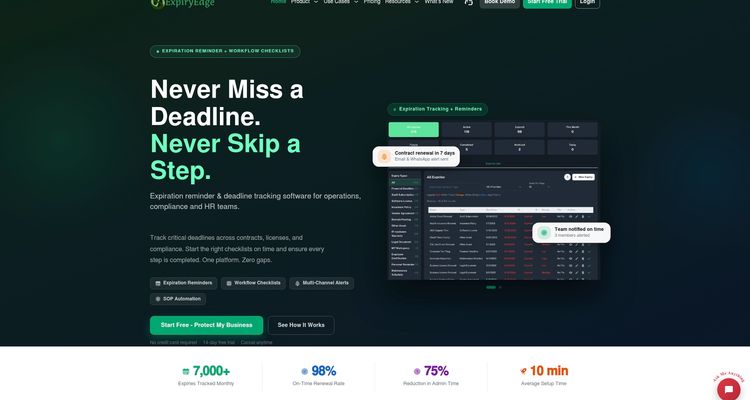
Expiryedge is built specifically for organizations that need to stay ahead of contract expirations, renewals, and compliance deadlines without building manual tracking systems. The platform centralizes contracts, licenses, certifications, and vendor agreements in one place, assigns clear ownership, and sends automated multi-channel alerts well before deadlines arrive.
Every renewal action in Expiryedge is logged with timestamps and documented workflows, giving compliance and legal teams the audit trail documentation they need without extra administrative work. Whether you manage SaaS subscriptions, insurance policies, or regulatory certifications, Expiryedge handles the tracking and escalation so your team focuses on decisions, not deadline chasing.
FAQ
What is contract renewal management?
Contract renewal management is the process of tracking, evaluating, and executing contract renewals before expiration dates. It covers deadline monitoring, performance assessment, approval workflows, and documentation.
When should a contract renewal review start?
Renewal reviews should start 120 to 180 days before the contract expiration date. That window provides enough time for performance assessment, negotiation, and internal approvals.
What is contract renewal risk?
Contract renewal risk is the financial, legal, operational, or security exposure that results from unmanaged or poorly tracked renewals. Risks include revenue leakage, compliance failures, and unreviewed access permissions.
What does renewal management maturity mean?
Renewal management maturity describes how far an organization has progressed from reactive, manual renewal tracking to automated, data-integrated workflows that connect renewal decisions to usage and risk data.
How does renewal management software differ from full CLM platforms?
Renewal management software focuses on the expiration and renewal phase of the contract lifecycle. Full contract lifecycle management platforms cover drafting, execution, and renewal in one system, but require more implementation time and cost.
Recommended
Article generated by BabyLoveGrowth
Not legal advice
This article is for general informational purposes and does not constitute legal advice. Laws, regulations and contract requirements vary by jurisdiction and change over time. Consult a qualified attorney in your jurisdiction before making decisions that depend on the specific legal interpretation discussed here.