
Best Tenant COI Tracking Software for Landlords and Property Managers (2026)

For a commercial portfolio with dozens of tenants, Jones is the most complete tenant COI tracker: tenants upload without logging in, AI and insurance specialists review each certificate against the lease, and it syncs with Yardi and MRI. For a smaller landlord or property manager who wants tenant certificates tracked next to leases, inspections and building certificates at a price you can see, ExpiryEdge is the better fit.
BCS is the strongest at lease-by-lease requirements. Yardi TenantShield makes sense if you already run Yardi Voyager. illumend, PINS Advantage and TrustLayer come at the job from vendor and construction compliance.
We make ExpiryEdge. Every other claim below is from the vendor's own site or help centre, checked on 30 October 2026, and linked.
Tenant COI trackers compared
| Tool | Built around tenants? | Lease-specific requirements | PMS integrations | Published pricing |
|---|---|---|---|---|
| Jones | Yes, tenants and vendors | Lease-aligned rules, lease extraction | Yardi, MRI, Prism | No, per record per year |
| ExpiryEdge | Tenants, vendors and the building's own dates | Set per request and reviewed by your team | No PMS sync; CSV import | $29 to $199 a month |
| BCS | Yes, lease is a billing unit | Per lease, deviations flagged | Yardi, MRI | Software from $0.95 per vendor a month |
| Yardi TenantShield | Yes, commercial tenants | Custom rules, built with you on Full Service | Voyager | No |
| illumend (myCOI) | Partly | Checks against lease or contract | Yardi Voyager | No |
| PINS Advantage | Tenants, vendors and subs | AI reads against your requirements | None listed for PMS | From about $300 a month |
| TrustLayer | Mostly vendors | Not stated | Yardi (vendors only) | Free to 50 vendors |
What a tenant COI tracker has to get right
The lease is the rulebook. It sets the limits, names who must be an additional insured, asks for a waiver of subrogation and often requires notice before cancellation. A tracker has to hold those terms per lease, because anchor tenants and kiosks rarely sign the same clause.
The certificate is weaker evidence than most leasing teams assume. ACORD's certificates FAQ says a certificate doesn't provide, amend or extend the policy. A 2013 Seyfarth Shaw legal update makes the related point that being the certificate holder doesn't make the landlord an additional insured.
That's why the endorsement matters. For landlords, the usual ISO form is CG 20 11, additional insured for managers or lessors of premises, which IRMI covers in Landlord as an Insured.
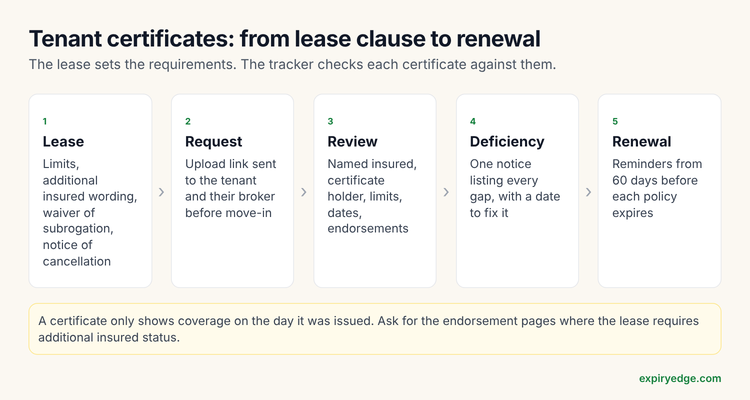 The five steps every tenant certificate goes through
1. Jones: best all-round tenant COI service
Jones verifies insurance for both tenants and vendors, and its property management page says no login is needed for either. It describes lease-aligned compliance and per-property tenant requirements, and its AI review is validated by people with a stated 24-hour turnaround.
When something's missing, Jones sends a gaps email explaining each deficiency. Integrations include Yardi Voyager, MRI and Prism by Building Engines, and the MRI integration shows tenant compliance status and expiry dates inside MRI.
Pricing: per record per year, quoted by sales, with integrations as an optional add-on, per the pricing page.
Watch out for: AppFolio isn't on the integration list, and you won't know the price until you talk to sales.
2. ExpiryEdge: best for smaller portfolios that track more than insurance
ExpiryEdge sends each tenant (or their broker) a request link. They upload the certificate and endorsement pages, answer any fields you add, such as policy number or carrier, and sign an acknowledgement if you need one. No account, no login. The link follows up on its own until it's complete.
Your property manager reviews each field and approves it or rejects it with a comment. A rejected field reopens the same link, so the tenant fixes only what was wrong. The policy dates become reminders, sent by email, SMS or WhatsApp to the tenant and by Slack or Teams to your team, with escalation if a renewal goes overdue.
The same tracker holds the building's own dates: the lease break and renewal options, fire risk assessments, lift inspections, boiler certificates. For a landlord with a few buildings and no compliance department, that's often the bigger win.
Pricing: published on the pricing page. Plans are $29, $49, $99 or $199 a month by number of tracked records, with a 14-day free trial and no credit card.
Watch out for: ExpiryEdge doesn't sync with Yardi or MRI, and it doesn't read the lease for you. Someone sets the requirements on each request, and someone checks the CG 20 11 wording.
3. BCS: best for lease-by-lease requirements
BCS (Business Credentialing Services) treats each lease as its own account. Its help article on agreement-specific requirements explains that each lease can carry its own insurance terms, and any deviation from the standard category is flagged. Certificate holder and additional insured names can be set per location.
The real estate page lists Yardi and MRI integrations plus lease abstraction. BCS sells self-service software and a full-service plan where its team does the review.
Pricing: published. The pricing page shows software free for up to 25 vendors, then $0.95 per vendor a month, and full service from $17.80 per vendor a year with a $10,000 annual minimum.
Watch out for: a tenant tracked at several locations counts as several accounts, per BCS's billing explainer.
4. Yardi TenantShield: best if you run Yardi Voyager
TenantShield is Yardi's own commercial tenant insurance product. According to its product page, tenants upload through the CommercialCafe tenant portal, non-responsive tenants get up to three automated reminders, and non-compliant tenants receive correction guidance. It also runs tenant screening against watch lists.
You can self-serve, or choose Full Service, where Yardi's compliance team runs the process and builds your checklist with you during set-up.
Pricing: not published.
Watch out for: it's built around Voyager and CommercialCafe. If you don't use Yardi, it's not your tool.
5. illumend (from myCOI): best for AI review across tenants and vendors
illumend is myCOI's AI-first product, launched in May 2025. Its AI assistant, Lumie, checks coverage against your lease or contract requirements, reads additional insured, waiver of subrogation and primary wording, and contacts the tenant with the exact requirement that's missing, per illumend.ai.
It integrates with Yardi Voyager, and commercial real estate is one of its listed industries.
Watch out for: most of its material is aimed at vendor and construction compliance. Ask to see a tenant workflow in the demo.
6. PINS Advantage: best self-service option with a price range
PINS Advantage supports workflows for subcontractors, vendors and tenants, and its homepage says AI reads every COI and endorsement against your requirements. Your team makes every approval decision; there's no done-for-you review.
Pricing: the pricing page says plans start around $300 a month and most annual contracts come in at $7,500 or less, based on the number of COIs tracked, with unlimited users.
Watch out for: no property management system integrations are listed, only Procore and Vista on the construction side.
7. TrustLayer: best free trial run for a short vendor list
TrustLayer's real estate page promises to verify tenants and vendors, and its Starter plan is free for up to 50 vendors, per the plans page.
Watch out for: its Yardi integration imports vendor records, not tenants. For a tenant-heavy portfolio, one of the tools above fits better.
ℹ️Also worth a look: CertFocus from [Vertikal RMS](https://www.vertikalrms.com/solutions/certfocus-coi-compliance-tracking/){nf} tracks tenants as well as suppliers, with full-service or self-service options. If your buildings run on Prism by Building Engines, its insurance module tracks tenant and vendor COIs inside the platform.
How to pick for your portfolio
Start with the system your leases live in. Yardi shops should price TenantShield and the Yardi-integrated trackers (Jones, BCS, illumend). MRI shops should look at Jones and BCS first.
Next, decide who does the review. If nobody in your team can read a CG 20 11 endorsement with confidence, pay for a service that does (Jones, BCS full service or TenantShield Full Service). If your property managers can, self-service tools cost far less.
Last, count what else needs tracking. A landlord with 15 tenants and four buildings usually has more building certificates than tenant policies, and one tracker for all of it beats two half-used systems. Our guide to the best way to track tenant COIs sets out the process step by step, and our COI tracking software page shows how ExpiryEdge handles it.
Frequently asked questions
No. The certificate holder box only says who gets a copy of the certificate. Additional insured status comes from an endorsement on the tenant's policy, typically ISO form CG 20 11 for landlords, so ask for the endorsement page itself.
BCS software starts free for 25 vendors, then $0.95 per vendor a month. PINS Advantage starts around $300 a month. ExpiryEdge runs $29 to $199 a month. Jones, TenantShield and illumend quote on request.
Yes, a few do. Jones, BCS and illumend connect to Yardi. Jones and BCS also connect to MRI, and Yardi sells its own tracker, TenantShield, inside Voyager. We didn't find one that lists AppFolio.
About 60 days before the tenant's policy expires, then follow up at 30 and 14 days. Put the expiry date of every policy on the lease file, not just the general liability, because umbrella and property policies often renew on different dates.