
COI Tracking for Tenants: The Best Way to Do It

The best way to track tenant certificates of insurance is to work from each lease, not from a generic list. Pull the insurance clause into a short checklist per tenant, request the certificate and endorsement pages from the tenant's broker before move-in, check them against that checklist, and diary every policy's expiry so renewals start about 60 days out.
That sounds like a lot of admin. In practice it's an hour per new lease and a few minutes per renewal, once the checklist exists. Here's the process, step by step.
Start with the lease, because tenants don't all sign the same clause
Your anchor tenant negotiated its insurance clause. The coffee kiosk signed your standard form. If you check both against the same list, you'll either reject a compliant anchor or wave through a kiosk that's under-insured.
Abstract each lease's insurance clause into a checklist with these items:
What to pull from each lease's insurance clause
- ✓
General liability limits per occurrence and aggregate
- ✓
Who must be additional insured: landlord, property manager, lender
- ✓
Property insurance on the tenant's contents and improvements
- ✓
Waiver of subrogation, and whether it's mutual
- ✓
Primary and non-contributory wording
- ✓
Notice of cancellation and how many days
- ✓
Any extra lines: liquor liability, business interruption, workers' comp
The additional insured line matters most. For landlords the usual ISO form is CG 20 11, additional insured for managers or lessors of premises. IRMI's article on the landlord as an insured explains how it works and why its wording about "premises leased to you" matters if a tenant overstays.
Know what a certificate can and can't tell you
A certificate is a summary. ACORD's own certificates FAQ says a certificate does not provide, amend, extend or alter the policy. ACORD 25 covers liability insurance, and ACORD 28 is the evidence of commercial property insurance.
The most common misunderstanding is the certificate holder box. Being named there means you get a copy. It doesn't make you an additional insured, a point a Seyfarth Shaw legal update on lease insurance makes directly. That's why your request should always ask for the endorsement pages.
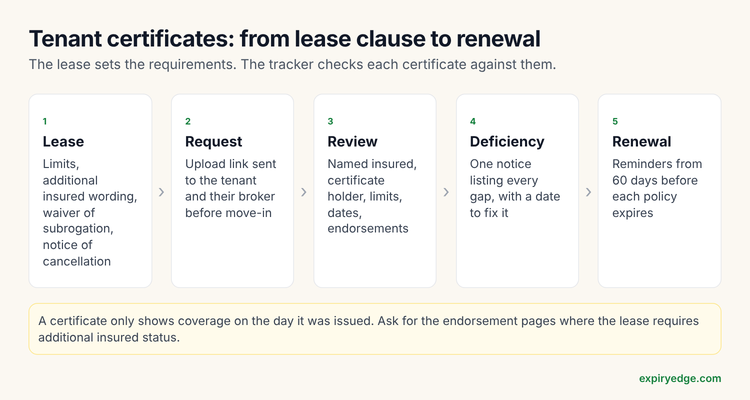 The tenant certificate cycle, from lease clause to renewal
Request it from the broker before the keys change hands
Make the certificate a condition of handing over keys or starting a fit-out. Before move-in is the only point where you have full leverage.
Send one request to the tenant's broker, with the tenant copied. Ask for the liability certificate, the property evidence, the additional insured and waiver endorsements, and the broker's direct email. Use an upload link rather than email attachments, so the documents land on the tenant's record and not in one manager's inbox.
Review six things, then send one deficiency notice
Check every certificate against that tenant's checklist:
- The named insured matches the tenant entity on the lease, not a parent or a trading name.
- Policy dates cover today and run past your next review.
- Each limit meets the lease, line by line.
- The endorsement pages name the landlord and any other parties the lease requires.
- Waiver of subrogation and primary wording appear where the lease asks for them.
- The certificate holder is your correct legal entity and address.
If something fails, send one notice that lists every gap and gives a date to fix it. Five separate emails train tenants to ignore you.
💡 Pro Tip
Keep a short note on each tenant's record of what you accepted and why, especially when you approve a deviation such as a lower umbrella limit. The person who reviews the renewal next year won't have to guess.
Track each policy on its own date
A tenant's general liability, umbrella and property policies often renew on different dates. Track each one separately, with its own reminder.
A schedule that works for tenants: request the renewal 60 days before expiry, follow up at 30 and 14 days, and on expiry day send the default notice your lease allows. Brokers need a few weeks after renewal to issue new certificates, so the 60-day start isn't too early.
Read your lease's default clause before you rely on it. Most give the landlord a right to buy cover and recharge the tenant, or to treat non-compliance as a breach after notice. Your property manager should know which before the first renewal is missed.
Put tenant dates next to the building's own dates
A landlord with a few buildings usually has more of the building's own deadlines than tenant policies: the building's insurance, lift inspections, fire risk assessments, boiler certificates, lease break and rent review dates. Tracking tenant COIs in one place and building dates somewhere else means two systems to check every Monday.
That's the gap ExpiryEdge was built for. It sends the tenant or broker an upload link with no login, lets your manager approve or reject each document with a comment, and reminds the tenant before each policy expires, by email, SMS or WhatsApp. The same tracker holds the building's certificates and lease dates. Plans start at $29 a month with a 14-day free trial.
If you manage a large commercial portfolio and want a service that reviews certificates for you, see our comparison of tenant COI tracking software, which covers Jones, BCS, Yardi TenantShield and four others. For the certificate itself, our sample certificate of insurance explained walks through an ACORD 25 box by box.
Frequently asked questions
Usually both, but only additional insured status gives the landlord coverage. The certificate holder just receives a copy. Ask for the endorsement page, typically ISO form CG 20 11 for managers or lessors of premises.
At move-in, then at every policy renewal, which for most tenants is once a year per policy. Also ask for a new certificate whenever the tenant changes insurer, assigns the lease or starts alterations.
Send a written notice that names the missing cover and gives a deadline, then follow your lease's default clause. Many leases let the landlord buy the cover and recharge the tenant, so check yours before you need it.
Not for a handful of tenants, if one person owns a spreadsheet and checks it weekly. Software helps once you have enough tenants and policies that renewals overlap, because it sends the requests and reminders without anyone remembering to.