
The 7 Best Statutory Compliance Software Tools in 2027, Ranked for FMs Running Planned Maintenance

ExpiryEdge is our first pick for facilities managers whose statutory work is mostly done by contractors. It holds every lift report, fire alarm certificate, water hygiene visit and contractor insurance as a dated record, reminds the contractor by email or SMS before each one is due, and collects the new report through a no-login link. The Pro plan is $49 a month for five users.
If your own technicians do the work and you need work orders, meter-based PMs or parts history, pick MaintainX, or run it alongside ExpiryEdge. It also publishes its prices, and you can start at $0. In the UK, ZetaSafe is the stronger pick if water hygiene and fire checks are the bulk of your load. Limble, UpKeep and Fiix are solid CMMS alternatives, and CalmCompliance is a UK tool with a per-site price.
We make ExpiryEdge. We ranked it first here. Facts about the six other tools come from their own product, pricing and help pages, which we read on 7 November 2026 and link throughout.
| Tool | Reminds the contractor who does the work (email, SMS, WhatsApp) | Contractors upload reports and insurance from a link, no login | Escalates overdue items to a manager | Audit trail you can export | Published pricing / free trial | Technician work orders (CMMS job) |
|---|---|---|---|---|---|---|
| ExpiryEdge Top pick | Yes, email, SMS, WhatsApp, Slack, Teams | Yes, no-login link with e-signatures | Yes, built in | Yes, timestamped and exportable | $29-$199/month, 14-day free trial | Runs beside your CMMS |
| MaintainX | Not stated | Not stated | Not stated | Not stated | $0 Basic, then $20 to $65 per user a month | Yes, by date or meter |
| ZetaSafe | Not stated | Not stated | Repeated issues escalate to a named person | Not stated | Quote on request | Yes, checks and PPM |
| Limble | Not stated | Vendors can join PM tasks | Not stated | Not stated | Price calculator, not published | Yes, unlimited PMs |
| UpKeep | Not stated | Contractor certificates checked before work starts | Not stated | Not stated | $24 and $55 per user a month, then quote | Yes, PMs from Premium |
| Fiix | Not stated | Not stated | Not stated | Not stated | $0 tier, then $45 and $75 per user a month | Yes, 25 PMs at $0 |
| CalmCompliance | Not stated | Stores contractor certificates with expiry tracking | Not stated | Not stated | From £490 per site a year, 15-day trial | Not stated |
How we compared these tools
Statutory work has two halves: the recurring task, and the contractor's certificate that proves it was done. Most of our columns follow the paperwork, since lift, fire and water work is mostly outsourced: does the reminder reach the contractor, can they upload without an account, who hears about it when they don't, and can you hand an inspector the log? Published pricing matters because a CMMS can be priced per user, per site or by quote. The last column covers the task side, for teams whose own technicians do the work. On 7 November 2026 we read each vendor's product pages, pricing and help docs, and checked intervals against LOLER, OSHA, New York's Department of Buildings and HSE. We didn't run paid trials of all seven. We make ExpiryEdge, so weigh our entry with that in mind.
The law names a duty, and your system has to turn it into a date
The law rarely names a software feature. It names a duty and, sometimes, an interval. Your system has to turn each one into a date, a task and a record you can hand an inspector.
Some intervals are fixed. In the UK, LOLER regulation 9 requires a thorough examination of lifting equipment for people at least every six months, and other lifting equipment every 12 months, unless an examination scheme says otherwise. In the US, OSHA 1910.157 wants portable extinguishers checked visually every month and given an annual maintenance check, with the date recorded.
Cities add their own. In New York, the Department of Buildings requires an annual periodic elevator inspection, an annual Category 1 test and a full-load Category 5 test every five years, with reports filed within 14 or 21 days.
Other duties are open-ended. Article 17 of the Fire Safety Order 2005 says premises and fire equipment must be kept in efficient working order under a suitable system of maintenance. For legionella, HSE's monitoring guidance sets monthly sentinel outlet temperature checks and six-monthly cold tank checks, while the risk assessment review has no fixed interval in law, per HSE's landlord page.
So a good tool does three jobs. It schedules the recurring task. It records who did it, with evidence. And it keeps the contractor's certificate, insurance and report on file, because most statutory work is done by someone you don't employ.
- Lift thorough examination: every 6 months for passenger lifts (UK, LOLER)
- Portable extinguishers: monthly visual check and annual maintenance (US, OSHA)
- Elevator periodic inspection and Category 1 test: every year (New York City)
- Legionella sentinel outlet temperatures: monthly (UK, HSE guidance)
- Backflow assembly test: on the schedule your water supplier sets
- Contractor insurance and accreditation: on each policy's own renewal date
1. ExpiryEdge: best all-in-one tracker for the certificates and contractor documents around your PPM
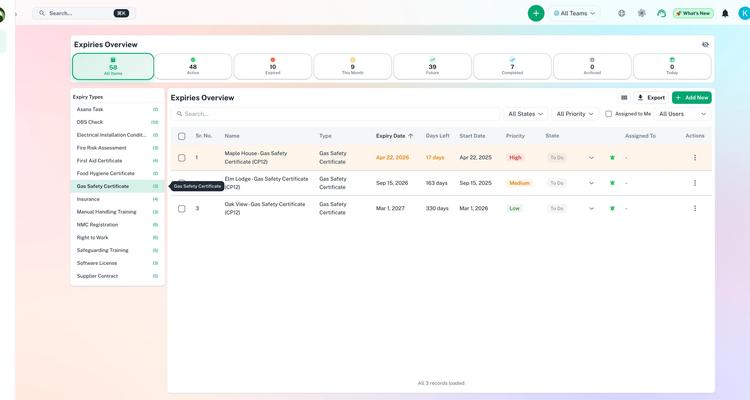
With ExpiryEdge, the lift report, fire alarm certificate and water hygiene visit stop arriving late, and you stop spending the week before an audit chasing contractors by phone. Every statutory date has an owner, a reminder that reaches the contractor, and a manager who hears about it if nothing happens.
Each lift, fire alarm panel, water system or extinguisher set becomes a record with its next inspection date, the contractor, and the last certificate attached. Upload an LOLER report or a fire alarm certificate and ExpiryEdge reads the dates off it. Before each date it reminds whoever you choose: your engineer in Teams, the lift contractor by email or SMS, the site manager on WhatsApp, and it escalates to you if nothing happens. The contractor gets a request link, with no login, to upload the new report, their insurance and their Gas Safe or NICEIC card, and to sign a method statement. You approve or reject each item, and a rejected item reopens on the same link.
For checks your own staff do, a scheduled SOP checklist runs every Monday or every month, say for flushing little-used outlets or a fire door walk, with a log of who ticked each step. One dashboard filters every site by category, and the audit log exports for an insurer or fire officer. Our facilities management page shows the setup.
Try it with your own statutory register in 15 minutes
- Import your asset register as a CSV, with custom fields for site, contractor and inspection type.
- Set a 60, 30 and 7-day schedule that emails the lift or fire contractor and sends the site manager a WhatsApp, escalating to you if nothing arrives.
- Send one contractor a no-login request link for their latest report and insurance certificate.
Pricing: priced per account, not per technician seat: Personal $29, Pro $49, Business $99 or Power $199 a month, depending on how many dated records you hold. Every plan starts with a 14-day free trial, no credit card. Users and record limits per plan are on the pricing page.
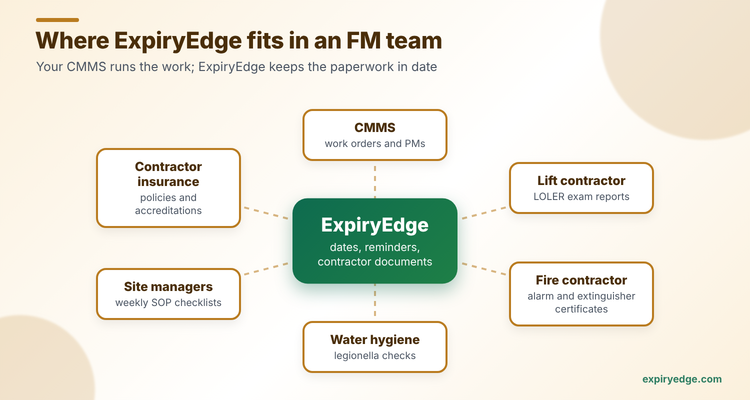
Good to know: ExpiryEdge runs beside your CMMS or CAFM rather than replacing it, so your technicians keep raising work orders where they already do, and the certificates and contractor documents around them live in ExpiryEdge.
2. MaintainX: best all-round PPM and inspection tool
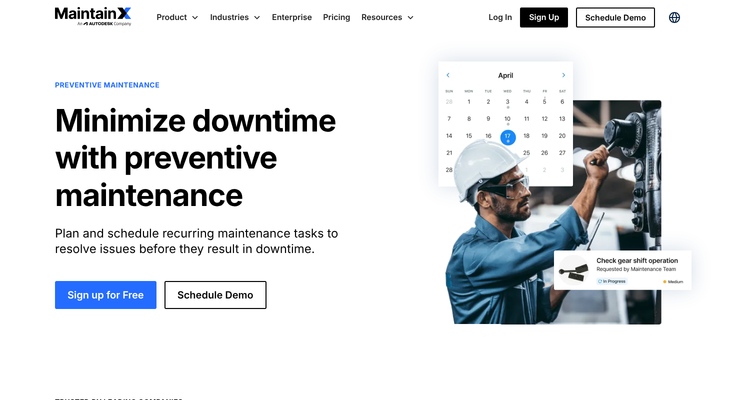
MaintainX is a CMMS used by facilities teams. Its facility management page says you can schedule preventive work by time or usage, replace paper checklists with templated procedures, and keep a searchable inspection history for audits. Technicians update work orders on a phone with photos and notes.
The checklists and inspections page goes further. A failed step can create a work order, alert the team or assign a technician, and completed inspections carry e-signatures and photos in a time-stamped audit trail you can export.
Pricing: published on the pricing page. Basic costs nothing but allows only two active repeating work orders. Essential is $20 per user a month billed yearly ($25 monthly), Premium is $65 ($75 monthly), and Enterprise is quoted. Meter-based maintenance starts at Premium.
Watch out for: the $0 Basic plan won't hold a real PPM schedule, and the facility page names no fire, lift or legionella content. You build those procedures yourself.
3. ZetaSafe: best for UK water hygiene and fire compliance
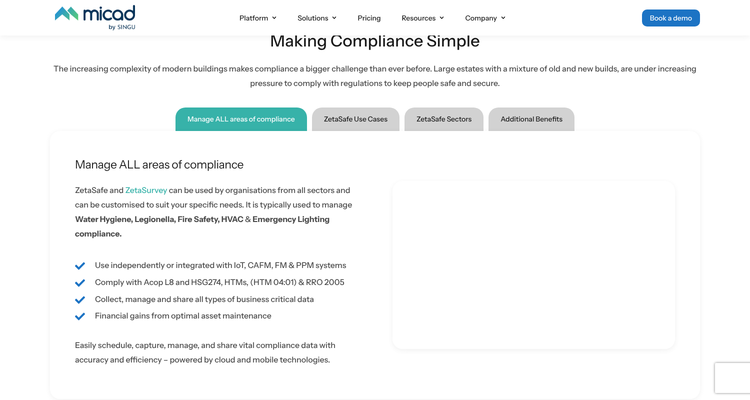
ZetaSafe, from Micad, is built for statutory checks rather than general maintenance. Its product page says it holds the temperature limits and frequencies from ACoP L8 and HSG274, takes readings with Bluetooth probes on a phone, and keeps a fire protection asset register for Fire Safety Order duties.
It also covers HVAC, emergency lighting, LOLER, gas and electrical safety. Failures trigger alerts, repeated issues escalate to a named person, and it can run alone or alongside your CAFM.
Pricing: not published. Micad's pricing page says quotes are tailored after a discovery process.
Watch out for: it's a UK-shaped product, and the page doesn't say whether contractors get their own access.
4. Limble: best for multi-site teams that want vendors inside the PM
Limble's facility page says you can invite outside vendors to take part in PM tasks and complete work orders, and that people can file requests by link or QR code without an account. Its compliance page names NFPA fire safety and NEC/NFPA electrical among the standards teams use it for, and says reports are easy to share with auditors.
Pricing: not published as figures. The pricing page lists Standard, Premium+ and Enterprise plans and sends you to a calculator. Meter-based scheduling and inspection checks start at Premium+.
Watch out for: Limble's own FAQ says a CMMS doesn't make you compliant by itself. You still have to set up the right tasks.
5. UpKeep: best if contractors work in the same system
UpKeep's facility management page triggers PMs on dates or meter readings and names life safety and HVAC as PM categories. Its Providers product lets contractors receive work orders directly, with their work recorded on the asset, and required certificates and safety sign-offs checked before work starts.
Pricing: published for two tiers on the pricing page: Essential at $24 per user a month and Premium at $55. Professional and Enterprise are quoted. PM scheduling isn't listed on Essential.
Watch out for: you'll need Premium for PM scheduling, and signature capture for compliance is listed on Professional, which is quote-only.
6. Fiix: best free starting point for a small estate
Fiix, a Rockwell Automation company, has a no-cost plan with up to 25 active PM tasks, work orders, a calendar and the mobile app. Pass/fail inspection tasks start at Basic.
Pricing: $0 for the entry plan, then Basic at $45 and Professional at $75 per user a month. Enterprise is quoted.
Watch out for: the audit trail and e-signatures are listed only on Enterprise, and Fiix leans towards plant maintenance more than buildings.
7. CalmCompliance: best published per-site price in the UK
CalmCompliance is a London-based tool. Its facilities page says it tracks fire, asbestos, water hygiene, electrical, gas and LOLER duties, keeps certificates such as EICRs and emergency lighting checks on each asset, and stores contractor certificates, insurance and training with expiry tracking.
Pricing: from £490 per site a year with unlimited users, a 15-day free trial and volume pricing above 10 sites, per the same page.
Watch out for: it's newer and smaller than the others here, and the page doesn't describe work order scheduling.
ExpiryEdge as an alternative to MaintainX
We put ExpiryEdge first because, when contractors do the work, a missed statutory date tends to be a certificate nobody chased rather than a work order nobody raised. Switch to ExpiryEdge if most of your statutory work is done by contractors and your real problem is the paperwork: the lift engineer's report, the fire alarm certificate, the water hygiene contractor's insurance. An office portfolio with eight buildings and 15 contractors doesn't need technician seats. It needs every date in one place and a reminder that reaches the contractor.
ExpiryEdge is also cheaper when your team is small. Five people on MaintainX Essential come to $100 a month billed yearly, at the $20 per user MaintainX lists. ExpiryEdge Pro is $49 a month for five users and 250 records, per our pricing page.
Stay with MaintainX if your own technicians do the work, you need meter-based PMs, or you want parts and asset history. Many teams run both: MaintainX for the work orders, ExpiryEdge for the certificates, contracts and contractor documents around them. Our ExpiryEdge vs CAFM comparison explains where the line falls.
Test every vendor on one passenger lift
List every statutory asset and who services it. If more than half the lines say "contractor", you need document collection more than work orders.
Then test with one awkward asset. Take a passenger lift: six-monthly LOLER exam, contractor insurance, a report with defects. Ask each vendor to show where the report lands, who gets reminded before the next exam, and what an inspector sees. The tool that answers all three without a workaround wins.
For the bigger picture, see our facilities compliance software guide and the service contract comparison. If fire safety is your main worry, how fire safety inspection tracking works covers the checks.
Frequently asked questions
Every six months at least. LOLER regulation 9 sets that for any equipment that lifts people, and 12 months for other lifting gear. A competent person can draw up an examination scheme with different dates, so ask your lift contractor which one you're on.
MaintainX runs from $0 to $65 per user a month, UpKeep lists $24 and $55, and Fiix lists $45 and $75. CalmCompliance starts at £490 per site a year. ExpiryEdge runs $29 to $199 a month. ZetaSafe and Limble quote on request.
Only in a small way. MaintainX's $0 Basic plan allows two active repeating work orders, and Fiix's entry plan allows 25 active PM tasks. That's enough to try a schedule, not to run a full statutory programme. ExpiryEdge offers a 14-day trial with no credit card, then paid plans.
Often not for scheduling, because your CAFM already raises PPM work orders. Teams usually struggle with the paperwork around it: contractor certificates, insurance and reports that arrive late. ExpiryEdge or CalmCompliance can track those dates next to the CAFM and chase the contractor.
OSHA 1910.157 asks for a visual check every month and a maintenance check once a year. You record the annual date and keep that record for a year after the last entry, or for the life of the shell if that's shorter.
SFG20 is the UK maintenance standard developed by BESA, sold through its Facilities-iQ software with more than 1,500 schedules. It tells you which tasks the law requires and how often. It doesn't schedule or record the work, so you pair it with a CAFM or CMMS such as Planon or MaintainX.