
How Dental Practices Track Autoclave, Compressor and X-Ray Maintenance: 6 Tools We'd Shortlist

ExpiryEdge is our first pick if you already have a service company you trust and your gap is the dates. It chases every validation, inspection and certificate date on time, gets the engineer to upload the certificate from a link, and runs a recurring checklist for the weekly spore test. It costs less than a dedicated platform.
If you want software and repairs from one vendor, pick UptimeHealth. It's built for dental and medical equipment, publishes its prices, and pairs the software with repair services. The others fill gaps. Mesa Labs (now branded GKE) and Healthfirst run mail-in spore testing with online results. MaintainX and Mitti (by SafetyCulture) are general maintenance and inspection apps that work well if you already use them across other sites.
Worth saying first: We make ExpiryEdge. UptimeHealth, Mesa Labs and the other four are described only from their own pages, which we opened on 7 November 2026; the links let you check every claim.
| Tool | Reminds the engineer and the nurse (email, SMS, WhatsApp) | Engineers upload signed reports from a link, no login | Weekly spore test as a recurring checklist | Tracks every validation, inspection and certificate date in one place | Published pricing / free trial | Repair service from the same vendor |
|---|---|---|---|---|---|---|
| ExpiryEdge Top pick | Yes, email, SMS, WhatsApp, Slack, Teams | Yes, no-login link | Yes, scheduled checklist with escalation | Yes, any dated item | $29-$199/month, 14-day free trial | Works with your own engineer |
| UptimeHealth | Alerts before compliance deadlines | Not stated | Not named on its features page | Equipment and PM history; warranty and contracts on Pro | From $118/month, annual contract; demo, no standard trial | Yes, on-site and depot repairs |
| Mesa Labs (GKE) spore testing | Opt-in reminders | Not stated | Mail-in testing, results kept up to three years | Spore results only | Not listed; buy online or quote | Not stated |
| Healthfirst spore testing | Testing reminders in OnTraq | Not stated | Mail-in testing, results in OnTraq | Spore and waterline results | $109.99 for 12 tests | Not stated |
| MaintainX | Not stated | Not stated | Recurring work orders with checklists | Asset history and audit trail | $0 Basic, then from $20 per user/month | Not stated |
| Mitti (by SafetyCulture) | Inspection alerts on assets | Not stated | Scheduled inspections | Asset register with documents | $0 up to 10 seats, then $24 per seat/month | Not stated |
How we compared these tools
The columns reflect who does the work on a dental machine. Does the engineer get reminded, and can they upload the signed report without a login? Does the nurse's weekly spore test run as a recurring checklist? Are all the validation and certificate dates in one place, and can you see a price? Repairs get one column because they're UptimeHealth's speciality. We read each vendor's product and pricing pages on 7 November 2026, and checked test intervals against the CDC, HTM 01-05, the Pressure Systems Safety Regulations and SDCEP. We didn't buy paid trials or send off spore tests. ExpiryEdge is ours, so weigh our view of it accordingly.
Nurse checks, engineer exams and the certificates between them
Dental equipment has three layers of dates. There are the checks your team does, the tests a lab or engineer does, and the certificates that prove both.
The team's checks are frequent. The CDC says a spore test should be used at least weekly on each sterilizer and on every load with an implantable device. In England, HTM 01-05 sets daily steam penetration and automatic control tests, weekly air leakage and residual air tests, and quarterly thermometric tests (or the maker's schedule). Sterilizers need validation at installation and every year after.
The engineer's examinations are less frequent but carry legal weight. In the UK, the Pressure Systems Safety Regulations 2000 require examination by a competent person within the intervals in each system's written scheme, and you can't run the system past its re-examination date. Scotland's dental guidance body, SDCEP, says that typically means sterilizers at least every 14 months and compressors at least every 26 months.
X-ray sets have their own cycle. SDCEP's summary of the FGDP guidance notes says routine tests should happen at least every three years, and yearly for hand-held units. In the US, each state's radiation control programme sets registration and inspection intervals, so check yours.
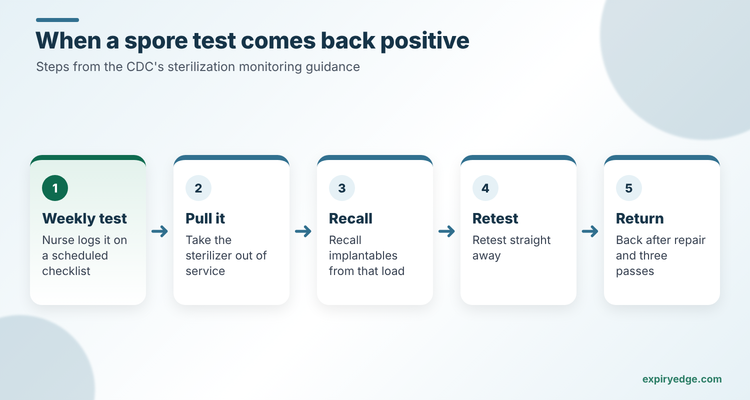
A positive spore test is the moment a tracker earns its keep. The CDC tells you to take the sterilizer out of service, recall any implantable items from that load and retest straight away. If the retest fails too, the unit stays out until it's repaired and passes three consecutive full-load tests. You want the engineer's number, the last service report and the next validation date in one place when that happens.
So a good tracker schedules the frequent checks, proves who did them, chases the engineer for the certificate, and warns you before any machine passes its date.
- Daily and weekly sterilizer tests logged by the user (HTM 01-05)
- Spore test at least weekly per sterilizer (CDC)
- Quarterly thermometric tests or the maker's schedule (HTM 01-05)
- Annual sterilizer validation and service
- Written-scheme examinations for sterilizers and compressors (PSSR, UK)
- X-ray routine tests at least every three years, yearly for hand-held (FGDP via SDCEP)
1. ExpiryEdge: best for keeping validation dates, engineer certificates and spore-test checks on schedule
With ExpiryEdge, the compressor certificate doesn't expire in a drawer and the Monday spore test doesn't get skipped without anyone noticing. Your engineer sends the signed report before it's due, the nurse gets the weekly check on her phone, and an inspector sees every date and sign-off in one export.
Each sterilizer, compressor and X-ray set is a record with its validation date, written-scheme examination date and routine test date, and reminders go out at the intervals you choose by email, SMS, WhatsApp, Slack or Teams. Your service engineer is an outside contact: before an examination is due, ExpiryEdge texts them a no-login link to upload the signed report, and its AI reads the next due date from the PDF. Reject a field with a comment and the same link reopens for just that item. The weekly spore test runs as a scheduled checklist every Monday, assigned to a named nurse, and the practice manager gets an escalation if it isn't done.
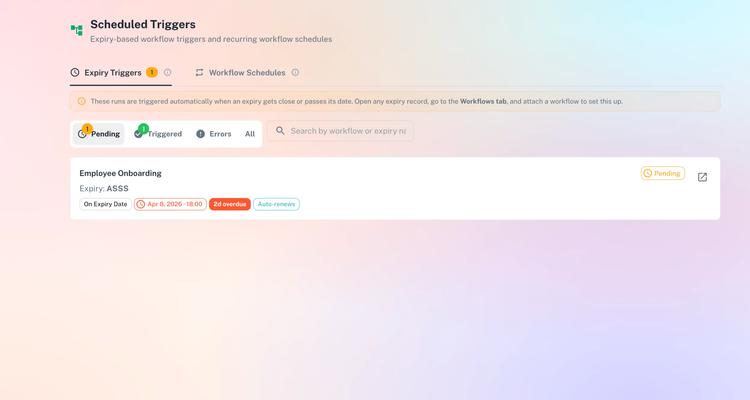
Try it with your own equipment list in 15 minutes:
- Import a CSV of your sterilizers, compressors and X-ray sets with custom fields for serial number, last validation and next written-scheme examination.
- Add your service engineer as an outside contact with a 60/30/7-day SMS schedule and a no-login link to upload the signed report.
- Schedule a Monday spore test checklist per sterilizer, assigned to a named nurse, with escalation to the practice manager if it's skipped.
Pricing: $29, $49, $99 or $199 a month, with a 14-day free trial and no credit card to start. Plan limits are on the ExpiryEdge pricing page.
Good to know: ExpiryEdge works with the service company you already trust, so you keep your engineer and your repair contract. If you'd rather buy repairs and software from one vendor, UptimeHealth bundles both.
2. UptimeHealth: best dedicated equipment tracker for dental practices
UptimeHealth makes equipment management software for dental and medical practices. It tracks each piece of equipment, schedules preventive maintenance, keeps the maintenance history and sends alerts before compliance deadlines. Reports are audit-ready in one click, and groups get one view across locations.
It also sells hands-on repair services: technicians who come to your practice and a repair depot for handpieces, ultrasonic scalers and electric motors, with a six-month warranty on depot repairs.
Pricing: published on the pricing page. Starter is $118 a month ($1,416 a year) for private practices, and Pro is $144 a month for multi-site groups, adding warranty and contract tracking and a service vendor marketplace. Elite is quoted. All plans are annual contracts, and prices cover up to 11 operatories.
Watch out for: there's no standard free trial, only a demo. The features page doesn't name spore-test or sterilizer logs, so ask how they're recorded.
3. Mesa Labs (GKE): best mail-in spore testing with a results dashboard
Mesa Labs runs mail-in spore testing, now under its healthcare brand GKE. Results go to a compliance dashboard where you can see them across several offices and look back up to three years. You can opt in to reminders and notifications, and choose an auto-renewal schedule.

Pricing: not listed on the page; you buy packages online or ask for a quote.
Watch out for: it covers biological monitoring only, not your other equipment dates.
4. Healthfirst spore testing: best if you already use OnTraq
Healthfirst sells mail-in spore testing with current and past results in its OnTraq platform, plus testing reminders. OnTraq also shows dental unit waterline results and suggests corrective actions.
Pricing: published. The 52-test system is $229.99 and the 12-test system is $109.99.
Watch out for: the page doesn't say whether OnTraq alerts you to a failed test, so confirm how you'll hear about one.
5. MaintainX: best general maintenance app for groups with facilities staff
MaintainX creates recurring work orders on a time or meter basis, attaches digital checklists, logs work from a phone with signatures and keeps a full history per asset. It builds an audit trail as you go. Its industry list doesn't include healthcare, so you'd set up dental checks yourself.
Pricing: published on the pricing page. Basic is $0 with two active repeating work orders. Essential is $20 per user a month billed yearly, Premium $65, and Enterprise is quoted.
Watch out for: the $0 tier's limit of two repeating work orders won't cover a practice with daily, weekly and quarterly tests.
6. Mitti (by SafetyCulture): best for checklist-based inspections
SafetyCulture's platform now appears as Mitti (by SafetyCulture). Its asset management keeps a register of each asset with scheduled inspections and alerts by time, runtime hours or odometer. Staff can scan a QR code to see what's been done and what's due.
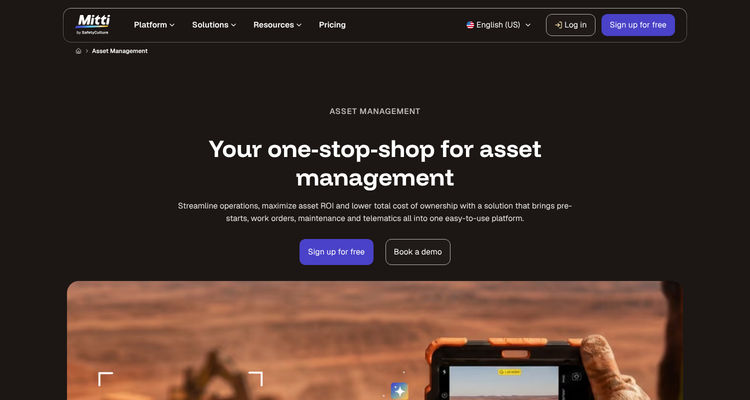
Pricing: published on the pricing page. Teams of up to 10 can start at $0 with five active inspection templates. Premium is $24 per seat a month billed yearly and adds automated maintenance.
Watch out for: it's built for frontline operations in general, so expect to build your own dental templates.
ExpiryEdge as an alternative to UptimeHealth
We put ExpiryEdge first because many practices already have a service company, and what slips is the paperwork. Switch if your equipment problem is dates, not repairs. Many practices already have a service company they trust. What goes wrong is the compressor certificate that expired in a drawer, or the validation the engineer never sent. ExpiryEdge chases those for $29 to $99 a month, billed monthly or yearly.
It also covers what UptimeHealth doesn't aim to: staff training dates, licences, contracts and the weekly spore test checklist, all in the same dashboard.
UptimeHealth is still the right call if you want one vendor for software, preventive maintenance and repairs, or a full asset inventory with service requests. For technician booking and parts, pair ExpiryEdge with your service company or pick UptimeHealth.
Walk the surgery with a notepad first
Walk the practice with a notepad. List every sterilizer, washer-disinfector, compressor, suction unit and X-ray set, with its last service, validation or examination date and who did it. If you can't find a date, that's your first job.
Then sort the list by who acts. Daily and weekly checks need a checklist your nurses will actually use. Engineer visits need a reminder far enough out to book them. We'd start at 60 days. Certificates need somewhere to land.
If one service company does everything, UptimeHealth's bundle may be simplest. If you use several engineers and labs, a date tracker such as ExpiryEdge keeps them all honest. Our equipment maintenance schedule guide helps you build the list, and equipment inspection tracking shows the setup.
For the rest of your compliance stack, see software for dental compliance and our comparison of dental compliance software.
Frequently asked questions
Weekly at least, says the CDC, and on every load that holds an implant. If a test comes back positive, take the sterilizer out of use and test it again. Mesa Labs (GKE) and Healthfirst both run mail-in testing and post the results online, so you've got a record to show.
Under the Pressure Systems Safety Regulations, a competent person examines it within the interval in its written scheme. SDCEP says that's typically at least every 26 months for compressors and every 14 months for sterilizers. Very small compressors under 250 bar-litres don't need a written scheme.
In the UK, SDCEP's summary of the FGDP guidance notes says routine tests at least every three years, yearly for hand-held units, and after major maintenance. In the US, your state radiation control programme sets registration and inspection intervals, so check its rules.
UptimeHealth's Starter plan is $118 a month on an annual contract. ExpiryEdge is $29 to $199 a month. MaintainX has a limited $0 tier, then charges $20 per user a month. Mitti lets teams of up to 10 start at $0 and then charges $24 per seat. All four publish these prices.
You can, but a spreadsheet won't remind anyone or show who skipped a week. A recurring checklist in ExpiryEdge, Done Desk Tasks or Mitti assigns the test to a named person and records completion, and a mail-in service such as Mesa Labs (GKE) keeps the lab results.