
What's the Best Client Document Collection Software for Insurance Agencies? 6 Options Compared

For most small and mid-sized agencies, ExpiryEdge is the best client document collection software. Clients open a link with no login, upload loss runs or schedules, fill in your questions and sign in the same place, and ExpiryEdge keeps chasing until it's done. Because each request can hang off a dated renewal record, it starts the chase at the right time every year.
If you run Applied Epic and your pain is commercial applications, Applied's Collaboration Portal, still widely called Indio, is the specialist to beat. It pre-fills last year's ACORD answers and sends signed applications to carriers. Content Snare suits agencies that want a general-purpose request tool, Canopy Connect pulls personal lines policy data straight from carriers, and Virtual Cabinet suits UK brokers who want a full document system with a portal.
We make ExpiryEdge. We've also ranked it first, so check our reasoning. Everything about the other five comes from their own sites and help centres as of 7 November 2026, with a link on each fact.
| Tool | Reminds the client until it's done (email, SMS, WhatsApp) | Clients upload from a link, no login | E-signatures included | Starts the chase from each renewal date | Audit trail you can export | Published pricing / free trial |
|---|---|---|---|---|---|---|
| ExpiryEdge Top pick | Yes, email, SMS, WhatsApp | Yes, no-login link | Yes, legally binding, built in | Yes, 90 days out or any schedule you set | Yes, timestamped log | $29-$199/month, 14-day free trial |
| Applied Collaboration Portal (Indio) | Not stated | Secure portal | Built in | Pre-fills last year's answers at renewal | Timestamped edits and signatures | Not published |
| Content Snare | Unlimited reminders | Yes, unguessable link | Via FuseSign or Annature, separate account | Not stated | Not stated | $35-$215+/month billed annually, 14-day free trial |
| Canopy Connect | Not stated | Client connects to carrier or uploads | Not stated | Not stated | Not stated | From $1,200/year |
| Virtual Cabinet | Not stated | Branded client portal | Built in | Not stated | Logs every action | Not published, quote |
| AgencyZoom | Not stated | Not stated | Via each sender's DocuSign account | Not stated | Not stated | $149-$349/month, 14-day trial |
How we compared these tools
We compared what decides whether a loss run comes back before the renewal: does the tool chase the client automatically, do they need a login, can they sign in the same place, does the chase start from the renewal date, is there a record you can export, and is the price published. Login friction counts most, because commercial clients rarely sign in to anything twice a year. On 7 November 2026 we read each vendor's product, pricing and help pages, and checked the disclosure duties in the Insurance Act 2015 and the Consumer Insurance (Disclosure and Representations) Act 2012. We didn't run paid trials of every tool, and we make ExpiryEdge, so weigh our first-place ranking accordingly.
Applications, loss runs, schedules, signed letters: what you chase and why it's evidence
Every account has a paper trail that has to come from the client. New business needs an application, prior carrier loss runs and, for commercial lines, schedules of locations, vehicles or equipment. Renewals need the same updated, plus a signed statement where the carrier asks for one. Mid-term, you're after signed forms, driver lists and audit figures.
The tool has to make that easy for someone who'll never log in to anything. It has to keep asking without you. And it has to show what the client said and when, because that record protects you if a claim turns on what was disclosed.
That last point has legal weight. In the UK, the Insurance Act 2015 puts a duty of fair presentation of the risk on a business client before the contract is entered into. For consumers, the Consumer Insurance (Disclosure and Representations) Act 2012 requires reasonable care not to misrepresent, and says that failing to confirm or amend details when the insurer asks can count as a misrepresentation. A timestamped request, with the client's own answers and signature, is the cleanest evidence you'll have.
- Signed application or renewal questionnaire
- Prior carrier loss runs for the years the carrier asks for
- Schedules: locations, vehicles, drivers, equipment, payroll
- Signed forms: no-loss statements, rejections of coverage, broker of record letters
- Proof the client received the policy documents
1. ExpiryEdge: best all-round option for small and mid-sized agencies
With ExpiryEdge, loss runs and signed renewal packs arrive before the renewal instead of the week of it, and your account managers stop writing the same chaser email five times. Each client's answers and signature are timestamped, which is the evidence you want if a claim ever turns on what was disclosed.
A document request goes out as a link the client opens with no account, running to several pages with 13 field types, including file uploads, dates, dropdowns and legally binding e-signatures. Save it as a template, say "Commercial auto renewal pack", reuse it for every account, and send it to up to 200 recipients at once. Follow-ups go out automatically by email, SMS or WhatsApp until the request is complete, and your reviewer approves or rejects each field with a comment, so the client fixes just the missing year of loss runs on the same link. Attach the request to the client's renewal record and the schedule starts the chase 90 days out every year, escalating to the account executive when the client goes quiet. ExpiryEdge reads the policy dates from an uploaded dec page, and every request, reminder and approval lands in an exportable audit trail.
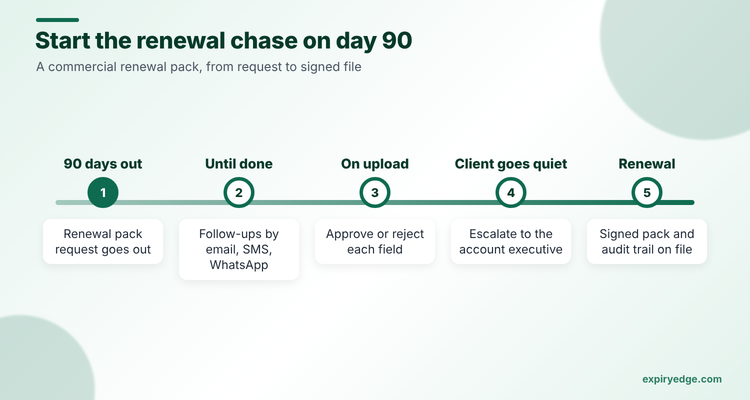
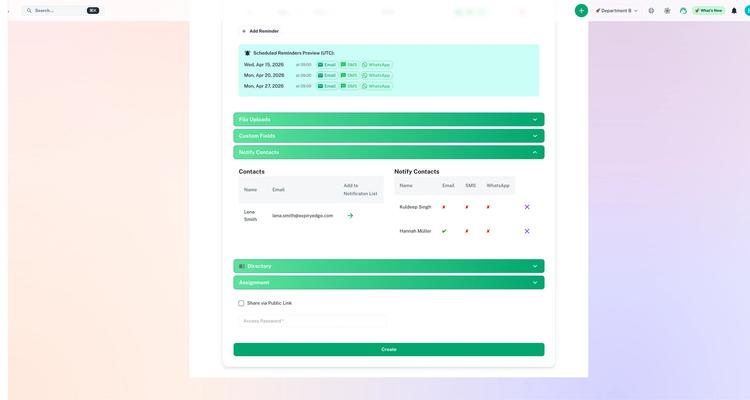
The document collection feature page shows the request builder.
Try it with your own renewal pack in 15 minutes
- Build a "Commercial auto renewal pack" template with uploads for five years of loss runs and the vehicle schedule, a driver-list field and an e-signature for the no-loss statement.
- Add one real client as an outside contact on their renewal record and set the request to go out 90 days before the policy date.
- Send it now as a test. Follow-ups go by email or SMS until it's done, and you reject just the missing loss-run year if one comes back short.
Pricing: four public tiers, from $29 a month for one user to $199 for fifty, with a 14-day free trial and no card needed to start. Plan limits for your account count are on the ExpiryEdge pricing page.
Good to know: ExpiryEdge works beside your agency management system rather than replacing it, so ACORD forms and carrier submissions stay where your team already does them. ExpiryEdge collects everything the client has to send you, on time.
2. Applied Collaboration Portal (Indio): best for commercial applications on Applied Epic
Applied's Collaboration Portal is, in Applied's words, "the tool many agencies still know as Indio". Clients and your team fill the same online application through a secure portal, with comments and changes tracked. It draws on more than 14,000 ACORD forms, carrier supplementals and custom questionnaires, and maps each answer across forms so nobody types it twice.
At renewal, last year's answers come back for the client to confirm, and every edit and signature is timestamped. You can upload dec pages or last year's application and AI fills the ACORD form for your review. A signed application goes to one carrier or several, and the finished documents file into Applied Epic.
Pricing: not published.
Watch out for: the current page describes it as built into Applied Epic. If you run another AMS, ask Applied whether you can buy it on its own.
3. Content Snare: best general-purpose request tool
Content Snare isn't built for insurance, but it's built for exactly this job. Its client experience page says there's no login and nothing to install. Clients get an unguessable link, everything saves as they type, and you can add a PIN or password if you want.
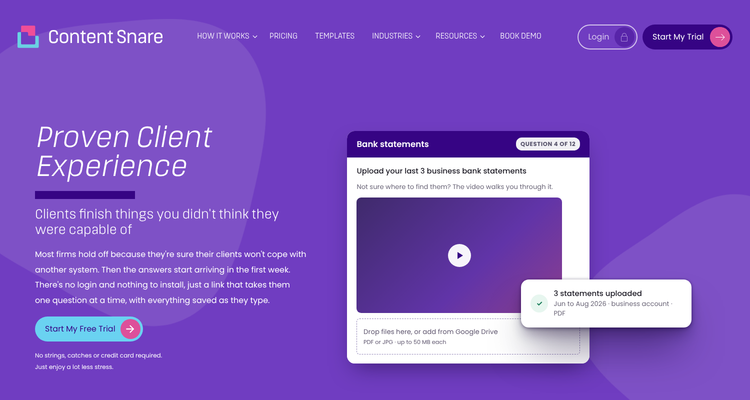
The pricing page lists unlimited reminders, an approval system and a 14-day free trial with no credit card. Plans are priced by active requests: a completed request stops counting. Document signing works through FuseSign or Annature, with your own account at that provider.
Pricing: billed annually, Basic is $35 a month for 20 active requests and 2 users, Plus $71 for 50, Pro $119 for 100, and Custom from $215 for 200 or more.
Watch out for: there are no insurance forms or AMS links out of the box, and e-signatures need a second subscription.
4. Canopy Connect: best for personal lines policy data
Canopy Connect solves a narrower problem: getting a prospect's current coverage. You send a branded link by text, email or QR code, and the client shares their policy by connecting to their carrier, uploading a dec page, filling a form or emailing documents, per Canopy's site. You get structured data and recent dec pages in a dashboard.
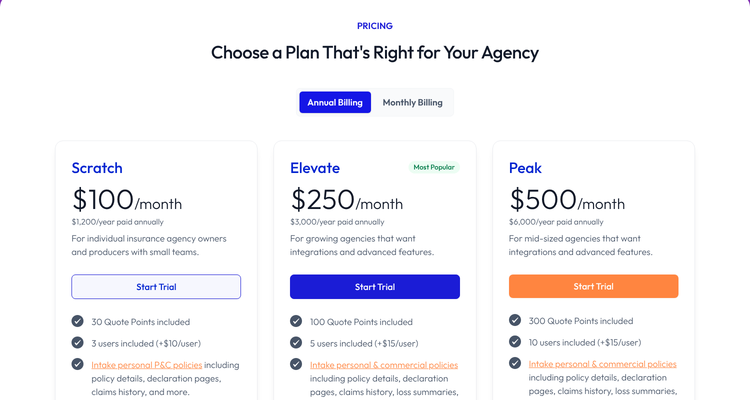
Pricing: the pricing page lists Scratch at $1,200 a year on annual billing for personal lines, with 30 quote points and 3 users. The next plan up, at $3,000 a year, adds commercial lines, loss summaries and direct links into Applied Epic, EZLynx and AgencyZoom.
Watch out for: it's an intake tool for quoting, not a general request tool for signed forms or schedules.
5. Virtual Cabinet: best for UK brokers wanting a full document system
Virtual Cabinet, a trading name of GetBusy UK Limited, sells document management with a client portal to insurance brokers. Its client portal sends documents or packs for legally binding e-signature, has two-way upload so clients can return completed documents, logs every action and alerts you when a client opens a file.
Pricing: not published. The pricing page lists plans with a "Get a quote" button and mentions annual invoicing or monthly direct debit.
Watch out for: it's a whole document system, so it's a bigger change than adding a request tool.
6. AgencyZoom: best if you already run AgencyZoom
AgencyZoom added e-signatures for every account in November 2025. You upload a file to a lead, customer or service request, tick "Create E-Sign Request", and DocuSign handles the signing, with status flowing back to AgencyZoom.
Pricing: the pricing page lists $149 to $349 a month for independent agencies.
Watch out for: each user who sends requests must connect their own DocuSign account, which is a separate cost, and the help article doesn't describe client uploads or automatic chasing.
ExpiryEdge as an alternative to Indio
Switch to ExpiryEdge if your agency isn't on Applied Epic, or if the documents you chase are mostly not applications: loss runs, schedules, signed letters, certificates and audit figures. ExpiryEdge's no-login links, field-by-field review and automatic follow-up cover that work for a published monthly price.
It also helps when the problem is timing. A tool that knows each client's renewal date can start the request on day 90 every year, and escalate to the account executive when the client goes quiet.
Stay with the Collaboration Portal if you send many commercial applications, want answers mapped across ACORD forms and carrier supplementals, and want signed applications to land straight in Epic. For that ACORD mapping, the Collaboration Portal is the specialist.
Your last ten client chases tell you which tool to test
Write down the last ten things you chased a client for. If most were applications, look hard at the Collaboration Portal, or Canopy Connect for personal lines quoting. If most were loss runs, schedules and signed letters, a request tool with chasing fits better.
Then test with a real client. Send the same three-item request from each tool on your shortlist to a friendly client, and time how long it takes them to finish. The tool your least technical client completes without phoning you is the right one.
Finally, decide whether the request should be tied to the renewal date. Our guide to software for insurance agencies shows how the pieces fit, the renewal tracking comparison covers the dates, and our insurance brokers page shows ExpiryEdge set up for a brokerage.
Frequently asked questions
Applied renamed it. It's now the Collaboration Portal in Applied Epic, though Applied's page says many agencies still call it Indio. You still get online collaborative applications, more than 14,000 ACORD and carrier forms, pre-filled renewals and e-signatures. Signed applications sync into Applied Epic.
Send one request with a clear list, a link that needs no login, and automatic reminders. ExpiryEdge and Content Snare both chase until the request is complete. Start about 90 days before a commercial renewal, and reject only the missing item rather than resending the whole form.
Yes with several tools. ExpiryEdge requests include legally binding e-signatures in a no-login link. Content Snare links need no login, but signing runs through FuseSign or Annature. AgencyZoom uses DocuSign, and Virtual Cabinet sends documents for e-signature through its client portal.
ExpiryEdge runs $29 to $199 a month. Content Snare lists $35 to $215 or more a month on annual billing, and Canopy Connect starts at $1,200 a year. AgencyZoom lists $149 to $349 a month. Applied and Virtual Cabinet quote on request.
None of the tools here is free to use long term. ExpiryEdge and Content Snare each offer a 14-day free trial with no credit card, and AgencyZoom offers a 14-day trial. That's enough time to send real requests to a few clients and see which tool they finish.