
DOT compliance software for fleets - without the telematics price tag.
Driver qualification files, CDL and medical card renewals, MVR pulls, drug and alcohol testing, IFTA/IRP, and annual vehicle inspections - all tracked together. Reminders go to drivers, safety managers, and dispatchers through the apps they already use. A flat monthly subscription, not $30–$60 per truck per month.
Quick answer
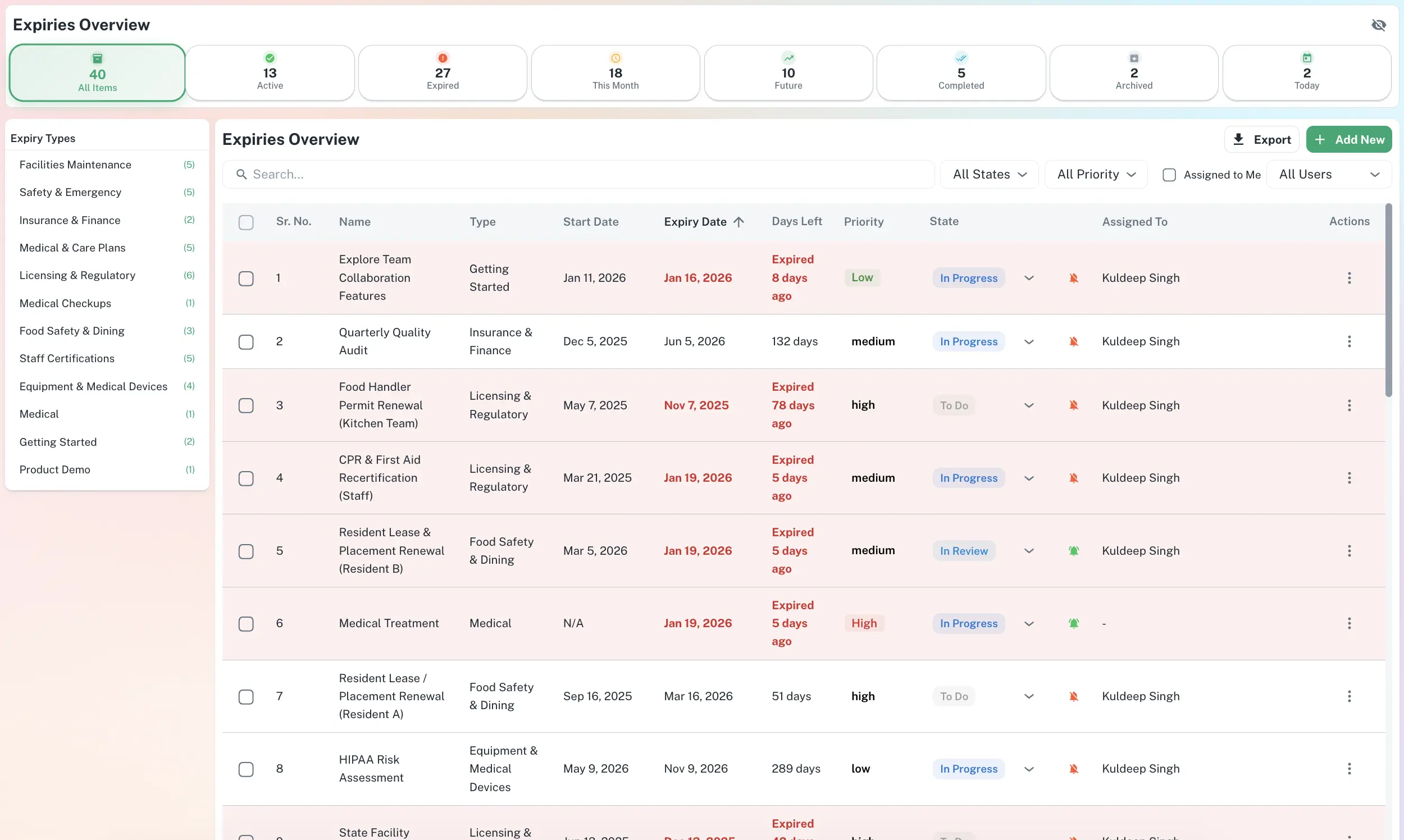
DOT compliance software tracks every deadline the US DOT and FMCSA require commercial fleets to meet - Driver Qualification Files, CDLs, medical examiner certificates, MVR pulls, drug and alcohol testing, annual vehicle inspections, and IFTA/IRP/UCR renewals. ExpiryEdge sends renewal reminders automatically, stores the paperwork in each driver and vehicle file, and produces audit-ready reports - on a flat subscription priced by team seats, not truck count.
The cost of a missed FMCSA deadline
$15,846
Max FMCSA record-keeping penalty - accrues at $1,584 per day
Source: 49 CFR Part 386, App. B (eCFR)$21,114
Max FMCSA penalty for a financial responsibility violation
Source: 49 CFR Part 386, App. B (eCFR)Every DOT deadline ExpiryEdge tracks
CDL - renews every 4–8 yrs by state (CA 5, TX/FL/NY 8)
Medical examiner certificate - up to 24 months
Driver Qualification File (DQF) - annual + on event
MVR pull - annual minimum (49 CFR 391.25)
Random drug & alcohol testing - 50% drug, 10% alcohol pool
Annual vehicle inspection - every 12 months (49 CFR 396.17)
IFTA license + decals - annual, Dec 31 expiry
IRP / apportioned plates - annual, state windows
UCR registration - annual, Dec 31
Hazmat endorsement + TSA assessment - every 5 yrs
CSA BASIC score monitoring - continuous, 24-mo roll-off
From a paper DQF to a deadline pipeline that runs itself
Every 49 CFR 391 slot tracked per driver
Application, 3-year MVR history, annual MVR review, road test certificate, and medical examiner certificate - each is a required slot on the driver record. A missing or incomplete DQF is the most common DOT audit finding; ExpiryEdge flags the gap before an inspector does.
Pre-employment screening enforced before a driver goes active
Annual MVR reviews scheduled centrally
State-specific CDL cycles applied by driver location
Alerts to drivers, dispatch, and safety - before the OOS order
Set a cadence per item - 90, 60, 30 and 7 days before expiry. A forgotten medical card means a roadside out-of-service order and an undelivered load. SMS goes to the driver, escalation goes to the safety manager and owner if nothing happens.
Email, SMS, WhatsApp, Slack, Microsoft Teams
Different recipients per step
Automatic escalation on missed deadlines
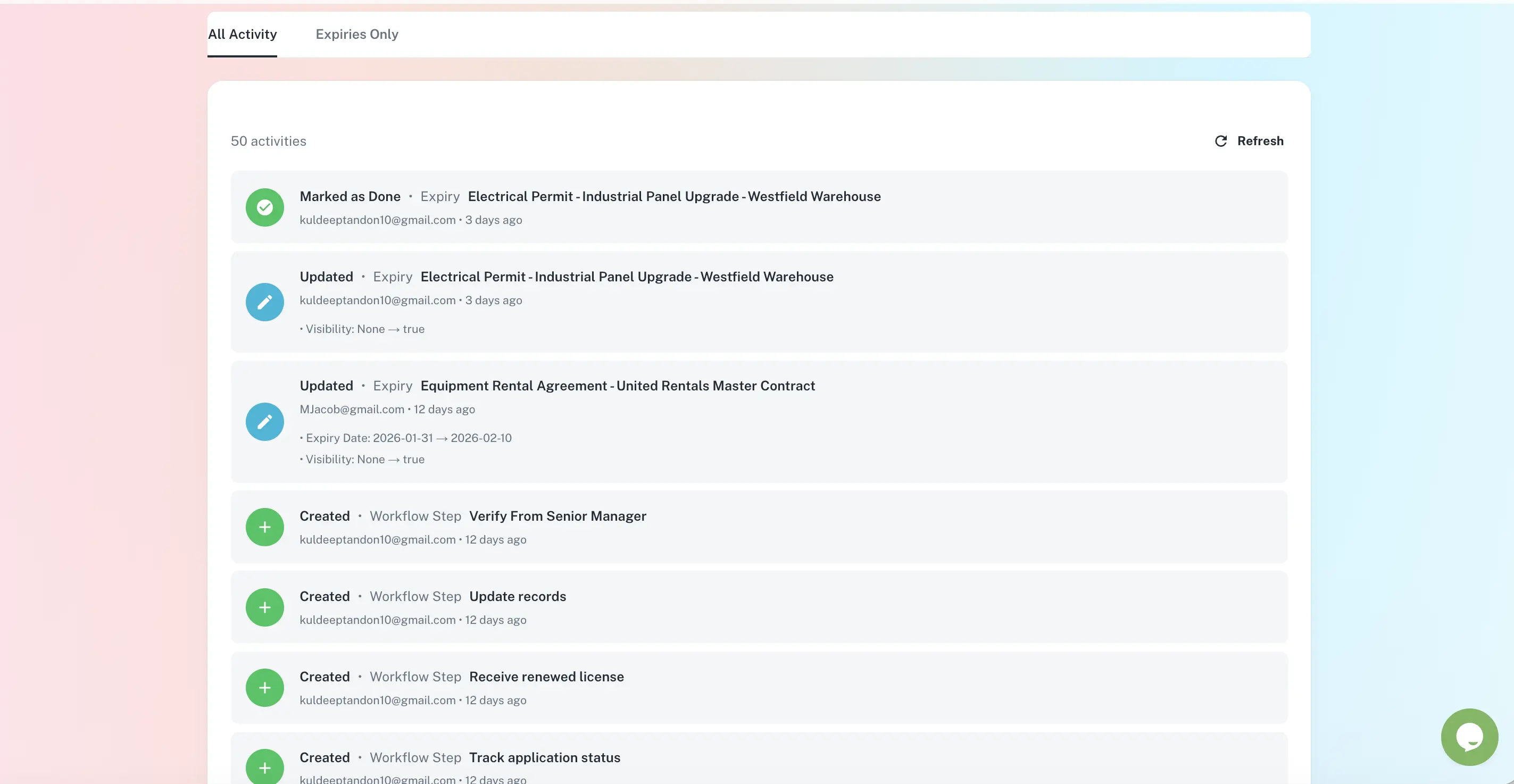
A DQF and inspection trail you can hand an auditor
Customer compliance audits land with no warning. One missing 391.51 form on one driver can fail an audit and put a contract on review. Every driver and vehicle file is one search away, with annual vehicle inspections and IFTA/IRP renewals tracked alongside, and an auditor self-service export.
DQF per driver, all required forms in one folder
Annual vehicle inspection logs (49 CFR 396.17)
One-click export to CSV, PDF or XLSX
Built for fleets the enterprise platforms ignore
Small fleets (5–25 trucks)
Owner-operator runs ops, dispatch, and compliance. A simple dashboard - driver name, deadline, status - with SMS to the driver 14 days out and escalation to the owner at 7 days. No telematics integration required.
Mid-size fleets (25–100 trucks)
The safety manager spends 20+ hours a week chasing renewals while CSA scores creep up. Bulk-import from your TMS, fire reminders to drivers, dispatchers and safety, and schedule annual MVR pulls centrally so results land back in the DQF.
For-hire & dedicated contract carriers
Customer compliance audits land with no warning and one missing 391.51 form fails the audit. Audit-ready DQF for every driver - all required forms in one folder, accessible by file or category, with an auditor self-service link.
Private fleets (food & beverage, energy, retail logistics)
Compliance is buried inside ops, with the truck team, warehouse, and safety each on a different system. One deadline platform across the whole operation - DOT files alongside warehouse permits, building inspections and corporate licenses.
Vocational fleets (construction, waste, utility)
Drivers also operate equipment, so CDL is one piece - they also need OSHA 10/30, MEWP/aerial, and hazmat certs. Track DOT documents and OSHA training cards in one driver record, with cross-trade reminders before expiry on either side.
Standalone compliance vs the bundled telematics suite
| ExpiryEdge | Enterprise telematics | Spreadsheet | |
|---|---|---|---|
| Pricing model | Flat seats | $30–60 / truck / mo | Free |
| DQF tracking per 49 CFR 391 | Partial | Manual | |
| Medical card / CDL renewal alerts | |||
| IFTA / IRP / UCR deadline tracking | Partial | ||
| Multi-channel reminders (SMS, WhatsApp, Teams) | Partial | ||
| Audit-ready document export | Manual | ||
| Works without buying ELD / GPS / dashcams | |||
| Setup time | An afternoon | Weeks | n/a |
DOT compliance software tracks every deadline the US Department of Transportation and the Federal Motor Carrier Safety Administration (FMCSA) require commercial fleets to meet. The main records are the Driver Qualification File (DQF), Commercial Driver License (CDL), medical examiner certificate, motor vehicle record (MVR) pulls, drug and alcohol testing, vehicle inspections, IFTA/IRP renewals, and UCR registration. Good software sends renewal reminders automatically, stores documents in driver and vehicle files, and produces audit-ready reports whenever you need them.
A Driver Qualification File (DQF) is a folder of paperwork for each driver, required by 49 CFR 391, that proves the driver meets FMCSA qualification standards. The file must include: the employment application (391.21), motor vehicle records from every state where the driver held a license in the past 3 years (391.23), an annual MVR review (391.25), the road test certificate or CDL waiver, the medical examiner certificate, and any required disclosures. Annual MVR reviews are required as long as the driver works for you. A missing or incomplete DQF is the most common DOT audit finding.
A standard medical examiner certificate is valid for up to 24 months. Drivers with certain conditions (high blood pressure, insulin-managed diabetes, sleep apnea) often get shorter certificates of 3, 6, or 12 months. The certificate must come from an examiner on the National Registry of Certified Medical Examiners. The driver also has to self-certify their medical status with their state DMV. If the certificate lapses, most states automatically downgrade the CDL.
There are two main tiers. Enterprise telematics suites (Samsara, Lytx, Verizon Connect) bundle DOT compliance with ELD, GPS, and dashcam services. They cost $30 to $60 or more per truck per month. For a 100-truck fleet, that is $36,000 to $72,000 per year. Standalone compliance software (Foley, Compliance Safety Manager, ExpiryEdge) charges a flat monthly fee no matter the fleet size, usually in the low thousands per year. The right choice depends on whether you already have ELD and GPS, or only need the documents and deadlines tracked.
Current FMCSA civil penalties (49 CFR Part 386, Appendix B, as amended 21 July 2026): record-keeping violations accrue at $1,584 per day up to a $15,846 maximum; non-record-keeping violations carry a maximum of $19,246; financial responsibility violations a maximum of $21,114. Falsified records or willful violations can be sent for criminal prosecution. Repeated violations also drag down your CSA BASIC scores, which raises insurance premiums and hurts your standing in customer audits.
IFTA (International Fuel Tax Agreement) licenses expire December 31 every year and must be renewed before that date. Renewal windows typically open October through November. New IFTA decals must be displayed on every qualified vehicle by March 1 of the new license year - until then, the prior year's decals are valid. Late renewal triggers fuel-tax interest, decal-replacement fees, and possible suspension of authority in member jurisdictions.
CSA (Compliance, Safety, Accountability) is the FMCSA's safety scoring system. Every inspection, violation, and crash feeds into seven categories called BASICs: Unsafe Driving, Hours of Service, Driver Fitness, Controlled Substances, Vehicle Maintenance, Hazmat, and Crash Indicator. Each one is scored against other carriers your size. High scores trigger audits, interventions, and lost contracts. Violations stay on the record for 24 months. Many shippers will not work with carriers that score above the 65th percentile in any BASIC.
Most TMS and ELD platforms handle dispatch, hours of service, and vehicle telemetry. They do not handle the per-driver document side (DQF, medical card, drug and alcohol pool, training records) or the per-vehicle annual inspection in a way that holds up in an audit. Compliance software fills that gap. ExpiryEdge connects to the major TMS platforms by CSV import or API. Driver and vehicle data flows in automatically, and all the document deadlines are tracked in one place.
Before a driver can operate a commercial vehicle, the carrier must: (1) verify the CDL and check its current status, (2) order a 3-year MVR from every state where the driver was licensed, (3) query the FMCSA Drug and Alcohol Clearinghouse, (4) run a pre-employment drug test, (5) complete a previous-employer safety check under 49 CFR 391.23, and (6) complete a road test (or accept the CDL in place of a road test). ExpiryEdge stores each of these as required slots on the new driver's record. You cannot mark the driver active until the file is complete.
ExpiryEdge replaces the document and deadline-tracking layer. It does not provide ELDs, GPS, dashcams, or driver behaviour scoring. If you already have telematics from Samsara or Lytx, ExpiryEdge sits alongside it as the deadline-aware compliance brain. If you do not have telematics yet and want compliance discipline first, ExpiryEdge is the lighter-weight starting point - and you can add a separate ELD vendor later for a fraction of the bundled cost.
Get DOT-audit-ready in an afternoon
Free for 14 days. No credit card. Bulk-import your drivers and vehicles, set your renewal cadence, and have a complete deadline pipeline live before close of business.