Guide · Germany · Electrical safety

DGUV V3 inspection in Germany: how often, and who may test?

DGUV Regulation 3 is the German accident insurers' rule for electrical installations and equipment. Fixed installations are typically tested every 4 years, portable equipment every 6 months as a guide value. Here is what the tables say, who may test, what the test label means and how to keep every date in view.

Start Free Trial
No credit card required · Setup in minutes
FixedinstallationCURRENTPortableequipmentDUE SOONSitedistribution b…CURRENTExtension leadsEXPIRED

Last updated · ExpiryEdge editorial team

Quick answer

In Germany, DGUV Regulation 3 requires electrical installations and equipment to be tested at intervals the employer sets in the risk assessment. The guide values are 4 years for fixed installations (1 year in rooms of a special kind) and 6 months for portable equipment, extendable to 1 year in workshops or 2 years in offices if the fault rate stays below 2 %. A qualified electrician is responsible for the test.

Reference

DGUV V3 test intervals (Tables 1A and 1B)

Guide values from the implementation notes to section 5 of DGUV Regulation 3. They are the starting point; your risk assessment under the German Ordinance on Industrial Safety (BetrSichV) sets the binding interval for your equipment.

DGUV V3 test intervals (Tables 1A and 1B)
Installation or equipmentIntervalBasisTested by
Fixed electrical installations and equipment4 yearsDGUV V3 § 5, Table 1AQualified electrician (Elektrofachkraft)
Installations in rooms and premises of a special kind (DIN VDE 0100 group 700)1 yearDGUV V3 § 5, Table 1AQualified electrician
RCD protective measures in non-stationary installations1 month (effectiveness)DGUV V3 § 5, Table 1AElectrician or instructed person with suitable test equipment
Portable equipment, extension leads and connection cablesGuide value 6 monthsDGUV V3 § 5, Table 1BElectrician, or instructed person with suitable test equipment
Portable equipment on construction sitesGuide value 3 monthsDGUV V3 § 5, Table 1BElectrician, or instructed person with suitable test equipment
Maximum with fault rate below 2 % - sites, workshops, production1 yearDGUV V3 § 5, Table 1BAs above
Maximum with fault rate below 2 % - offices and similar2 yearsDGUV V3 § 5, Table 1BAs above
Setting the binding intervalIn the risk assessmentBetrSichV § 3 (6)Employer
The fault rate is the share of tested equipment found defective. Records of each test must be kept at least until the next test (BetrSichV § 14 (7)); electronic records are allowed. Summary for orientation, last reviewed October 2026 - not legal advice.
What people ask

DGUV V3 testing explained

Is DGUV V3 testing mandatory?

Yes, for employers in Germany. DGUV Regulation 3 is binding accident prevention law for member companies of the statutory accident insurers, and the BetrSichV separately requires work equipment to be tested at intervals set in the risk assessment. Landlords who only let premises are not covered for the tenant's equipment, but they remain responsible for the building's own fixed installation under general safety duties.
How often in an office?

Portable equipment starts at a 6-month guide value. Where tests show a fault rate below 2 %, offices may extend to a maximum of 2 years. Fixed installations follow the 4-year guide value. Document why you chose the interval - that reasoning is what an inspector or insurer will ask about.

Who may carry out the test?

A qualified electrician (Elektrofachkraft) is responsible. For portable equipment, an electrotechnically instructed person may test with suitable measuring and test equipment, under the direction and supervision of a qualified electrician. Many businesses use a contractor for fixed installations and train in-house staff for portable equipment.

What does it cost?

There is no fixed price. Contractors usually charge per device for portable equipment and by effort for fixed installations, so cost depends on the number of devices, how spread out they are and whether faults are repaired on the spot. Compare quotes on the same basis: price per device, documentation format and what happens to failed items.

At a glance

Intervals, test label and device register

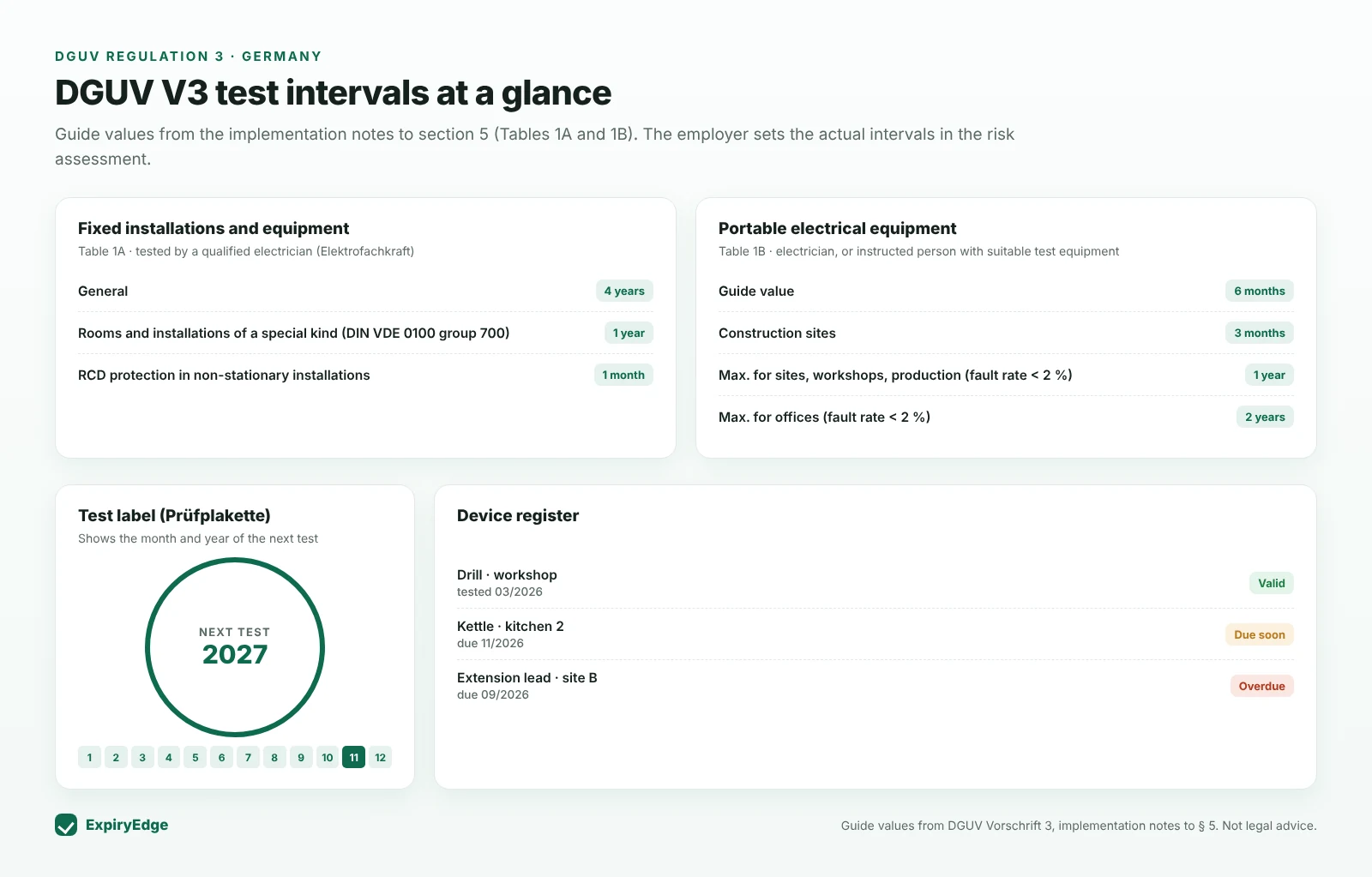
Overview of DGUV V3 test intervals: fixed installations 4 years or 1 year for special rooms, portable equipment 6 months guide value, 3 months on sites, maximum 1 or 2 years with a fault rate below 2 %, a test label showing the next test date and a device register with valid, due and overdue items
Guide values from DGUV Regulation 3, implementation notes to section 5.
How it works

How to organise DGUV V3 testing in five steps

1
1. List every installation and device

Build a register of fixed installations by building and of portable equipment by location or department, including extension leads and site distribution boards.

2
2. Set the interval in the risk assessment

Start from the Table 1A and 1B guide values and adjust for the environment. Record the reasoning, for example a 2-year office interval based on a fault rate below 2 %.

3
3. Assign a responsible person

Name who books the qualified electrician, who tests portable equipment in-house and who approves repairs. One owner per site avoids gaps.

4
4. Test, label and record

Each tested item gets a test label with the next due date. Keep the test record at least until the next test.

5
5. Follow up faults and the next due date

Take failed equipment out of use, record the repair or disposal and make sure the next test date is in a reminder system, not only on the label.

Keeping it on schedule

How ExpiryEdge keeps DGUV V3 dates from slipping

One record per installation or device group
The next test date, an owner and the last report

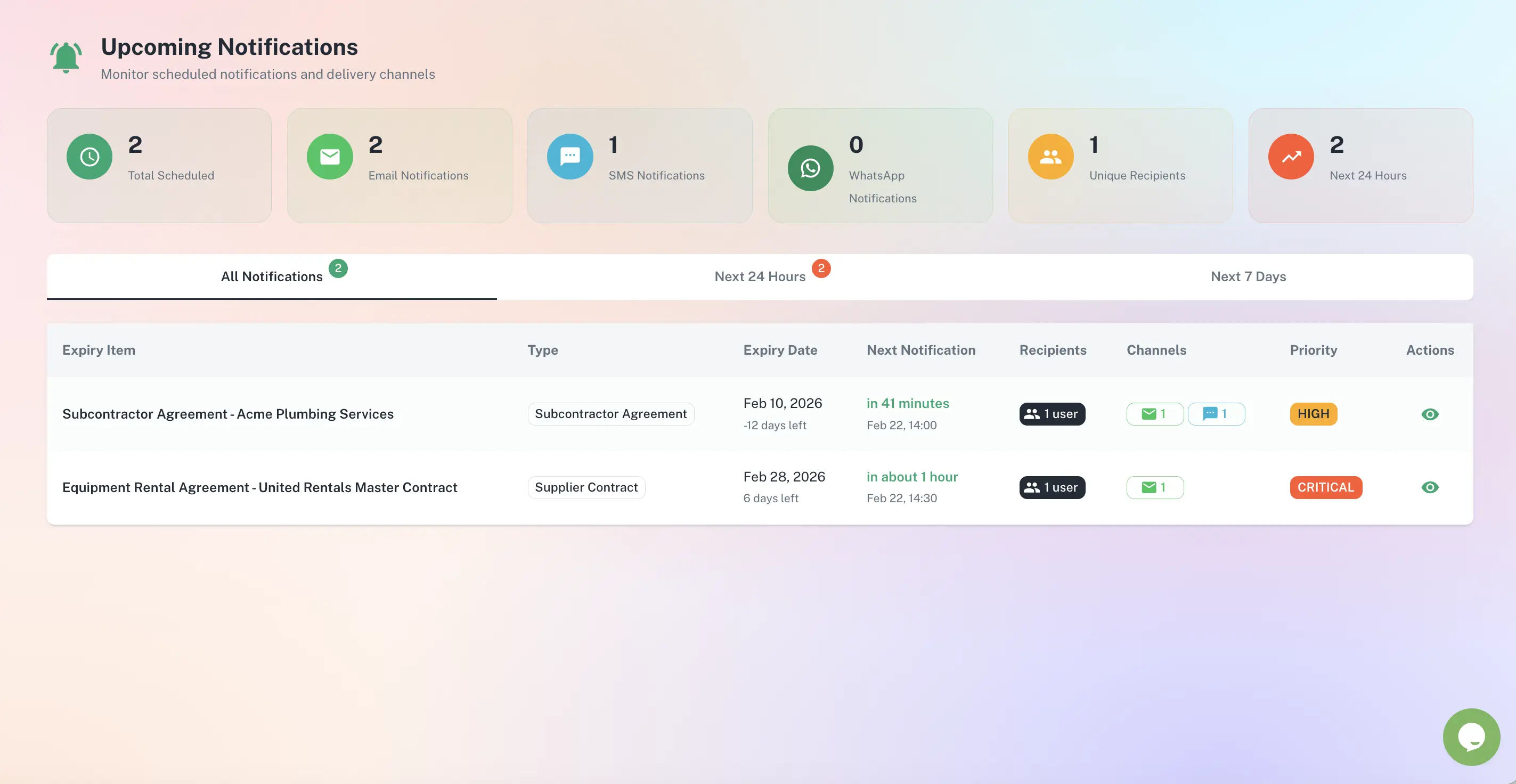
Import your register from a spreadsheet. Each fixed installation or device group gets its interval, location, responsible person and the last test report. When the test is logged, the next due date rolls forward automatically. Reminders go out 90, 60, 30 and 7 days before - by email, SMS, WhatsApp, Slack or Teams - and escalate if nothing happens.

Recurring dates roll forward on your interval

Owner and backup per site

Escalation when a test is overdue

ExpiryEdge list of upcoming electrical test dates with owners and status
Reports from your contractor
The electrician uploads the report by link

After the visit, the electrical contractor gets a link to upload the test report and the list of failed items, without creating an account. ExpiryEdge follows up until it arrives and keeps it on the record, so an insurer or the accident insurer's inspector gets the full history in one export.

No-login upload link

Automatic follow-up

Export as PDF, CSV or XLSX

ExpiryEdge record with an electrical test report attached
Frequently asked questions

Guide values: fixed installations every 4 years (1 year in rooms and installations of a special kind), portable equipment every 6 months, on construction sites every 3 months. With a fault rate below 2 %, portable equipment may be tested at most every year in workshops and production or every 2 years in offices. The employer sets the binding interval in the risk assessment.

A qualified electrician (Elektrofachkraft) is responsible. Portable equipment may also be tested by an electrotechnically instructed person with suitable test equipment, under the direction and supervision of a qualified electrician.

Not testing work equipment on time is an administrative offence under the BetrSichV, and after an accident the accident insurer and the employer's liability insurer will ask for the test records. Book the test, take visibly damaged equipment out of use and record what you did.

The regulation requires testing and records, not a specific sticker. A label showing the next test date is the common way to show the status at the device, and many companies require it internally. The record is what counts as proof.

DGUV V3 applies to employers and their equipment. A landlord who only lets premises is not responsible for the tenant's devices, but remains responsible for the safe condition of the building's fixed electrical installation and should check it regularly.

DGUV V3 testing is the legal requirement for employers. The E-Check is a branded inspection offered by electrical trade businesses; it can be used to meet the DGUV V3 requirement when it covers the same scope and interval.

Every DGUV V3 date with an owner and a reminder

Import your device register, set the intervals, assign owners. Free 14-day trial, no credit card.