
Why Compliance Teams Need Workflow Automation

Why Compliance Teams Need Workflow Automation

Compliance teams need workflow automation because it turns deadline-driven obligations into auditable, enforceable processes that run on schedule and log evidence automatically. Without it, you’re relying on spreadsheets, calendar reminders, and email chains to satisfy regulators who expect documented, timestamped proof that controls ran when they were supposed to. Frameworks like SOC 2, FDA FSMA, and OFAC enforcement actions all share the same expectation: show your work, on time, every time.
The immediate, stakeholder-friendly case for automation comes down to four things:
- Accuracy: Automated workflows remove the human handoff errors that cause missed steps, wrong approvers, and undocumented exceptions.
- Audit trails: Automation that encodes controls as live workflows produces timestamped, auditable evidence as a byproduct, closing the evidence gaps auditors most commonly flag.
- Deadline enforcement: Triggers and escalation rules fire whether or not someone remembers to check a spreadsheet.
- Time savings: Teams spend less time assembling evidence and more time on judgment-intensive work that automation cannot replace.
Key Takeaways
Compliance workflow automation is the most reliable way to guarantee audit-ready evidence, enforce deadlines, and reduce the manual overhead that makes compliance teams reactive instead of proactive.
| Point | Details |
|---|---|
| Automation produces evidence automatically | Encoding controls as live workflows generates timestamped audit logs as a byproduct, closing the gaps auditors most commonly flag. |
| Start with deadline-driven workflows | License renewals, access reviews, and supplier certificate tracking deliver the highest ROI because failures there are measurable and expensive. |
| Governance is non-negotiable | Every workflow needs a named owner, version control, and change-approval gates before it goes into production. |
| Measure before and after | Track missed-deadline rate, audit response time, and hours per review cycle to build the ROI case for a full program. |
| Expiryedge centralizes deadline-driven compliance | Expiryedge tracks expiry dates, fires multi-channel reminders, escalates overdue tasks, and logs every action for audit, from one dashboard. |
Why compliance teams need workflow automation: definition and scope
Compliance workflow automation is the practice of encoding regulatory controls and internal policies as repeatable, software-driven workflows that execute on a schedule or in response to a trigger, capture evidence at each step, and route exceptions to the right person without manual intervention.
That definition matters because it separates automation from two things it is often confused with: a document repository and a generic task manager. A repository stores evidence after the fact. A task manager reminds you to do something. Automation does both and adds the logic layer: it decides what happens next based on rules, records every decision with a timestamp, and integrates with the systems where your data actually lives.
The core technical and operational components of a compliance automation platform are:
| Component | What it does |
|---|---|
| Triggers and scheduling | Fires a workflow on a date, an event, or a data change (e.g., a license expiry date approaching) |
| Decision rules | Routes tasks, escalates overdue items, or halts a process when a condition is not met |
| Integrations | Pulls data from HR, identity providers, document stores, and line-of-business systems |
| Append-only audit logging | Records every action, approval, and timestamp in a tamper-evident log |
| Evidence tagging | Attaches documents, screenshots, and form responses to the specific control they satisfy |
| Dashboards and reporting | Gives compliance leaders real-time visibility into control status and upcoming deadlines |
IBM’s workflow automation overview describes this as replacing manual tasks with software-driven triggers and integrations that improve consistency, scalability, and real-time visibility. The key word is consistency: a workflow runs the same way every time, which is exactly what an auditor is checking for.
One governance point that often gets skipped in early implementations: someone must own each workflow, and changes to production workflows must go through a formal change-control process. Letting individual team members edit live workflows without versioning is how you end up with an audit log that doesn’t match your documented procedures.
What breaks in manual compliance processes
Manual compliance fails in predictable ways. The failure modes are not dramatic; they accumulate quietly until an audit or an enforcement action makes them visible all at once.
The most common patterns: a license renewal date sits in a spreadsheet that only one person monitors, and that person is on leave when the renewal window opens. An access review is completed over email, but the approvals are scattered across three inboxes with no unified timestamp. A supplier’s insurance certificate expires, and no one notices until a contract dispute surfaces it. These are not edge cases. They are the ordinary operational reality for teams managing compliance manually across dozens of obligations.
The enforcement risk is concrete. DOJ criminal fraud enforcement materials document that inadequate oversight and poor recordkeeping directly increase enforcement exposure in fraud and compliance cases. Regulators do not distinguish between “we didn’t know” and “we didn’t document it.” Both outcomes look the same in an investigation.
OFAC enforcement actions reinforce this point for financial institutions: organizations that cannot demonstrate timely, documented sanctions screening face civil penalties regardless of whether a violation was intentional. The evidence gap is the problem, not just the underlying act.
The operational cost of manual processes is also real before any enforcement action occurs. Teams spend hours before each audit assembling evidence that should have been captured automatically. Compliance staff chase approvers for signatures on documents that should have routed themselves. Missed deadlines on certifications or regulatory filings generate remediation work that is far more expensive than the original task.
Key benefits of workflow automation for compliance teams
The benefits of workflow automation are not abstract. Each one maps to a metric you can track and report to leadership.
- Reduced human error: Automated routing eliminates the wrong-approver and missed-step errors that plague email-based processes. Digitizing approvals, reporting, and audit trails reduces manual errors and keeps organizations audit-ready.
- Continuous evidence capture: Evidence is generated as a byproduct of the workflow running, not assembled the night before an audit. This compresses audit prep from days to hours.
- Deadline enforcement: Escalation rules fire automatically when a task is overdue, so a missed renewal cannot slip through because someone forgot to follow up.
- Centralized visibility: A single dashboard shows every open obligation, its owner, its due date, and its current status. No more status meetings to find out where things stand.
- Faster audit response: When an auditor asks for evidence of a control, you pull a timestamped log rather than reconstructing an email thread. Workflow automation routes tasks, integrates data, and provides real-time visibility that frees teams for the strategic work auditors actually want to discuss.
- Scalability: Adding a new regulatory requirement means adding a workflow, not hiring another person to track it manually.
Example KPIs that map directly to these benefits: percentage of compliance deadlines met on time, average audit evidence response time (in hours), number of exceptions requiring manual escalation per quarter, and cost per compliance action (staff hours multiplied by loaded hourly rate).
Pro Tip: Start with the two or three workflows where a missed deadline has the highest penalty or the most audit scrutiny. License renewals, periodic access reviews, and supplier certificate tracking are the highest-ROI starting points because failures there are both measurable and expensive.
Where workflow automation delivers the most value
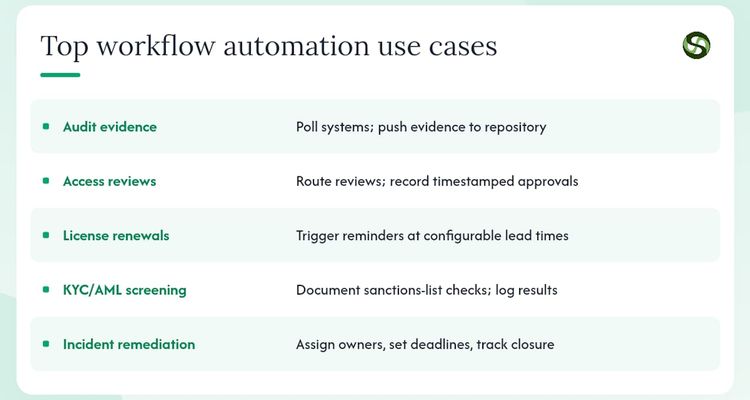
The use cases below represent the highest-value starting points for most compliance teams. The specific triggers and evidence types differ by industry, but the underlying pattern is the same: a deadline or a recurring obligation that must be documented.
Evidence collection for audits (all industries): Automated workflows poll systems, collect screenshots and approvals, and push assembled evidence packages to a compliance repository. SOC 2 Type II audits, in particular, require continuous evidence across a defined audit period. Manual collection for that window is a full-time job; automation makes it a background process.
Periodic access reviews (technology and finance): User access to sensitive systems must be reviewed on a defined schedule. Automation routes the review to the right manager, records the approval or removal decision with a timestamp, and escalates non-responses. The Basel Committee’s operational resilience guidance sets supervisory expectations for financial institutions that make timely, auditable access controls a regulatory requirement, not just a best practice.
License and certification renewals (healthcare, manufacturing, HR): Expiry dates for professional licenses, facility permits, and employee certifications trigger reminder workflows at configurable lead times. The role of expiry alerts in HR compliance is particularly acute in healthcare, where a lapsed clinical license creates both a patient safety and a regulatory exposure.
KYC/AML screening workflows (financial services): Customer onboarding and periodic re-screening require documented evidence that sanctions lists were checked, adverse media was reviewed, and risk ratings were assigned. FATF guidance on AML program expectations reinforces the need for continuous monitoring and documented screening workflows. Automation ensures the screening step cannot be skipped and logs the result.
Supplier compliance checks (procurement): Vendor insurance certificates, SOC 2 reports, and regulatory certifications all carry expiry dates. Automated workflows track those dates, request updated documents from suppliers, and flag gaps before a contract renewal or an audit. See how supplier compliance tracking works for procurement teams for a practical breakdown of this workflow.
Incident remediation tracking (all industries): When a compliance finding or a control failure is identified, a remediation workflow assigns owners, sets deadlines, and tracks closure. Without automation, remediation items sit in spreadsheets and age past their target dates.
Inspection and maintenance scheduling (manufacturing, facilities): Inspection deadline automation prevents the scenario where a facility permit lapses because an inspection was not scheduled on time.
A cross-cutting note: most of these use cases depend on data from other systems. An access review workflow needs a feed from your identity provider. A license renewal workflow needs expiry dates from your HR system. Integration quality is not a nice-to-have; it determines whether the automation is reliable or just another manual step with a different interface.
What features should compliance teams require from a platform?
Translating product capability language into compliance requirements is where most vendor evaluations go wrong. Teams evaluate features in isolation rather than asking: does this feature satisfy a specific audit or control objective?
| Feature | Compliance requirement it satisfies |
|---|---|
| Orchestration and triggers | Controls run on schedule and in response to data events, not human memory |
| Append-only audit logging | Tamper-evident record of every action, required for SOC 2 and most regulated-industry frameworks |
| Evidence tagging | Documents and approvals are attached to the specific control they satisfy, not stored in a generic folder |
| IDP and HR integrations | Access reviews and certification workflows pull live data rather than relying on manually updated lists |
| Role-based approvals | Only authorized personnel can approve a control step, with the approval recorded against their identity |
| SLA and escalation rules | Overdue tasks are automatically escalated before a deadline is missed, not after |
| Reporting and dashboards | Real-time control status is available to compliance leaders without running a manual report |
| Data security controls | Role-based access, encryption at rest and in transit, and data residency options for regulated data |
On the no-code versus code-first question: no-code platforms accelerate adoption for cross-functional compliance teams and reduce dependence on IT for small, high-value pilots. The tradeoff is governance. No-code tools can make it too easy for non-technical users to modify production workflows without a change-control review. The right answer is a platform that offers no-code design with enforced versioning and approval gates for changes to live workflows.
How to implement compliance workflow automation in phases
A phased rollout reduces risk and builds the organizational confidence that sustains a larger program. Here is a practical sequence:
- Map your highest-risk manual processes. Identify the three obligations where a missed deadline or a documentation gap creates the most regulatory or operational exposure. These become your pilot workflows.
- Define workflow owners and approvers. Every workflow needs a named owner who is accountable for its accuracy and a designated approver for exceptions. Document these roles before you build anything.
- Integrate your source systems. Connect the platform to the HR, identity, document, and line-of-business systems that hold the data your workflows need. Incomplete integrations are the leading cause of pilot failures.
- Build and test the pilot workflows. Run each workflow in a test environment with real data scenarios, including edge cases and exceptions. Validate that the audit log captures what an auditor would expect to see.
- Validate with your audit team. Before go-live, walk an internal auditor or your external auditor’s representative through the workflow output. Confirm the evidence format and log structure meet their requirements.
- Train users and document procedures. Compliance staff need to understand what the workflow does, what their role is when it escalates, and how to handle exceptions. Change management is where most pilots stall.
- Go live on the pilot workflows and measure. Track missed-deadline rate, audit response time, and exception volume for 60–90 days before expanding.
- Expand by control family. After the pilot succeeds, add workflows for the next control family (e.g., move from license renewals to vendor compliance checks). Avoid trying to automate everything at once.
For governance, maintain a workflow change-control log, version all workflow definitions, set a retention policy for audit logs that matches your regulatory requirements, and schedule a quarterly review of workflow accuracy against current policy. A deadline escalation workflow guide can help you design the escalation and reminder logic for each phase.
How to measure success: KPIs and a simple ROI calculation
Measuring the value of compliance automation requires tracking a small set of operational metrics before and after implementation. Here is a practical set:
| KPI | How to collect it from automated workflows |
|---|---|
| Missed-deadline rate | Count of workflows that reached their due date without completion, divided by total workflows in the period |
| Audit evidence response time | Time from auditor request to evidence delivery, logged in the workflow system |
| Time per compliance review | Average staff hours per review cycle, compared to pre-automation baseline |
| Exception volume | Number of tasks escalated per period; a declining trend indicates improving process quality |
| Cost per compliance action | Staff hours per action multiplied by loaded hourly rate; compare pre- and post-automation |
A simple ROI formula: (Hours saved per year × loaded hourly rate) + (Penalty risk reduction) − (Annual platform cost) = Net annual value.
A worked example using conservative assumptions: a compliance team of five people spends an average of four hours per week assembling evidence and chasing approvals manually. Automation reduces that to one hour per week. That is 15 hours per week recovered, or roughly 780 hours per year. At a loaded hourly rate of $75, that is $58,500 in recovered staff capacity annually. Add the avoided cost of a single missed renewal penalty (which can range from hundreds to tens of thousands of dollars depending on the license type) and the ROI case is straightforward for most mid-market organizations.
How Expiryedge operationalizes deadline-driven compliance
Expiryedge is built specifically for the compliance use cases described throughout this article. Its core design is date-driven: every tracked item has an expiry or due date, and the platform fires multi-channel reminders, escalations, and task assignments automatically as that date approaches.
Here is how a license renewal workflow runs in Expiryedge:
- 90 days out: Automated reminder sent to the license owner with a task to initiate the renewal application.
- 60 days out: Second reminder with an escalation to the compliance manager if the task is not marked in progress.
- 30 days out: Final reminder with an escalation to the department head and a dashboard flag visible to the compliance team.
- Renewal complete: Owner uploads the renewed license document, which is tagged to the compliance record and logged with a timestamp.
- Audit request: The compliance manager pulls the full audit trail, showing every reminder, every escalation, every approval, and the attached document, in a single exportable log.
Expected outcomes for teams that move from spreadsheet-based tracking to Expiryedge include fewer missed renewals, reduced time spent on manual follow-up, and centralized evidence that cuts audit preparation time. The platform also supports automated compliance tracking for contracts, certifications, vendor agreements, and inspection schedules from the same dashboard, so compliance leaders get a single view of all deadline-driven obligations rather than managing separate trackers by category.
Common pitfalls when automating compliance workflows
Automation does not eliminate compliance risk. It shifts where the risk lives. The most common pitfalls are:
- Poor data quality at the source. A workflow that fires on an expiry date is only as reliable as the expiry dates in your system. Audit and clean source data before building workflows, not after.
- Over-automating judgment calls. Some compliance decisions require human judgment: a risk rating that depends on context, a waiver that requires legal review. Automating these without a human-in-the-loop gate creates a false sense of coverage.
- No change control on production workflows. Allowing edits to live workflows without versioning and approval means your audit log may not match your documented procedures. Lock production workflows and require a formal change request for any modification.
- Integration gaps that create silent failures. A workflow that cannot reach its source system will fail silently if there is no error alerting. Build integration health checks into your monitoring.
- Auditor validation skipped at go-live. The most expensive mistake is building a workflow, running it for a year, and then discovering at audit that the log format does not satisfy the auditor’s evidence requirements. Validate early.
Pro Tip: Preserve human-in-the-loop gates for any compliance decision that involves a risk rating, a waiver, or a regulatory interpretation. Automation should enforce the process and capture the decision; the judgment itself stays with a qualified person.
On vendor lock-in: prefer platforms with open APIs and standard data export formats. If you ever need to migrate your compliance records, you need to be able to extract your audit logs in a format another system can ingest. API-first integration practices reduce switching costs and keep your data portable.
What compliance leaders should do next
Workflow automation is not a future-state aspiration for compliance teams. The regulatory environment in the United States, from FDA FSMA’s documented preventive controls to DOJ’s enforcement emphasis on recordkeeping, already expects the kind of auditable, timestamped evidence that only automation produces reliably at scale.
Three immediate next steps for a compliance leader ready to act:
- Identify one to three priority workflows where a missed deadline or a documentation gap creates the highest regulatory or operational exposure. License renewals, periodic access reviews, and supplier certificate tracking are the most common starting points.
- Secure an executive sponsor who can unblock integration access and change-management resources. Pilots that stall usually stall because IT access or budget approval is stuck, not because the technology is wrong.
- Define pilot success KPIs before you start. Agree on the baseline metrics (current missed-deadline rate, current audit response time, current hours per review cycle) so you have a before-and-after comparison that makes the ROI case for the full program.
Start with a 60–90 day pilot on your highest-risk workflow. Measure, adjust, and expand from there.
The adoption challenge most articles skip
Most implementation guides treat compliance automation as a technology problem. It is not. The technology is the easy part. The hard part is getting the compliance team, the IT team, and the business units to agree on who owns each workflow, what the escalation path looks like, and what happens when a workflow fires incorrectly.
Budget more time for stakeholder alignment than you think you need. A realistic pilot timeline for a mid-market organization is 60–90 days from kickoff to a validated, auditor-reviewed workflow. Teams that rush this phase tend to go live with workflows that satisfy the platform’s requirements but not the auditor’s. The governance work, defining owners, locking change controls, and validating log formats, is not overhead. It is the compliance work.
One more thing worth saying plainly: automation does not make compliance easier by removing judgment. It makes compliance more reliable by removing the parts that should never have required judgment in the first place. The deadline reminder, the evidence attachment, the escalation to the right manager: none of those should depend on someone remembering. Free your team from the remembering so they can focus on the deciding.
Expiryedge: deadline-driven compliance automation built for your team
Missed renewals and fragmented audit evidence are expensive problems with a straightforward fix. Expiryedge gives compliance teams a centralized platform where every license, certification, contract, and regulatory obligation has a deadline, an owner, and an automated workflow behind it.

Multi-channel reminders fire at configurable lead times. Escalations route automatically when tasks go overdue. Every action is logged with a timestamp and attached to the relevant compliance record, so your audit trail builds itself as work gets done. From contract expiry and renewal management to supplier certificate tracking and inspection scheduling, Expiryedge covers the full range of deadline-driven compliance obligations from one dashboard.
Start with one to three of your highest-risk workflows. Most teams see measurable results within the first 60–90 days. Try Expiryedge and bring your first pilot workflow live before your next audit cycle opens.
Sources
- Compliance workflow automation: making SOC 2, GDPR, and ISO auditable by design | Tines
- IBM — Workflow automation overview
- Justice
This article is general information, not a substitute for advice from a qualified lawyer. Consult a qualified legal professional about your own circumstances before acting on anything here.
FAQ
Why is workflow automation important for compliance teams?
Workflow automation ensures that compliance controls run on schedule, capture timestamped evidence automatically, and escalate overdue tasks without human intervention. This reduces the documentation gaps and missed deadlines that regulators and auditors most commonly cite as enforcement risk.
What is a compliance workflow?
A compliance workflow is a defined sequence of tasks, approvals, and evidence-capture steps that executes a regulatory control or internal policy obligation. Automated compliance workflows fire on a trigger or schedule and log every action for audit purposes.
What is compliance automation?
Compliance automation is the use of software to execute, document, and monitor regulatory and policy obligations without manual intervention at each step. It covers everything from license renewal reminders and access reviews to KYC screening and audit evidence collection.
What does the compliance process workflow look like in practice?
A typical automated compliance workflow starts with a trigger (an approaching expiry date or a scheduled review), routes tasks to the assigned owner, sends escalation alerts if the task goes overdue, captures the completed evidence or approval with a timestamp, and closes the loop with a logged record available for audit. Platforms like Expiryedge handle this sequence for deadline-driven obligations across licenses, certifications, contracts, and inspections.
How do you measure the ROI of compliance workflow automation?
Calculate hours saved per year multiplied by the loaded hourly rate, add the avoided cost of missed-deadline penalties, and subtract the annual platform cost. A team recovering 780 staff hours per year at a $75 loaded rate recovers $58,500 in capacity before accounting for penalty avoidance.
Recommended
Frequently asked questions
A compliance workflow is a defined sequence of tasks, approvals, and evidence-capture steps that executes a regulatory control or internal policy obligation. Automated compliance workflows fire on a trigger or schedule and log every action for audit purposes.
Compliance automation is the use of software to execute, document, and monitor regulatory and policy obligations without manual intervention at each step. It covers everything from license renewal reminders and access reviews to KYC screening and audit evidence collection.
A typical automated compliance workflow starts with a trigger (an approaching expiry date or a scheduled review), routes tasks to the assigned owner, sends escalation alerts if the task goes overdue, captures the completed evidence or approval with a timestamp, and closes the loop with a logged record available for audit. Platforms like Expiryedge handle this sequence for deadline-driven obligations across licenses, certifications, contracts, and inspections.
Calculate hours saved per year multiplied by the loaded hourly rate, add the avoided cost of missed-deadline penalties, and subtract the annual platform cost. A team recovering 780 staff hours per year at a $75 loaded rate recovers $58,500 in capacity before accounting for penalty avoidance.