
Why Clinical Certifications Must Stay Current

Why Clinical Certifications Must Stay Current

Clinical certifications must stay current because The Joint Commission, the Centers for Medicare & Medicaid Services (CMS), and state licensing boards all require documented, verified credentials before a provider can legally deliver care, bill for services, or maintain accreditation. A single lapsed certification can trigger a survey citation, block reimbursement, or pull a clinician from the schedule mid-shift.
The three consequences that matter most to healthcare managers are:
- Accreditation and billing risk: Expired credentials expose organizations to Joint Commission citations, CMS reimbursement denials, and potential False Claims Act liability.
- Staffing and service disruption: An ineligible clinician cannot be assigned to patient care, creating immediate coverage gaps and overtime costs.
- Patient safety exposure: Credential lapses correlate with gaps in verified competency, which surveyors treat as a direct quality-of-care concern.
The single most effective control is centralized tracking with monthly verification and timestamped audit trails, managed through a platform like Expiryedge.
Key Takeaways
Clinical certifications must stay current because The Joint Commission, CMS, and state boards require verified, documented credentials throughout the care cycle, not just at hire.
| Point | Details |
|---|---|
| Monthly verification is now required | The Joint Commission’s 2025 updates mandate monthly credential monitoring; annual checks no longer satisfy survey expectations. |
| 30-day intra-cycle window | Organizations have 30 days to submit missing monthly data before a Joint Commission intra-cycle review becomes a formal finding. |
| Ownership beats reminders | Assign one named owner per credential category with a documented escalation ladder at 90, 60, and 30 days before expiration. |
| PSV evidence is non-negotiable | Every credential record needs a timestamped PSV screenshot or PDF; verbal confirmation does not satisfy tracer methodology. |
| Expiryedge centralizes the process | Expiryedge automates alerts, collects PSV-linked documents, and exports audit-ready timestamped records for survey packets. |
Why clinical certifications must stay current: the real cost of a lapse
Most compliance failures in healthcare do not start with a clinical error. According to fragmented credential tracking practices, organizations most often fall out of compliance because renewals are scattered across spreadsheets and shared drives, not because staff lack the skills to renew. The documentation gap is the problem.
Operational consequences hit first and fastest:
- A nurse whose BLS expires cannot be assigned to a patient care unit until the credential is restored.
- A physician with a lapsed state license is ineligible for billing, regardless of clinical competence.
- Multi-site clinics face compounding risk when one site’s gap triggers a system-wide survey review.
Legal and financial exposure follows quickly. CMS can deny reimbursement for services rendered by a provider whose credentials were not current at the time of service. Under the False Claims Act, knowingly billing for services by an ineligible provider creates liability that extends beyond the claim itself. Survey citations from The Joint Commission can escalate to Requirement for Improvement (RFI) status, and repeated findings can threaten accreditation.
Patient safety is the dimension that tends to get underweighted in budget conversations. Surveyors using tracer methodology will follow a patient’s care episode and check every credential of every provider who touched that patient. A gap in one record becomes a finding across the entire episode.
According to Ethico’s analysis of the 2025 Joint Commission updates, manual credentialing processes struggle to scale to monthly monitoring cadences, and the window between monthly checks can still leave a 29-day gap where a license status changes without detection.
What U.S. regulations and accreditation standards actually require
The Joint Commission describes certification as a comprehensive on-site review using tracer methodology, with certification maintained through continuous compliance over a two-year cycle. That two-year cycle is not a grace period. Compliance is expected throughout, and intra-cycle evaluations occur near the one-year midpoint.
For certified programs such as the Comprehensive Cardiac Center, quarterly CMIP reporting of mandatory standardized performance measures is required. Certification is not a one-time achievement. Organizations must submit performance data on schedule or risk findings at the intra-cycle review.
The intra-cycle evaluation process gives organizations 30 days to enter missing monthly data before the review event. Miss that window and the gap becomes a formal finding.
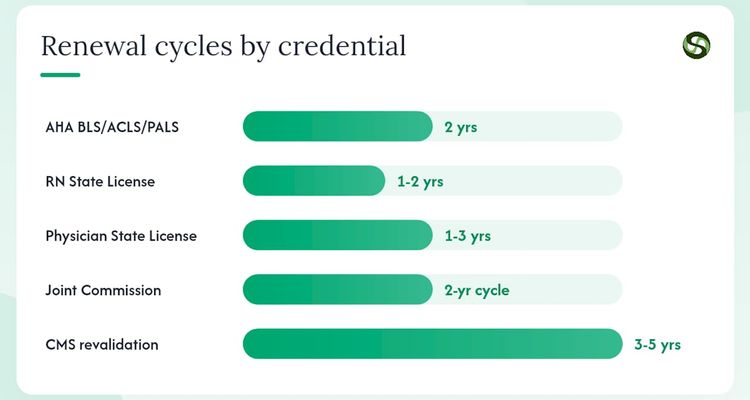
CMS operates on its own timeline, typically tied to provider enrollment and revalidation cycles that run every three to five years depending on provider type. State licensing boards set their own renewal windows, which vary by state and license type.
| Credential | Issuing Body | Typical Renewal Cycle |
|---|---|---|
| BLS (Basic Life Support) | American Heart Association | 2 years |
| ACLS (Advanced Cardiovascular Life Support) | American Heart Association | 2 years |
| PALS (Pediatric Advanced Life Support) | American Heart Association | 2 years |
| RN State License | State Board of Nursing | 1–2 years (varies by state) |
| Physician State License | State Medical Board | 1–3 years (varies by state) |
| Joint Commission Certification | The Joint Commission | 2-year cycle with intra-cycle review |
State boards publish renewal requirements and timelines publicly. For dental staff, resources such as state-specific CE compliance guides illustrate how boards communicate renewal windows and continuing education requirements.
How to track, renew, and document certifications operationally
A certification expiration tracking checklist starts with a single source of truth. Every credential record should capture:
- Credential type and license number
- Issuing body and state of issuance
- Expiration date and renewal-eligible date
- Primary-source verification (PSV) record with timestamp
- Supporting document (certificate, license printout, or PSV screenshot)
- Assigned owner (HR, department manager, or clinician)
Ownership is the variable most organizations underestimate. Reminders without a named owner get ignored. Assign one person per credential category, and document that assignment in your policy.
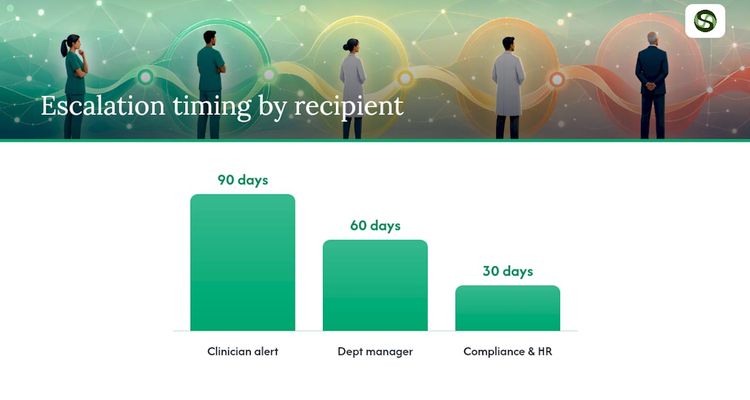
Monthly verification steps should follow this sequence: pull the active credential list, run PSV against the issuing authority, flag any status changes, and escalate any expiration within 90 days to the department manager. Resolved flags get timestamped and filed.
Pro Tip: Design a three-tier escalation ladder: 90 days out, the clinician gets an automated alert; 60 days out, the department manager is notified; 30 days out, the compliance officer and HR director are looped in with a resolution deadline.
For documentation, accepted proof types include PSV screenshots with URL and timestamp, official license printouts, and issuing-body confirmation letters. Store everything in a named folder structure that a surveyor can navigate in under two minutes.
Best practices and internal controls that prevent lapses
The shift The Joint Commission made in 2025 toward monthly credential monitoring reframes credentialing as an ongoing risk-management function, not a periodic HR task. The governance model has to match that cadence.
Core controls that hold up under survey:
- Mandatory monthly verification policy with a documented owner for each credential category
- Automated multi-tier alerts (90/60/30-day thresholds) sent to the clinician, manager, and compliance officer
- Role-based dashboards showing coverage percentage by department and credential type
- Audit trail for every check, including who ran the PSV, when, and what the result was
Pro Tip: Multi-state license portfolios are where shared-responsibility breaks down fastest. Assign one compliance owner per state, not per clinician, and build state-specific renewal calendars into your tracking system.
What surveyors actually look for during audits
Surveyors using tracer methodology do not accept verbal assurances. They want a file they can open and verify in minutes. Audit-ready documentation should include PSV evidence, timestamped checks, a responsible owner, and an organized file structure surveyors can navigate quickly.
An audit packet for a single provider should contain:
- Current license number and expiration date
- PSV screenshot or PDF with timestamp and source URL
- Competency log for the relevant credential period
- Chain-of-custody note showing who verified, when, and how
- CMIP submission confirmation for certified programs (where applicable)
For intra-cycle RFI responses, organizations have 30 days to submit missing monthly data. Prepare a response template in advance with these fields: provider name, credential type, verification date, PSV source, and responsible owner. Attach the PSV evidence as a labeled PDF.
Pro Tip: Run a mock audit quarterly. Pull five random provider records and verify that every required element is present and current. If any record takes more than three minutes to assemble, your documentation process needs tightening.
When does automation make sense for certification tracking?
Manual tracking works at roughly 20–30 providers. Beyond that, the operational burden of manual verification consumes credentialing staff time at a rate that creates both burnout risk and compliance gaps. The decision to automate is less about budget and more about population size and audit frequency.
Procurement checklist for a deadline-tracking solution:
- Continuous monitoring with real-time status alerts (not just monthly batch checks)
- PSV integration or document collection with e-signature capability
- Configurable multi-tier escalation alerts by credential type and role
- Timestamped audit trails exportable for survey packets
- Role-based access for HR, managers, and compliance officers
- HRIS integration to sync provider rosters automatically
- SOC 2 Type II certification for data security
For organizations managing multi-state license portfolios or Joint Commission intra-cycle readiness, license renewal software with automated PSV and configurable escalations closes the gap that monthly manual checks leave open.
Pro Tip: Before buying, ask vendors for a sample audit export. If the export does not include a timestamp, the PSV source, and the owner’s name on every row, it will not satisfy a surveyor.
The lesson most organizations learn too late
The organizations that sail through Joint Commission surveys are not the ones with the most sophisticated credentialing staff. They are the ones that stopped treating certification currency as a reminder problem and started treating it as a governance problem. Ownership beats reminders every time.
A near-miss that comes up repeatedly in compliance conversations: a department manager receives an automated alert that a nurse’s ACLS expires in 28 days. The manager assumes the nurse received the same alert and will handle it. The nurse assumes the manager is tracking it. Neither acts. The credential lapses on a Friday. By Monday, the staffing coordinator has a coverage gap and a compliance flag to explain.
The fix is not a better reminder. It is a policy that names one person responsible for resolution, with a documented escalation path if that person does not act within 48 hours. Culture change follows governance design, not the other way around.
Expiryedge keeps your certification program audit-ready
Expired credentials cost healthcare organizations more than survey citations. They cost coverage, revenue, and staff confidence. Expiryedge is built specifically for deadline-driven compliance work, and clinical certification tracking is one of its core use cases.

The platform centralizes every credential record, runs automated PSV-linked document collection, and sends multi-channel alerts at 90, 60, and 30 days before expiration. For Joint Commission intra-cycle readiness, Expiryedge generates timestamped audit exports that match the evidence format surveyors expect. For multi-site clinics managing multi-state license portfolios, role-based dashboards give compliance officers real-time visibility across every location.
Start a free trial at Expiryedge and run your first 30-day audit-readiness check using the operational checklist in this article.
Sources
- Learn about what it takes to achieve Joint Commission certification
- Joint Commission intra-cycle process and CMIP guidance
- Credential Tracking, Competencies, and Expirations: How Agencies Fall Out of Compliance
- JCAHO 2025 Monthly Credential Monitoring Requirements: Complete Compliance Checklist | Ethico Insights
This article is general information, not a substitute for advice from a qualified lawyer. Consult a qualified legal professional about your own circumstances before acting on anything here.
FAQ
Why do clinical certifications expire in the first place?
Certifications like BLS and ACLS are time-limited because clinical protocols change and competency must be periodically re-verified. Issuing bodies set renewal cycles (typically 1–2 years) to confirm that providers remain current with evidence-based standards.
What happens if a Joint Commission surveyor finds an expired credential?
An expired credential during a survey typically results in a Requirement for Improvement citation. Repeated or widespread findings can escalate to conditional accreditation or, in severe cases, loss of accreditation status.
How often does The Joint Commission require credential verification?
The Joint Commission’s 2025 updates shifted the expectation to monthly monitoring of key credentials, replacing the older annual or biennial re-credentialing model as the primary compliance cadence.
Can Expiryedge handle multi-state license portfolios?
Yes. Expiryedge tracks credentials by state, credential type, and assigned owner, with configurable alerts and role-based dashboards that give compliance officers visibility across every location in a multi-site organization.
What is primary-source verification and why does it matter?
Primary-source verification (PSV) means confirming a credential’s status directly with the issuing authority, such as a state board or the American Heart Association. Surveyors require PSV evidence, not self-reported copies, because it is the only form of verification they treat as definitive.
Recommended
Frequently asked questions
An expired credential during a survey typically results in a Requirement for Improvement citation. Repeated or widespread findings can escalate to conditional accreditation or, in severe cases, loss of accreditation status.
The Joint Commission's 2025 updates shifted the expectation to monthly monitoring of key credentials, replacing the older annual or biennial re-credentialing model as the primary compliance cadence.
Yes. Expiryedge tracks credentials by state, credential type, and assigned owner, with configurable alerts and role-based dashboards that give compliance officers visibility across every location in a multi-site organization.
Primary-source verification (PSV) means confirming a credential's status directly with the issuing authority, such as a state board or the American Heart Association. Surveyors require PSV evidence, not self-reported copies, because it is the only form of verification they treat as definitive.