
Respirator Fit Test Requirements: OSHA 1910.134 Checklist

OSHA's respirator fit test requirements, in 29 CFR 1910.134(f), say anyone wearing a tight-fitting respirator must pass a qualitative or quantitative fit test before first use, whenever the facepiece size, style, model or make changes, and at least annually. A medical evaluation must come first, and each fit test record is kept until the next test.
You have a crew in respirators, a mix of half masks and N95s, and someone asks when everyone was last fit tested and whether they were medically cleared first. This guide gives you the rule in plain English, the order to do things in, and a tracker that shows who is due.
Key takeaways
- Fit testing applies to every tight-fitting facepiece, including filtering facepieces such as N95s, whenever a respirator is required.
- Test before first use, on any change of facepiece size, style, model or make, at least annually, and again when the worker's face or weight changes.
- A medical evaluation by a physician or other licensed health care professional (PLHCP) must come before the fit test. OSHA does not require it every year.
- Appendix A to 1910.134 is mandatory: it lists 4 qualitative and 6 quantitative methods and the 8 test exercises.
- A quantitative test passes at a fit factor of at least 100 for half masks and at least 500 for full facepieces.
- Fit test records must show 5 items and be kept until the next test; medical records follow 29 CFR 1910.1020 (employment plus 30 years).
- Respiratory protection was the 6th most cited OSHA standard in fiscal year 2026.
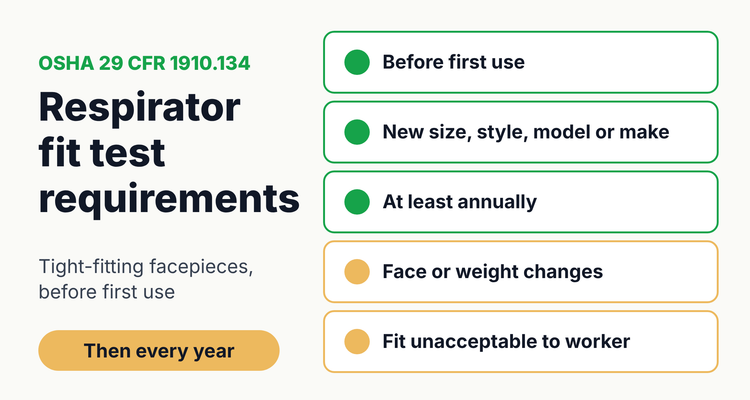 Five events trigger a fit test under 1910.134(f); the annual one is the easiest to miss.
Who needs a respirator fit test?
Every employee who must wear a tight-fitting respirator needs a fit test, whether it is a disposable N95, an elastomeric half mask or a full facepiece. 29 CFR 1910.134(f) applies to "an employee using a tight-fitting facepiece respirator". Loose-fitting hoods and helmets do not form a face seal, so they are not fit tested.
The same rule reaches construction. 29 CFR 1926.103 says the construction requirements "are identical to those set forth at 29 CFR 1910.134", and the construction asbestos and lead standards (1926.1101 and 1926.62, see our guide to asbestos certification types) require a respiratory protection program under 1910.134, including paragraphs (f) through (m). The asbestos standard adds that employers "must not select or use filtering facepiece respirators for use against asbestos fibers".
There is one narrow exception. If an employee chooses to wear a filtering facepiece (dust mask) when no respirator is required, the employer only has to give them the information in Appendix D, not a fit test. States with their own OSHA-approved plans can add rules; California's equivalent, Title 8 section 5144, has the same annual fit test.
What are the respirator fit test requirements for frequency?
OSHA requires a respirator fit test before first use, when the facepiece changes, at least annually, and whenever a change in the worker's face or a complaint about fit calls for a retest. Here are the triggers, one by one:
Respirator fit test triggers under 29 CFR 1910.134 (verified 12 October 2026)
| Trigger | What the standard says | Paragraph |
|---|---|---|
| Before first use | Fit tested "prior to initial use of the respirator" | (f)(2) |
| Different facepiece | "whenever a different respirator facepiece (size, style, model or make) is used" | (f)(2) |
| Annual | "and at least annually thereafter" | (f)(2) |
| Physical change | Additional test when changes "could affect respirator fit", such as "facial scarring, dental changes, cosmetic surgery, or an obvious change in body weight" | (f)(3) |
| Fit unacceptable to the worker | The employee gets "a reasonable opportunity to select a different respirator facepiece and to be retested" | (f)(4) |
| Construction asbestos work | Program under 1910.134 (f) through (m), so at least annually; the non-mandatory Appendix H to 1926.1101 still tells workers "every 6 months" | 1926.1101(h)(2); App. H |
That last row causes real confusion. The mandatory text of the construction asbestos standard points to 1910.134, which sets the annual minimum. The six-month line sits in a non-mandatory information appendix written for workers. Testing more often is always allowed, so if your contracts or training materials say six months, follow the stricter date.
10%
of N95 users in a NIOSH study were predicted to have an unacceptable fit 1 year after a passing test
20%
predicted at 2 years, doubling the share at risk if not retested
24%
of subjects who lost 20 lb or more had an unacceptable fit
Those figures come from a three-year NIOSH study of 229 people (Zhuang and others, Journal of Occupational and Environmental Hygiene, 2016), which concluded that the results "support the current OSHA requirement for annual fit testing".
What must happen before the fit test?
Before a fit test, the employee must have a medical evaluation, and before they use the respirator at work they must be trained. Paragraph (e)(1) says the employer "shall provide a medical evaluation to determine the employee's ability to use a respirator, before the employee is fit tested or required to use the respirator in the workplace".
- Who evaluates: a PLHCP, using the Appendix C questionnaire or an exam that gets the same information. A positive answer to questions 1 to 8 in Section 2, Part A triggers a follow-up exam.
- What the employer gets back: a written recommendation covering only limitations, any need for follow-up, and confirmation that the employee received a copy. Not the medical details.
- Cost and timing: respirators, training and medical evaluations are "at no cost to the employee" (c)(4), and the questionnaire is given confidentially during normal working hours or at a convenient time and place (e)(4).
- How often: there is no fixed cycle. OSHA's 2004 interpretation letter says "There is not a specific annual requirement for medical evaluations in the standard", though the PLHCP may prescribe annual tests.
- When to re-evaluate: when the employee reports symptoms, when a PLHCP, supervisor or program administrator asks, when fit testing or program evaluation shows a need, or when work conditions add a substantial physical burden (e)(7).
- Training: before first use, then "annually, and when" the workplace or respirator changes or the worker's knowledge falls short (k)(3) and (k)(5).
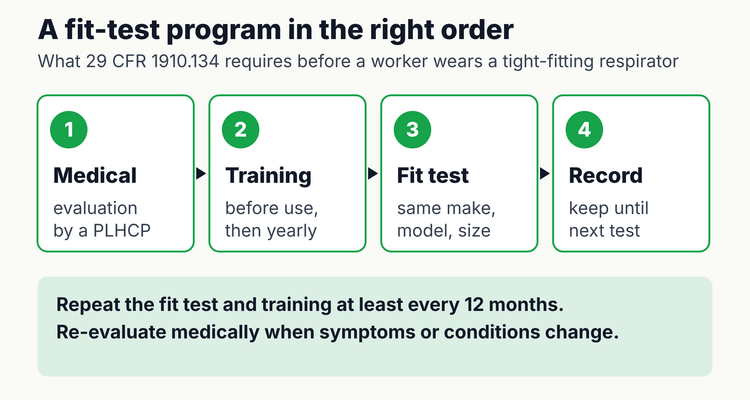 Get the order right: medical evaluation, training, fit test, record. Then repeat the fit test and training yearly.
What does OSHA Appendix A require during a fit test?
Appendix A to 1910.134 is mandatory and sets out how every fit test is run, which methods are accepted and what counts as a pass. Here is the process it describes, in order:
- Let the worker choose. The test subject picks the most acceptable respirator from "a sufficient number of respirator models and sizes", with a mirror available.
- Wear it first. The chosen mask is worn for at least 5 minutes to assess comfort before the test starts.
- Do a user seal check. Positive and negative pressure checks (Appendix B-1) or the manufacturer's equivalent. Fail it and select another facepiece.
- Check the face. The test "shall not be conducted if there is any hair growth between the skin and the facepiece sealing surface", including stubble.
- Wear the real kit. Test with any safety equipment, such as eye protection, that will be worn on the job.
- Run the exercises. Normal breathing, deep breathing, head side to side, head up and down, talking, grimace (quantitative only, 15 seconds), bending over, normal breathing. Each lasts one minute except the grimace.
- Don't adjust. "Any adjustment voids the test, and the fit test must be repeated."
- Ask about comfort. If the respirator has become unacceptable, try another model.
OSHA-accepted fit test methods in Appendix A (verified 12 October 2026)
| Type | Methods listed | Pass criterion | Limits |
|---|---|---|---|
| Qualitative (QLFT): pass/fail by taste, smell or irritation | Isoamyl acetate; saccharin; Bitrex; irritant smoke (stannic chloride) | Subject does not detect the test agent | Only for negative pressure air-purifying respirators that need a fit factor of 100 or less (f)(6). Isoamyl acetate is not for particulate filters unless an organic vapor filter is fitted |
| Quantitative (QNFT): measured leakage | Generated aerosol; ambient aerosol condensation nuclei counter (CNC); two modified CNC protocols (elastomeric masks, filtering facepieces); controlled negative pressure (CNP); CNP REDON | Fit factor of at least 100 (half facepiece) or at least 500 (full facepiece) (f)(7) | Modified CNC and CNP protocols use their own exercise sets in Appendix A |
Tight-fitting powered air-purifying and supplied-air respirators are tested in negative pressure mode, "regardless of the mode of operation" used on the job (f)(8).
What fit test records does OSHA require?
OSHA requires a written record of every fit test with five details, kept until the next fit test, plus medical records under 1910.1020 and a copy of the current written program.
Fit test record: the five items in 1910.134(m)(2)
- ✓
Name or identification of the employee tested
- ✓
Type of fit test performed (for example, QLFT saccharin or QNFT ambient aerosol)
- ✓
Specific make, model, style and size of respirator tested
- ✓
Date of the test
- ✓
Pass or fail for a QLFT, or the fit factor and strip chart or other recording for a QNFT
Medical evaluation records must be kept "for at least the duration of employment plus thirty (30) years" under 29 CFR 1910.1020(d)(1)(i). Keep them apart from the training file, because the employer's copy should be the PLHCP's written recommendation, not the questionnaire. All of these records must be available to affected employees and to OSHA on request (m)(4).
How do you run a respirator fit test program for crews?
Run it as a calendar, not a scramble: one row per worker and respirator, a fixed testing month, and reminders before each worker's anniversary.
Do this now: a first-30-days plan (no software needed)
- Day 1 (1 hour): list every employee who must wear a tight-fitting respirator, and the exact make, model, style and size each one uses. Anyone without a model on record needs a test.
- Day 2 (30 minutes): check each person has a written PLHCP recommendation on file. No recommendation means no fit test yet.
- Week 1: book fit testing for anyone past 12 months, anyone with no record, and anyone who changed model. Ask the tester for records with all five (m)(2) items.
- Week 2: run or refresh respirator training for anyone past 12 months, and record the date.
- Week 3: build the tracker below and set reminders at 60 and 30 days before each due date.
- Week 4: pick one testing month per year for the whole crew, so new starters are pulled into the same cycle at their next test.
Fit test tracker: columns and formulas (row 2 = first employee)
| Column | Header | What goes in it |
|---|---|---|
| A | Employee | One row per employee per respirator |
| B | Respirator | Make, model, style and size |
| C | Medical clearance date | Date of the PLHCP written recommendation |
| D | Limitations | From the recommendation, e.g. PAPR only |
| E | Last fit test | Date of the last pass |
| F | Method and result | e.g. QNFT CNC, fit factor 180 |
| G | Fit test due | =IF(E2="",TODAY(),EDATE(E2,12)) |
| H | Last training | Date |
| I | Training due | =IF(H2="",TODAY(),EDATE(H2,12)) |
| J | Next due | =MIN(G2,I2) |
| K | Days left | =J2-TODAY() |
| L | Status | =IF(C2="","NO MEDICAL",IF(K2<0,"OVERDUE",IF(K2<=30,"BOOK NOW","OK"))) |
Add two conditional formatting rules on column K: red when =$K2<=30, amber when =$K2<=60. Sort by column K each Monday. A blank test date shows as due today, so missing records stand out. These lead times are our working advice, not a rule.
💡 Pro Tip
Record the exact model and size, not just "half mask". The rule ties the test to a "different respirator facepiece (size, style, model or make)", so when purchasing switches brands, your tracker can show in one filter who needs retesting before the new stock is handed out.
How can you go beyond bare compliance?
- Stock two or three models and sizes so the Appendix A selection step has real choice and fewer people fail.
- Ask about weight change at each test. NIOSH found 24% of people who lost 20 lb or more no longer had an acceptable fit.
- Write a facial hair policy that matches the rule: hair that crosses the seal means no tight-fitting respirator.
- Collect proof from new hires. Training received in the last 12 months can count under (k)(4), but only if documented, and it still has to be repeated within 12 months of that date.
What happens if you miss a respirator fit test?
If a fit test is missed, the employee cannot be required to wear that tight-fitting respirator until they pass a new one, and the employer is exposed to a citation.
⚠️What happens if you miss it: 1910.134(f)(2) requires the test before use and "at least annually thereafter", so an overdue worker in a required respirator is out of compliance on every shift. OSHA's maximum penalty is $16,550 per serious or other-than-serious violation and $165,514 per willful or repeated violation (29 CFR 1903.15(d)). Respiratory protection was the 6th most frequently cited OSHA standard in fiscal year 2026.
Spreadsheet or software?
A spreadsheet works for a single crew: the tracker above shows who needs a test, training or medical clearance. It strains when you have several sites, multiple respirator models, subcontracted crews, and fit tests sitting next to asbestos and lead certification renewals on different cycles, or when you must show who was cleared and tested on a given date.
ExpiryEdge holds each worker's fit test, training and certificates as records with an owner and backup, the test record attached, reminders at 90, 60, 30 and 7 days by email, SMS, Slack or Teams, and an audit trail. See how that works for environmental contractors, read the wider guide to employee certification tracking, and use the free contractor document tracker for subcontractor crews.
Frequently asked questions
How often is a respirator fit test required by OSHA?
At least once a year. 29 CFR 1910.134(f)(2) requires a fit test before first use, whenever a different facepiece size, style, model or make is used, and at least annually after that. An extra test is needed when changes such as weight loss or dental work could affect the fit.
Do N95 respirators need a fit test?
Yes, when the N95 is required. A filtering facepiece is a tight-fitting respirator, so it needs a fit test under 1910.134(f). The exception is voluntary use when no respirator is required; then the employer only provides the Appendix D information.
Is a medical evaluation required every year for respirator users?
No. A medical evaluation is required before the first fit test or required use. OSHA's 2004 interpretation says there is no specific annual requirement, but the PLHCP may prescribe annual checks, and re-evaluation is required when symptoms or work conditions change.
What is the difference between qualitative and quantitative fit testing?
A qualitative test is pass or fail: the worker reports whether they can detect a test agent such as saccharin or Bitrex. A quantitative test measures leakage and gives a fit factor. Qualitative tests are only allowed for negative pressure air-purifying respirators that need a fit factor of 100 or less.
How long do you keep respirator fit test records?
Until the next fit test is administered, under 1910.134(m)(2)(ii). The record must show the employee, test type, respirator make, model, style and size, the date, and the result. Medical evaluation records are kept for the length of employment plus 30 years under 29 CFR 1910.1020.
Can someone with a beard be fit tested?
Not if the hair crosses the sealing surface. Appendix A says the test shall not be conducted if there is hair growth between the skin and the facepiece seal, including stubble, and 1910.134(g)(1) bars tight-fitting respirators in that case. Loose-fitting respirators are an option to discuss with the program administrator.
Sources
- 29 CFR 1910.134, Respiratory protection, including Appendices A, C and D (eCFR)
- 29 CFR 1926.103, Respiratory protection in construction (eCFR)
- 29 CFR 1926.1101, Asbestos in construction, including Appendix H (eCFR)
- 29 CFR 1926.62, Lead in construction (eCFR)
- 29 CFR 1910.1020, Access to employee exposure and medical records (eCFR)
- 29 CFR 1903.15, Proposed penalties (eCFR)
- OSHA: Penalties
- OSHA: Top 10 Most Frequently Cited Standards (updated 10/5/26)
- OSHA interpretation, October 21, 2004: medical evaluations
- OSHA interpretation, October 16, 1998: annual fit testing
- NIOSH: New study supports OSHA annual fit testing requirements
- Zhuang Z. et al., Temporal changes in filtering-facepiece respirator fit, J Occup Environ Hyg 2016 (PubMed)
- Cal/OSHA: Title 8 section 5144, Respiratory protection
Last reviewed: 12 October 2026
Frequently asked questions
Yes, when the N95 is required. A filtering facepiece is a tight-fitting respirator, so it needs a fit test under 1910.134(f). The exception is voluntary use when no respirator is required; then the employer only provides the Appendix D information.
No. A medical evaluation is required before the first fit test or required use. OSHA's 2004 interpretation says there is no specific annual requirement, but the PLHCP may prescribe annual checks, and re-evaluation is required when symptoms or work conditions change.
A qualitative test is pass or fail: the worker reports whether they can detect a test agent such as saccharin or Bitrex. A quantitative test measures leakage and gives a fit factor. Qualitative tests are only allowed for negative pressure air-purifying respirators that need a fit factor of 100 or less.
Until the next fit test is administered, under 1910.134(m)(2)(ii). The record must show the employee, test type, respirator make, model, style and size, the date, and the result. Medical evaluation records are kept for the length of employment plus 30 years under 29 CFR 1910.1020.
Not if the hair crosses the sealing surface. Appendix A says the test shall not be conducted if there is hair growth between the skin and the facepiece seal, including stubble, and 1910.134(g)(1) bars tight-fitting respirators in that case. Loose-fitting respirators are an option to discuss with the program administrator.
Not medical, clinical, or HIPAA compliance advice
This article is for general informational purposes and does not constitute clinical or HIPAA compliance advice. ExpiryEdge is not currently a HIPAA Business Associate. Healthcare organisations handling Protected Health Information should review the specifics of their compliance programme with a qualified privacy officer or HIPAA consultant.


