
Lead Inspector Certification Renewal: EPA and State Rules

Lead inspector certification renews every 3 years where EPA runs the program. You take an accredited 8-hour refresher, apply online and must hold the new certificate before the old one expires; EPA advises applying 90 days ahead. Most states run their own programs on other cycles: Texas and Wisconsin certify for 2 years, Georgia for 12 months.
Your card is coming up for renewal, or you manage a team of inspectors and risk assessors and can't tell whose certificate expires when, or under which program. This guide shows who certifies you, what each renewal needs and when, and a tracker you can set up in 20 minutes.
Key takeaways
- EPA runs the lead-based paint activities program in 11 states (Alaska, Arizona, Florida, Idaho, Montana, Nevada, New Mexico, New York, South Carolina, South Dakota and Wyoming), four territories and most Tribal lands. Every other state has its own EPA-authorized program.
- Under EPA, inspectors and risk assessors recertify every 3 years (5 years if their course used a proficiency test), after an accredited refresher of at least 8 hours.
- EPA says your new certificate must be issued before the current one expires. It recommends applying at least 90 days ahead and refreshing no earlier than 18 months before expiry.
- If an EPA certification lapses, you retake the accredited course and reapply for initial certification, including the third-party exam where required.
- Texas and Wisconsin certify for 2 years; Georgia certifications run for 12 months; Michigan requires an annual renewal by March 31 plus a refresher and exam every 3 years.
- Renovation, repair and painting (RRP) certificates are separate: renovators refresh within 5 years, and RRP firms recertify every 5 years.
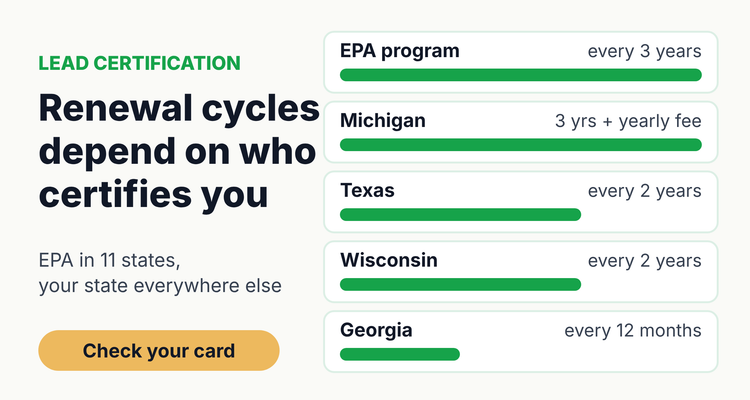 Lead certification cycles depend on who certifies you, not on the course you took.
Who issues lead inspector certification: EPA or your state?
Lead inspector certification is issued by EPA in 11 states and by an EPA-authorized state program everywhere else, so the first step in any renewal is checking which one is printed on your card. EPA's program overview lists the states it administers: Alaska, Arizona, Florida, Idaho, Montana, Nevada, New Mexico, New York, South Carolina, South Dakota and Wyoming, plus American Samoa, Guam, the Northern Mariana Islands, the U.S. Virgin Islands and most Tribal lands.
The federal rules are in 40 CFR Part 745. Subpart L covers lead-based paint activities: inspection, risk assessment and abatement in pre-1978 housing and child-occupied facilities. Subpart E covers renovation, repair and painting. They are separate programs with separate certificates.
The disciplines matter for renewal. EPA's certification page says inspectors "may perform inspection and post-abatement dust-lead testing activities", while risk assessors may also do lead hazard screens and risk assessments. Under 40 CFR 745.226(b), a risk assessor must first complete the accredited inspector course, which is why some states ask risk assessors to take two refreshers.
How does EPA lead inspector certification renewal work?
EPA lead inspector certification renewal means taking an accredited refresher, then applying online and receiving a new certificate before your current one expires. The rule is 40 CFR 745.226(e): a certified individual must be re-certified "every 3 years if the individual completed a training course with a course test and hands-on assessment" or "every 5 years if the individual completed a training course with a proficiency test".
In practice, EPA's own certification page simply says "You must be recertified every three years. Your EPA certificate will indicate when your certification expires." Use the date on the certificate, not the date you took the course.
EPA lead inspector and risk assessor renewal rules (verified 12 October 2026)
| Requirement | What the rule or EPA says | Where it is set |
|---|---|---|
| Cycle | Every 3 years (5 if the course used a proficiency test) | 40 CFR 745.226(e)(1) |
| Refresher length | At least 8 training hours, with a hands-on component, for inspector and risk assessor | 40 CFR 745.225(e)(2) |
| Refresher per discipline | "You must take an accredited refresher training course for each discipline in which you are certified" | EPA individual recertification page |
| When to refresh | EPA recommends no earlier than 18 months before expiry; you do not lose time by refreshing early | EPA individual recertification page |
| When to apply | EPA recommends applying online no later than 90 days before expiry | EPA individual recertification page |
| Deadline | Refresher, application and new certificate all completed before the current certificate expires | EPA individual recertification page |
| New term | The new certificate begins on your current expiration date and runs 3 years | EPA individual recertification page |
| Exam | No third-party exam for recertification | EPA individual recertification page |
| Fee | $410 for inspector or risk assessor re-certification | 40 CFR 745.238(c) |
| What to upload | PDF of the refresher certificate, a passport photo taken within 6 months, and payment | EPA individual recertification page |
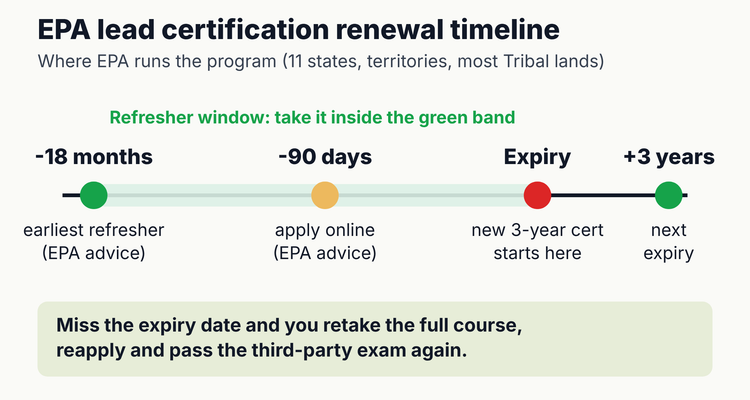 Refreshing early costs nothing under EPA: the new certificate still starts on your old expiry date.
How do state lead inspector certification rules differ?
State programs set their own terms, refresher windows and late rules, so a renewal plan built for EPA can fail in a state program. We checked four authorized states against their rules and agency pages on 12 October 2026.
Lead inspector certification renewal by program: EPA and four state examples (last verified 12 October 2026)
| Program | Term | Refresher and filing | If it lapses | Official source |
|---|---|---|---|---|
| EPA (AK, AZ, FL, ID, MT, NV, NM, NY, SC, SD, WY, territories, most Tribal lands) | 3 years | Refresher: 8-hour refresher per discipline; EPA advises no earlier than 18 months before expiry. Filing: apply online; EPA advises 90+ days before expiry | No work; retake course and reapply, with exam if required | 40 CFR 745.226(e); epa.gov/lead |
| Texas (Department of State Health Services) | 2 years | Refresher: Inspector refresher no sooner than 180 days before expiry; risk assessors take inspector and risk assessor refreshers. Filing: complete renewal application no later than 30 days before expiry | Late fees up to 1 year; after 1 year, apply as new, including the exam | 25 TAC 295.206, 295.207; DSHS certification FAQ |
| Wisconsin (Department of Health Services) | 2 years | Refresher: One-day refresher every 2 years; DHS notes no Wisconsin provider currently offers it and lists alternatives. Filing: recertify before expiry or within 12 months after | No work after the card expires; over 12 months, initial course again | Wis. Admin. Code DHS 163.10, 163.11; dhs.wisconsin.gov |
| Michigan (Department of Health and Human Services) | Annual renewal; recertify every 3 years | Refresher: Refresher plus the third-party exam within 6 months of the course; risk assessors take both inspector and risk assessor. Filing: annual renewal application and fee by March 31 | Rule does not say; confirm with MDHHS | Mich. Admin. Code R 325.99304; MDHHS discipline sheet |
| Georgia (Environmental Protection Division) | 12 months, or the training expiry if earlier | Refresher: Refresher within 24 months of the last training. Filing: renewal application with refresher certificate and fee | Work after expiry is a violation of the rule | Ga. Comp. R. & Regs. 391-3-24-.05 |
Three patterns stand out. Texas punishes early refreshers: a course taken more than 180 days before expiry does not count. Michigan and Texas both make risk assessors refresh in two disciplines. And Wisconsin's own page warns that the one-day refresher "is not currently offered by any Wisconsin provider", so inspectors there need to plan the out-of-state or alternative route early.
What is the difference between individual, firm and RRP lead certification?
Individual lead certification lets a person do the work, firm certification lets the business offer it, and RRP certification covers renovation rather than inspection, so most companies hold several on different clocks.
Lead certificates a company may need to track (federal rules, verified 12 October 2026)
| Certificate | Who holds it | Renewal cycle | Source |
|---|---|---|---|
| Inspector or risk assessor (lead-based paint activities) | Individual | Every 3 years (5 with a proficiency-test course) | 40 CFR 745.226(e) |
| Lead-based paint activities firm | Business | Fees every 3 years | 40 CFR 745.226(f)(7) |
| RRP renovator | Individual | Refresher within 5 years of the initial course; 3 years if the refresher had no hands-on part | 40 CFR 745.90(a)(4) |
| RRP firm | Business | Every 5 years; an application 90 or more days before expiry is timely | 40 CFR 745.89(b) |
| Dust sampling technician | Individual | Certified inspectors and risk assessors may act as one "without further training" | 40 CFR 745.90(a)(3) |
A firm certificate does not cover its people, and a person's certificate does not cover the firm. EPA's rule says a certified firm attests that it "shall only employ appropriately certified employees", so one lapsed inspector can put the firm's work at risk too.
How do you renew lead inspector certification, step by step?
Renew by working back from the expiry date on your current certificate, with the refresher booked first, because courses may not run often in your area.
- Confirm the issuer. Check whether EPA or a state issued each certificate. If you work in several states, list each one separately.
- Find the expiry date. Use the date printed on the certificate or card, not the course date. In Texas, the expiry "is not necessarily the two-year anniversary of the training completion date".
- Check the refresher window. EPA advises no earlier than 18 months before expiry; Texas accepts nothing earlier than 180 days; Georgia wants it within 24 months of the last training.
- Book every refresher you need. Risk assessors in Texas and Michigan need both inspector and risk assessor refreshers. Under EPA, each discipline you hold needs its own refresher.
- Apply as soon as you pass. Under EPA, upload the refresher certificate PDF, a passport photo and payment, ideally 90 or more days before expiry. In Texas, file at least 30 days before.
- Check the new certificate arrived. You are only renewed when the new certificate is issued, so chase it before the old date passes.
- Update the paperwork on site. Texas requires a department-issued ID card and a photo ID at the work site.
Do this now: a 20-minute lead certification audit
You can set this up today with no software. Times are our estimates for a team of up to 10 people.
- Collect the certificates (8 minutes). Every inspector, risk assessor, RRP renovator and firm certificate, with the issuing program.
- Build the tracker below (7 minutes). One row per certificate, not per person.
- Book the nearest deadline (5 minutes). Sort by days left and book the first refresher now.
Lead certification tracker: columns and formulas (row 2 = first record)
| Column | Header | What goes in it |
|---|---|---|
| A | Person or firm | One row per certificate |
| B | Discipline | Inspector, risk assessor, RRP renovator, RRP firm |
| C | Program | EPA, TX, WI, MI, GA and so on |
| D | Certificate number | From the certificate |
| E | Expiry date | From the certificate or card |
| F | Earliest refresher date | EPA: =EDATE(E2,-18) (advice); Texas: =E2-180 (rule) |
| G | Apply-by date | EPA: =E2-90 (advice); Texas: =E2-30 (rule) |
| H | Refresher done | Date of the refresher certificate |
| I | Days to apply-by | =G2-TODAY() |
| J | Status | =IF(E2<TODAY(),"LAPSED",IF(H2>=F2,"Refresher done",IF(I2<=60,"Book refresher","OK"))) |
| K | Owner and backup | Inspector plus office manager |
Format column I red at 30 days or less and amber at 90 or less. Sort by column I every Monday. For a Michigan row, add a second line for the March 31 annual renewal, because it runs on its own date.
Reminder to send at 120 days (template): "Hi [name], your [program] [discipline] certificate expires on [date]. Please book an accredited [discipline] refresher between [earliest refresher date] and [date], and send me the certificate the day you finish. I'll submit the renewal by [apply-by date]. Thanks, [name]."
💡 Pro Tip
Environmental consultancies we work with keep each certificate title as its own record: the EPA or state inspector certificate, the risk assessor certificate, the RRP renovator card and the firm certificate each get an expiry, a file and an owner. A renewed firm certificate then can't hide an individual one that lapsed.
What happens if your lead inspector certification lapses?
If your certification lapses, you must stop lead-based paint activities until you are recertified, and under EPA that usually means starting again from the initial course.
⚠️What happens if you miss it: EPA says that if you do not receive recertification before your current certification expires, "then you cannot conduct lead-based paint activities", and you must retake the course and reapply for initial certification, including any third-party exam. Working uncertified is a prohibited act under TSCA (40 CFR 745.235), and the inflation-adjusted civil penalty maximum is $49,772 per violation for penalties assessed on or after January 8, 2025 (40 CFR 19.4). Texas will not renew a certification expired for a year or more.
What mistakes cause lead inspectors to lapse?
- Treating the refresher as the renewal. Under EPA you also have to apply and receive the new certificate before expiry.
- Refreshing too early in Texas. A refresher taken more than 180 days before expiry does not count there.
- Forgetting the second refresher. Texas and Michigan risk assessors need both inspector and risk assessor refreshers.
- Missing Michigan's annual date. The 3-year refresher cycle does not replace the yearly renewal due by March 31.
- Assuming one certificate travels. An EPA certificate covers states where EPA runs the program. Authorized states issue their own; EPA's page explains the route for state-certified people who want federal certification.
- Losing the 6-month interim window. For new staff, a course completion certificate is interim certification that "shall expire 6 months after issuance" (40 CFR 745.226(b)(4)).
Many lead professionals also hold asbestos credentials and wear respirators. Track those on the same sheet: see asbestos certification types and renewal, asbestos inspector certification requirements and respirator fit test requirements.
Spreadsheet or software?
A spreadsheet is enough for one or two people in one program: the tracker above covers every date that matters. It gets fragile when you have several disciplines per person, people certified in more than one state, firm and RRP certificates, plus asbestos, mold and fit-test dates on other cycles, or when a client asks you to prove who was certified on a given day.
That is where ExpiryEdge earns its place: each certificate is a record with an owner and backup, the scanned certificate attached, reminders at 90, 60, 30 and 7 days by email, SMS, Slack or Teams, and an audit trail. See how it works for environmental contractors and consultancies. For subcontracted inspectors, the free contractor document tracker keeps their certificates in one place.
Frequently asked questions
How often do you renew lead inspector certification?
Where EPA runs the program, every 3 years, or every 5 years if your training course used a proficiency test. State programs differ: Texas and Wisconsin certify for 2 years, Georgia for 12 months, and Michigan requires a yearly renewal plus a refresher and exam every 3 years.
Can I renew my EPA lead certification after it expires?
No. EPA says the refresher, application and new certificate must all be complete before your current certification expires. If not, you must retake the accredited course and reapply for initial certification, including the third-party exam if your discipline requires it.
Do I need to retake the exam to renew lead inspector certification?
Not under EPA: its recertification page says no third-party exam is required. Michigan is different: its rule requires the refresher and the third-party exam every 3 years. Check your state program.
How early can I take the lead inspector refresher course?
EPA recommends no earlier than 18 months before your certification expires, and you do not lose time by refreshing early. Texas does not accept a refresher taken more than 180 days before expiry, and Georgia wants it within 24 months of your last training.
Is RRP certification the same as lead inspector certification?
No. RRP certification covers renovation, repair and painting under 40 CFR 745 Subpart E. Lead inspector certification covers inspections under Subpart L. RRP renovators refresh within 5 years, and RRP firms recertify every 5 years.
How much does EPA lead inspector re-certification cost?
The fee in 40 CFR 745.238 is $410 for inspector or risk assessor re-certification, plus the cost of the accredited refresher course, which training providers set. State programs charge their own fees, such as $325 for two years in Wisconsin.
Sources
- 40 CFR Part 745 (eCFR), including 745.89, 745.90, 745.225, 745.226, 745.235 and 745.238
- 40 CFR 19.4, civil monetary penalty inflation adjustments (eCFR)
- EPA: Lead-Based Paint Abatement and Evaluation Program, Individual Recertification (updated June 25, 2026)
- EPA: Individual Certification
- EPA: Program Overview and authorized state programs
- EPA: Lead Abatement, Inspection and Risk Assessment (updated October 5, 2026)
- 25 TAC 295.206, lead inspector certification (Texas)
- 25 TAC 295.207, lead risk assessor certification (Texas)
- Texas DSHS: Frequently asked questions about certification
- Wis. Admin. Code DHS 163.10 and 163.11
- Wisconsin DHS: Lead inspector
- Mich. Admin. Code R 325.99304, recertification
- Michigan DHHS: Lead risk assessor discipline sheet
- Ga. Comp. R. & Regs. 391-3-24-.05
Last reviewed: 12 October 2026
Frequently asked questions
No. EPA says the refresher, application and new certificate must all be complete before your current certification expires. If not, you must retake the accredited course and reapply for initial certification, including the third-party exam if your discipline requires it.
Not under EPA: its recertification page says no third-party exam is required. Michigan is different: its rule requires the refresher and the third-party exam every 3 years. Check your state program.
EPA recommends no earlier than 18 months before your certification expires, and you do not lose time by refreshing early. Texas does not accept a refresher taken more than 180 days before expiry, and Georgia wants it within 24 months of your last training.
No. RRP certification covers renovation, repair and painting under 40 CFR 745 Subpart E. Lead inspector certification covers inspections under Subpart L. RRP renovators refresh within 5 years, and RRP firms recertify every 5 years.
The fee in 40 CFR 745.238 is $410 for inspector or risk assessor re-certification, plus the cost of the accredited refresher course, which training providers set. State programs charge their own fees, such as $325 for two years in Wisconsin.


