
Asbestos Certification: 5 Types, Yearly Refreshers, State Rules

Asbestos certification under EPA's Model Accreditation Plan comes in five required disciplines: worker, contractor/supervisor, inspector, management planner and project designer. Each needs an initial course and exam, and every certificate expires one year after the course. A yearly refresher, a full day or half day depending on the discipline, extends it one more year.
You run a crew, or the people side of an environmental consultancy, and every person holds two or three asbestos titles, each with its own course date, state card and renewal window. Miss one refresher and that person can't legally work the next job. Below are the federal rules, an 8-state renewal table, a 60-minute audit and a tracking sheet with the formulas written.
Key takeaways
- EPA's Model Accreditation Plan (MAP) requires five disciplines: worker, contractor/supervisor, inspector, management planner and project designer. Project monitor is recommended, not required.
- Initial courses run 4 days (worker), 5 days (supervisor), 3 days (inspector and project designer) and 3 + 2 days (management planner).
- Every certificate expires 1 year after the course and exam; each annual refresher extends it 1 year from the refresher date.
- Refreshers last 1 day for workers, supervisors and project designers, and a half day for inspectors. Management planners take two half days.
- Accredited people must carry their initial and current certificates at the job site. Working without them is grounds for de-accreditation.
- States set their own windows: Texas renews no more than 60 days early, California requires filing at least 60 days before the card expires, and New Jersey asks for 30 days.
- OSHA adds separate clocks: asbestos training at least annually and medical exams at least annually for covered workers.
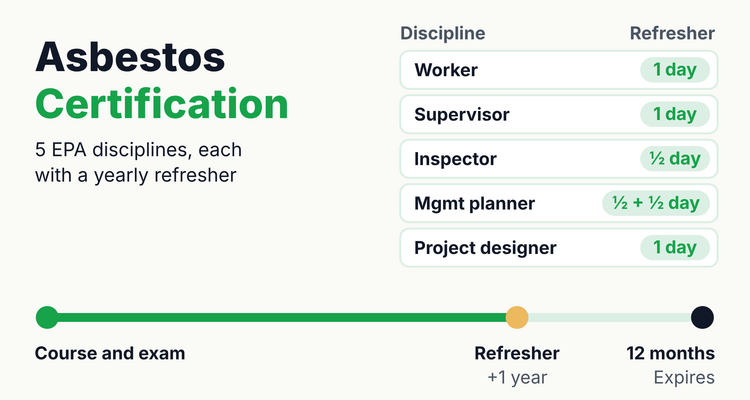 Five federal disciplines, one rule: every asbestos certificate runs out a year after the last course.
What are the 5 types of asbestos certification?
The five required types of asbestos certification are worker, contractor/supervisor, inspector, management planner and project designer, set by the EPA Model Accreditation Plan in 40 CFR Part 763, Subpart E, Appendix C.
The plan comes from the Asbestos Hazard Emergency Response Act (AHERA). It covers work on friable asbestos-containing building material (ACBM) in schools and in public and commercial buildings. States run their own programs, which must be at least as stringent as the MAP, according to EPA's asbestos professionals page.
Asbestos certification types under the EPA Model Accreditation Plan (verified 12 October 2026)
| Discipline | What it lets you do | Initial course | Exam | Annual refresher |
|---|---|---|---|---|
| Worker | Carry out response actions and maintenance that disturb friable ACBM | 4 days, at least 14 hours hands-on | 50 questions, 70% to pass | 1 full day |
| Contractor/supervisor | Supervise those activities; may also work as a worker | 5 days, at least 14 hours hands-on | 100 questions, 70% | 1 full day |
| Inspector | Inspect for ACBM and collect samples | 3 days, 4 hours hands-on | 50 questions, 70% | Half day |
| Management planner | Prepare school management plans | 3-day inspector course + 2-day planner course; current inspector accreditation required | 50 questions, 70% | Half-day inspector + half-day planner |
| Project designer | Design response actions and abatement projects | At least 3 days | 100 questions, 70% | 1 full day |
| Project monitor (recommended only) | Observe abatement for the owner; often clearance air monitoring | EPA suggests 5 days, at least 6 hours hands-on | Set by the state | Set by the state |
One day means 8 hours, including breaks and lunch, under the MAP. Courses must be taught by EPA- or state-approved instructors, and each refresher must be a separate course, not combined with other training.
Which asbestos training is not a certification?
Two common kinds of asbestos training are required but are not MAP accreditation, so track them as separate items:
- OSHA construction training. Under 29 CFR 1926.1101(k)(9), employers train workers doing Class I to IV asbestos work before the first assignment and at least annually after that. Class III training takes at least 16 hours.
- School custodial and maintenance training. Under 40 CFR 763.92, school districts give maintenance and custodial staff at least 2 hours of awareness training, plus 14 more hours for staff who disturb ACBM.
States also add their own titles. New York's Department of Labor (DOL) issues nine certificate codes, including air sampling technician, restricted handler (allied trades) and operations and maintenance.
How does asbestos certification renewal work?
Asbestos certification renewal works on a one-year cycle: the certificate expires one year after the course and exam, and an annual refresher extends it one year from the refresher date.
Appendix C requires every certificate to show a unique number, the discipline, course and exam dates, and "an expiration date of 1 year after the date upon which the person successfully completed the course and examination." It also says: "After completing the annual refresher course, persons shall have their accreditation extended for an additional year from the date of the refresher course."
Three details catch people out:
- The refresher date resets the clock. Taking it early moves next year's deadline earlier too, unless your state says otherwise (Wisconsin's rule is below).
- Your state card can run on a different date. New York says the refresher must be taken every year "regardless of the expiration date on your NYS Department of Labor handler certificate (hard card)."
- Carry both certificates. The MAP says accredited people "must have their initial and current accreditation certificates at the location where they are conducting work."
How do asbestos certification rules differ by state?
Each state that runs an asbestos program sets its own card term, renewal window and paperwork, on top of the federal refresher. We checked eight state programs on their official pages and rules on 12 October 2026.
Asbestos certification renewal rules in 8 states (last verified 12 October 2026)
| State and agency | Term | Renewal timing rule | Also needed | Official source |
|---|---|---|---|---|
| California, Cal/OSHA (consultant and site surveillance technician) | 1 year from issuance | File renewal at least 60 days before the card expires; no renewal after expiry (new application instead) | AHERA refresher certificates that expire after the card; photo; fee ($325 consultant, $270 technician) | dir.ca.gov/DOSH/ACRU/certification_renewal_factSheet.html; 8 CCR 341.15 |
| Massachusetts, Department of Labor Standards | 1 year (all worker, supervisor and consultant licenses) | Apply at least 7 calendar days before expiry (individuals); 30 days for contractor and consulting firms | Current initial and refresher training certificates | 454 CMR 28.07 and 28.08 |
| Minnesota, Department of Health (inspector) | Not stated in the rule; renewal follows each annual refresher | Inspector may keep working up to 30 days after the refresher if the renewal is filed and the diploma is on site | $100 renewal fee; a late refresher counts only within 12 months of the previous diploma's expiry | revisor.mn.gov/rules/4620.3330 |
| New Jersey, Department of Health and Department of Labor (worker, supervisor) | 1 year | Submit at least 30 days before expiry (N.J.A.C. 12:120-5.10); DOH says renewals must be filed within one year of the previous permit's expiry | Evidence of refresher training | nj.gov/health/ceohs/asbestos/asbestos-workers-supervisors/ |
| New York, Department of Labor (codes A to I) | Card date varies | Refresher every year regardless of card date; more than 2 years without one means the initial course again | DOL copy of the DOH-2832 training certificate | forms.labor.ny.gov/WP/SH442.pdf (rev. 12/25) |
| Pennsylvania, Department of Labor and Industry | Annual, through the training certificate's expiry date | One-year grace period for training; allow 2 to 3 weeks for processing | Employer's firm certification must be current before an employee can renew | pa.gov (L&I asbestos certification FAQs) |
| Texas, Department of State Health Services | Not stated in the rule text we checked | Renew no more than 60 days before, or more than 1 year after, expiry | Refresher certificate; physician's statement signed within the last 12 months | 25 TAC 296.42; dshs.texas.gov asbestos licensing list |
| Wisconsin, Department of Health Services | 1 year | Expiry date depends on when the refresher is taken (see worked example) | Most recent course must be Wisconsin-accredited and held in Wisconsin; $175 a year for inspectors | DHS 159.11 and 159.12; dhs.wisconsin.gov |
Two rules to plan around. In California, the AHERA refresher certificates you send must expire at least one day after the card's expiration date. In Pennsylvania, an employee can't renew while their abatement company's certification has expired.
For other states, start from EPA's state asbestos contacts list and confirm the term on the agency's own page. Inspectors have extra entry rules in several states, covered in our guide to asbestos inspector certification requirements.
How do you renew an asbestos certificate, step by step?
Start 90 days before the earliest of the training certificate and the state card. These seven steps fit most states.
- Find both dates. Record the training certificate expiry and the state card or license expiry. They often differ.
- Check your state's window. Texas won't accept renewals more than 60 days early. California wants the request at least 60 days before the card expires. New Jersey asks for 30 days and Massachusetts 7.
- Book the right refresher. It must match the discipline and be approved by your state. Management planners need both half days.
- Gather the extras. Texas needs a physician's written statement signed within 12 months. California needs a current photo. New York accepts only the DOL copy of form DOH-2832.
- File and pay. Use the state portal or form, and keep a copy of everything you send.
- Carry proof while you wait. Minnesota inspectors may work up to 30 days after the refresher if the application is filed and the diploma is on site. Other states don't say this, so check.
- Record the new dates. Update the tracker with the new certificate and card dates, and set the next reminders.
How should you track asbestos certifications for a crew?
Track asbestos certifications with one row per person per discipline per state, two expiry columns (training certificate and state card), and reminders at 90, 60, 30 and 7 days before the earlier one.
Do this now: a 60-minute certification audit
- List everyone (10 minutes). Include supervisors, inspectors, air techs and anyone on leave or about to rejoin.
- Pull every certificate (20 minutes). Collect the latest training certificate and state card for each discipline and state. Scan them into one folder named by person.
- Build the sheet (10 minutes). Copy the layout below into Excel or Google Sheets.
- Enter the dates (15 minutes). One row per person, discipline and state.
- Sort and act (5 minutes). Sort by days left. Book refreshers for anyone under 90 days today, and pull anyone expired off accredited work.
Asbestos certification tracker: columns and formulas (row 2 = first record)
| Column | Header | What goes in it |
|---|---|---|
| A | Name | One row per person, discipline and state |
| B | Discipline | Worker, supervisor, inspector, planner, designer, project monitor |
| C | State and certificate number | e.g. NY code D, TX license number |
| D | Last course date | Initial course or most recent refresher |
| E | Training certificate expiry | =IF(D2="","",EDATE(D2,12)) |
| F | State card expiry | From the card or the state's license lookup |
| G | Next deadline | =MIN(E2,F2) |
| H | Days left | =G2-TODAY() |
| I | File-by date | =F2-60 in California; =F2-30 in New Jersey; =F2-7 in Massachusetts |
| J | Earliest filing date (Texas) | =F2-60 |
| K | Fit test and medical exam dates | Separate OSHA clocks |
| L | Owner and backup | e.g. operations manager and safety lead |
| M | Proof | File link to certificate, card and receipt |
Add two color rules to column H. Select H2 down and add custom formula rules: =$H2<=30 red, then =$H2<=90 amber, with red on top. Sort by column H every Monday.
Worked example: Wisconsin's refresher timing rule. Under DHS 159.11, a refresher taken more than 3 months before the card expires gives a new expiry 12 months from the refresher. Taken less than 3 months before, the new expiry is 12 months from the old expiry. Taken after expiry, it is one year from the refresher. With the old expiry in F2 and the refresher date in D2:
=IF(D2<=EDATE(F2,-3),EDATE(D2,12),IF(D2<=F2,EDATE(F2,12),EDATE(D2,12)))
Say an inspector's card expires March 31, 2027 (illustrative dates). A refresher on February 10, 2027 falls inside the last 3 months, so the new card runs to March 31, 2028. The same refresher on November 10, 2026 would cut the card to November 10, 2027. Book refreshers in the final 3 months and nobody loses time.
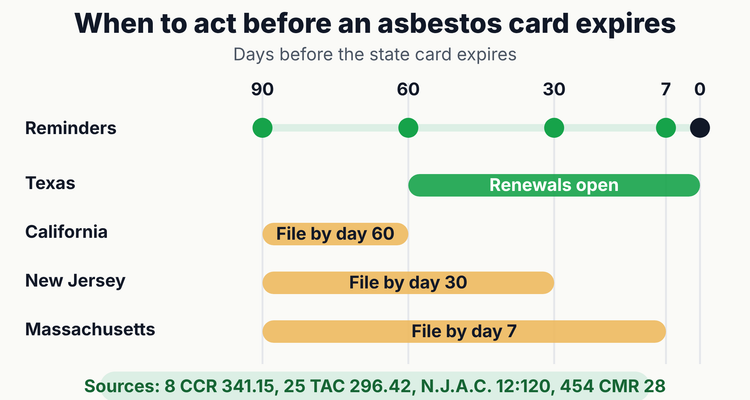 Set reminders from the state's filing rule, not just the expiry date: California's deadline is 60 days out.
💡 Pro Tip
Environmental consultancies we work with track each employee's certificate titles separately, one record per title and state, rather than one record per person. When a supervisor also holds inspector and air sampling titles, each gets its own expiry, reminder and file, so a renewed supervisor card never hides a lapsed inspector card.
When is a spreadsheet enough?
A spreadsheet works for a small crew in one state with one person who checks it weekly. It starts to fail when people hold several titles across states, when a state's filing deadline falls 60 days before expiry, or when a client or regulator asks who checked what and when. Errors are common too: Raymond Panko's review of spreadsheet audits found errors in 94% of the spreadsheets studied.
ExpiryEdge covers those gaps: each certificate is a record with an owner and backup, the scanned card, and a renewal checklist, and reminders go out at 90, 60, 30 and 7 days by email, SMS, Slack or Teams, with an audit trail of every change. See how it works for environmental contractors and consultancies.
What happens if an asbestos certification lapses?
A person whose asbestos certification lapses cannot do accredited work until they are recertified, and the longer they wait the more training they repeat.
⚠️What happens if you miss it: under the MAP, anyone who performs asbestos work requiring accreditation without it is in violation of the Toxic Substances Control Act (TSCA), and states must de-accredit people who work without their initial and current certificates on site. Texas bars work on an expired license and won't renew one expired more than a year. California won't renew after the card expires, so you apply and test again.
- Expired less than a year: take the refresher and renew, if your state allows. Pennsylvania has a one-year grace period for training.
- Expired more than two years in New York: you must take the initial course again.
- In Wisconsin: a refresher taken no later than 24 months after your most recent accredited training still renews, with a new expiry one year from the refresher.
- In California: a lapsed consultant or technician card means a new application and the state exam.
How can you make asbestos renewals easier?
Plan refreshers as a calendar, not as emergencies, and keep the paperwork in one place.
- Batch refreshers by month. Group people whose dates fall in the same month and book one course date. In Wisconsin, book inside the final 3 months so nobody loses time.
- Pair the refresher with the fit test. Respirator fit tests are also due at least annually under OSHA, so schedule both together. See our guide to respirator fit test requirements.
- Check the employer side. In Pennsylvania, an expired company certification blocks employee renewals. Track the firm's license with the same reminders.
- Keep the state's copy. New York accepts only the DOL copy of form DOH-2832. File it the day the course ends.
- Track mold licenses alongside. Many asbestos consultancies also hold state mold licenses on two-year cycles. See mold assessor license requirements.
- Ask subcontractors for proof. Collect each sub's certificates before mobilization with a contractor document tracker.
Asbestos certification tracking checklist
- ✓
Every person has one row per discipline and state, with certificate number
- ✓
Training certificate expiry and state card expiry are both recorded
- ✓
State filing windows (60, 30 or 7 days) are entered as their own dates
- ✓
Reminders are set at 90, 60, 30 and 7 days with an owner and backup
- ✓
Initial and current certificates are carried to every job site
- ✓
Fit test and medical exam dates are tracked as separate items
Frequently asked questions
What are the 5 types of asbestos certification?
EPA's Model Accreditation Plan requires five disciplines: worker, contractor/supervisor, inspector, management planner and project designer. EPA also recommends a sixth, project monitor, which some states certify. States may add their own titles, such as New York's air sampling technician or restricted handler.
How long is an asbestos certification good for?
Under the federal model, a certificate expires one year after the course and exam. Each annual refresher extends it for another year from the refresher date. State cards can run on different dates, so check both the training certificate and the state card.
How long is the asbestos refresher course?
Workers, contractor/supervisors and project designers take one full day. Inspectors take a half day. Management planners take a half-day inspector refresher plus a half-day management planner refresher. One day of training equals 8 hours, including breaks and lunch.
Is there a grace period if my asbestos certificate expires?
Only if your state set one. EPA recommends a 12-month grace period but does not require it. Pennsylvania has a one-year grace period for training, New York requires the initial course again after more than two years, and Texas will not renew a license expired more than one year.
Can I take the asbestos refresher online?
Often, yes. EPA has decided online training can satisfy the annual refresher, but the accrediting state must approve the online course. Pennsylvania, for example, allows virtual refreshers taught live by an approved provider, not self-paced online courses.
Does my asbestos certification transfer to another state?
Not automatically. Each state runs its own program. New Jersey offers reciprocity for current certificates from other EPA-authorized states, while Pennsylvania requires its own certification and photo ID for everyone doing abatement work there.
Sources
- 40 CFR Part 763, Subpart E, Appendix C: Asbestos Model Accreditation Plan (eCFR)
- 40 CFR 763.92, training for school maintenance and custodial staff (eCFR)
- EPA: Asbestos Professionals
- EPA: State Asbestos Contacts
- 29 CFR 1926.1101, OSHA asbestos standard for construction (eCFR)
- Cal/OSHA: Certification renewal fact sheet
- 8 CCR 341.15, certification of asbestos consultants and site surveillance technicians
- 454 CMR 28.07, asbestos consultants (Massachusetts)
- 454 CMR 28.08, asbestos contractors, supervisors and workers (Massachusetts)
- Minnesota Rules 4620.3330, certification of asbestos inspector
- New Jersey Department of Health: Asbestos workers and supervisors
- N.J.A.C. 12:120-5.10, permit renewal
- New York State Department of Labor: Form SH 442, asbestos certificate application instructions
- Pennsylvania Department of Labor and Industry: Asbestos certification FAQs
- 25 TAC 296.42, Texas asbestos license applications and renewals
- Texas DSHS: Licensing requirements by license type
- Wisconsin Administrative Code DHS 159.11 and 159.12
- Wisconsin DHS: Asbestos Inspector
- Panko, What We Don't Know About Spreadsheet Errors Today (arXiv)
Last reviewed: 12 October 2026
Frequently asked questions
Under the federal model, a certificate expires one year after the course and exam. Each annual refresher extends it for another year from the refresher date. State cards can run on different dates, so check both the training certificate and the state card.
Workers, contractor/supervisors and project designers take one full day. Inspectors take a half day. Management planners take a half-day inspector refresher plus a half-day management planner refresher. One day of training equals 8 hours, including breaks and lunch.
Only if your state set one. EPA recommends a 12-month grace period but does not require it. Pennsylvania has a one-year grace period for training, New York requires the initial course again after more than two years, and Texas will not renew a license expired more than one year.
Often, yes. EPA has decided online training can satisfy the annual refresher, but the accrediting state must approve the online course. Pennsylvania, for example, allows virtual refreshers taught live by an approved provider, not self-paced online courses.
Not automatically. Each state runs its own program. New Jersey offers reciprocity for current certificates from other EPA-authorized states, while Pennsylvania requires its own certification and photo ID for everyone doing abatement work there.


