
Farmer Brewery License in Massachusetts: Rules, Fees, Renewals

A farmer brewery license in Massachusetts is a state license from the Alcoholic Beverages Control Commission (ABCC), under M.G.L. c. 138, s. 19C, for brewers who grow cereal grains or hops for their beer. It allows wholesale sales and bottle sales to take away. Serving by the glass needs a separate local pouring permit that the ABCC approves.
If you farm and brew, or plan to, the rules sit in one long statute section, a handful of ABCC pages and whatever your town asks for. This guide translates section 19C into plain English with clause references, compares it with the other brewery licenses, and gives you a renewal calendar and a list of mistakes to avoid.
Key takeaways
- The ABCC issues farmer brewery licenses under M.G.L. c. 138, s. 19C. By law, a farmer-brewer is a person who "grows cereal grains or hops for the purpose of producing malt beverages". The statute sets no minimum percentage.
- The statutory fee starts at $22 a year for 5,000 barrels or less and is based on the barrels you produce.
- To apply you need a TTB Brewer's Notice, FDA food facility registration and a $3,000 surety bond. The ABCC asks you to allow 4 to 6 weeks.
- The license alone does not allow pours by the glass. That needs a Farmer Series Pouring Permit from your town, approved by the ABCC, for your own beer only.
- You cannot hold an interest in a section 12 or 15 retail license, and you cannot hold a farmer brewery and a pub brewery license at the same time.
- Renewals run through ePLACE and require your FDA registration and a current surety bond. At the end of each license year you report production and pay any extra fee owed.
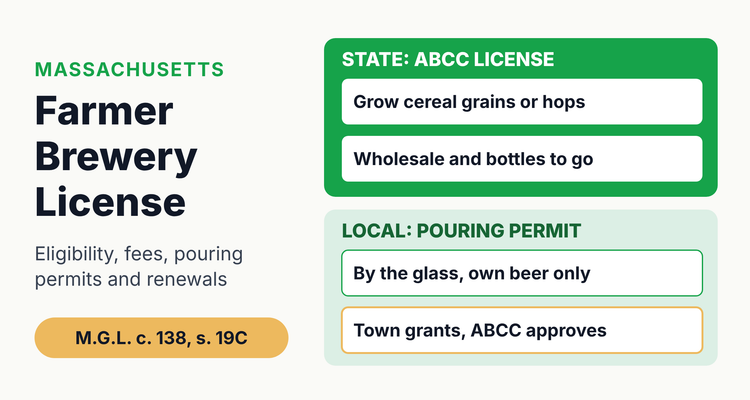 A Massachusetts farmer brewery license is a state license; pouring by the glass is a local permit on top.
What is a farmer brewery license in Massachusetts?
It is a state license for a brewery run by someone who grows cereal grains or hops for brewing. Section 19C says it exists "for the purpose of encouraging the development of domestic farms", and chapter 138, section 1 defines a farmer-brewery as a plant where malt beverages are made "provided that said hops or cereal grains are grown by the farmer-brewer."
Neither the statute nor the ABCC's state license FAQ (re-issued December 15, 2025) sets a minimum share of home-grown ingredients. If you have read older reports of a percentage rule, ask the ABCC in writing how it applies the growing requirement to your application.
Who can apply?
Under s. 19C(a), the ABCC issues the license to Massachusetts citizens who are also residents, partnerships made up only of such people, corporations organized in Massachusetts or admitted to do business there, and LLCs or LLPs organized in Massachusetts. It must refuse the license if, among other reasons:
- a church or school within 500 feet objects under section 16C
- the applicant holds an interest in a section 12 (on-premises retail) or section 15 (package store) business
- the applicant holds an interest in more than one section 18 wholesaler business
- the license fee or bond has not been paid, or the applicant is not of responsible character
What can a farmer brewery sell, and to whom?
Section 19C(g) lists every sales channel. Retail sales must be of beer produced by or for the brewery under its brand, and must take place on the brewery premises or at a licensed agricultural event (s. 19C(h)).
Farmer brewery sales channels under M.G.L. c. 138, s. 19C(g) (verified 12 Oct 2026)
| Who you sell to | Allowed? | Limit or condition |
|---|---|---|
| Licensed manufacturers, wholesalers and other farmer-breweries | Yes, wholesale | None stated |
| Bars, restaurants and package stores (s. 12, 13, 14, 15 licensees) | Yes, wholesale in kegs, casks, barrels or bottles | Total yearly sales to these licensees capped at 50,000 gallons |
| Consumers, to take away | Yes, by the bottle | On the brewery premises, or at an agricultural event with a s. 15F license |
| Consumers, by the glass | Only with a pouring license | Own beer only, on brewery or farm grounds (s. 19C(n)) |
| Buyers in other states and countries | Yes, wholesale | Where sale is not prohibited |
| Pharmacists, hospitals, schools and other s. 28 buyers | Yes, wholesale | As allowed by s. 28 and s. 30 |
You may import malt, cereal grains, fermentable sugars and hops, but not malt beverages or alcohol (s. 19C(f)).
Farmer brewery, manufacturer or pub brewery: which license fits?
Massachusetts has three main brewery licenses, and the choice decides how you can sell. This comparison is compiled from each statute section.
Massachusetts brewery licenses compared (verified 12 Oct 2026)
| Farmer brewery (s. 19C) | Manufacturer (s. 19) | Pub brewery (s. 19D) | |
|---|---|---|---|
| Growing requirement | Must grow cereal grains or hops | None | None |
| Drinking on site | Local pouring license, own beer only | Local on-premises license approved by ABCC, own products | Section 12 license; all drinks or wine and beer |
| To-go sales | By the bottle on premises | Not listed in s. 19 | By the bottle, up to two gallons |
| Statutory fee | From $22 a year (5,000 barrels or less) | $6,000 to $10,000 per plant, set by the ABCC | $1,000 to $3,000 a year by barrels |
| Key restriction | No interest in s. 12 or s. 15 retail | Sales to licensees, export and s. 28 buyers | At least 50% of beer sold made on site; no interest in package stores, wholesalers or other manufacturers |
You cannot hold both a farmer brewery and a pub brewery license at the same time, according to the ABCC's application page. For pouring rules in other states, see our taproom license requirements guide.
How do you apply for a farmer brewery license?
You apply online to the ABCC through ePLACE after your federal approvals are in place. Work through these steps in order:
- Get your TTB Brewer's Notice. The ABCC lists it as a required document. Our Brewer's Notice amendments guide covers what to file when details change later.
- Register with FDA as a food facility.
- Arrange the surety bond. The ABCC says the entity "must be bound unto the Commonwealth of Massachusetts for $3,000."
- Collect the documents: personal information forms for anyone with a financial interest, a CORI release and proof of citizenship for the license manager, a floor plan, lease or occupancy papers, and financial and business documents.
- Estimate your first year's production and pay the fee for that band (s. 19C(m)).
- Within 7 days of filing, notify nearby schools and churches. Send written notice by registered mail, return receipt requested, to each school and church within 500 feet (s. 19C(d)).
- Wait for review. The ABCC asks you to allow 4 to 6 weeks and contacts you if anything is missing.
- Apply to your town for the pouring permit if you want to serve by the glass.
How does the Farmer Series Pouring Permit work?
The pouring permit is a local license that lets you sell your beer for drinking on site. The ABCC's application page says: "To serve alcohol by the glass on the premises, the Farmer Brewery license holder must obtain a Farmer Series Pouring Permit."
- Who grants it: the local licensing authority, subject to ABCC approval, and the procedures in section 15A apply (s. 19C(n)).
- Where: at any location the town approves in writing on the brewery grounds or the farm run with it, provided the farm is appurtenant and contiguous.
- What: only beer produced by or for the brewery and sold under its brand. The ABCC's 2016 advisory adds that no other alcoholic beverages may be sold anywhere the permit covers.
- Samples: the ABCC says a farmer brewery may serve samples on its premises "as long as the Local Licensing Authority permits it."
- Several farmer licenses: if you also hold a farmer-winery or farmer-distillery license, a section 19H license can cover all your products across contiguous premises.
Towns set their own process. One town's published checklist asks for zoning confirmation, a business certificate, the state license, a server training plan, insurance and tax affidavits, and a public hearing with notice to abutters before the permit issues.
Can you sell at farmers markets and fairs?
Yes, with a special license under section 15F. The event must be certified as agricultural by the Department of Agricultural Resources, sales are in sealed containers for off-site drinking, and the town fee is no more than $50. Free samples are limited to 2 ounces each and five per customer.
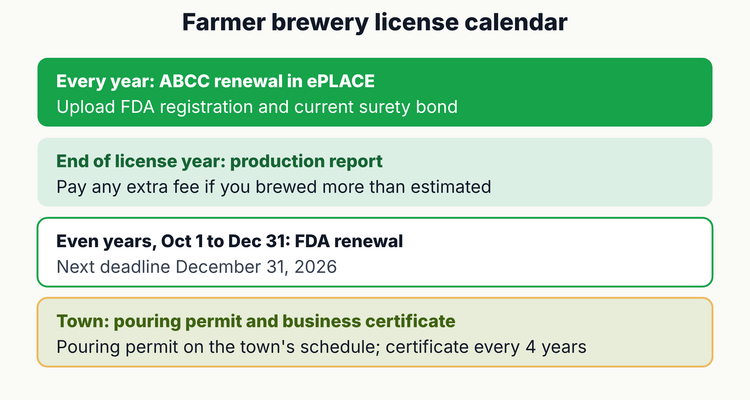 A farmer brewery license calendar: state, federal and local items that recur.
How do farmer brewery license renewals work?
You renew the state license through ePLACE, and the ABCC requires your FDA registration and an updated or current surety bond for farmer series renewals. The fee is annual, so renewal is a yearly task, and your local pouring permit renews separately on the town's schedule.
Massachusetts farmer brewery compliance calendar
| Item | Who | When | Source |
|---|---|---|---|
| State license renewal | ABCC, via ePLACE | Yearly; check the expiry shown in ePLACE | mass.gov ABCC renewal requirements |
| Production report and any extra fee | ABCC | End of each license year | s. 19C(m) |
| Farmer Series Pouring Permit | Town licensing authority | Ask your town; s. 16A's November rule covers s. 12 and 15 licenses | s. 19C(n); s. 16A |
| FDA food facility registration | FDA | Oct 1 to Dec 31 of even years; next deadline Dec 31, 2026 | 21 CFR 1.230 |
| TTB excise return | TTB | Next quarterly and annual returns due Jan 14, 2027 | TTB due dates |
| Business certificate (DBA) | City or town clerk | Every four years | M.G.L. c. 110, s. 5 |
| New manager, owner or investor | Town and ABCC | Approval before the change takes effect | ABCC state license FAQ |
On ownership and management changes, the ABCC's FAQ says such a change "is not legal unless and until the new individual(s) is (are) approved by both the LLA and the ABCC." If your manager resigns, you must apply for a change of manager immediately. The federal side has its own rules, covered in our brewery license checklist.
Do this now: set up your farmer brewery license tracker
Allow about 45 minutes (an estimate). Add one row per item from the calendar above, with these columns: Item, Issuer, Number, Expiry or due date, Owner, Backup, Proof link and Days left.
- Days left: =D2-TODAY() in the Days left column, with red under 30 and amber under 90.
- Next FDA deadline: =DATE(YEAR(TODAY())+MOD(YEAR(TODAY()),2),12,31) returns December 31 of the current year in even years and of next year in odd years.
- Business certificate: =EDATE(issue_date,48) gives the four-year expiry.
- Barrels to gallons: the statute counts a barrel as 31 gallons, so =barrels*31 converts your production. The ABCC's online application lists the same fee bands in gallons, so ask the ABCC which unit it applies before you pay.
- Notice proof: file the registered-mail receipts for the school and church notices with the license record. They are your evidence if notice is ever disputed.
What mistakes do farmer breweries make?
These come straight from the statute and the ABCC's guidance:
- Pouring by the glass on the state license alone. On-site drinking needs the local pouring permit.
- Pouring guest beer or cider. The pouring permit covers only beer produced by or for your brewery.
- Taking a stake in a bar, restaurant or package store. An interest in a section 12 or 15 business is grounds for refusal.
- Changing managers or owners first and filing later. The change is not legal until the town and the ABCC approve it.
- Underestimating production. The fee is paid on an estimate, and you owe the difference when you report at year end.
- Selling at a farmers market without a section 15F license, or serving more than the sample limits.
- Mixing up barrels and gallons when you work out your fee band.
⚠️What happens if you miss it? The ABCC can refuse to renew a farmer brewery license; you can request a hearing, and the commission decides within 30 days of it (s. 19C(b)). If the required school and church notices were not mailed, the ABCC must cancel the license unless an exception applies (s. 19C(d)). If FDA registration is not renewed by December 31, 2026, FDA treats it as expired and cancels it, and the ABCC requires it for renewal. A business certificate not renewed after four years lapses, with a fine of up to $300 for each month the violation continues.
Spreadsheet or software for a farmer brewery?
A single farmer brewery with one pouring permit has fewer than a dozen recurring items, and the tracker above handles that well. Open it monthly and act on anything amber.
A tool starts to pay off once several people share the work, or you add a farmer-winery or farmer-distillery license with its own dates. ExpiryEdge can hold each license as a record with an owner and backup, send reminders at 90, 60, 30 and 7 days, and keep the bond, FDA confirmation and permit photo with the record. If you also distill, read our distillery license requirements guide, and see the brewery and distillery compliance page for the full set of federal, state and local items.
Frequently asked questions
Do I have to grow hops to get a farmer brewery license in Massachusetts?
You must grow cereal grains or hops for brewing. Chapter 138 defines a farmer-brewer as a person who grows cereal grains or hops to produce malt beverages, but neither the statute nor the ABCC's FAQ sets a minimum percentage, so confirm how the ABCC applies it to your plans.
Can a farmer brewery serve beer by the glass?
Only with a Farmer Series Pouring Permit. Your city or town grants it with ABCC approval under s. 19C(n), and it covers only beer produced by or for your brewery, on the brewery or contiguous farm grounds.
How much does a farmer brewery license cost?
The statute sets an annual fee of $22 for 5,000 barrels or less, rising to $44, $82 and $110 for larger bands. You also need a $3,000 surety bond, and your town charges its own fee for the pouring permit.
Can a farmer brewery also hold a restaurant or bar license?
No. Section 19C bars a farmer brewery applicant from holding an interest in a section 12 or section 15 business, and the ABCC says you cannot hold a farmer brewery and a pub brewery license at the same time.
How long does the ABCC take to approve a farmer brewery license?
The ABCC asks applicants to allow 4 to 6 weeks after submission. Your local pouring permit is a separate process and often includes a public hearing.
Can a farmer brewery sell at farmers markets?
Yes, with a special license from the town under section 15F for a certified agricultural event. Sales are in sealed containers for off-site drinking, and samples are limited to 2 ounces each and five per customer.
Sources
- Mass. General Laws ch. 138, s. 19C (farmer-brewery licenses)
- Mass. General Laws ch. 138, s. 1 (definitions)
- Mass. General Laws ch. 138, s. 19 (manufacturers)
- Mass. General Laws ch. 138, s. 19D (pub breweries)
- Mass. General Laws ch. 138, s. 19H (combined farmer-series pouring)
- Mass. General Laws ch. 138, s. 15F (agricultural events)
- Mass. General Laws ch. 138, s. 16A (renewals)
- Mass. General Laws ch. 110, s. 5 (business certificates)
- Mass.gov, Apply for a Farmer Brewery License (ABCC)
- Mass.gov, ABCC State License Renewal Requirements
- Mass.gov, ABCC State License FAQs (re-issued December 15, 2025)
- Mass.gov, ABCC Farmer Series advisory (August 11, 2016)
- Mass.gov, ABCC advisory for Farmer Series Pouring Permit (2013)
- Town of Littleton, MA, Requirements for Farmer Series Pouring Permit
- FDA, biennial renewal reminder (2026)
- eCFR, 21 CFR Part 1 Subpart H (food facility registration)
- TTB, Due Dates for Tax Returns
Last reviewed: 12 October 2026
Frequently asked questions
Only with a Farmer Series Pouring Permit. Your city or town grants it with ABCC approval under s. 19C(n), and it covers only beer produced by or for your brewery, on the brewery or contiguous farm grounds.
The statute sets an annual fee of $22 for 5,000 barrels or less, rising to $44, $82 and $110 for larger bands. You also need a $3,000 surety bond, and your town charges its own fee for the pouring permit.
No. Section 19C bars a farmer brewery applicant from holding an interest in a section 12 or section 15 business, and the ABCC says you cannot hold a farmer brewery and a pub brewery license at the same time.
The ABCC asks applicants to allow 4 to 6 weeks after submission. Your local pouring permit is a separate process and often includes a public hearing.
Yes, with a special license from the town under section 15F for a certified agricultural event. Sales are in sealed containers for off-site drinking, and samples are limited to 2 ounces each and five per customer.


