
Taproom License Requirements: 7-State Table and Renewal Checklist

A taproom license is usually not one license. To pour your own beer on site in the US, you need federal TTB approval for the taproom area, a state license or permit that allows on-premises sales, and local permits such as a pouring license. The state license and its renewal date vary by state.
Maybe you are opening a second taproom across town, or a regulator has just asked which license covers your tasting room. The rules are spread across federal regulations, state statutes and town hall forms. This guide puts the verified state examples in one table, walks through the approvals in order and gives you a tracker you can build in an hour.
Key takeaways
- TTB treats a taproom inside your brewery as a "tavern" on brewery premises. You get it approved through your Brewer's Notice, with a diagram of public and non-public areas (27 CFR 25.25).
- A taproom away from the brewery is a separate place of sale. TTB requires dealer registration for every location before you start selling.
- States follow two patterns: the brewery license itself carries retail privileges (Washington, New York farm breweries), or you need a separate on-premises license (Massachusetts, North Carolina, Michigan brewpubs).
- Location caps differ: up to three other retail locations in North Carolina, five branch offices for a New York farm brewery, four retail licenses in Washington and eight vendor's licenses in Florida.
- Renewal rules differ too. North Carolina brewery permits never expire, but on-premises malt beverage permits need a $400 registration by May 1. Michigan licenses must be renewed by April 30.
- In California, on-premises servers and managers must be certified in Responsible Beverage Service (RBS) within 60 days of starting work, and the certificate lasts three years.
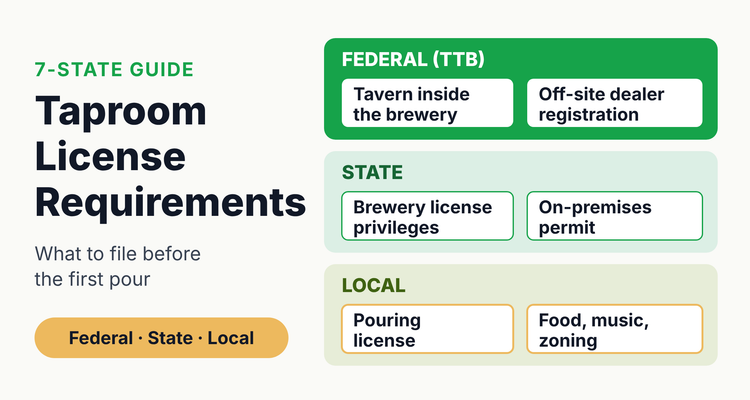 A taproom license is really three layers of approval: federal, state and local.
What is a taproom license?
A taproom license is the permission to sell your beer to customers for drinking on site. In most states that permission is stacked from three layers: federal approval of the space, a state license or permit with on-premises privileges, and local permits for the building and the business.
Some states fold the retail privilege into the brewery license. Others make you hold a separate pouring license, often granted by the city or town and approved by the state. Either way, each layer has its own paperwork, renewal date and change rules, so each needs its own row in your tracker.
Which federal approvals does a taproom need?
The federal approval depends on where the taproom is. TTB, the Alcohol and Tobacco Tax and Trade Bureau, handles both cases, and there is no federal fee to apply.
A taproom inside the brewery
TTB calls this a tavern, meaning "a portion of brewery premises where beer is sold to consumers." You request it by submitting a Brewer's Notice (TTB F 5130.10) that shows the tavern's boundaries, which areas the public can reach, how you will keep them apart, how you will measure beer for tax and which tanks will hold tax-determined beer (27 CFR 25.25). Beer must be tax-determined before it is dispensed into a glass. Food, taxpaid wine and taxpaid spirits may also be sold there.
Moving the taproom's boundaries later is a premises change. Under 27 CFR 25.78, extended premises cannot be used before TTB approves the amended notice. Our guide to TTB Brewer's Notice amendments covers the 30-day and approval-first rules in detail.
A taproom away from the brewery
An off-site taproom is a separate place where beer is sold. TTB's retailer guidance says registration must be made "before engaging in business" and "for every location of said business", using TTB F 5630.5d in Permits Online. Your Brewer's Notice registers you as a dealer only at the brewery itself. After that, you file again by July 1 only if the registration details change (27 CFR 31.111).
Taproom license requirements by state
The table below compiles taproom rules from each state's statute or alcohol agency, with the official link in every row. It is a starting point, not legal advice: confirm the details for your address with the agency before you sign a lease.
Taproom license requirements in 7 states (Verified 12 Oct 2026)
| State | Taproom route | Limits worth knowing | Renewal | Official source |
|---|---|---|---|---|
| California | Type 23 Small Beer Manufacturer (under 60,000 barrels a year); ABC says its most common users are microbreweries and brewpubs. Type 75 Brewpub-Restaurant for restaurants that brew. | Type 23 may sell its own packaged beer to consumers to take away. On-premises servers and managers need RBS certification within 60 days of hire. | Active about one year from issue. Renew even if no notice arrives; +50% penalty within 60 days, +100% from 60 to 90, then revoked. | https://www.abc.ca.gov/licensing/license-types/ |
| Massachusetts | Manufacturer (s. 19): local on-premises license approved by the ABCC (s. 19(b)). Farmer-brewery: pouring license (s. 19C(n)). Pub brewery (s. 19D) with a s. 12 license. | Farmer-brewery pouring covers own beer only, on brewery or farm grounds. A pub brewery must make at least 50% of what it sells on site. | Section 12 licenses renew in November (s. 16A). State licenses renew in ePLACE with FDA registration and a current surety bond. | https://malegislature.gov/Laws/GeneralLaws/PartI/TitleXX/Chapter138 |
| Michigan | Brewpub license, issued to a licensed food service establishment that also holds a Class C, tavern or hotel license. | One license per brewpub location. Must hold a TTB Brewer's Notice. Quarterly beer tax reports postmarked by Jan 15, Apr 15, Jul 15 and Oct 15. | Annual. Renewal portal opens March 1; renew by April 30. | https://www.legislature.mi.gov/Laws/MCL?objectName=mcl-436-1405 |
| New York | Farm brewery license (ABC Law s. 51-a) lets you sell and hold tastings at the licensed premises, and run a restaurant. | Up to five branch offices away from the farm brewery. May make and sell only New York State labelled beer. | Renewal advisory about three months before expiry. File late and you cannot sell once the license expires. | https://www.nysenate.gov/legislation/laws/ABC/51-A |
| North Carolina | Brewery permit (G.S. 18B-1104) plus the on-premises malt beverage permit under G.S. 18B-1001. | Breweries selling under 100,000 barrels a year may sell at up to three other locations in the state. | Brewery permit valid indefinitely. On-premises malt beverage permit: $400 registration by May 1; 25% late fee after April 30. | https://www.ncleg.gov/EnactedLegislation/Statutes/HTML/BySection/Chapter_18B/GS_18B-903.html |
| Washington | Microbrewery license ($150, under 60,000 barrels) lets you act as a retailer of your own beer. | Other breweries' brands capped at 25% of taps. Up to four retail licenses. Farmers market endorsement $112.50 a year. | Annual, through the Department of Revenue Business Licensing Service. Notice about 45 days ahead; pay by the expiry date. | https://app.leg.wa.gov/RCW/default.aspx?cite=66.24.244 |
| Florida | Vendor's license issued to a malt beverage manufacturer for sales on a single complex that includes the brewery (s. 561.221(2)). | Up to eight vendor's licenses. The vendor premises must appear on the manufacturer's approved premises diagram. | Not verified for this table. Ask the Division of Alcoholic Beverages and Tobacco. | http://www.leg.state.fl.us/statutes/index.cfm?App_mode=Display_Statute&URL=0500-0599/0561/Sections/0561.221.html |
Two patterns stand out. In Washington and New York, the brewery license itself carries retail privileges, so a taproom is mostly a local and federal exercise. In Massachusetts, North Carolina and Michigan, the pouring privilege is a separate license or permit with its own renewal, so a lapse can stop pours while production carries on. For Massachusetts farm-based breweries, see our farmer brewery license guide.
How do you get a taproom license, step by step?
Work in this order. Each step depends on the one before, and leases are hard to undo. Times are typical planning estimates, not agency deadlines; the Massachusetts ABCC, for example, asks applicants to allow 4 to 6 weeks for a farmer-brewery license.
- Choose on-site or off-site. On-site means a Brewer's Notice amendment; off-site means a separate TTB dealer registration and usually separate state and local licenses.
- Check zoning before you sign. Ask the building department whether a taproom is allowed at the address and what occupancy limits apply.
- File with TTB. Submit the amended Brewer's Notice with the tavern diagram, or register the new location on TTB F 5630.5d. Do not pour in new space until TTB approves it.
- Apply for the state license or permit that carries on-premises privileges (see the table). Note any location cap before planning the next site.
- Apply for the local pouring license if your state uses one. Expect a public hearing in many towns.
- Add food, entertainment and building permits. Ask the clerk for the full list for the address.
- Train servers. In California, register servers and managers in the RBS portal and certify them within 60 days of hire.
- Record every approval in your tracker with its number, expiry or review date, owner and proof, before the first pour.
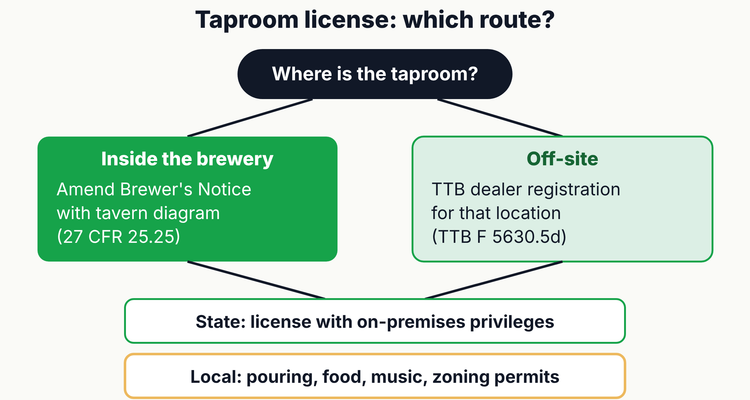 Taproom license decision tree: start with where the taproom is.
Which local permits does a taproom need?
Local permits vary by city and town, so ask the clerk for the list for each address. One Massachusetts town's published checklist for a farmer-series pouring permit shows how much a town can ask for:
- zoning confirmation from the building inspector
- a business certificate from the town clerk
- the state farmer-series license, then the town's pouring permit application
- common victualler (food) and entertainment licenses, if applicable
- a criminal record (CORI) acknowledgment for owners
- a server training plan and, later, proof of training and a server roster
- a public hearing, with notice to abutters paid by the applicant
- workers' compensation and liability insurance proof, a tax compliance affidavit and all town inspections before the permit issues
Each of those can carry its own expiry. Taprooms in several towns multiply the list, which is why our guide to tracking business license renewals across 50 states recommends one row per permit per location.
Can a taproom pour at festivals and farmers markets?
Sometimes, but usually under a separate permit. Massachusetts lets a town grant a special license for sealed-container sales at agricultural events certified by the Department of Agricultural Resources, with a local fee of no more than $50; malt beverage samples are capped at 2 ounces and five per customer, and the town must send the ABCC a copy at least 7 days before the event (M.G.L. c. 138, s. 15F). Washington microbreweries can add a farmers market endorsement for $112.50 a year and must send the board a list of dates, times and locations each month before selling.
Do this now: a 60-minute taproom license audit
You can do this today with a blank spreadsheet. The times are estimates for one brewery and one taproom; add 15 minutes per extra location.
- Photograph the walls (10 minutes). Every posted license and permit gives you a number, an issuer and often an expiry date.
- Open your Brewer's Notice (10 minutes). Does the approved diagram show the taproom exactly as it is used today, patio included? If not, that is an amendment to file.
- Check dealer registration for off-site taprooms (5 minutes). Each one needs its own registration.
- Log in to the state portal (15 minutes). Record each license number, expiry date and fee. In North Carolina and Michigan, note the fixed May 1 and April 30 dates.
- Email the clerk (5 minutes). Ask: "Please list every license and permit on file for [address], with expiry dates."
- List server certificates (15 minutes). One row per person, with certification and expiry dates.
Then lay the results out in these columns. The example values are illustrative.
Taproom license tracker: copyable column layout
| Column | What to enter | Example |
|---|---|---|
| A: Location | Brewery or taproom name | Taproom 2 |
| B: Permit | License, permit or registration | On-premises malt beverage permit |
| C: Level | Federal, State or Local | State |
| D: Issuer | Agency or town board | State ABC commission |
| E: Number | From the certificate | From the certificate |
| F: Due date | Expiry, registration or review date | 5/1/2027 |
| G: Renewal opens | Agency window, or =F2-60 | 3/2/2027 |
| H: Fee | From the last notice | $400 |
| I: Owner / backup | Two named people | GM / head brewer |
| J: Proof | Link to certificate, receipt and wall photo | Shared folder link |
| K: Days left | =F2-TODAY() | Number |
| L: Status | Formula below | Due ≤90 |
In L2, paste =IF(F2="","Add a date",IF(K2<0,"EXPIRED",IF(K2<=30,"Due ≤30",IF(K2<=90,"Due ≤90","OK")))) and fill down. Add conditional formatting so red shows under 30 days and amber under 90.
For fixed annual dates, let the sheet roll the year forward. For a May 1 registration, use =DATE(YEAR(TODAY())+(TODAY()>DATE(YEAR(TODAY()),5,1)),5,1), which always shows the next May 1. Change 5,1 to 4,30 for Michigan's April 30 deadline. For permits that never expire, such as the Brewer's Notice, put a yearly review date in F so someone checks the diagram and details.
For California RBS certificates, the hire deadline is =hire_date+60 and the expiry is =EDATE(cert_date,36).
⚠️What happens if you miss a taproom renewal? In New York, if the renewal is not filed before the license period ends, you cannot sell alcohol once the license expires. California adds a 50% penalty for renewal within 60 days after the deadline and 100% from 60 to 90 days, then revokes the license automatically. North Carolina charges a 25% late fee after April 30 and revokes permits whose registration fee goes unpaid, though not before June 1. Washington applies late renewal penalties if the fee is not paid by the expiry date.
How can you make taproom renewals less stressful?
- Give each location an owner and a backup. The taproom manager owns local permits; one person owns federal and state filings.
- Tie the diagram to construction. Add "check the Brewer's Notice diagram" to any patio, wall or bar project checklist, because new space needs approval before use.
- Put fixed state dates on the calendar once. North Carolina's May 1 and Michigan's April 30 never move.
- File proof the same day. Save the receipt and a photo of the posted permit in the location's folder.
- Track people, not just premises. Server certificates expire on their own schedules and follow staff turnover.
💡 Pro Tip
One multi-site craft brewery we work with ends each renewal by asking on-site staff to upload a photo of the renewed permit hanging in place. It proves the new certificate is up, not just paid for.
Spreadsheet or software for taproom licenses?
With one taproom and fewer than about 20 rows, the spreadsheet above is enough. Sort by days left every Monday and act on anything amber.
It gets harder with several locations and staff certificates. A spreadsheet cannot remind the right taproom manager when their pouring permit is 30 days out, or chase a server whose certificate is about to lapse. That is where a tool such as ExpiryEdge earns its place: reminders at 90, 60, 30 and 7 days by email, SMS, Slack or Teams to each owner and backup, plus an audit trail of who renewed what. Our brewery and distillery compliance page shows how a full license calendar fits together, and the brewery license checklist covers the federal filings behind every taproom.
Frequently asked questions
Do I need a separate license for a brewery taproom?
It depends on the state. In Washington and for New York farm breweries, the brewery license includes retail privileges, while Massachusetts, North Carolina and Michigan use a separate on-premises license or permit. You also need TTB approval of the taproom area and local permits.
Does TTB need to approve my taproom?
Yes. A taproom inside the brewery is a tavern on brewery premises and is approved through your Brewer's Notice with a diagram (27 CFR 25.25). An off-site taproom needs TTB dealer registration for that location before you start selling.
How many taprooms can a brewery have?
Each state sets its own cap. North Carolina allows up to three other retail locations for breweries under 100,000 barrels, a New York farm brewery may run five branch offices, Washington allows four retail licenses and Florida up to eight vendor's licenses.
Does a taproom license expire?
Most state and local taproom licenses renew yearly, for example by April 30 in Michigan. Some never expire but carry annual fees, such as North Carolina's $400 registration due May 1. Your TTB approvals have no renewal date but must be amended when things change.
Can a taproom sell other breweries' beer?
Sometimes. A Washington microbrewery may pour other breweries' beer up to 25% of its taps, while Massachusetts farmer-brewery pouring licenses cover only beer produced by or for the brewery. Check your state's statute before adding guest taps.
Do taproom staff need server training?
In California, yes: on-premises servers and managers must be RBS certified within 60 days of starting, and the certificate is valid for three years. Many towns also ask for a server training plan before granting a pouring permit.
Sources
- eCFR, 27 CFR 25.25 (tavern on brewery premises)
- eCFR, 27 CFR 25.78 (extension of brewery premises)
- eCFR, 27 CFR Part 31 (alcohol beverage dealers)
- TTB, Beverage Alcohol Retailers: Registration Requirements
- TTB, Applying for a Permit and/or Registration
- California ABC, License Types
- California ABC, License Fees
- California ABC, Responsible Beverage Service
- Mass. General Laws ch. 138, s. 19 (manufacturers)
- Mass. General Laws ch. 138, s. 19C (farmer-breweries)
- Mass. General Laws ch. 138, s. 19D (pub breweries)
- Mass. General Laws ch. 138, s. 15F (agricultural events)
- Mass. General Laws ch. 138, s. 16A (renewals)
- Mass.gov, ABCC State License Renewal Requirements
- Mass.gov, Apply for a Farmer Brewery License (ABCC)
- Town of Littleton, MA, Requirements for Farmer Series Pouring Permit
- Michigan Compiled Laws 436.1405 (brewpub license)
- Michigan LCC, License Renewal
- New York ABC Law s. 51-a (farm brewery)
- New York SLA, Renew Your License
- N.C. Gen. Stat. 18B-1104 (brewery permit)
- N.C. Gen. Stat. 18B-903 (duration, renewal, registration)
- RCW 66.24.244 (Washington microbrewery license)
- Washington LCB, Renew Your License
- Florida Statutes s. 561.221
Last reviewed: 12 October 2026
Frequently asked questions
Yes. A taproom inside the brewery is a tavern on brewery premises and is approved through your Brewer's Notice with a diagram (27 CFR 25.25). An off-site taproom needs TTB dealer registration for that location before you start selling.
Each state sets its own cap. North Carolina allows up to three other retail locations for breweries under 100,000 barrels, a New York farm brewery may run five branch offices, Washington allows four retail licenses and Florida up to eight vendor's licenses.
Most state and local taproom licenses renew yearly, for example by April 30 in Michigan. Some never expire but carry annual fees, such as North Carolina's $400 registration due May 1. Your TTB approvals have no renewal date but must be amended when things change.
Sometimes. A Washington microbrewery may pour other breweries' beer up to 25% of its taps, while Massachusetts farmer-brewery pouring licenses cover only beer produced by or for the brewery. Check your state's statute before adding guest taps.
In California, yes: on-premises servers and managers must be RBS certified within 60 days of starting, and the certificate is valid for three years. Many towns also ask for a server training plan before granting a pouring permit.


