
Distillery License Requirements: TTB DSP Permits, Bonds, States

A distillery license in the US comes in two layers. Federally, you register a distilled spirits plant (DSP) with TTB and get a basic permit before you produce, usually with a bond. Your state then issues its own distillery license, and local permits cover the building. The federal approvals never expire, but most changes must be filed within 30 days.
If you are planning a distillery, or already run one and are not sure which papers are current, the hard part is that nothing reminds you. There is no federal renewal notice, and a missed change can end a permit automatically. This guide lists every approval with its citation, the change rules, the bond trigger and the reports, plus a register you can build today.
Key takeaways
- You must register a distilled spirits plant on TTB F 5110.41 and get TTB approval before operating. Beverage distillers also need a basic permit under the Federal Alcohol Administration Act. There is no federal fee.
- Neither the registration nor the basic permit has an expiry date. Both continue until surrendered, suspended, revoked or automatically terminated.
- Most changes need an amended registration within 30 days. A new name, location or premises needs TTB approval before you use it.
- If control of the company changes, the basic permit ends 30 days later unless you apply for a new one within those 30 days.
- No bond is needed while you qualify for quarterly or annual tax returns ($50,000 or less a year in tax). Cross $50,000 and you must furnish a bond.
- Monthly operations reports are due by the 15th of the next month. The next quarterly and annual excise returns are due January 14, 2027.
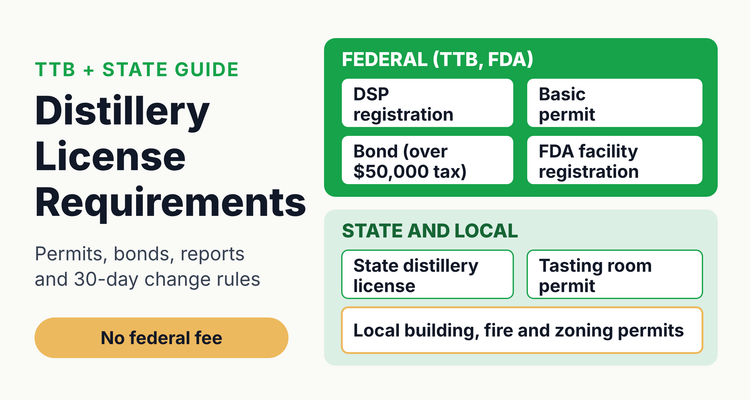 Every distillery license sits in the federal layer or the state and local layer.
What licenses does a distillery need?
A US distillery needs federal approvals from TTB (the Alcohol and Tobacco Tax and Trade Bureau) and FDA, a state license, and local permits for the building. The table below lists each one with its legal source, whether it expires and what makes you file again.
Distillery license requirements at a glance (verified 12 Oct 2026)
| Approval | Issuer and source | Expires? | When you must file again |
|---|---|---|---|
| DSP registration (TTB F 5110.41) | TTB, 27 CFR 19.72 | No; invalid if a required bond or permit becomes invalid (19.80) | Most changes within 30 days (19.112); some need approval first |
| Basic permit (FAA Act) | TTB, 27 CFR 1.21 | No (1.43) | New name or trade name before use; address change; ownership or management changes |
| Distilled spirits bond (TTB F 5110.56) | TTB, 27 CFR 19.151 | Runs until terminated or superseded | Tax passes $50,000 a year; surety problems; location change |
| Dealer registration | TTB, 27 CFR 19.202 | No | Selling at any location other than the DSP |
| Label approval (COLA) | TTB, 27 CFR 5.21 | Per label | Before bottling spirits for interstate sale |
| Formula approval | TTB | Per product | Some products need it before label approval |
| Food facility registration | FDA, 21 CFR Part 1 | Renew Oct 1 to Dec 31 of even years | Most changes within 60 days |
| State distillery license | State alcohol agency | Usually annual (see state table) | Owner, location or premises changes |
| Local permits | City or town | Varies | Ask the clerk for each address |
Distillers who also brew should read our brewery license checklist, since a DSP may not be located where beer or wine is produced (27 CFR 19.52).
How do you get a TTB distilled spirits plant registration?
You apply online through TTB's Permits Online, and you cannot operate until TTB approves. TTB says there is "no fee at the federal level to apply for or maintain approval". Work through these steps in order:
- Pick a lawful location. A DSP may not be in a residence or a shed, yard or enclosure connected to one, on a boat, where beer or wine is produced or where liquor is sold at retail (27 CFR 19.52). Home distilling is prohibited outright (19.51).
- Decide your operations. You must intend to operate as a distiller, a warehouseman or both; a DSP cannot be set up only to process spirits (19.72).
- Register the plant on TTB F 5110.41. Include the plant description, major equipment, security statement and production procedure. If TTB asks for more information, you have 60 days to send it.
- Apply for the basic permit. Beverage distillers apply on TTB F 5100.24 under 27 CFR Part 1. Operations that do not need a basic permit, such as industrial alcohol, need an operating permit instead (19.91).
- File a bond or claim the exemption. Furnish a bond on TTB F 5110.56, or state on the registration that you expect $50,000 or less in tax a year.
- Ask for approval of any other business on site, such as a tasting room or shop, before you run it. TTB's approval says whether it may sit on bonded or general premises (19.55).
- Register with FDA as a food facility, and get formula and label approvals before bottling.
- Apply for the state license and local permits. Most states expect the federal approvals first.
Keep the approved registration documents on site in a current loose-leaf file that a TTB officer can inspect (19.81).
Does a distillery license expire?
The federal approvals do not expire, but they can end without warning. A basic permit "shall continue in effect until suspended, revoked, annulled, voluntarily surrendered, or automatically terminated" (27 CFR 1.43). The registration has no end date either, but if a required bond or permit becomes invalid, the registration becomes invalid too, and you must file a new registration and get it approved before resuming (19.80).
State licenses are different. Most renew yearly or carry yearly fees, as the state table below shows, so they belong on a calendar.
Which changes need a TTB amendment or approval first?
Any change to the information on your registration must be filed within 30 days unless a rule sets another time (27 CFR 19.112). These are the changes that catch distilleries out.
Distillery changes and what to file with TTB
| Change | What to file | Deadline |
|---|---|---|
| New officers, directors, members or managers | Amended TTB F 5110.41 or letterhead notice (19.115); notify for the basic permit (1.42) | 30 days; basic permit says "immediately" |
| Stockholders change, no change of control | Letterhead notice (19.114) | 30 days, or yearly on May 1 |
| Change of control (stock or LLC interests) | Amended TTB F 5110.41 (19.114) and a new permit application (1.44) | 30 days, or the permit terminates |
| New owning entity | Successor qualifies as a new DSP: registration and bonds (19.116) | File well before the change; permit application within 30 days |
| Proprietor name or trade name | Amended registration or permit (19.113, 1.40) | Approval before using the name |
| Business address | Amended basic permit (1.41) | File when it changes |
| Plant location | Amended TTB F 5110.41 plus new bond or consent of surety (19.118) | Approval before operating |
| Extend or curtail premises | Amended TTB F 5110.41 (19.119) | Approval before the change |
| Bond status | Amended TTB F 5110.41 (19.136) | When status changes |
| Closing an operation | TTB F 5110.41, permit and final monthly report (19.147) | When discontinuing |
TTB's own guidance on ownership changes is blunt: if the successor's registration and bond are not approved first, or the permit application is not filed within 30 days, "all regulated operations must cease until approval is granted in writing".
When does a distillery need a bond?
You need a bond unless you pay tax on a deferred basis and qualify for quarterly or annual returns, which means $50,000 or less in distilled spirits tax this year and last year (27 CFR 19.151(d), 19.235). Bonds for industrial-use spirits are always required.
Once your tax for the calendar year passes $50,000, you must furnish a bond and amend your registration to change your bond status. You are treated as bonded for operations if you submit the operations bond within 30 days of crossing the threshold (19.168(b)).
The bond amount depends on what you do. For a single plant, the operations bond penal sum is at least $5,000 and need not be more than $100,000 for a distiller, $10,000 to $200,000 for a distiller and warehouseman, and $15,000 to $250,000 for a distiller, warehouseman and processor (19.166). If your surety becomes insolvent or drops off Treasury Circular 570, you must file a superseding bond (19.168(a)).
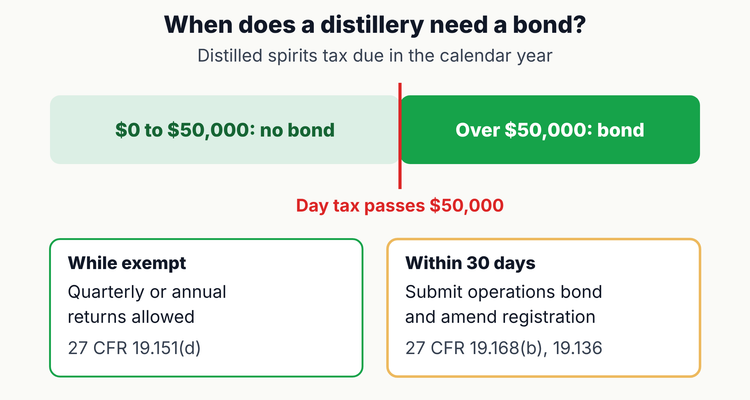 The $50,000 bond trigger for a distillery license, under 27 CFR 19.151 and 19.168.
Which reports and tax returns does a distillery file?
- Monthly operations reports (production TTB F 5110.40, storage 5110.11, processing 5110.28, denaturing 5110.43) are due by the 15th day of the following month, on paper or through Pay.gov (19.632).
- Excise tax returns (TTB F 5000.24) are semimonthly by default, quarterly at $50,000 or less a year and annual at $1,000 or less, each due on the 14th day after the period ends (19.235, 19.236).
- Weekend rule. If a due date falls on a weekend or legal holiday, the return is due the business day before.
- September. Semimonthly filers have an extra return period in late September, with payment due September 28 or 29 (19.237).
- Next dates. TTB's 2026 table shows the October to December quarterly return and the 2026 annual return both due January 14, 2027.
Distillery license requirements by state
State rules decide where you can sell and how much. These four examples come from each state's statute or agency, with links. Confirm the details for your address before you rely on them.
State distillery license examples (verified 12 Oct 2026)
| State | License | On-site sales | Fee or renewal | Official source |
|---|---|---|---|---|
| California | Type 74 Craft Distiller (up to 150,000 gallons a fiscal year); Type 04 Distilled Spirits Manufacturer | Type 74 may sell up to 4.5 liters of its own spirits per consumer per day at the premises; RBS training applies | Active about one year; late renewal +50% then +100%, revoked after 90 days | https://www.abc.ca.gov/licensing/license-types/ |
| Massachusetts | Farmer-distillery (M.G.L. c. 138, s. 19E) | Local pouring license for own spirits on distillery or farm grounds (s. 19E(o)) | $22 a year up to 5,000 proof gallons; report production yearly and pay any extra fee | https://malegislature.gov/Laws/GeneralLaws/PartI/TitleXX/Chapter138/Section19E |
| North Carolina | Distillery permit (G.S. 18B-1105) | Bottle sales to tour visitors where ABC stores are approved; mixed beverages where authorized | Valid indefinitely (G.S. 18B-903) | https://www.ncleg.gov/EnactedLegislation/Statutes/HTML/BySection/Chapter_18B/GS_18B-1105.html |
| Washington | Distiller's license, $2,100 a year; $150 for distillers making 150,000 gallons or less with at least half the raw materials grown in Washington (RCW 66.24.140) | Samples of 0.5 oz or less; up to two off-site tasting rooms at $2,100 a year each | Annual renewal through the Department of Revenue | https://app.leg.wa.gov/RCW/default.aspx?cite=66.24.140 |
Selling by the glass brings its own permits and limits, much like a brewery taproom. Our taproom license requirements guide covers the tasting-room side, and the Massachusetts farmer brewery license guide explains the combined pouring license available to holders of more than one farmer-series license.
Do this now: build a distillery license register
This takes about an hour for one plant (an estimate). Open a spreadsheet and add one row per approval, using these columns and formulas. Example values are illustrative.
Distillery license register: copyable layout
| Column | What to enter | Formula or example |
|---|---|---|
| A: Approval | Registration, permit, bond, license | Basic permit |
| B: Issuer | TTB, FDA, state, town | TTB |
| C: Number | From the approval | From the approval |
| D: Expiry or review date | Real expiry, or a yearly review date for items that never expire | 1/15/2027 |
| E: Owner / backup | Two named people | Owner / ops lead |
| F: Days left | Days to D | =D2-TODAY() |
| G: Last change date | Date of the last officer, owner or premises change | 6/2/2026 |
| H: File by | 30-day TTB clock | =IF(G2="","",G2+30) |
| I: Proof | Link to approval and receipt | Shared folder link |
Add two helper calculations on a second tab:
- Bond trigger. Enter each return's tax in column B and use =IF(SUM(B2:B30)>50000,"Bond required: submit within 30 days","Exempt while eligible"). Reset the range each January.
- Report and return dates. For a report month in A2, the monthly report is due =DATE(YEAR(A2),MONTH(A2)+1,15). For a quarter ending on date Q2, the return is due =WORKDAY(Q2+15,-1), which moves a weekend due date back to Friday. Holidays are not included, so compare with TTB's published table.
⚠️What happens if you miss it? If a required bond or permit becomes invalid, your DSP registration becomes invalid too, and you must file a new registration and get approval before operating again (27 CFR 19.80). After a change of control, the basic permit automatically terminates 30 days later unless you have applied for a new one (27 CFR 1.44). TTB warns that failing to file on time means regulated operations must stop until it approves in writing, with possible adverse action or significant tax consequences. Producing spirits without a registered plant carries criminal penalties under 26 U.S.C. 5601.
How can a distillery stay ahead of license changes?
- Add a TTB check to every corporate change. Put "amend TTB registration and permit" on the checklist for new officers, new investors, renamed brands and moves.
- Review the registration once a year. Pick a date, such as the May 1 stockholder update, and compare the file with reality.
- Track tax monthly, not yearly. The bond deadline runs from the day you cross $50,000, so watch the running total.
- Keep the surety's details on the bond record. You need them fast if the surety changes or a superseding bond is required.
- Treat the state license like any other renewal, with reminders at 90 and 30 days and a named backup.
💡 Pro Tip
Store the date of every officer, owner and trade-name change next to the license it affects. A 30-day clock that starts on the change date is easy to miss when the change is filed by your lawyer and the license sits with operations.
Spreadsheet or software for distillery licenses?
For one plant with a dozen approvals, the register above is enough if someone opens it every Monday. Federal items rarely change; the risk is a missed 30-day clock or a state renewal.
A tool helps when several people trigger changes, or when you run a distillery alongside a brewery or tasting rooms. ExpiryEdge sends reminders at 90, 60, 30 and 7 days to an owner and backup, keeps reusable checklists for changes such as a new officer, and logs who renewed what. If you also brew, the free brewery license calendar adds federal brewery dates. See our brewery and distillery compliance page for the full picture.
Frequently asked questions
How much does a federal distillery license cost?
Nothing in TTB fees: TTB says there is no fee at the federal level to apply for or maintain approval. You may still pay for a bond if you expect more than $50,000 a year in tax, and states charge their own license fees.
Does a TTB distillery permit expire?
No. A basic permit continues until it is suspended, revoked, annulled, surrendered or automatically terminated, and DSP registration has no end date. It can end early, for example 30 days after a change of control if no new application is filed.
Do I need a bond to open a distillery?
Not if you expect $50,000 or less a year in distilled spirits tax and qualify for quarterly or annual returns. Once your yearly tax passes $50,000 you must furnish a bond, and you have 30 days to submit the operations bond.
What is the difference between DSP registration and a basic permit?
Registration on TTB F 5110.41 approves the plant itself under the Internal Revenue Code. The basic permit under the Federal Alcohol Administration Act authorizes the business of distilling for beverage use. Beverage distillers need both.
Can I get a distillery license for my home?
No. Federal rules prohibit producing distilled spirits at home, and a distilled spirits plant may not be located in a residence or in a shed, yard or enclosure connected to one (27 CFR 19.51 and 19.52).
Do I need label approval for my spirits?
Yes, before bottling, unless TTB grants an exemption for spirits sold only in your state. That exemption requires the label to say "For sale in [state] only" (27 CFR 5.21 and 5.23).
Sources
- eCFR, 27 CFR Part 19 (Distilled Spirits Plants)
- eCFR, 27 CFR Part 1 (Basic permit requirements)
- eCFR, 27 CFR 5.21 (COLAs for distilled spirits)
- eCFR, 27 CFR 5.23 (exemption from label approval)
- TTB, Applying for a Permit and/or Registration
- TTB, Distilled Spirits Industry
- TTB, Change in Proprietorship or Change in Control
- TTB, Distilled Spirits FAQs
- TTB, Due Dates for Tax Returns
- TTB, The Bioterrorism Act and the Alcohol Beverage Industry
- FDA, biennial renewal reminder (2026)
- California ABC, License Types
- California ABC, License Fees
- Mass. General Laws ch. 138, s. 19E (farmer-distilleries)
- N.C. Gen. Stat. 18B-1105 (distillery permit)
- N.C. Gen. Stat. 18B-903 (permit duration)
- RCW 66.24.140 (Washington distiller's license)
- RCW 66.24.146 (Washington tasting room license)
- Washington LCB, Renew Your License
Last reviewed: 12 October 2026
Frequently asked questions
No. A basic permit continues until it is suspended, revoked, annulled, surrendered or automatically terminated, and DSP registration has no end date. It can end early, for example 30 days after a change of control if no new application is filed.
Not if you expect $50,000 or less a year in distilled spirits tax and qualify for quarterly or annual returns. Once your yearly tax passes $50,000 you must furnish a bond, and you have 30 days to submit the operations bond.
Registration on TTB F 5110.41 approves the plant itself under the Internal Revenue Code. The basic permit under the Federal Alcohol Administration Act authorizes the business of distilling for beverage use. Beverage distillers need both.
No. Federal rules prohibit producing distilled spirits at home, and a distilled spirits plant may not be located in a residence or in a shed, yard or enclosure connected to one (27 CFR 19.51 and 19.52).
Yes, before bottling, unless TTB grants an exemption for spirits sold only in your state. That exemption requires the label to say "For sale in [state] only" (27 CFR 5.21 and 5.23).


