
Visa and Work Permit Tracking Mistakes HR Teams Make

Visa and Work Permit Tracking Mistakes HR Teams Make

The single biggest reason U.S. employers get blindsided by ICE audits is not a legal filing error — it is the absence of one accountable owner and a reliance on fragmented spreadsheets that nobody fully trusts. The six highest-impact tracking failures are:
- No designated POC for immigration compliance
- Spreadsheet-based or siloed tracking with no audit trail
- I-9 records and sponsorship files stored together or out of sync
- Missed reverification deadlines for time-limited work authorization
- Failure to produce Form I-9 records within three business days of an ICE Notice of Inspection
- No automated alerts at 90 days or earlier before expiration
A centralized deadline-tracking platform like Expiryedge, combined with documented SOPs and clear role assignments, closes all six gaps before an ICE or USCIS review surfaces them.
Key Takeaways
The single most effective fix for visa and work permit tracking failures is assigning one named owner, automating 90-day alerts, and maintaining separate, audit-ready I-9 and sponsorship records.
| Point | Details |
|---|---|
| Designate one owner | A named immigration compliance POC eliminates the finger-pointing that causes missed renewals and failed audits. |
| Automate alerts at 90+ days | Alerts at 90, 60, and 30 days before expiry give teams enough runway to file extensions and complete reverification before authorization lapses. |
| Separate I-9 and sponsorship files | Commingling both in one folder creates DOJ IER discrimination exposure independent of any ICE action. |
| Run mock audits quarterly | Teams that rehearse NOI response consistently produce I-9 records within the three-business-day window with fewer substantive errors. |
| Expiryedge centralizes all controls | Expiryedge provides automated escalation workflows, immutable audit trails, and role-based document storage to keep teams audit-ready. |
What are the most common visa and work permit tracking mistakes?
- No single accountable owner. Compliance tasks float between HR, legal, and payroll with no one person responsible, creating gaps that only surface during audits.
- Spreadsheet-based tracking. Version control failures and security vulnerabilities are endemic to shared spreadsheets; when the HR owner leaves, manual tracking collapses entirely.
- I-9 and sponsorship file commingling. Storing both in one folder can imply discriminatory intent during a DOJ IER review.
- Late Section 2 completion. Employers must complete Section 2 within three business days of the employee’s first day of paid work — missing that window is one of the most cited audit triggers.
- Missed reverification. Time-limited work authorization expires; failing to reverify before the expiration date creates a knowing-hire risk.
- Incorrect document handling. Accepting expired documents or requiring more than the I-9 Lists A/B/C combination violates INA §274B anti-discrimination rules.
- No 90-day (or earlier) automated alerts. Teams that rely on calendar reminders set by individuals miss renewals whenever staff turns over.
- Inability to produce I-9s within three business days. When ICE issues a Notice of Inspection, employers have three business days to produce records — organizations without centralized storage routinely fail this.
- No documented SOPs or mock audits. Teams that have never rehearsed an inspection response make avoidable errors under time pressure.
- Disconnected HRIS, I-9, and petition data. Mismatched worksite or wage data across systems is a frequent driver of adverse audit findings.
Why do these tracking mistakes carry serious compliance risk?
The consequences map directly to the mistake type. Substantive I-9 violations carry per-form civil penalties; paperwork violations carry lower but still material per-form fines. Multiply either across a workforce of 50 or 200 employees and the exposure becomes a budget-level event, not an HR inconvenience.
Beyond fines, the operational risks are just as damaging:
- Constructive knowledge liability. If a supervisor knows an employee’s authorization has lapsed and work continues, the employer may face a “knowing hire” determination even without a formal audit.
- Audit escalation. An ICE Notice of Inspection that reveals missing or incomplete I-9s can escalate to a full worksite enforcement action.
- DOJ IER exposure. Over-documenting — requesting documents beyond what Lists A/B/C require — triggers anti-discrimination investigations independent of any ICE action.
- Business disruption. A sponsored employee whose H-1B extension was not filed in time may lose work authorization mid-project, forcing an immediate operational gap.
The root causes are almost always operational, not legal: poor data ownership, no audit trail, disconnected systems, and undertrained staff. Legal counsel can advise on the rules; only an operational fix closes the exposure.
How do you fix each of these tracking mistakes?
Mistakes 1 and 2 (no owner, spreadsheet tracking): Designate a named POC within 30 days. Migrate all expiration dates to a centralized platform with role-based access and immutable logs within 90 days. SOP line: “The designated immigration compliance officer owns all visa and permit expiration records and is the sole point of contact for ICE/USCIS correspondence.”
Mistake 3 (commingled files): Immediately separate I-9 storage from sponsorship case files. Keep two distinct, secure audit trails — one for I-9 verification records, one for petition and case data. Combining them can create evidence of discriminatory practice during a DOJ review.
Mistake 4 (late Section 2): Build a workflow trigger that fires on the employee’s first day of paid work and requires Section 2 sign-off within three business days. Escalate to the compliance officer if unsigned after 48 hours.
Mistake 5 (missed reverification): Set automated alerts at 90, 60, and 30 days before any time-limited authorization expires. Assign reverification tasks to a named owner, not a shared inbox.
Mistake 6 (document handling): Train all I-9 processors annually on Lists A/B/C acceptance rules. SOP line: “Processors must accept any valid document combination from Lists A or B+C without directing the employee which document to present.” This is required under INA §274B.
Mistakes 7 and 8 (no alerts, can’t produce I-9s): Automate multi-channel alerts (email, SMS, dashboard) at 90 days minimum. Store all I-9s in a system that can produce legible paper copies within three business days of an NOI.
Mistake 9 (no SOPs or mock audits): Run a mock audit quarterly. Assign a response lead, pull all current I-9s, verify completeness, and time the exercise against the three-business-day production window.
Mistake 10 (disconnected data): Schedule a quarterly reconciliation between HRIS records, I-9 files, and petition case data. Flag any mismatch in worksite, job title, or wage data for legal review before the next audit cycle.
Pro Tip: Separation of I-9 files from sponsorship files is one of the most overlooked controls. Many teams store both in the same employee folder for convenience — that single habit creates DOJ IER exposure that a spreadsheet audit will never catch.
Who should own visa and permit tracking in your organization?
Lack of a designated accountable owner is the most consistent predictor of compliance failure. The minimum role set for a defensible process:
| Role | Responsible | Accountable | Consulted | Informed |
|---|---|---|---|---|
| Designated immigration POC | Owns all expiry records and NOI response | HR Director | Immigration counsel | Payroll, HRIS admin |
| Backup owner | Covers POC absences | HR Director | POC | Legal |
| Immigration counsel | Legal review of filings | Partner/GC | POC | HR Director |
| HRIS/payroll admin | Data reconciliation | HR Director | POC | Payroll manager |
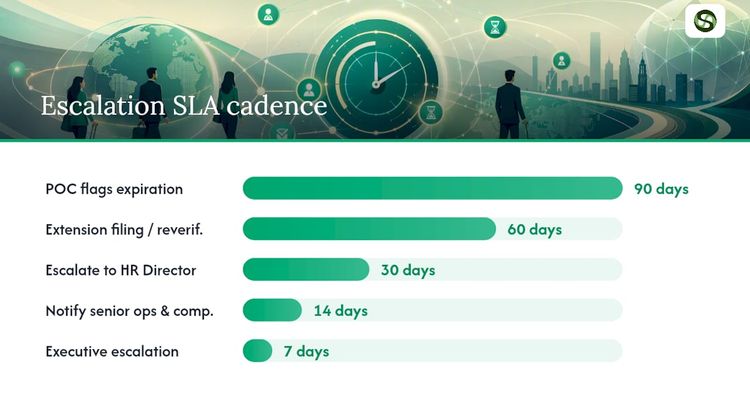
Escalation SLA cadence:
- 90 days out: POC flags expiration; legal counsel notified for petition types requiring early filing.
- 60 days out: Extension filing initiated or reverification workflow triggered.
- 30 days out: Escalation to HR Director if no action confirmed.
- 14 days out: Senior ops/compliance notified; contingency work plan drafted.
- 7 days out: Executive escalation; legal counsel on standby.
Escalation SOP language for your HR playbook: “If a visa or work permit expiration reaches the 30-day threshold without a confirmed filing or reverification action, the HR Director escalates to the Chief Operating Officer and outside immigration counsel within one business day.”
What must a centralized tracking system include?
Must-have features:
- Immutable audit trails and integrity controls
- Multi-channel automated alerts (email, SMS, in-app) configurable at 90/60/30/14/7-day intervals
- Role-based access controls with separate I-9 storage module
- Automated reverification workflow triggers
- HRIS and payroll integration for real-time data reconciliation
- Ability to produce legible I-9 copies within three business days
- Secure document storage with encryption and access logging
- Exportable audit-ready reports
Nice-to-have features:
- E-Verify integration flags
- E-signature collection for document workflows
- Mobile access for remote/multi-state teams
Automated expiry alerts integrated with HRIS are the single highest-leverage technical control — they replace the human memory dependency that causes most missed renewals. Electronic I-9 storage systems must also include audit trails and integrity controls, per practitioner guidance on producing records within three business days. For audit trail architecture and immutable log requirements, verify that any system you evaluate can demonstrate tamper-evident logging before purchase.
What alert schedule should you follow for renewals and reverification?
| Trigger | Action | Owner |
|---|---|---|
| 90 days before expiry | Legal counsel reviews petition type and filing timeline | Immigration counsel |
| 60 days before expiry | Begin extension preparation; gather supporting documents | POC + counsel |
| 90 days before expiry | File extension petition (for petition types requiring early filing); trigger reverification workflow for EAD/TN holders | POC |
| 60 days before expiry | Confirm receipt notice from USCIS; escalate if not received | POC |
| 30 days before expiry | Escalate to HR Director; draft contingency work plan | HR Director |
| 14 days before expiry | Senior ops notified; legal on standby | COO/GC |
| 7 days before expiry | Executive escalation; assess work stoppage risk | Executive team |
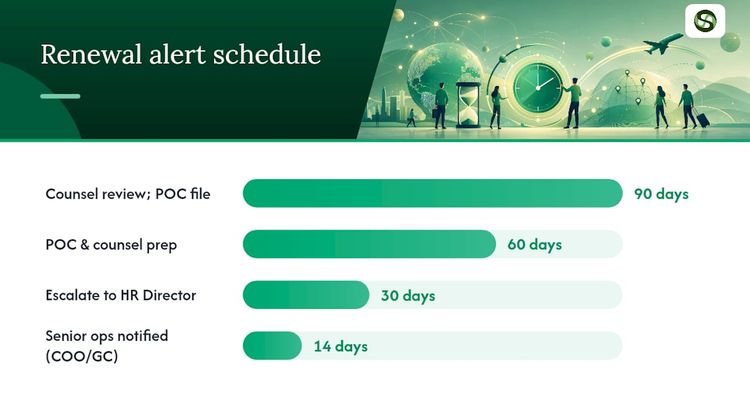
I-9 reverification deadlines differ from petition timelines. Reverification must happen before the employee’s work authorization expires — not after. For H-1B cap-exempt extensions filed under cap-gap, the authorized period extends automatically; track the I-94 expiry date, not the petition receipt date, as the operative deadline.
How do you prepare for an ICE Notice of Inspection?
A mock audit run quarterly is the single most effective preparation. Work through this checklist:
- Pull all current I-9s for active employees and terminated employees within the retention window (three years from hire date or one year after termination, whichever is later).
- Verify you are using the current USCIS-approved Form I-9 edition.
- Check Section 2 completion dates against each employee’s first day of paid work — flag any completed after three business days.
- Confirm employer certification signatures are present in Section 2.
- Verify document recording accuracy: document title, issuing authority, document number, and expiration date must be recorded exactly as they appear on the document.
- Identify any employees with time-limited authorization and confirm reverification is complete or scheduled.
- Time the exercise: can your team produce all requested I-9s within three business days?
When an actual NOI arrives:
- Designate a single response lead immediately.
- Collect all I-9s and supporting payroll/tax records.
- Do not alter or “correct” any I-9 after receiving the NOI — corrections made post-NOI can be treated as obstruction.
- Engage immigration counsel before responding.
A defensible I-9 process combines regular internal audits, documented correction methods, and a designated inspection-response protocol. Organizations that have run at least two mock audits before an NOI consistently produce records faster and with fewer substantive errors.
What can you fix in the next 30–90 days?
30 days:
- Designate a named immigration compliance POC and document the role in writing.
- Centralize all I-9s in a single, secure location separate from sponsorship files.
- Enable 90-day automated expiration alerts — even a shared calendar is better than nothing while a platform is procured.
60 days:
- Run a focused I-9 completeness sweep: Section 2 dates, employer signatures, document recording accuracy.
- Train all I-9 processors on Lists A/B/C acceptance rules and anti-discrimination requirements.
90 days:
- Complete HRIS-to-I-9 reconciliation; flag mismatches for legal review.
- Run your first mock audit against the NOI checklist above.
Warnings: Do not photocopy documents beyond what the I-9 process requires — it creates over-documentation risk. Do not combine I-9 and sponsorship files for storage convenience. Automated compliance tracking replaces these manual workarounds with controls that hold up under inspection. For workplace compliance best practices and system design benchmarks, practitioner resources can supplement your internal SOP development.
A practitioner’s view on what actually changes outcomes
Most teams that struggle with visa and work permit compliance are not short on knowledge — they are short on structure. The organizations that consistently pass ICE inspections without penalty are not necessarily the ones with the most sophisticated legal teams. They are the ones that assigned a named owner, built a 90-day alert cadence, and ran at least one mock audit before an inspector showed up.
The fix that moves the needle fastest is almost always the same: stop treating immigration compliance as a shared responsibility and start treating it as a named job function. When everyone owns it, nobody does. Assign the POC, give them a documented escalation path, and back them with a system that produces an audit trail automatically. The legal exposure does not disappear, but it becomes manageable — and defensible.
Expiryedge keeps your team audit-ready before the clock runs out
Missed renewals and failed ICE inspections share a common thread: no system that flags what is coming and who is responsible. Expiryedge is built for exactly this. It maps directly to the procurement checklist above: automated multi-channel alerts at configurable intervals (90/60/30/14/7 days), immutable audit trails, role-based access with separate document storage modules, RACI-style task assignments, and exportable audit-ready reports — all from one centralized platform.

Teams using Expiryedge replace the spreadsheet dependency that causes most missed renewals with a system that escalates automatically when a deadline approaches and no action has been confirmed. Every alert, assignment, and document interaction is logged and timestamped. When an NOI arrives, your response lead pulls the full record in minutes, not days.
Start a free trial at Expiryedge and see how deadline-driven compliance tracking works in practice.
Sources
- Form I-9 employment eligibility mistakes employers make most often in 2026 — Coggno
- How to manually track immigration requirements — SHRM
- Accidental compliance officers: Your HR team may be at risk — GradyFirm
- Immigration compliance — Davidson Morris
This article is general information, not a substitute for advice from a qualified lawyer. Consult a qualified legal professional about your own circumstances before acting on anything here.
FAQ
What is the three-business-day rule for Form I-9?
Employers must complete Section 2 of Form I-9 within three business days of an employee’s first day of paid work. The same three-business-day window applies when ICE issues a Notice of Inspection — employers must produce all requested I-9 records within that period.
How far in advance should you start an H-1B extension filing?
Common practice is to begin extension preparation at least six months before the petition’s expiry date, with the actual filing initiated around 90 days out, depending on the petition type and current USCIS processing times.
Why should I-9 files be stored separately from sponsorship case files?
Combining both in one folder can create evidence of discriminatory document practices during a DOJ IER review. Separate, secure storage for each file type keeps the two compliance tracks legally distinct.
What triggers a DOJ IER anti-discrimination investigation?
Requesting documents beyond what Form I-9 Lists A/B/C require — or directing employees which specific document to present — can trigger an IER investigation under INA §274B, independent of any ICE worksite enforcement action.
Can Expiryedge handle multi-state or remote employee visa tracking?
Expiryedge’s centralized platform tracks expiration dates and assigns tasks regardless of employee location, making it practical for organizations with distributed workforces where compliance ownership would otherwise fragment across regional HR teams.
Recommended
Frequently asked questions
Common practice is to begin extension preparation at least six months before the petition's expiry date, with the actual filing initiated around 90 days out, depending on the petition type and current USCIS processing times.
Combining both in one folder can create evidence of discriminatory document practices during a DOJ IER review. Separate, secure storage for each file type keeps the two compliance tracks legally distinct.
Requesting documents beyond what Form I-9 Lists A/B/C require — or directing employees which specific document to present — can trigger an IER investigation under INA §274B, independent of any ICE worksite enforcement action.
Expiryedge's centralized platform tracks expiration dates and assigns tasks regardless of employee location, making it practical for organizations with distributed workforces where compliance ownership would otherwise fragment across regional HR teams.
Not legal advice
This article is for general informational purposes and does not constitute legal advice. Laws, regulations and contract requirements vary by jurisdiction and change over time. Consult a qualified attorney in your jurisdiction before making decisions that depend on the specific legal interpretation discussed here.