
What's the Best Compliance Calendar Software for Nonprofits? 5 Options Compared

For most small and mid-sized nonprofits, ExpiryEdge is the best compliance calendar software. It holds every recurring date in one place, from the Form 990 and state renewals to the D&O policy and the annual conflict of interest forms, and it chases the person who has to act, including your accountant or insurance broker. Harbor Compliance is the better pick if you fundraise in many states and want specialists to prepare and file the registrations for you.
Board portals cover the governance side. BoardEffect and OnBoard suit larger boards that want approvals and signatures in one place, and Boardable publishes its per-user prices.
We make ExpiryEdge, and we rank it first for smaller nonprofits, so you know where we stand. What we report about Harbor Compliance and the three board portals comes from their own pages on 7 November 2026, linked inline.
| Tool | Reminds whoever acts, including your accountant and broker (email, SMS, WhatsApp) | Trustees sign disclosures from a link, no login | Tracks every filing, renewal, policy and trustee term in one place | Escalates overdue items to the executive director | Audit trail you can export | Published pricing / free trial |
|---|---|---|---|---|---|---|
| ExpiryEdge Top pick | Yes, email, SMS, WhatsApp, Slack, Teams | Yes, e-signature with automatic follow-up | Yes, recurring dates on one dashboard | Yes, built in | Yes, timestamped log | $29-$199/month, 14-day free trial |
| Harbor Compliance | License Manager tracks renewals | Not stated | Registrations and entity filings | Not stated | Not stated | Not published; quoted with filing fees |
| BoardEffect | Automated follow-ups on board actions | Approval requests; login not stated | Not stated | Not stated | Audit log on Pro | Not published, quote |
| OnBoard | Not stated | eSignatures on Premium | Not stated | Not stated | Not stated | Not published, demo |
| Boardable | Not stated | eSignatures on every plan | Not stated | Not stated | Not stated | $20.99-$35.99 per user/month, 14-day free trial |
How we compared these tools
The columns are the questions a treasurer or executive director asks. Does the reminder reach whoever actually acts, including the accountant and broker? Can trustees sign disclosures without an account? Does every filing, renewal and trustee term sit in one list, and who hears when one is overdue? Is there a record you can export, and can you see the price before a call? Which vendors file with regulators for you is covered in each section. We read each vendor's product and pricing pages on 7 November 2026, and checked the deadlines against the IRS, California's Registry of Charities and the Charity Commission for England and Wales. We didn't run paid trials of every portal. ExpiryEdge is ours, so read its first place with that in mind.
Three sources of deadlines, and none of them reminds you
A nonprofit's deadlines come from three directions: the tax authority, the charity regulator in every state or country you fundraise in, and your own board. None of them sends a reminder you can rely on.
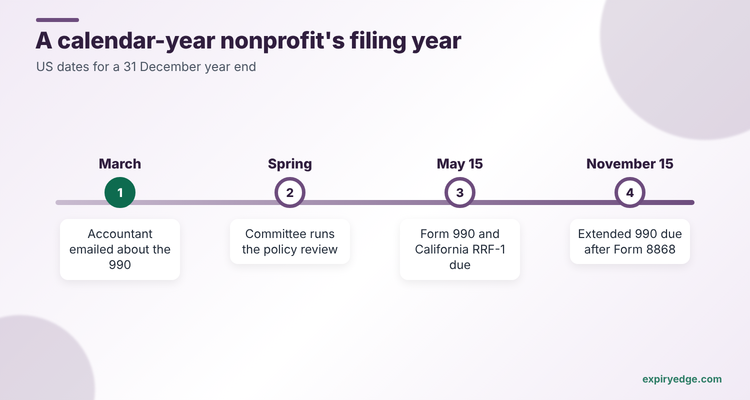
Start with the IRS. Form 990, 990-EZ and 990-PF are due by the 15th day of the fifth month after your year ends, so May 15 for a calendar year, per the IRS due date page. Form 8868 buys an automatic six-month extension. Miss three years in a row and your exemption is revoked automatically.
States add their own cycle. California's Registry of Charities wants Form RRF-1, a copy of your 990 and a fee of $25 to $1,200 four months and 15 days after year end. Late filers face fees, a delinquent status and possible suspension. Other states that register charities set their own forms, fees and deadlines.
In England and Wales, the Charity Commission says you must submit the annual return within 10 months of your financial year end. Above £25,000 of income, that includes the trustees' annual report and accounts. The Commission's essential trustee guide (CC3) is blunt: failing to submit accounts is a criminal offence.
Then there's the board's own housekeeping. The 990's governance section asks about a conflict of interest policy, a whistleblower policy and a document retention policy. Insurance renews every year. Trustee terms end.
- Form 990 or 990-EZ: 15th day of the fifth month after year end
- Form 8868 extension, if you need one: same due date
- State charitable registration renewals, such as California's RRF-1
- Charity Commission annual return: within 10 months of year end
- Annual conflict of interest disclosures from every board member
- D&O, general liability and property insurance renewals
- Policy reviews and trustee term end dates
Why nonprofit calendars break
The dates themselves aren't hard. The people are. A treasurer who knew the 990 timetable steps down, and the new one inherits a shared drive. The development director who set up the California registration leaves in February, and the renewal is due in May.
Outside people make it worse. Your accountant prepares the return, your broker renews the insurance, and each trustee has to sign their own disclosure. A calendar that only reminds your own staff misses half the chain.
So the test for any tool is simple. Each item needs a named owner who isn't a job title in someone's head, a reminder that reaches that person early enough to act, and a record of what was done. If the tool can also ask the outside person directly, you've removed one of the usual reasons things slip, which is a reminder that never left your office.
1. ExpiryEdge: best compliance calendar for small and mid-sized nonprofits
With ExpiryEdge, the 990, the California renewal and the D&O policy don't slip because the treasurer who knew the timetable stepped down. Your executive director stops rebuilding the calendar every year, and outside people like your accountant hear about their deadlines directly.
Every deadline is a record with an owner, a category and a due date that repeats, so your 990, each state registration, the Charity Commission return, the D&O policy and the annual audit sit on one dashboard you can filter by category or team. Upload last year's insurance certificate and ExpiryEdge reads the expiry date. Reminders follow a schedule you set, say 90, 60, 30 and 7 days, and reach people outside your organisation: your accountant gets an email about the 990 in March, your broker gets a no-login request link for the renewed D&O certificate, and if nothing happens the item escalates to the executive director. Every trustee gets the annual conflict of interest form as one request with an e-signature field, and ExpiryEdge follows up until each one signs. A policy review runs as a recurring checklist assigned to the governance committee each spring, and everything lands in an exportable audit log.
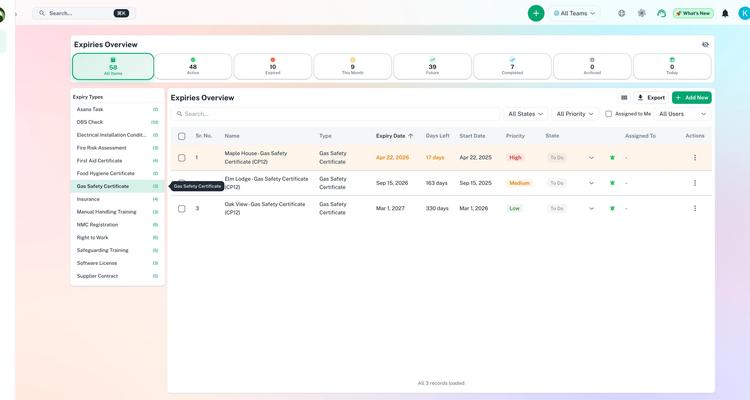
Our nonprofits page shows the setup, and the annual compliance task page covers recurring tasks.
Try it with your own filing dates in 15 minutes
- Import a CSV of next year's obligations (990, state registrations, insurance policies, trustee terms) with a recurrence and an owner on each.
- Add your accountant and broker as outside contacts and give the 990 and D&O records a 90/60/30/7-day schedule that escalates to the executive director.
- Send every trustee the annual conflict of interest form as one request link with an e-signature field.
Pricing: Personal is $29 a month and Power $199, with Pro and Business between, all priced by dated items. Every plan starts with a 14-day free trial and no credit card. Check what each plan holds on the ExpiryEdge pricing page.
Good to know: your accountant keeps preparing and filing returns the way they do now, and you set each date once with its recurrence. If you solicit in 30 states and want registrations filed for you, pair ExpiryEdge with Harbor Compliance's managed service.
2. Harbor Compliance: best for multi-state charitable registration
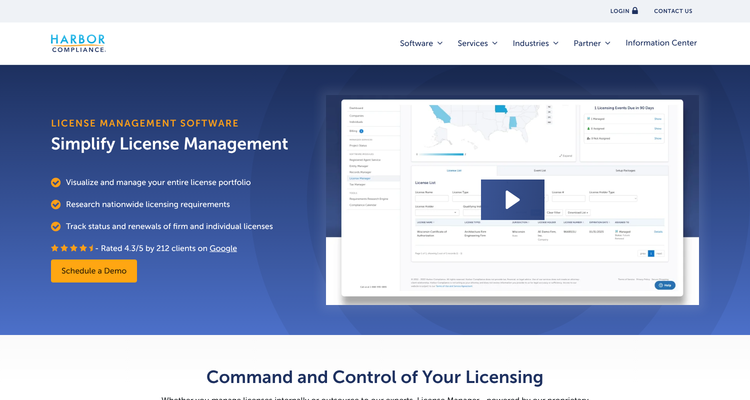
Harbor Compliance sells a fully managed charitable registration service that pairs specialists with its own software. Harbor's site summary says registration is delivered through Labyrinth, Inc., its nonprofit brand, and Labyrinth's page says it has worked on charitable registrations for more than thirty years.
The software page lists License Manager for tracking renewals, Records Manager for corporate records, and a Requirements Research Engine that searches more than 22,000 filing requirements.
Pricing: not published. Harbor says filing fees depend on your situation, and your specialist sets the exact amount.
Watch out for: you'll need a sales call. Harbor covers registrations and entity filings, not insurance renewals, grant reports or board policy reviews.
3. BoardEffect: best board portal for mission-driven organisations
BoardEffect, from Diligent, describes itself on its homepage as built for mission-driven organisations. Board books and minutes are shared digitally, and its workflow tools assign actions, automate follow-ups and request approvals.
Pricing: the pricing page lists Pro and Plus plans with no figures. Pro covers one board with an audit log, survey templates and unlimited certifications. Plus adds unlimited boards and minutes.
Watch out for: the pricing page doesn't list e-signatures or D&O questionnaires, so ask how annual disclosures are collected.
4. OnBoard: best for annual D&O questionnaires
OnBoard is a board portal with three tiers. Its pricing page puts approvals and eSignatures, surveys and task management on Premium. D&O questionnaires and board assessments come with Ultimate or as a governance add-on to Premium.

Pricing: not published. OnBoard prices by plan tier and number of users after a demo.
Watch out for: the questionnaire tools sit on the top tier. A small board that needs only signed annual disclosures may be paying for a lot it won't open.
5. Boardable: best published price for a board portal
Boardable publishes per-user prices on its pricing page. Every plan includes tasks, eSignatures and governance forms, with board agreements and assessments given as examples.
Pricing: first-year prices, billed annually, are $20.99 per user a month for Essentials, $29.99 for Professional and $35.99 for Professional+. Volume pricing lowers the rate, and there's a 14-day trial with no credit card.
Watch out for: a 15-person board on Professional comes to about $5,400 a year at list price. The page doesn't list reminders for filing or renewal dates.
ExpiryEdge as an alternative to Harbor Compliance
Switch to ExpiryEdge if you register in a handful of states and your accountant already prepares the filings. What you need then is a calendar that reminds the right person in time, not a filing service. A nonprofit with five state registrations, a 990, three insurance policies and twelve trustees' annual disclosures has about 25 recurring items, which fits the $29 Personal plan.
ExpiryEdge also reaches the dates Harbor doesn't touch: insurance, grant reports, policy reviews and trustee terms.
Stay with Harbor if you solicit nationally, the rules in each state are the hard part, or nobody on staff has time to prepare renewals. Harbor's specialists do the work. Some organisations use both: Harbor for registrations, ExpiryEdge for everything else on the calendar.
Sort your year into two piles: file it, or just remember it
List every recurring obligation for the next 12 months, with its owner. Include insurance, board disclosures and state renewals, not just tax filings. The list is usually longer than people expect.
Then sort them into two piles: things you need someone else to file, and things you just need to remember. A filing service handles the first pile. A calendar with reminders and document requests handles the second, and for most organisations that's the bigger pile.
Finally, test the reminder chain. Ask each vendor to show what your treasurer receives 60 days before the 990 is due, and what happens if she ignores it. For the rest of the sector picture, see our nonprofit compliance software guide, the grant deadline comparison and the volunteer background check comparison.
Frequently asked questions
Form 990, 990-EZ and 990-PF are due by the 15th day of the fifth month after your accounting year ends, so May 15 for a calendar-year organisation. Form 8868 gives an automatic six-month extension. Three consecutive years without filing means automatic revocation of tax-exempt status.
Within 10 months of the end of your financial year, so 31 October for a charity with a 31 December year end. Charities with income over £25,000 also send their trustees' annual report and accounts, plus any independent examiner's or auditor's report the law requires.
ExpiryEdge runs $29 to $199 a month after a 14-day free trial. Boardable's pricing page lists first-year prices from $20.99 to $35.99 per user a month. The others don't publish prices: you'll get a quote from Harbor Compliance, BoardEffect or OnBoard, and Harbor adds government filing fees on top of its own.
Only if you solicit donations in many states and don't have time to manage each one's rules. Harbor Compliance, through Labyrinth, prepares and files registrations for you. If you register in a few states and your accountant handles filings, a calendar such as ExpiryEdge that reminds everyone in time is usually enough.
Send one form to every board member each year with a signature field and follow up until all are back. OnBoard offers D&O questionnaires on its top tier, Boardable includes eSignatures and governance forms, and ExpiryEdge sends a no-login request link with e-signatures and automatic follow-up.
No single law sets how often. The Charity Commission tells trustees to review risk from time to time, and the IRS Form 990 asks if you have conflict of interest, whistleblower and document retention policies. A simple rule that works: review each policy once a year on a fixed date.