
Mold Assessor License Requirements: NY, TX, FL, DC and LA

A mold assessor license is required in only a few US jurisdictions. We verified New York, Texas, Florida and Washington, DC, which license mold assessors on two-year cycles. New York, Texas and Florida also require continuing education to renew: 4, 8 and 14 hours. Louisiana licenses mold remediation, not assessment.
Your firm does mold work in more than one state, or you're adding mold assessment to an asbestos or industrial hygiene practice, and you need to know who needs which license and when each one lapses. Below is a sourced comparison, the conflict-of-interest rules, a step-by-step path and a renewal tracker with the date maths done.
Key takeaways
- New York requires a mold assessment license for projects over 10 square feet; licenses last two years and renew with a 4-hour refresher.
- Texas mold assessment consultants complete a 40-hour course, pass a state exam and renew every two years with 8 hours of continuing education (CE).
- Florida mold assessor licenses all expire on July 31 of even-numbered years; renewal needs 14 CE hours and a $105 fee.
- Washington, DC licenses mold assessment professionals for two years: $300 initial, $105 renewal, and an approved exam passed within the last two years.
- Louisiana requires a mold remediation license for projects of $7,500 or more, but has no separate assessor license.
- New York and Florida bar the same licensee from assessing and remediating the same property; Florida's bar runs 12 months.
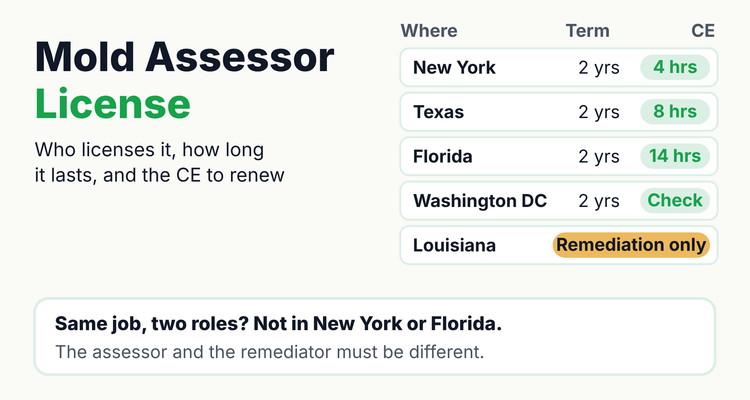 Four jurisdictions license mold assessors on two-year cycles; Louisiana licenses remediation only.
Which states require a mold assessor license?
The jurisdictions we could verify that require a mold assessor license are New York, Texas, Florida and Washington, DC; Louisiana licenses mold remediation only. Each sets its own training, exam, insurance and renewal rules.
Mold assessor license requirements by jurisdiction (last verified 12 October 2026)
| Jurisdiction, agency and license | To qualify | Term, renewal and CE | Fees found | Official source |
|---|---|---|---|---|
| New York: Department of Labor. License: Mold assessor (individual); mold assessment contractor (company) | Age 18+; 32-hour DOL-approved mold assessor course; contractors need liability insurance of at least $50,000 | 2 years from issuance; renewal can't be filed more than 90 days before expiry. CE: 4-hour DOL-approved refresher | Individual assessor fee eliminated (DOL); statute sets $150 to $300 for the assessment license | dol.ny.gov/mold-program; Labor Law Art. 32 (form SH 120) |
| Texas: Department of Licensing and Regulation (TDLR). License: Mold assessment consultant; mold assessment technician; mold assessment company | Consultant: 40-hour course, state exam, degree or experience (e.g. high school plus 5 years in an allied field); technician: 24-hour course, high school or GED | Renew every 2 years; no grace period. CE: 8 hours, taken within the 2-year term | Consultant $500; technician $150 renewal | tdlr.texas.gov/mld; 16 TAC 78.22 |
| Florida: Department of Business and Professional Regulation (DBPR). License: Mold assessor (MRSA) | State exam; associate degree with 30 science or related semester hours plus 1 year of sampling experience, or high school plus 4 years; training in water, mold and respiratory protection | All licenses expire July 31 of even years; notices 90 to 120 days before. CE: 14 hours of approved courses per cycle | $105 renewal; $25 delinquent fee | myfloridalicense.com; Fla. Stat. 468.8413 |
| Washington, DC: Department of Energy and Environment (DOEE). License: Mold assessment professional | Age 18+; approved exam passed within 2 years; high school plus 3 years and 6 jobs, or degree plus 1 year, or CIH, PE, CSP, sanitarian or architect plus 6 months; $1M liability and errors and omissions insurance | 2-year term. CE: Not stated on DOEE's licensing page | $300 initial; $105 renewal | doee.dc.gov/service/mold-professional-licensing |
| Louisiana: State Licensing Board for Contractors. License: Mold remediation license (no assessor license) | Projects of $7,500 or more; qualifying party has 24 hours of training in mold remediation and basic mold assessment | Initial license 1 year, then renew for 1, 2 or 3 years. CE: None for mold | Not checked | lslbc.gov (FAQ and license types) |
New York's 10-square-foot line. New York Labor Law Article 32 defines a mold "project" as assessment, remediation or abatement "of areas greater than ten square feet," excluding routine cleaning. It also exempts, among others, residential owners working on their own property and owners (or their employees) working on their own apartment building of four or fewer units.
Texas licenses companies too. A Texas mold assessment consultant who employs more than one licensed person must also hold a mold assessment company license, and employers need commercial general liability insurance of at least $1 million per occurrence.
For jurisdictions not listed, check your state's contractor or professional licensing board directly. Many mold firms also hold asbestos titles, which run on yearly cycles: see asbestos certification types and renewal.
What do mold assessor conflict-of-interest rules say?
Mold assessor conflict-of-interest rules stop the person who finds the mold from selling the fix on the same job, and they decide how firms that offer both services must split the work.
- New York: "No licensee shall perform both mold assessment and mold remediation on the same property," and no person may own an interest in both the assessing and the remediating licensee on the same property (Labor Law §936).
- New York: the assessor prepares the work analysis and gives it to the client before remediation starts; the remediator follows with a written work plan kept on site (§935).
- Florida: an assessor may not remediate a structure the assessor or their company assessed within the last 12 months, with an exception for certain Division I contractors (Fla. Stat. 468.8419).
- Florida: an assessor may not inspect for a fee any property they have a financial interest in, or take referral fees from a remediator.
How do you get a mold assessor license, step by step?
Pick the jurisdiction first, because each one sets its own course, exam and experience rules. These six steps cover New York, Texas, Florida and DC.
- Confirm the license type. New York and Texas license individuals and companies separately. Texas also has a technician license for people who sample under a consultant.
- Check your education and experience. Texas, Florida and DC each set pathways, from high school plus several years of field experience to a professional credential plus months of experience.
- Take the approved course. New York's mold assessor course is 32 hours; Texas's consultant course is at least 40 hours. Use the agency's approved provider list.
- Pass the exam. Texas and Florida run state exams; DC requires a DOEE-approved exam passed within the past two years. New York's course ends with an exam of at least 50 questions.
- Line up insurance. New York mold contractors need at least $50,000 of liability cover, DC assessors $1 million of general liability and errors and omissions cover, and Texas employers $1 million of general liability.
- Apply, then diarize the renewal. Record the expiry date the day the license arrives and work back from it.
How does mold assessor license renewal work?
Mold assessor license renewal works on a two-year cycle in every jurisdiction we checked, with CE hours due inside the cycle and a renewal window that opens before expiry.
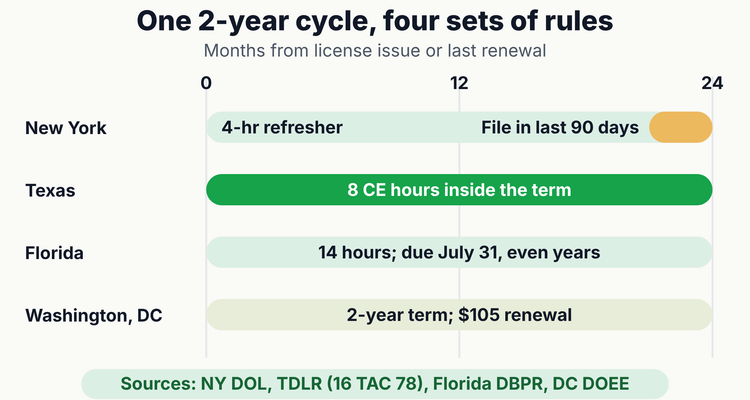 Same two-year cycle, different rules for when the hours and the paperwork are due.
- New York: renewal applications "cannot be submitted more than 90 days prior to the expiration," and every licensee needs the 4-hour refresher.
- Texas: the CE course must be completed "within the two-year term of the credential preceding the expiration date," and you must renew before the license expires even if no notice arrives.
- Florida: everyone renews by July 31 of even years. The last deadline was July 31, 2026; the next is July 31, 2028. CE isn't required before your first full renewal cycle.
- Washington, DC: the term is two years and renewal costs $105. DOEE's licensing page doesn't list CE, so confirm current renewal requirements in the portal.
Do this now: a 45-minute mold license audit
- List every license (10 minutes). Individual and company licenses, per jurisdiction, plus each insurance certificate the licenses depend on.
- Look each one up (15 minutes). Use the agency's license search for the current expiry date. Don't rely on the paper license.
- Count CE hours (10 minutes). Record completed hours and the course dates for each person this cycle.
- Build the tracker (5 minutes). Copy the layout below.
- Act on anything under 90 days (5 minutes). Book CE, and in New York diarize the day the 90-day window opens.
Mold license tracker: columns and formulas (row 2 = first record)
| Column | Header | What goes in it |
|---|---|---|
| A | Name | Person or company |
| B | Jurisdiction and license | e.g. NY mold assessor, TX consultant |
| C | Issue date | From the license |
| D | Expiry | NY and DC: =EDATE(C2,24); Texas: date on the license; Florida: see formula below |
| E | CE hours required | NY 4, TX 8, FL 14 |
| F | CE hours done | Sum of certificates this cycle |
| G | CE gap | =MAX(0,E2-F2) |
| H | Earliest filing date | New York: =D2-90 |
| I | Insurance expiry | Liability or E&O certificate the license relies on |
| J | Next deadline | =MIN(D2,I2) |
| K | Days left | =J2-TODAY() |
| L | Owner and backup | e.g. licensee and office manager |
Florida's fixed date as a formula. This returns the next July 31 of an even year: =DATE(YEAR(TODAY())+MOD(YEAR(TODAY()),2)+IF(AND(MOD(YEAR(TODAY()),2)=0,TODAY()>DATE(YEAR(TODAY()),7,31)),2,0),7,31). On October 12, 2026 it gives July 31, 2028.
Color column K with =$K2<=30 red and =$K2<=90 amber, and add a third rule that turns column G amber when it is above zero inside 180 days of expiry: =AND($G2>0,$D2-TODAY()<=180).
Worked example: a late Texas renewal. A mold assessment consultant's renewal fee is $500. Renew within 90 days after expiry and you pay 1.5 times, $750. Between 91 days and 18 months, twice, $1,000, and you can't do mold work at any point while expired.
💡 Pro Tip
Environmental consultancies we work with track each employee's certificate titles separately, so a person's New York mold assessor license, their Texas consultant license and their asbestos inspector certificate are three records with three expiry dates, not one line on a staff list. The CE hours and insurance certificate sit with the license that needs them.
When is a spreadsheet enough?
One licensee in one state, with CE booked early, can live in a spreadsheet. It gets risky when a firm holds individual and company licenses across states, when licenses depend on insurance certificates that renew on their own dates, or when Florida's fixed deadline lands on everyone at once. ExpiryEdge tracks each license as its own record with owner and backup, the license and insurance files, a CE checklist, and reminders at 90, 60, 30 and 7 days by email, SMS, Slack or Teams. See how it works for environmental contractors and consultancies.
What happens if you work without a valid mold assessor license?
Working without a valid mold assessor license can mean fines, a lapse in your right to work, and in Florida a criminal charge.
⚠️What happens if you miss it: New York can fine violators up to $2,000 for a first violation and up to $10,000 for each later one (Labor Law §937). Texas has no grace period, bars mold work on an expired license and charges up to twice the renewal fee to reinstate. In Florida, performing mold assessment without complying with the licensing law is a second-degree misdemeanor for a first violation (Fla. Stat. 468.8419).
How can a mold firm make license renewals easier?
Spread the CE, watch the insurance and keep the assessment and remediation sides apart on paper.
- Take CE in the first year of the cycle. Texas only counts hours taken within the two-year term, so early is fine; late is a lapse.
- Plan Florida as one company-wide deadline. With every license expiring July 31 of even years, book CE for the whole team by spring.
- Track insurance as its own deadline. In Texas, a lapsed policy means stopping mold work until new proof is filed.
- Check conflicts before you quote. In New York and Florida, decide at intake whether you're the assessor or the remediator on that property.
- Collect subcontractor licenses. Keep remediators' licenses and insurance on file with a contractor document tracker.
- Line up related credentials. Assessors who also inspect for asbestos should see asbestos inspector certification requirements.
Mold assessor license checklist
- ✓
Every individual and company license has its own row and expiry date
- ✓
CE hours required and completed are tracked per person per cycle
- ✓
New York renewals diarized for the day the 90-day window opens
- ✓
Florida licenses set to July 31 of the next even year
- ✓
Insurance certificates tracked with their own expiry dates
- ✓
Reminders at 90, 60, 30 and 7 days with owner and backup
Frequently asked questions
Which states require a mold assessor license?
We verified mold assessor licensing in New York, Texas, Florida and Washington, DC. Louisiana licenses mold remediation contractors for projects of $7,500 or more but has no separate assessor license. Check your state's licensing board before you take work, because rules change.
How long is a mold assessor license valid?
Two years in each jurisdiction we checked. New York licenses run two years from issuance, Texas credentials renew every two years, DC's term is two years, and Florida licenses all expire on July 31 of even-numbered years.
How many continuing education hours does a mold assessor need?
New York requires a 4-hour DOL-approved refresher to renew. Texas requires 8 hours for mold assessment consultants and technicians, taken within the two-year term. Florida requires 14 hours of department-approved courses per biennial cycle, though not before your first full renewal cycle.
Can a mold assessor also do the remediation?
Not on the same job in New York or Florida. New York bars a licensee from performing both the assessment and the remediation on the same property. Florida bars an assessor from remediating a structure they or their company assessed in the last 12 months, with a narrow exception for certain contractors.
What happens if my Texas mold license expires?
There is no grace period, and you can't do mold work until you renew. Within 90 days of expiry you pay 1.5 times the renewal fee; from 91 days to 18 months, twice the fee. Between 18 months and three years you need the executive director's approval.
How much does a mold assessor license cost?
Fees we found: Texas mold assessment consultant $500 to apply and $500 to renew, Florida $105 to renew, and DC $300 initial and $105 renewal. New York's Department of Labor says the fee for individual mold assessor licenses has been eliminated; company licenses still pay.
Sources
- New York State Department of Labor: Mold Program
- NYS DOL Form SH 120: Labor Law Article 32 (rev. 12/25)
- NYS DOL Form SH 129: Initial mold course curriculums (rev. 12/25)
- NYS DOL Form SH 130: Mold refresher course (rev. 12/25)
- TDLR: Renew a Mold Assessment Consultant License
- TDLR: Mold continuing education
- TDLR: Apply for a Mold Assessment Consultant License
- 16 TAC 78.22, renewals (Texas)
- 16 TAC 78.52, mold assessment consultant license (Texas)
- 16 TAC 78.68, training (Texas)
- Florida DBPR: Mold-Related Services
- Florida DBPR: Mold-Related Services FAQs
- Florida Statutes 468.8413, examinations
- Florida Statutes 468.8419, prohibitions and penalties
- DC DOEE: Mold Professional Licensing
- Louisiana State Licensing Board for Contractors: FAQ
- Louisiana State Licensing Board for Contractors: Types of licenses
Last reviewed: 12 October 2026
Frequently asked questions
Two years in each jurisdiction we checked. New York licenses run two years from issuance, Texas credentials renew every two years, DC's term is two years, and Florida licenses all expire on July 31 of even-numbered years.
New York requires a 4-hour DOL-approved refresher to renew. Texas requires 8 hours for mold assessment consultants and technicians, taken within the two-year term. Florida requires 14 hours of department-approved courses per biennial cycle, though not before your first full renewal cycle.
Not on the same job in New York or Florida. New York bars a licensee from performing both the assessment and the remediation on the same property. Florida bars an assessor from remediating a structure they or their company assessed in the last 12 months, with a narrow exception for certain contractors.
There is no grace period, and you can't do mold work until you renew. Within 90 days of expiry you pay 1.5 times the renewal fee; from 91 days to 18 months, twice the fee. Between 18 months and three years you need the executive director's approval.
Fees we found: Texas mold assessment consultant $500 to apply and $500 to renew, Florida $105 to renew, and DC $300 initial and $105 renewal. New York's Department of Labor says the fee for individual mold assessor licenses has been eliminated; company licenses still pay.


