
GRC Software Platform vs Deadline Tools: When Each Wins

Most teams shopping for compliance tooling in 2026 have the same question: do we need a GRC software platform, or do we just need something that makes sure renewals, licenses, and recurring obligations never slip?
They sound similar because both can “help with compliance.” In practice, they win in different situations.
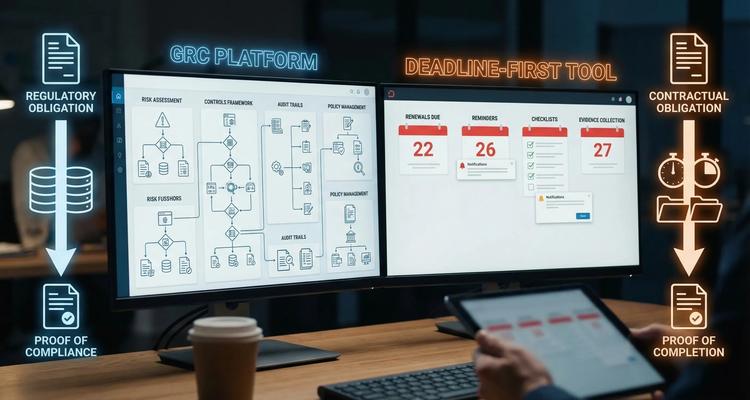
A GRC platform is built to govern risk and compliance across an organization. Deadline tools are built to execute time-bound work reliably, with ownership, reminders, and proof.
This guide gives you a clear, practical way to decide which category you need (and when the best answer is both).
Quick definitions (so you can compare apples to apples)
GRC software platform (Governance, Risk, and Compliance): A system designed to manage governance structures, enterprise risks, controls, policies, audits, and attestations. It is typically used by compliance, risk, internal audit, and security teams to demonstrate control coverage, testing, and reporting.
Deadline tools (renewal and obligation tracking): Tools built to track dates and recurring obligations (renewals, permits, insurance, inspections, certifications, contract notice windows), route the work via checklists, and prove completion with attached evidence.
ExpiryEdge sits in the second category: deadline-first tracking plus workflow checklists, multi-channel notifications, document attachment, dashboards, search, and bulk import, aimed at preventing late fees and failed audits by making execution predictable.
What a GRC software platform is best at
A GRC platform shines when you need a formal operating model for risk and controls, not just “don’t miss the date.” Common strengths include:
- Risk and control structure: risk registers, control libraries, mapping controls to frameworks.
- Policy and exception management: policy lifecycle, acknowledgments, exceptions, and renewals.
- Control testing and assurance: test plans, evidence requests, issue tracking, remediation.
- Audit management: audit plans, findings, workpapers, and standardized reporting.
- Enterprise reporting: rollups for leadership and board-level oversight.
If your environment is built around frameworks and assurance cycles, the center of gravity is not the deadline. It is the control.
For example, an information security program aligned to the NIST Cybersecurity Framework tends to revolve around control ownership, evidence requests, and periodic assessments. Deadlines exist, but they are not the only object you must manage.
What deadline tools are best at
Deadline tools win when the work is primarily operational, recurring, and date-driven, where failure looks like:
- a license lapses
- an insurance policy expires
- a permit is not renewed
- a contract auto-renews because notice was missed
- an inspection or certification is overdue
- a vendor credential packet is incomplete when auditors show up
In these scenarios, teams do not fail because they lack a risk taxonomy. They fail because execution breaks down in predictable ways:
- Ownership is unclear, or the owner changes.
- The “renew-by” date is earlier than the expiration date, but no one tracks it.
- Proof is stored in email threads, shared drives, or someone’s desktop.
- Reminders are not staged, escalated, or sent in the channel people actually respond to.
A deadline-first tool (like ExpiryEdge) is designed to harden the execution loop:
- Smart expiration tracking (including renew-by logic)
- Automated workflow checklists so the renewal is repeatable
- Multi-channel notifications to reduce “I didn’t see the email” misses
- Centralized expiry dashboard for visibility
- Document attachment so evidence is always tied to the record
- Advanced search, calendar view, and bulk import to onboard quickly
- Team collaboration and customizable expiry categories to fit different departments
When a GRC software platform wins
You should strongly consider a GRC platform when most of these statements are true.
You need controls management, not just deadline tracking
If your core question is “Which controls do we have, who owns them, how do we test them, and how do we report them?”, a GRC platform is built for that.
This is common in programs like SOX, SOC 2, ISO 27001, HIPAA security administration, and enterprise risk management.
You have multiple assurance stakeholders (and formal audit rhythms)
If you are supporting internal audit, external audit, customer audits, and regulator exams, you usually need:
- standardized evidence requests
- consistent testing methodology
- issue and remediation workflows
- reporting that rolls up across business units
Deadline tools can help operationally, but GRC is often the system that leadership expects for oversight.
You must map obligations to frameworks and show coverage
GRC platforms are strong when you must show “coverage” of controls against frameworks, not just completion of tasks.
This is a governance problem as much as it is an execution problem.
You require complex access models and segregation-of-duties
Many GRC deployments include strict permissioning patterns across lines of defense, internal audit independence, and formal sign-offs.
That can be overkill for renewal operations, but essential for enterprise assurance.
When deadline tools win (and GRC is often too heavy)
Deadline tools are the better choice when the primary pain is missed renewals, scattered proof, and last-minute scrambles.
Your biggest risk is operational lapse
If the outcomes you care about look like “no lapses, no surprise auto-renewals, no late fees, no failed vendor onboarding,” the right tool is one that makes deadline execution boring.
Common examples:
- business licenses and permits
- insurance COIs and policy renewals
- equipment inspections and safety certifications
- facility and multi-location compliance calendars
- contract notice windows, renewals, and termination rights
- subscription renewals that require budgeting, approval, and cancellation steps
You need fast adoption across non-compliance teams
A lot of “compliance” work is done by operations, finance, legal ops, facilities, procurement, and site managers.
Deadline-first tools tend to fit those teams better because the workflow is concrete:
- Here is the record.
- Here is the renew-by date.
- Here is the checklist.
- Here is the proof.
- Here is who gets notified if it is late.
You need proof attached to the obligation, not stored somewhere else
Audit pain is often not “we did not do it,” but “we cannot prove it quickly.”
A deadline tool that lets you attach renewal confirmations, certificates, and completed checklists directly to the expiry record can turn audits into retrieval, not reconstruction.
You have many similar obligations with slight variations
Deadline-heavy operations often have hundreds or thousands of items that share a pattern:
- recurring date
- owner
- location or vendor
- a short checklist
- an evidence document
This is exactly the kind of workload that benefits from bulk import, categories, and templated checklists.
A practical decision matrix
Use this table as a quick filter. It does not replace a full evaluation, but it will usually point you in the right direction.
| Your primary need | What “good” looks like | Category that typically wins |
|---|---|---|
| Enterprise risk oversight | risk registers, control mapping, testing cycles, executive reporting | GRC software platform |
| Audit and assurance operations | evidence requests, testing methodology, remediation tracking | GRC software platform |
| Renewals and expirations | staged reminders, renew-by logic, ownership, proof attached to each item | Deadline tool |
| Multi-location compliance dates | per-site calendars, clear owners, checklists, proof packs | Deadline tool |
| Contract notice windows | deadline stacks (notice, renewal, termination), escalation, attachments | Deadline tool (or CLM plus deadline tooling) |
| “We already have GRC but deadlines still slip” | execution layer with reminders, checklists, and evidence capture | Deadline tool alongside GRC |
The overlap: why many mature teams use both
In practice, many organizations end up with a two-layer setup:
- GRC as the governance layer (framework mapping, assurance, reporting)
- A deadline-first system as the execution layer (renewals, recurring obligations, proof capture)
This approach works well when your GRC platform is great at “what controls exist,” but day-to-day renewals still live in:
- spreadsheets
- shared inboxes
- calendar invites
- ticket queues with inconsistent fields
What “integration” can mean (without heavy engineering)
You do not always need complex integrations to get value. Many teams use a simple operating model:
- The GRC platform defines the obligation or control area.
- The deadline tool tracks the operational deadlines and evidence packs.
- During audits, the deadline tool becomes the fast retrieval source for renewal proof.
If you want to sanity check your reminder design before you commit to a tool stack, ExpiryEdge’s guide on timing and escalation is a helpful reference: Expiration reminder setup: best timing for renewals.
Real-world examples (where the choice becomes obvious)
Example 1: A growing manufacturing company
- Needs to keep equipment inspections and safety certifications current.
- Has recurring vendor insurance requirements and COIs.
- Audits are mostly about proof that inspections and renewals happened.
This is typically a deadline-tool win, because execution and evidence are the bottleneck.
Example 2: A fintech preparing for SOC 2
- Needs control ownership, testing plans, evidence collection campaigns, and management reporting.
- Must map controls to criteria and track exceptions.
This is typically a GRC platform win, because the center of gravity is control assurance.
Example 3: A logistics or construction operator with container-related compliance
If you buy or lease physical assets, you often inherit recurring dates: inspections, certifications, insurance, maintenance intervals, and contract renewals. Even procurement can be time-sensitive.
For teams sourcing equipment like containers, having reliable suppliers matters. If you are evaluating vendors, a reference point for procurement workflows is a supplier site where you can buy shipping containers online and follow a defined ordering and delivery process.
The tooling decision still comes down to your internal need: if the recurring operational dates are the pain, deadline-first tooling usually delivers faster value than a full GRC rollout.
Example 4: A multi-location healthcare services group
- Must track licenses, training renewals, facility permits, and inspections.
- Must retrieve proof quickly during audits.
- Work is distributed across many sites.
This usually favors deadline tooling first, then adding GRC later if governance and control testing become formalized.
How to choose without overbuying (or under-scoping)
Start with the object you are actually failing
Ask: What went wrong the last three times?
If the answers are “we forgot,” “we did not know who owned it,” “we renewed but cannot find the proof,” then you need an execution system with reminders, ownership, checklists, and attachments.
If the answers are “we cannot demonstrate control coverage,” “we cannot run consistent testing,” “we cannot report risk posture,” then you need a GRC platform.
Measure implementation friction honestly
GRC implementations can be high impact, but they often require data modeling, stakeholder alignment, framework mapping, and process definition.
Deadline tools should be easier to pilot because you can:
- bulk import a register of renewals and obligations
- standardize a handful of categories
- attach proof to each record
- test staged reminders and escalation
If you want a tool-agnostic checklist for what matters most in deadline-first compliance operations, this resource is directly relevant: Compliance management software: core features checklist.
Avoid the common trap: “We will use a project tool for deadlines”
General task tools can work for some teams, but deadline-heavy compliance work usually breaks them because:
- recurrence is inconsistent (and history gets lost)
- evidence is not consistently attached to the obligation record
- ownership and escalation are not standardized
- reporting becomes manual
If deadlines are audit-sensitive, treat them as records with proof, not as one-off tasks.
Where ExpiryEdge fits (if your problem is deadline control)
If your primary goal is to prevent missed renewals, late fees, and audit fire drills, ExpiryEdge is built for deadline-first compliance execution:
- centralized dashboard for all expiries
- customizable categories for contracts, licenses, subscriptions, operations
- automated checklists so renewals are repeatable
- multi-channel notifications with clear ownership
- document attachment and search for audit-ready proof
- calendar view and bulk import to deploy quickly
You can explore the platform at ExpiryEdge and evaluate it alongside your current approach.
Frequently Asked Questions
Is a GRC software platform the same as compliance management software? Not always. Many people use “compliance software” broadly. A GRC software platform is typically designed for risk, controls, and assurance. Deadline-first compliance tools focus on renewals, recurring obligations, reminders, workflows, and proof.
Can a deadline tool replace a GRC platform?
If your compliance program is primarily operational and deadline-driven, a deadline tool may be sufficient. If you need control mapping, testing cycles, and enterprise risk reporting, a deadline tool usually complements GRC rather than replacing it.
What is the biggest sign we need a deadline-first system?
You are doing the work, but you cannot reliably execute on time across the team, or you cannot retrieve proof quickly. Missed renewals, surprise auto-renewals, and last-minute audit scrambling are the common triggers.
What is the biggest sign we need a GRC platform?
You need to run formal control testing, map controls to frameworks, manage exceptions, and produce consistent reporting for leadership, auditors, or regulators.
Can we use both without duplicating work?
Yes, if you draw a clean line: GRC for governance and assurance reporting, deadline tooling for execution and evidence capture tied to each obligation. Many teams keep the operational proof in the deadline system and reference it during audits.
Build a simpler compliance operating system (starting with the dates)
If missed renewals and scattered proof are your current bottlenecks, start by making deadline execution predictable: one place to track obligations, clear owners, staged reminders, repeatable checklists, and evidence attached to every record.
ExpiryEdge is designed for exactly that. Visit expiryedge.com to see how a deadline-first platform can reduce late fees, prevent lapses, and make audits faster by default.