
Home Care Training Software: 6 Tools Compared for Aide In-Service Hours and the Care Certificate

ExpiryEdge is our first pick for home care agencies whose training comes from several places, including classroom sessions and outside providers. It tracks every aide's hours, certificates and refresher dates on one dashboard and texts the caregiver when something is due. For the classes themselves, pair it with CareAcademy: it's built for caregivers, assigns classes by state rules, reminds aides by text and email, and publishes its prices.
Larger home health agencies with nurses and therapists often prefer Relias or HealthStream for their clinical libraries. UK providers should look at Careskills Academy or iLearn Care for Care Certificate and mandatory courses.
We make ExpiryEdge. The details on CareAcademy, Relias and the rest come from their own sites as of 7 November 2026, each linked.
| Tool | Tracks every aide's hours and certificates in one place, from any trainer | Reminds the caregiver (SMS, WhatsApp, email) | Caregivers upload outside certificates from a link, no login | Audit trail or survey reports you can export | Course library | Published pricing / free trial |
|---|---|---|---|---|---|---|
| ExpiryEdge Top pick | Yes, any certificate, hours or refresher | Yes, SMS, WhatsApp, email, Slack, Teams, with escalation | Yes, no-login link | Yes, timestamped and exportable | Logs courses from any library or classroom | $29-$199/month, 14-day free trial |
| CareAcademy | Its own classes, plus CareSync history from other CareAcademy employers | Yes, text and email | Not stated | Audit-ready reports | 550+ classes, assigned by state rules | From $239 a month, one-year minimum, free trial |
| Relias | Not stated | Not stated | Not stated | Compliance reports for surveyors | Yes, aide courses in six languages | Not published, demo on request |
| Careskills Academy | Training matrix for its learners | Not stated | Not stated | Not stated | 200+ CPD courses, Care Certificate | From £15; unlimited from £2.92 per user a month |
| iLearn Care (Agilio) | Not stated | Not stated | Not stated | Not stated | 130+ courses, Care Certificate-aligned | Not published, quote |
| HealthStream | Not stated | Not stated | Not stated | Not stated | 80+ compliance and 500+ CE courses | Not published, demo on request |
How we compared these tools
A surveyor doesn't ask which course library you bought. They ask whether each aide reached her 12 hours and holds a current CPR card, and for proof. So our columns ask whether a tool tracks every aide's hours and certificates from any trainer, texts the caregiver, lets her upload an outside certificate without an account, and gives you records you can export. We kept one column for the course library, because some agencies need the classes too. Published pricing is last. On 7 November 2026 we read each vendor's product and pricing pages, and checked the hour rules against eCFR, CQC and Skills for Care. We didn't take paid trials or sit through every course. We make ExpiryEdge, so weigh our take on it with that in mind.
Sixty aides means sixty training years, not one December deadline
It has to get the right hours into the right people before the deadline, and prove it afterwards. The deadline depends on who regulates you.
For Medicare-certified home health agencies, the rule is federal. 42 CFR 484.80 says a home health aide must get at least 12 hours of in-service training in each 12-month period, supervised by a registered nurse. Aides also need a competency evaluation before they work, and some skills must be observed with a patient or a pseudo-patient. Online courses can't cover that part.
Non-medical personal care agencies answer to their state, and the hours, topics and deadlines differ from state to state. That's why "assigns by state" matters in the table above.
In England, CQC's Regulation 18 guidance says staff training needs must be assessed at the start of employment, that providers define other mandatory training for each role, and that lapses should be noticed and acted on quickly. New care workers usually start with the Care Certificate, which now has 16 standards after a 2025 update added learning disability and autism awareness.
The hard part isn't the courses. It's the calendar. A federal 12-month period runs from each aide's own date, so an agency with 60 aides has 60 different deadlines, not one in December. Caregivers who join mid-year, take leave or move between branches make it worse. Good software counts hours per person against her own window and warns you while there's still time to book a session.
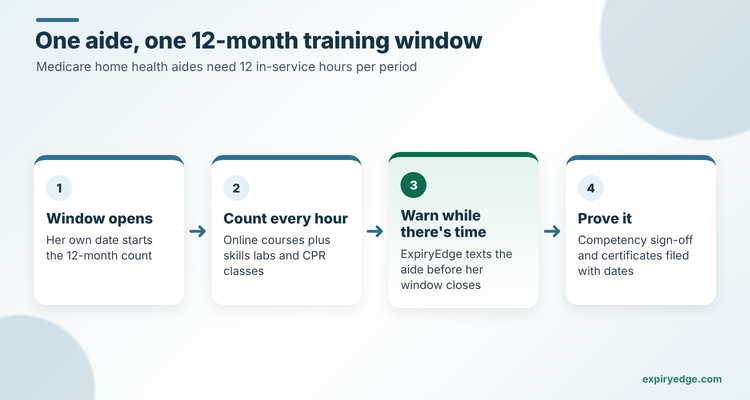
The other trap is training that never touches the platform. A nurse-led skills lab, a CPR class at the local hospital or a certificate from a previous employer all count, but only if someone records them with a date and keeps the evidence.
- Start date of her 12-month training year, not just the calendar year
- Hours completed so far, by topic
- Any classroom or skills-lab session done outside the online platform
- Competency sign-off, with the nurse who observed it
- Expiry dates on certificates that sit beside training, such as CPR or food hygiene
1. ExpiryEdge: best for keeping every aide's hours and certificates current, whoever does the training
With ExpiryEdge, no aide reaches the end of her training year short of hours without you knowing, and no CPR card lapses unnoticed. You stop chasing caregivers for paperwork, and you can hand a surveyor proof of 12 hours in a couple of clicks.
Most agencies don't train in one place: online modules, a nurse's skills lab, a hospital partner's CPR class, a certificate from a new hire's last job. ExpiryEdge puts all of it on one record per caregiver, with custom fields for hours completed, topic and who observed the skill. Ninety days before her training year ends, the caregiver gets an SMS, WhatsApp or email with a no-login link to upload any outside certificate, and her coordinator gets a Slack or Teams alert. If she's still short, it escalates to the branch manager. A recurring checklist runs your monthly in-service day, and the dashboard filters by category so you see every caregiver short of hours across three branches.
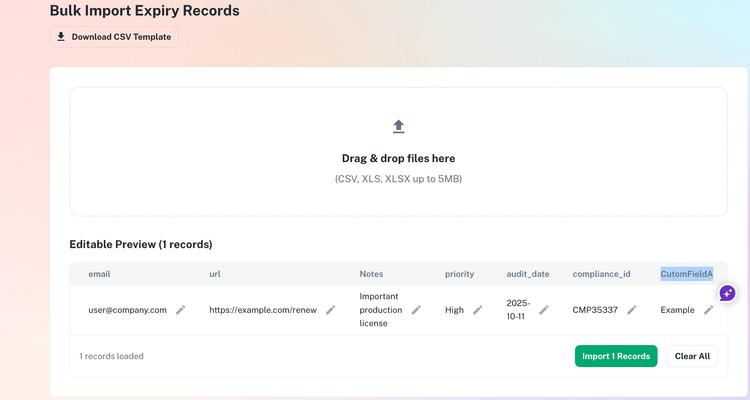
Try it with your own training records in 15 minutes:
- Build a training template with custom fields for hours completed, topic and observing nurse, then import last year's spreadsheet by CSV.
- Set each aide's training-year end as the due date with a 90/30/7-day schedule that texts her and escalates to the branch manager.
- Add a monthly recurring checklist for in-service day, with a step to upload the signed attendance sheet.
Pricing: $29, $49, $99 or $199 a month, and yearly billing knocks off two months. Start with a 14-day free trial, no card needed. See the item and user limits for each plan on the pricing page.
Good to know: ExpiryEdge works with whatever training you already use, so you keep CareAcademy, Relias or your own classroom sessions and get every hour and certificate on one record.
2. CareAcademy: best for most US home care agencies
CareAcademy is a caregiver training platform for home care and senior care. Its homepage lists 550+ classes, including home health aide training, dementia care and nursing skills, and says it assigns classes automatically based on state and federal requirements. It reminds caregivers by text and email, tracks progress on one dashboard and produces audit-ready reports.
CareSync lets a new employer import a caregiver's training history from another CareAcademy-powered agency, so she doesn't repeat classes she's already done. CareAcademy is now part of Activated Insights, whose integrations page lists links with WellSky, AlayaCare, HHAeXchange, AxisCare, CareSmartz360 and others.
Pricing: the pricing page lists Essentials at $239 a month, Advanced at $383 and Complete at $419, with a one-year minimum contract that renews annually and a free trial.
Watch out for: the annual commitment. Price the plan for your real caregiver count before you sign.
3. Relias: best for home health agencies with clinical staff
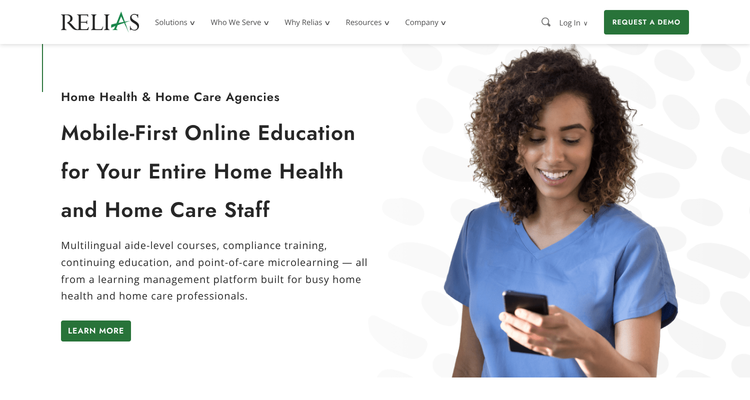
Relias sells an LMS and course library for home health and home care agencies. Aide-level courses come in English, Spanish, Haitian Creole, Filipino, Russian and Chinese, which matters when your caregivers don't all read English comfortably. Nurses and therapists get hundreds of continuing education courses.
Its accreditations team maps state and federal training requirements to Relias courses. The platform automates onboarding and annual training and produces compliance reports for surveyors.
Pricing: not published; request a demo.
Watch out for: the page we read didn't say whether you can log classroom training done elsewhere. Ask, if your aides do skills labs in person.
4. Careskills Academy: best low-cost Care Certificate option in the UK
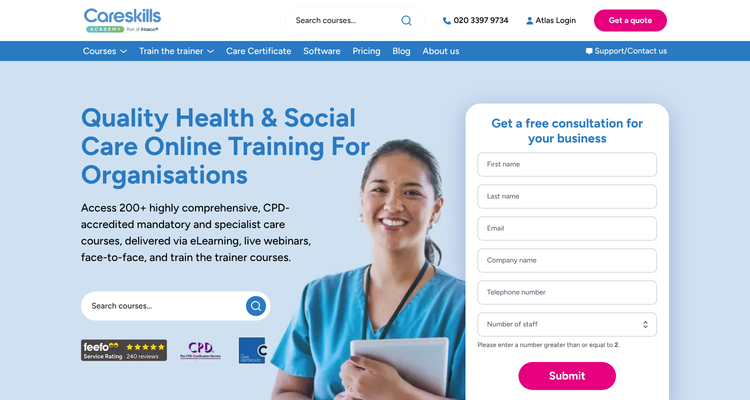
Careskills Academy, part of iHasco, offers 200+ CPD-accredited care courses by e-learning, webinar, face-to-face and train-the-trainer. Its Care Certificate course covers all 16 standards and is written by Skills for Care. An automatic training matrix shows each learner's progress.
Pricing: the Care Certificate starts from £15. Careskills Unlimited starts from £2.92 per user a month for 101-150 staff, and course credits start from £12.30.
Watch out for: the homepage doesn't mention expiry reminders for refresher training, so check how the matrix flags lapsed courses.
5. iLearn Care (Agilio): best for small UK care providers who want one bundle
Agilio's iLearn Care gives care providers 130+ CPD-certified courses covering core, mandatory and specialist topics, plus Care Certificate-aligned training. Agilio lists domiciliary care among the organisations iLearn supports.
Pricing: not published on that page; get a quote.
Watch out for: iLearn is sold across healthcare sectors, so ask which courses are written for home care rather than care homes.
6. HealthStream: best for Medicare-certified home health and hospice
HealthStream's home health page lists 80+ micro compliance courses, OASIS and CMS Conditions of Participation-aligned courses, and 500+ continuing education courses for home health, hospice and interdisciplinary teams. Its Home Care Pulse offering covers caregiver training for nurses, CNAs and caregivers.
Pricing: not published; book a demo.
Watch out for: HealthStream sells many products across healthcare. Ask which ones you need for aide in-service so you don't pay for hospital tools.
ExpiryEdge as an alternative to CareAcademy
We put ExpiryEdge first because a surveyor asks for proof of hours and current cards, and that record is what it keeps. If your problem is content, CareAcademy or a similar library is the right call. For dementia care courses and quiz scores, pair ExpiryEdge with one.
Switch, or add ExpiryEdge, when your problem is the record around the training. That looks like caregivers trained by three different providers, nurses' skills checks kept on paper, CPR and first aid cards that expire on their own clocks, or an annual contract that costs more than your training budget for a 20-caregiver agency. ExpiryEdge holds all of it on one dashboard, chases the caregiver by text, and gives you an audit export when the surveyor asks for proof of 12 hours.
Don't switch if CareAcademy already covers every topic you need and your caregivers do nothing outside it. One system is easier than two.
Write down your hour rule, then ask three questions
Write down your rule first. A Medicare-certified agency needs 12 in-service hours a year per aide. A personal care agency needs whatever its state says. A UK provider needs the Care Certificate for new staff and its own refresher list. Then count the hours per caregiver and the number of caregivers.
Next, ask each vendor three questions. Can it assign courses to my state's rule? Can I log training done somewhere else? What does it cost for my exact headcount over a year? CareAcademy and Careskills answer the last one on their sites; the rest need a call.
If you want the bigger picture, our home care compliance software hub covers training alongside caregiver checks and supervisory visits, and the caregiver compliance tracking comparison covers TB, CPR and background checks. For how other healthcare teams keep certificates current, see ExpiryEdge for healthcare.
Frequently asked questions
Under 42 CFR 484.80, an aide in a Medicare-certified home health agency needs at least 12 hours of in-service training in each 12-month period, supervised by a registered nurse. Non-medical personal care agencies follow state rules, which vary, so check your state licensing agency.
CareAcademy lists plans at $239, $383 and $419 a month with a one-year minimum. Careskills Academy's Care Certificate starts from £15, and its unlimited plan from £2.92 per user a month. Relias, HealthStream and iLearn Care quote on request. ExpiryEdge doesn't sell courses; it tracks the ones you buy, at $29 to $199 a month.
Not all of it. Federal rules say certain skills must be evaluated by watching the aide perform them with a patient or pseudo-patient, and a registered nurse must run the evaluation. Online courses from CareAcademy or Relias can cover theory, but you still need an observed skills check on record.
Only if training happens outside it. CareAcademy tracks its own courses and reports on completion. If caregivers also do classroom skills labs, CPR from a third party or training at a previous employer, a tool like ExpiryEdge keeps those certificates and dates on the same record.
It's the agreed starting standard for people new to care work in England, run by Skills for Care with NHS England and Skills for Health. There are now 16 standards; a 2025 update added one on learning disability and autism. Careskills Academy and iLearn Care sell courses built around it.