Legal Teams: Manage Contract Deadlines Without Last-Minute Rush

The last-minute contract deadline rush usually is not caused by one missed calendar invite. It happens when notice periods, auto-renewals, insurance certificates, and approval steps live in different places, owned by different people, with no shared “renew-by” date your team can operationalize.
This FAQ-style guide is built for legal teams who want a repeatable system for contract deadlines that holds up under audit pressure, quarter-end volume, and employee turnover.
Contract deadline fundamentals (FAQ)
What contract deadlines should legal teams track (beyond the expiration date)?
Legal teams typically need a “deadline stack,” not a single end date. The highest-risk misses tend to be notice-based (non-renewal windows, termination notice, price increase notice), performance-based (deliverables, milestones, renewal conditions), and governance-based (required reviews and approvals).
A useful baseline is to track the dates below, even if you later decide some can be handled by the business owner.
| Deadline type | Where it usually appears | What goes wrong if missed | What to capture in the record |
|---|---|---|---|
| Non-renewal / cancellation notice date | Auto-renewal clause | Unwanted renewal, pricing increases, budget surprise | Notice period length, notice method, counterparty contact, internal “renew-by” date |
| Renewal option exercise date | Renewal section, exhibits | Loss of favorable rates or renewal rights | Option window, required form of notice, renewal term |
| Termination for convenience notice | Termination clause | Lost flexibility, extended spend | Notice period, required delivery method |
| Regulatory or policy-driven review date | Internal policy, playbook | Compliance gaps, audit findings | Review owner, evidence required, review checklist |
| Insurance / certificate renewal | Insurance requirements, SOW | Breach, stop-work, vendor onboarding delays | Coverage type, certificate holder, proof attachment |
| Data/security addendum re-validation | DPA, security schedule | Security exceptions, delayed renewals | Approval path, required documents |
| Price increase notice date | Pricing clause | Unplanned cost increases | Increase cap, notice window, renegotiation trigger |
If you only track “contract end date,” you are blind to the dates that actually drive urgency.
What’s the difference between an “expiration date” and a “renew-by” date? The expiration date is what the contract says. The renew-by date is what your team must hit to complete internal work before the notice window closes or the counterparty needs action.
A simple way to avoid chaos is to treat renewals like a mini-project with a finish line earlier than the legal deadline:
- Contract deadline (notice or end date)
- Minus counterparty processing time (signature, approvals, vendor portal)
- Minus internal cycle time (business review, risk review, legal redlines)
- Minus buffer for vacations, quarter-end, and procurement bottlenecks
That computed date is what your reminders and workflow should target.
How far in advance should we start renewal work to avoid a scramble?
It depends on contract complexity and dependencies, but many legal teams use staged lead times tied to risk. For example, a high-impact vendor with security review and budget approval usually needs significantly more runway than a low-risk auto-renewing SaaS seat bundle.
If you want a starting point, use staged reminders (early review, mid-cycle check, final notice window, last-call escalation) and then tighten or extend based on how long your organization actually takes to approve changes.
If you want a deeper timing framework, see ExpiryEdge’s guide on expiration reminder setup and renewal timing.
Ownership and collaboration (FAQ)
Who should “own” contract deadlines in a legal team? Ownership works best when it is explicit and two-layered:
- Business owner (the person accountable for “do we renew, renegotiate, or exit?”)
- Legal ops or legal coordinator (the person accountable for “did the workflow run, did we capture evidence, did we send notice correctly?”)
Legal should not be the only owner of every contract date, but legal should set the standard for how deadlines are recorded, how notice is sent, and what proof is retained.
How do we stop contract renewals from stalling in procurement, finance, or security review?
Most stalls happen because renewals are treated as a single event rather than a sequenced workflow. A practical fix is to attach a checklist to each renewal type with clear exit criteria.
Example checkpoints that reduce last-minute pileups:
- Budget confirmation completed before legal review begins
- Security questionnaire initiated before pricing negotiation finalizes
- Signature routing prepared before the notice window closes
The key is that each step has an owner, a due date, and a place to store the outcome (email confirmation, approval note, updated doc).
What should we do when the contract owner leaves the company?
Treat turnover as a predictable failure mode. Your system should make it easy to reassign ownership and see what is at risk.
Operationally, this means:
- Every contract deadline has a primary owner and a backup
- The record includes the “what happens next” context (renewal intent, negotiation status)
- Supporting documents and proof live with the record, not in a departing employee’s inbox
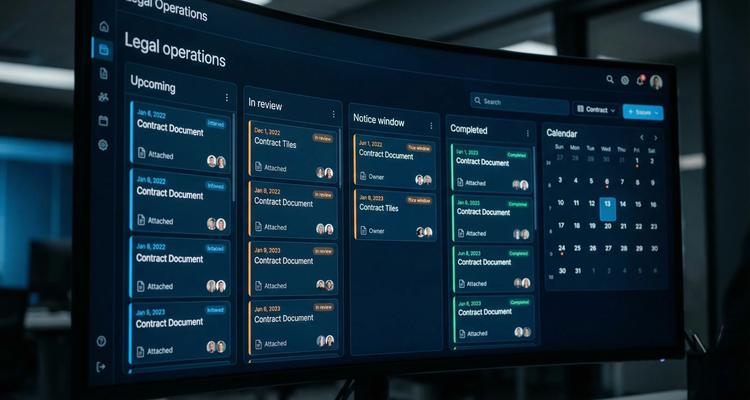
This is where a centralized dashboard matters more than another calendar.
What if we simply don’t have enough capacity to manage deadlines well? If the backlog is structural (volume growth, new regulations, M&A), you may need either a dedicated contract manager/legal ops hire or outside support for peaks.
For organizations tied to infrastructure and construction programs, staffing can be especially specialized. In those cases, partnering with a recruiter that understands the domain can reduce mis-hires and ramp time. For example, some firms use a specialist civil engineering recruitment partner when legal workload is tightly coupled to project delivery and vendor ecosystems.
Audit-ready contract deadline management (FAQ)
What evidence should we keep to prove we met a contract deadline?
Keep evidence like you expect to explain it six months later to an auditor, a regulator, or a new internal stakeholder. At minimum, retain:
- The clause (or excerpt) that sets the deadline
- The notice you sent (final version)
- Proof of delivery (email thread, courier receipt, portal confirmation)
- Counterparty acknowledgment (if applicable)
- The final executed renewal/termination document
If this proof lives across email, shared drives, and chat threads, you will recreate the last-minute rush during every audit, even if you technically met deadlines.
How can we make deadline reporting useful for leadership (not just a list of dates)?
Legal leadership usually wants to know risk and workload, not every contract detail. Consider reporting on:
- Deadlines due in the next 30/60/90 days by risk tier
- Items inside the notice window (no longer “fixable” without escalation)
- Renewals awaiting business decision vs awaiting legal vs awaiting counterparty
- “No owner” or “no evidence attached” exceptions
A dashboard becomes actionable when it highlights exceptions and bottlenecks, not when it merely mirrors a spreadsheet.
Tools and automation (FAQ)
Why don’t shared calendars and spreadsheets prevent last-minute contract deadline rushes?
They can work at low volume, but they usually fail under real legal-team conditions:
- Ownership changes break the system
- Notice windows and multi-step workflows are hard to represent cleanly
- Evidence gets stored elsewhere (no audit trail)
- Reminders don’t escalate reliably when someone is out
If you want the side-by-side comparison, ExpiryEdge has a detailed breakdown of workflow system software vs spreadsheets.
What should we look for in software to manage contract deadlines without last-minute fire drills?
Prioritize capabilities that match how legal work actually happens:
- A centralized register (single source of truth for deadlines and metadata)
- Smart expiration tracking with flexible, staged alerts
- Workflow checklists so renewal work is repeatable
- Team collaboration (assignment, handoffs, visibility)
- Document attachment so evidence is stored with the deadline
- Search and filters so you can answer questions fast
- Calendar view for planning and workload balancing
- Bulk import for migrating from spreadsheets
These criteria matter because they reduce the two drivers of scramble: unknown ownership and unknown status.
How does ExpiryEdge help legal teams manage contract deadlines without last-minute rush?
ExpiryEdge is designed for teams tracking renewals, licenses, and compliance deadlines where missing one date creates outsized cost. For legal teams, it can serve as a deadline-first system to:
- Track contract notice periods and renewal dates in one place (smart expiration tracking)
- Run consistent renewal playbooks (automated workflow checklists)
- Notify the right people at the right time (multi-channel notifications)
- Keep supporting documents and proof attached to the record (document attachment)
- Give legal ops and stakeholders shared visibility (centralized expiry dashboard, team collaboration)
- Find anything quickly during audits and escalations (advanced search)
- Plan workload across weeks and quarters (calendar view)
To see if it fits your workflow, you can Start Free – No Credit Card or Book Demo.
Can we implement this without a painful migration project?
Yes, if you start with a focused scope and a repeatable template. A low-friction rollout approach is:
- Start with one contract category (for example, top 20 vendors by spend or risk)
- Define required fields (notice period, owner, backup, renew-by date, evidence)
- Import what you already have (even if imperfect) and fix forward
- Run a weekly review cadence for 30 days, then expand categories
Tools with bulk import, category templates, and fast search reduce the “big bang” risk.
What operational cadence keeps contract deadlines under control year-round?
A cadence is what turns reminders into a system. Many legal ops teams find these two touchpoints sustainable:
- Weekly 20-minute triage: what entered the notice window, what has no owner, what is blocked
- Monthly planning review: upcoming 60 to 120 day renewals, resourcing, negotiation strategy
The goal is to prevent surprises, not to add meetings. If your team is still surprised, it usually means your renew-by dates are too late or ownership is unclear.
Getting started (FAQ)
What’s the fastest way to reduce last-minute renewal risk this quarter?
Do a “notice window audit” first, not a full contract inventory.
Pick a time horizon (next 90 days) and identify:
- Any contracts with auto-renewal clauses
- Any renewals requiring security, finance, or procurement approvals
- Any items with missing owner or missing notice method
Then standardize just those records and run staged reminders. You will reduce fire drills quickly, and you can broaden coverage afterward.
How do we know the system is working?
The signal is not “we have fewer emails.” The signal is fewer exceptions:
- Fewer renewals discovered inside the notice window
- Fewer contracts with missing ownership
- More renewals completed with evidence attached
- Less time spent rebuilding status for leadership
If you want to move from reactive to controlled, make the system visible, measurable, and easy to maintain.
When you’re ready to operationalize this across the team, Start Free – No Credit Card or Book Demo to see how ExpiryEdge supports contract deadline tracking, workflows, and audit-ready documentation.
Not legal advice
This article is for general informational purposes and does not constitute legal advice. Laws, regulations and contract requirements vary by jurisdiction and change over time. Consult a qualified attorney in your jurisdiction before making decisions that depend on the specific legal interpretation discussed here.