How to Manage Compliance Obligation Renewals Effectively

How to Manage Compliance Obligation Renewals Effectively

Managing compliance obligation renewals requires centralized tracking, automated alerts, and clearly assigned ownership to prevent missed deadlines.
Organizations must treat renewal management as a governance process involving decision-making, risk assessment, and continuous record updating to avoid penalties and disruptions.
Managing compliance obligation renewals is the process of tracking, reviewing, and acting on contractual and regulatory deadlines to maintain continuous organizational compliance and avoid penalties. Frameworks like OSHA, EPA, and ISO standards each carry specific renewal cycles, and missing a single deadline can trigger legal repercussions, operational setbacks, and reputational damage. Yet most compliance teams still rely on spreadsheets and manual reminders, which creates serious gaps. The shift from reactive deadline-chasing to governance-driven renewal management is the single most important change a compliance or operations manager can make.
How to manage compliance obligation renewals: prerequisites and tools
Compliance obligation renewals are defined as the recurring actions required to keep contracts, licenses, permits, and regulatory filings current and legally valid. Before any process or technology can work, three prerequisites must be in place: a centralized obligation register, defined ownership for each renewal, and a documented policy framework that sets lead times and escalation rules.
The obligation register is the foundation. Every license, permit, vendor agreement, and regulatory filing belongs in one place, mapped to its owner, renewal date, and supporting evidence. Without this, teams operate from fragmented lists that decay over time, especially when staff turns over.
Regulatory frameworks like OSHA, EPA, and ISO have specific renewal deadlines that require dedicated tracking mechanisms. Failure to track these obligations can lead to legal consequences and operational setbacks. That specificity means a generic task manager will not cut it.

The right tool category depends on your organization’s scale and complexity. The table below maps tool categories to their core functions and primary benefits.
| Tool category | Core function | Primary benefit |
|---|---|---|
| Centralized tracking platform | Single register for all obligations and deadlines | Eliminates fragmented spreadsheets and data gaps |
| Automated alert and escalation system | Multi-channel reminders with tiered escalation | Ensures sufficient lead time before each deadline |
| Workflow automation engine | Task assignment, approval routing, and status tracking | Reduces manual coordination and missed handoffs |
| Integration layer (ERP, CRM, procurement) | Connects renewal data to existing business systems | Removes data silos and manual re-entry errors |
| Audit and reporting module | Generates evidence trails and compliance records | Supports audits and regulatory reviews |
Integration with ERP, CRM, and procurement platforms creates an end-to-end automated ecosystem that improves reliability and reduces manual data entry errors. That integration also gives leadership a single view of compliance status across the organization.
Pro Tip: Build your obligation register before selecting any software. A tool is only as good as the data you put into it. Start by auditing every active license, permit, contract, and regulatory filing your organization holds.
How to implement a step-by-step compliance renewal process
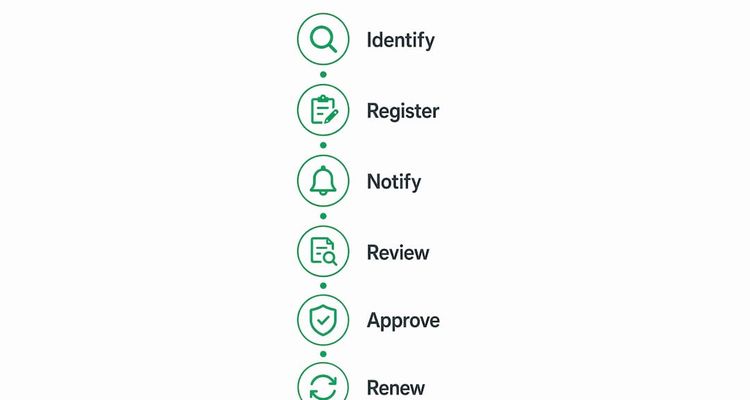
A structured process turns renewal management from a reactive scramble into a predictable governance cycle. The five steps below apply to organizations of any size.
- Establish governance and ownership. Assign a named owner to every obligation in your register. Ownership means accountability: that person is responsible for initiating the renewal review, gathering evidence, and escalating when needed. Without named owners, renewals fall through the cracks during staff changes.
- Centralize obligation data and map relationships. Move every contract, license, permit, and regulatory filing into a single platform. Map each obligation to its related vendor, asset, or business unit. Treating contracts as connected objects linked to vendors, assets, and controls enables real-time risk visibility and proactive renewal alerts. This mapping prevents costly lapses that occur when obligations are tracked in isolation.
- Automate alerts and escalation workflows. Set tiered reminders at 90, 60, and 30 days before each deadline. Escalation notifications and automated reminders give compliance teams sufficient lead time to act. Without these alerts, renewals are handled reactively, which increases risk and reduces negotiating leverage.
- Evaluate renewal terms, performance, and risk. Each renewal trigger is an opportunity to review vendor performance, renegotiate terms, and assess whether the obligation still fits the organization’s risk profile. Renewal governance involves formal decision-making, not just monitoring deadlines. Managers who treat renewals as decision points consistently achieve better terms and lower risk exposure.
- Document decisions and update records. After every renewal, record the outcome, the rationale, and any changed terms. Update the obligation register immediately. This documentation becomes the evidence trail for audits and protects the organization if a dispute arises later.
Common mistakes to avoid: skipping the risk review at step four, setting only a single reminder instead of tiered alerts, and failing to update records after renewal. Each of these errors compounds over time and creates audit exposure.
Pro Tip: Set your first escalation alert at 90 days for any obligation with a renewal cycle of one year or less. That lead time gives you room to renegotiate, gather evidence, and route approvals without rushing.
What are the best practices for compliance renewal management?
The most effective compliance teams treat renewal management as a governance discipline, not an administrative task. That shift in mindset produces measurably better outcomes across risk, cost, and regulatory standing.
- Automate to reduce manual workload. Manual processes and spreadsheets create high risk of missed renewals, penalties, and operational disruption. Automated alerts, escalation workflows, and centralized dashboards reduce these errors significantly. Automation also frees compliance managers to focus on decision-making rather than data entry.
- Integrate renewals with risk and vendor management. Renewals should trigger broad risk reviews covering vendor risk, security controls, and operational coverage, not just deadline compliance. Modern renewal processes automate task creation and assign ownership to embed renewals in organizational risk programs. This integration prevents the common failure of renewing a high-risk vendor contract without a current risk assessment.
- Use dashboards and visual timelines. Real-time dashboards give compliance managers a single view of all upcoming deadlines, overdue items, and renewal statuses. Visual timelines make it easy to spot clusters of renewals in the same period and plan resources accordingly.
- Standardize workflows across departments. HR, procurement, facilities, and legal all manage obligations with renewal cycles. A single standardized workflow, applied consistently, prevents each department from developing its own tracking method and creating new silos.
- Build a compliance obligations checklist. A checklist for each obligation type, covering required documents, approval steps, and post-renewal record updates, reduces errors and speeds up the renewal cycle. Checklists also make onboarding new team members faster and less risky.
- Govern auto-renewal traps. Many vendor contracts include auto-renewal clauses that lock organizations into unfavorable terms if no action is taken before a cutoff date. Proactive renewal roadmaps and renewal alerts prevent unfavorable auto-renewals by flagging these clauses well in advance.
For organizations working with external consultants on enterprise compliance automation, integrating those advisory relationships into your renewal governance framework ensures that external expertise feeds directly into your internal processes.
What are the common challenges in compliance renewal tracking?
Even well-designed renewal programs run into predictable obstacles. Knowing these challenges in advance lets you build defenses before they cause a missed deadline.
Data rot in static systems. Decentralized, static tracking tools cause data rot and loss of contextual renewal information, especially during staff turnover. When an obligation owner leaves, the knowledge of why a contract exists, what its renewal history is, and who the vendor contact is often leaves with them. Linking each renewal to its supporting evidence, owner history, and risk assessments preserves that context.
Lack of ownership and coordination. Obligations without named owners get renewed late or not at all. This problem is most common in organizations that track renewals in shared spreadsheets with no assigned accountability. The fix is simple: every obligation in the register must have a primary owner and a backup.
Overlooking interconnected risks. Renewals integrated into organizational risk programs trigger vendor risk assessments, security control reviews, and operational verifications at each renewal point. Teams that skip this step renew contracts without knowing whether the vendor still meets their security or performance standards.
Missed escalation alerts. A single reminder set too close to the deadline leaves no time for review, approval, or renegotiation. Tiered escalation, starting at 90 days and repeating at 60 and 30 days, solves this. Organizations managing IT license renewals face particular exposure here, since lapsed software licenses can trigger immediate operational disruption.
Auto-renewal traps. Contracts that auto-renew without review lock organizations into terms that may no longer reflect market rates or current risk assessments. Auditing your obligation register quarterly to flag contracts with auto-renewal clauses is the most direct way to prevent this.
Pro Tip: Run a quarterly audit of your obligation register. Check for stale data, unassigned owners, and contracts with auto-renewal clauses that fall within the next 180 days. This single habit prevents the majority of renewal failures.
Key Takeaways
Effective compliance renewal management requires governance, automation, and integrated risk review at every renewal trigger, not just deadline monitoring.
| Point | Details |
|---|---|
| Centralize all obligations | Build one register mapping every license, permit, and contract to its owner and renewal date. |
| Automate tiered alerts | Set escalation reminders at 90, 60, and 30 days to give teams enough lead time to act. |
| Treat renewals as decisions | Use each renewal trigger to review vendor performance, renegotiate terms, and assess risk. |
| Prevent data rot | Link every obligation to its evidence, owner history, and risk records to survive staff turnover. |
| Integrate with risk programs | Connect renewal workflows to vendor risk and security reviews to avoid renewing high-risk contracts blindly. |
Renewals are a governance problem, not a calendar problem
Most compliance teams I have worked with frame renewal management as a scheduling challenge. Get the dates right, set a reminder, and the job is done. That framing is the root cause of most renewal failures I have seen.
The real problem is governance. A renewal date without a decision process attached to it is just a deadline. The organizations that consistently avoid penalties and operational disruptions are the ones that treat every renewal as a formal review point. They ask: does this obligation still serve us? Is the vendor still performing? Have our risk standards changed since we last signed? Those questions require time, data, and ownership, none of which you have if you are scrambling three days before a deadline.
AI-powered regulatory obligation mapping has changed what is possible for compliance teams. Automated extraction, applicability filtering, and gap analysis reduce the manual workload that used to make thorough renewal reviews impractical. The technology removes the excuse of not having enough time to do renewals properly.
The teams I have seen succeed share one habit: they treat their obligation register as a living document, not a static spreadsheet. They update it after every renewal, every staff change, and every contract amendment. That discipline is what separates organizations that manage renewals from organizations that survive them.
— Kuldeep
Expiryedge: built for deadline-driven compliance teams
Compliance and operations managers who need to track compliance obligations across licenses, permits, contracts, and regulatory filings can use Expiryedge as a centralized platform purpose-built for this work.

Expiryedge combines expiration tracking with automated multi-channel alerts, escalation workflows, task assignments, and audit-ready reporting. Teams get real-time visibility into every upcoming deadline, with reminders sent through multiple channels to keep owners accountable. The platform covers contracts, certifications, vendor agreements, insurance policies, and regulatory obligations from a single dashboard, reducing the administrative effort that makes manual renewal management unsustainable at scale.
FAQ
What is compliance obligation renewal management?
Compliance obligation renewal management is the process of tracking, reviewing, and acting on recurring deadlines for licenses, permits, contracts, and regulatory filings to maintain continuous organizational compliance. It includes governance procedures, automated alerts, and documented decision-making at each renewal point.
Why do manual spreadsheets fail for tracking compliance renewals?
Manual spreadsheets cause data rot, miss escalation windows, and lose context during staff turnover. Automated platforms with centralized registers and tiered alerts significantly reduce these errors and support audit-ready documentation.
How far in advance should compliance renewal alerts be set?
Set the first alert at 90 days before the renewal date, with follow-up escalations at 60 and 30 days. This lead time allows for risk reviews, renegotiation, and approval routing without deadline pressure.
What should a compliance obligations checklist include?
A compliance obligations checklist should cover required renewal documents, named owners, approval steps, risk review tasks, and post-renewal record update requirements. Standardizing this checklist across departments reduces errors and speeds up each renewal cycle.
How does renewal management connect to vendor risk management?
Each renewal should trigger a vendor risk assessment, security control review, and operational verification, not just a deadline check. Integrating renewals with risk programs prevents organizations from renewing contracts with vendors who no longer meet current performance or security standards.
Recommended
Frequently asked questions
Manual spreadsheets cause data rot, miss escalation windows, and lose context during staff turnover. Automated platforms with centralized registers and tiered alerts significantly reduce these errors and support audit-ready documentation.
Set the first alert at 90 days before the renewal date, with follow-up escalations at 60 and 30 days. This lead time allows for risk reviews, renegotiation, and approval routing without deadline pressure.
A compliance obligations checklist should cover required renewal documents, named owners, approval steps, risk review tasks, and post-renewal record update requirements. Standardizing this checklist across departments reduces errors and speeds up each renewal cycle.
Each renewal should trigger a vendor risk assessment, security control review, and operational verification, not just a deadline check. Integrating renewals with risk programs prevents organizations from renewing contracts with vendors who no longer meet current performance or security standards.