Best ComplianceNow.ai Alternatives for Deadline-Driven Teams

Best ComplianceNow.ai Alternatives for Deadline-Driven Teams

TL;DR:
Expiryedge is a purpose-built expiry tracking platform ideal for deadline-driven teams managing contracts and certifications. It offers fast deployment, multi-channel alerts, and auditable notifications to prevent missed obligations without heavy configuration. Most teams should start with expiry-first tools before considering complex GRC or evidence automation platforms.
For deadline-driven operations and compliance teams, Expiryedge is the top pick among ComplianceNow.ai alternatives. It is purpose-built for expiry tracking, escalation workflows, and auditable reminders across contracts, certifications, and regulatory obligations — without the heavy customization overhead of enterprise GRC platforms.
The fastest path to zero missed deadlines is an expiry-first platform, not a repurposed GRC suite. Deadline-driven teams need reliable multi-channel alerts, clear escalation ownership, and exportable audit trails — not months of policy configuration.
Four alternative categories are worth evaluating:
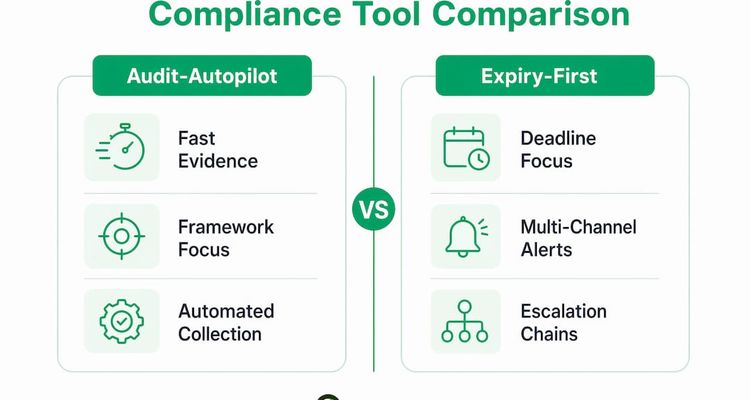
- Expiry-first deadline managers (Expiryedge): best for contract renewals, certifications, and recurring compliance obligations
- Audit-autopilot platforms (e.g., Hyperproof, AuditBoard): best for SOC 2/ISO 27001 evidence collection in cloud environments
- Enterprise GRC workflow platforms (e.g., Agiloft, OneTrust): best for large regulated organizations needing policy management and regulatory mapping
- Lightweight AI compliance assistants (e.g., ComplianceNow.ai): best for ISO consultants and small certification teams
Table of Contents
- Which ComplianceNow.ai alternatives fit your team’s needs?
- What features matter most for deadline-driven compliance?
- How do you estimate the true cost of a compliance tool?
- What does a realistic onboarding and migration look like?
- What questions should you ask vendors during a demo?
- When is Expiryedge the right choice for your team?
- Key Takeaways
- The tool category most teams get wrong
- Expiryedge covers the gap most compliance tools leave open
- Useful sources
- FAQ
Which ComplianceNow.ai alternatives fit your team’s needs?
Industry analysts confirm that compliance tools are not interchangeable: audit-autopilot tools favor automated evidence collection, while regulatory-mapping platforms prioritize law tracking and risk scoring. The table below maps each category to what actually matters for deadline-driven teams.
| Category | Best For | Deadline/Expiry Tracking | Reminders & Escalation | Integrations & API | Implementation Effort | Security Certs | Pricing Shape | AI Capability | Audit/Evidence |
|---|---|---|---|---|---|---|---|---|---|
| Expiry-first deadline manager | Ops/compliance SMB–mid-market | Native, purpose-built | Multi-channel, configurable escalation | Lightweight HR/ERP/ticketing | Low (1–3 weeks) | SOC 2 | Per-seat subscription | Deadline logic, alert automation | Auditable notification logs |
| Audit-autopilot platform | SaaS/cloud, SOC 2/ISO teams | Partial (framework-tied) | Automated evidence reminders | Deep cloud/SaaS integrations | Medium (4–8 weeks) | SOC 2 Type II, ISO 27001 | Per-seat or per-framework | Continuous control testing | Automated evidence collection |
| Enterprise GRC platform | Large regulated enterprises | Configurable but complex | Workflow-driven, high setup | ERP/IDAM/ticketing, broad | High (3–6 months) | SOC 2, ISO, HIPAA | Enterprise flat fee + services | Policy generation, regulatory mapping | Full GRC audit trail |
| Lightweight AI assistant | ISO consultants, small teams | Basic tracking | Email alerts | Limited | Very low (days) | Varies | Low monthly fee | AI policy drafting | Basic documentation |
What to expect in practice:
- Audit-autopilot platforms like AuditBoard and Hyperproof shine at continuous cloud evidence collection but are not optimized for tracking operational deadline obligations like contract renewals or employee certifications.
- Enterprise GRC platforms like Agiloft and OneTrust offer deep regulatory mapping and policy management, but implementation timelines routinely run three to six months and require dedicated admin resources.
- Lightweight AI assistants including ComplianceNow.ai are fast to deploy for ISO documentation, but they carry real risk of missing enforcement context specific to your industry.
Trust signals to request from any vendor: SOC 2 Type II or ISO 27001 attestation letters, customer case studies with named organizations, a live demo or 30-day trial, and mentions in analyst write-ups such as Expert Insights.
What features matter most for deadline-driven compliance?
The capabilities below separate tools that prevent missed deadlines from tools that merely document compliance after the fact.
High-priority features:
- A dedicated expiry and deadline data model (not a generic task field)
- Multi-channel alerts: email, SMS, Slack, and in-app, with configurable lead times
- Escalation workflows that reassign ownership when a deadline approaches unacknowledged
- Exportable audit trails and evidence packages for auditors
- Native integrations with HR, ERP, IDAM, and ticketing systems
- Policy and regulatory mapping tied to specific obligations (not generic AI output)
The core trade-off is between automation depth and regulatory grounding. Audit-autopilot platforms collect evidence fast but may leave gaps in operational regulatory obligations. Enterprise platforms map regulations precisely but demand months of configuration. An expiry-first tool sits in the middle: fast to deploy, operationally focused, and auditable without requiring a dedicated GRC admin.
On AI specifically: regulatory-mapping tools like Compliance.ai use near-real-time scanning and an Expert-in-the-Loop methodology to map regulatory changes to internal controls. That is genuinely valuable for financial services or healthcare compliance teams. For most ops teams managing contract renewals and certifications, it is more capability than they need — and more cost.

Pro Tip: During any vendor demo, ask the sales rep to show you a sample AI-generated policy output grounded in your industry’s enforcement data. If they can only show a generic template, budget significant internal hours to validate and customize it before it is audit-ready.
AI-generated policy documents are often boilerplate, and the hidden cost of customizing them is real. Tools like Compliancestack ground risk scores in enforcement trends and regulatory citations rather than generic outputs — a meaningful differentiator for regulated industries.
How do you estimate the true cost of a compliance tool?
Sticker price is rarely the whole story. A low monthly fee can look attractive until you account for the internal hours required to validate AI outputs and configure workflows.
Common pricing shapes:
- Per-seat subscription (most SMB and mid-market tools)
- Per-obligation or per-record pricing (some regulatory mapping platforms)
- Enterprise flat fee plus professional services (GRC suites)
- Low monthly entry fee with upsells for frameworks or integrations
Hidden costs to budget:
- Policy customization and validation time (often 20–40 hours per framework for AI-generated outputs)
- Integration development for non-native connectors
- Vendor-managed implementation fees (common in enterprise GRC)
- Ongoing review labor as regulations change
Simple TCO estimate:
| Cost Component | Formula | Example (sample obligations, sample users) |
|---|---|---|
| Software subscription | Monthly fee × 12 | $500/mo × 12 = annual total |
| Implementation | Hourly rate × setup hours | hourly rate × hours = total |
| AI output validation | Hourly rate × validation hours | hourly rate × hours = total |
| Integration dev | Hourly rate × dev hours | hourly rate × hours = total |
| Total Year-1 TCO | total cost estimate |
An expiry-first tool with native deadline logic cuts validation hours significantly because there is no AI policy output to review — the system tracks dates, not drafts documents.
What does a realistic onboarding and migration look like?
Skipping a structured migration plan is the single most common reason compliance teams end up with an incomplete obligation inventory six months after go-live.
- Discovery and inventory: Catalog every obligation type — contracts, certifications, licenses, inspections, regulatory filings.
- Data mapping: Standardize fields (owner, expiry date, renewal lead time, escalation path) before importing.
- Integration setup: Connect HR, ERP, IDAM, and ticketing systems; confirm data flows with a test record.
- Rule and workflow configuration: Build alert schedules, escalation chains, and assignment rules per obligation class.
- Pilot and verification: Run one obligation class (e.g., vendor contracts) for two to four weeks; confirm alerts fire and escalations route correctly.
- Full rollout: Expand to all obligation classes; train owners and managers.
- Post-launch tuning: Adjust lead times and escalation thresholds based on the first renewal cycle.
| Deployment Scenario | Typical Timeline |
|---|---|
| Lightweight pilot (one obligation class) | 1–3 weeks |
| Mid-market rollout (multiple classes, basic integrations) | 4–12 weeks |
| Enterprise/regulatory mapping deployment | 3–6 months |
Extraction accuracy for unstructured documents varies significantly across platforms — a real consideration when migrating legacy contract data. Common pitfalls: incomplete obligation inventory at the start, underestimating manual validation for AI-generated policies, and no named owner for escalation paths.
What questions should you ask vendors during a demo?
Use this list during live demos. Weight the first four questions highest for deadline-driven teams.
- Can you export a complete, timestamped audit trail for every notification and action?
- Which integrations ship out of the box, and which require custom development?
- Walk me through exactly what happens when a deadline is missed — who gets notified, in what order?
- What certifications do you hold: SOC 2 Type II, ISO 27001, HIPAA?
- Show me a sample AI policy output grounded in [your industry]'s enforcement data.
- What is your implementation SLA, and what happens if you miss it?
Red flags to watch for:
- Vague answers about evidence export (“it’s in the roadmap”)
- No named escalation path for missed deadlines
- AI outputs that are clearly generic templates with no enforcement grounding
- Implementation timelines stated as ranges with no contractual commitment
- Security certifications listed without attestation letters available on request
HIPAA fines reach up to $2M per violation category, and GDPR penalties can hit €20M or 4% of global revenue. Those numbers make audit trail quality and regulatory mapping non-optional for teams in regulated industries.
Scoring suggestion: Weight deadline tracking, audit/evidence export, and integration depth at 40% of your total vendor score. Pricing and UI together should not exceed 20%.
When is Expiryedge the right choice for your team?
Expiryedge is the right fit when your primary problem is missing deadlines, not drafting policies. If your team manages contracts, certifications, vendor agreements, or recurring inspections and the pain is late renewals and unclear ownership, an expiry-first platform solves that faster than a GRC suite.
Where Expiryedge performs best:
- Contract renewal teams tracking vendor, customer, and lease agreements
- HR and operations teams managing employee certification expirations
- Procurement teams handling supplier renewal cycles
- Facilities and lab teams scheduling inspections and equipment validations
- Compliance teams needing auditable proof that notifications were sent and acknowledged
Operational benefits:
- Fewer missed renewals through multi-channel alerts with configurable lead times
- Clear escalation ownership so no deadline falls through the cracks
- Lower admin overhead compared to configuring a full GRC platform
- Auditable notification logs exportable for auditors or internal review
For healthcare-specific workflows, the hospital compliance software comparison shows how expiry-first tracking applies to certification and inspection cycles in clinical settings.
Key Takeaways
For deadline-driven compliance teams, the fastest path to fewer missed obligations is an expiry-first platform with native escalation workflows, not a repurposed GRC suite with months of configuration ahead of it.
| Point | Details |
|---|---|
| Match tool to problem | Audit-autopilot tools excel at evidence collection; expiry-first tools prevent missed deadlines. |
| TCO includes hidden labor | Budget for policy validation hours and integration dev — often $5,000+ in Year 1 beyond subscription fees. |
| Pilot before committing | A 1–3 week pilot on one obligation class reveals real-world fit faster than any demo. |
| Demand audit trail proof | Require a live export of timestamped notifications during the demo, not a roadmap promise. |
| Expiryedge for ops teams | Expiryedge is the recommended pick for contract, certification, and procurement deadline management. |
The tool category most teams get wrong
Most compliance managers I talk with start their search looking for a single platform that does everything: tracks deadlines, maps regulations, generates policies, and collects audit evidence. That search almost always ends with an enterprise GRC contract they cannot fully use for 18 months.
The smarter move is to separate the problem. Regulatory mapping and policy generation are genuinely hard problems that require deep domain expertise and continuous legal monitoring. Deadline tracking and escalation management are operational problems that require a reliable, configurable system with good alert logic. Conflating the two leads to over-buying on features you will not use and under-investing in the operational reliability that actually prevents penalties.
If your team’s most pressing risk is a missed contract renewal or an expired certification that surfaces during an audit, start with the operational layer. A focused expiry-first tool like Expiryedge gets you to reliable deadline coverage in weeks. You can layer in regulatory mapping later, once the operational foundation is solid. Negotiate a pilot scope with any vendor — one obligation class, a defined timeline, and a clear SLA for implementation support. If they resist scoping a pilot, that tells you something important about how the implementation will go.
Expiryedge covers the gap most compliance tools leave open
Most GRC platforms and AI compliance tools are built for policy documentation and framework audits. Expiryedge is built for the operational layer underneath: the contract that expires next Tuesday, the certification that lapses in 30 days, the vendor agreement nobody flagged until it was already overdue.

Expiryedge gives deadline-driven teams multi-channel alerts, configurable escalation chains, and auditable notification logs — deployed in days, not months. There is no policy configuration backlog, no AI output to validate, and no six-month implementation timeline standing between your team and reliable deadline coverage. Start with a single obligation class — contracts or certifications — and see the difference a purpose-built expiry tracking platform makes in your first renewal cycle. Sign up or request a demo to get your pilot running this week.
Useful sources
- Best 8 AI Compliance Solutions for Business (2026) — Expert Insights: Analyst categorization of compliance tools by primary strength; essential for understanding audit-autopilot vs. regulatory-mapping distinctions.
- Best AI-Powered Compliance Monitoring Software — Energent.ai: Quick comparison of tool categories including integration depth and document extraction accuracy.
- Compliance.ai — Regulatory Change Management: Explains the RegTech approach to scanning and mapping regulatory changes to internal controls.
- ComplianceStack — Compliance Intelligence: Covers enforcement-grounded risk scoring and the real cost of unvalidated AI policy outputs.
- ComplyZen.ai — AI Compliance for Small Businesses: Useful benchmark for low-cost AI tools and the hidden customization labor they require.
- Deadline Escalation Workflow Guide — Expiryedge: Practical guide for configuring escalation ownership and workflows.
- Certification Expiration Tracking Checklist — Expiryedge: Checklist for compliance teams running a certification tracking pilot.
- The Role of Translation in Legal Compliance — Glocco: Relevant for organizations managing compliance obligations across multiple jurisdictions or languages.
Next step: Run a 30-day expiration pilot on your highest-risk obligation class. Use the vendor evaluation checklist in this article during every demo, and require a live audit trail export before signing anything.
FAQ
What is the best alternative to ComplianceNow.ai for deadline tracking?
Expiryedge is the strongest pick for teams whose core need is tracking contract renewals, certifications, and recurring compliance deadlines. It deploys in days and includes native escalation workflows and auditable notification logs.
How do audit-autopilot platforms differ from expiry-first tools?
Audit-autopilot platforms like AuditBoard and Hyperproof automate evidence collection for SOC 2 and ISO 27001 frameworks. Expiry-first tools track operational deadlines and send escalating alerts — a different job, and a faster deployment for ops-focused teams.
What hidden costs should I budget for when switching compliance tools?
Beyond the subscription fee, budget for integration development, policy validation hours (often 20–40 hours per AI-generated framework), and vendor implementation fees. Year-1 total cost of ownership for a mid-market team can run significantly higher than the annual license alone.
How long does it take to migrate to a new compliance platform?
A lightweight pilot on one obligation class typically takes 1–3 weeks. A full mid-market rollout runs 4–12 weeks. Enterprise deployments with deep regulatory mapping often require 3–6 months.
Does Expiryedge hold security certifications?
Expiryedge’s current certification status is best confirmed directly with the vendor during a demo. Always request attestation letters for any SOC 2 or ISO 27001 claims before signing a contract.
Recommended
Frequently asked questions
How do audit-autopilot platforms differ from expiry-first tools?
Audit-autopilot platforms like AuditBoard and Hyperproof automate evidence collection for SOC 2 and ISO 27001 frameworks. Expiry-first tools track operational deadlines and send escalating alerts — a different job, and a faster deployment for ops-focused teams.
What hidden costs should I budget for when switching compliance tools?
Beyond the subscription fee, budget for integration development, policy validation hours (often 20–40 hours per AI-generated framework), and vendor implementation fees. Year-1 total cost of ownership for a mid-market team can run significantly higher than the annual license alone.
How long does it take to migrate to a new compliance platform?
A lightweight pilot on one obligation class typically takes 1–3 weeks. A full mid-market rollout runs 4–12 weeks. Enterprise deployments with deep regulatory mapping often require 3–6 months.
Does Expiryedge hold security certifications?
Expiryedge's current certification status is best confirmed directly with the vendor during a demo. Always request attestation letters for any SOC 2 or ISO 27001 claims before signing a contract.