Regulatory Commitment Tracking: A 2026 Guide for Compliance Teams

Regulatory Commitment Tracking: A 2026 Guide for Compliance Teams

Regulatory commitment tracking documents and monitors post-approval obligations to ensure compliance and audit readiness.
It connects obligation management with regulatory intelligence, enabling proactive updates before enforcement deadlines.
Regulatory commitment tracking is defined as the systematic process of documenting and monitoring post-approval obligations, such as stability studies, risk management requirements, and safety reports, to ensure timely compliance across the full regulatory lifecycle. In practice, it also covers logging meeting schedules, correspondence, and agreed outcomes with regulators. Compliance, operations, and legal teams rely on this process, formally called regulatory obligations management, to maintain audit readiness and prevent costly enforcement gaps. Without it, organizations cannot prove compliance on demand, which is the leading cause of program failure in high-scrutiny regulatory environments.
What is regulatory commitment tracking and why does it matter?

Regulatory commitment tracking is the structured practice of recording every obligation your organization has made to a regulatory body and monitoring each one through to completion. The term “regulatory obligations management” is the recognized industry standard for this discipline. Both phrases describe the same core process, and compliance professionals use them interchangeably depending on their sector.
The stakes are high. Tracking regulatory commitments is mandatory in regulated environments and serves as the primary line of defense during judicial reviews, freedom of information requests, and formal complaints. A clear, defensible audit trail showing who committed to what and when is not optional. It is the evidence base that protects the organization.
Regulatory commitment tracking differs from general compliance management in one critical way. It focuses specifically on obligations that have already been agreed upon, whether through post-approval conditions, consent decrees, or voluntary pledges, rather than on broad legal requirements. That specificity makes it both more granular and more operationally demanding than standard compliance programs.
What are the core components of a regulatory commitment inventory?
A commitment inventory is the structured register that sits at the heart of any tracking program. A well-built inventory contains at least six core elements for every obligation recorded.
| Core element | Purpose |
|---|---|
| Obligation name | Identifies the specific commitment clearly |
| Source document | Links the obligation to its regulatory origin |
| Affected scope or product | Defines which products, sites, or markets apply |
| Internal owner | Assigns accountability to a named individual |
| Linked controls | Connects the obligation to internal processes |
| Review cadence | Sets the schedule for status checks and updates |
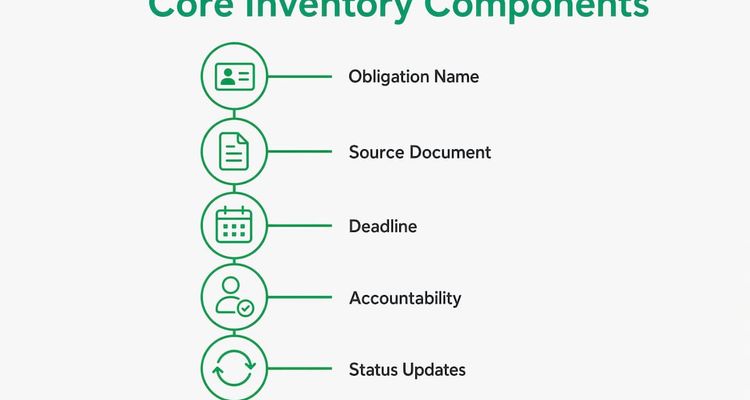
Organizations track both binding and voluntary commitments. Binding commitments include post-approval conditions set by bodies like the FDA or EMA. Voluntary commitments include sustainability pledges or public safety statements. Both carry reputational risk if missed, which is why leading compliance programs treat them with equal rigor.
Capturing accountability explicitly is the element most teams underinvest in. Assigning a named internal owner to each obligation, rather than a department or team, creates direct accountability. Deadlines without owners are just dates on a calendar. Owners without deadlines are just job titles.
Pro Tip: When building your commitment inventory, link each obligation directly to its source document rather than storing evidence separately. This single practice eliminates the most common audit gap: evidence that exists but cannot be located under pressure.
How does regulatory commitment tracking connect to regulatory intelligence?
Tracking does not operate in isolation. Effective programs connect commitment monitoring to regulatory intelligence, specifically the practice of horizon scanning. Regulatory intelligence teams use horizon scanning to detect regulatory changes 18 to 36 months ahead of enforcement. That lead time allows proactive gap analysis and budget planning before new obligations take effect.
The connection between tracking and change management works through a clear data flow:
- New or amended regulations are identified through horizon scanning.
- Changes are mapped to existing internal policies, controls, and training records.
- Affected commitments in the inventory are flagged for review and update.
- Audit logs capture every change, creating a continuous compliance record.
This flow transforms commitment tracking from a static register into a live operational tool. Programs that connect regulatory change data to internal procedures and audit logs achieve continuous audit readiness rather than scrambling at inspection time.
Hybrid regulatory intelligence units that combine legal accuracy with domain expertise are the most effective structure for this work. Legal professionals identify what the regulation requires. Subject matter experts translate that requirement into operational terms. Without both perspectives, commitments get mapped to the wrong controls or misinterpreted entirely.
Pro Tip: Assign a regulatory change owner who reviews the commitment inventory every time a relevant regulation is updated. Waiting for the annual review cycle is too slow in fast-moving regulatory environments.
What differentiates regulatory commitment tracking from compliance auditing?
Compliance professionals frequently conflate three distinct functions: tracking, monitoring, and auditing. Each serves a different purpose, and confusing them creates gaps in the compliance program.
- Regulatory commitment tracking records specific obligations and monitors their status in real time. It is forward-looking and obligation-specific.
- Compliance monitoring is a continuous, proactive process focused on maintaining adherence across all regulatory requirements. It alerts teams before regulatory changes cause disruptions.
- Compliance auditing is a periodic, backward-looking assessment that identifies past failures and evaluates the current state of the compliance program at a fixed point in time.
Tracking provides the evidence base that both monitoring and auditing draw from. Without a reliable commitment register, monitoring lacks a reference point and auditing lacks documentation. The tracking function is the foundation, not a subset, of the other two.
The practical implication for compliance teams is significant. Monitoring tells you whether you are currently compliant. An audit tells you whether you were compliant at a past date. Tracking tells you what you committed to, whether you fulfilled it, and who is responsible. All three are necessary, but tracking is the one that creates accountability at the individual obligation level.
What are the best practices for implementing regulatory commitment tracking?
Effective implementation requires more than a spreadsheet and good intentions. The most common failure mode is treating the tracking system as a document filing cabinet rather than an active management tool. A compliance tracker treated as passive storage leads to non-compliance at audit time because evidence exists but is not linked to the obligations it supports.
The following practices define programs that work:
- Build a centralized control library. Without a centralized control library mapping regulatory requirements to internal controls, organizations experience inconsistent compliance activities and duplicated effort during regulatory changes. The library is the backbone of consistent tracking.
- Link evidence to source documents. Store evidence directly within the commitment record, not in a separate folder or system. Auditors follow the obligation, not the filing structure.
- Assign named owners, not teams. Accountability diffuses when a team owns an obligation. One named individual must be responsible for each commitment’s status.
- Set structured review cadences. Each obligation needs a defined review schedule tied to its regulatory deadline, not a generic quarterly check.
- Form hybrid teams. Hybrid regulatory intelligence units combining legal and domain expertise reduce misinterpretation risks and ensure commitments map correctly to real workflows.
The organizations that get this right treat their commitment inventory as a living management tool. Status updates happen continuously, not at audit time. Evidence is attached at the point of execution, not reconstructed afterward.
What software features support regulatory commitment tracking?
Digital platforms have replaced spreadsheets as the standard for managing regulatory obligations at scale. Many compliance programs fail because they cannot prove compliance on demand. Purpose-built tracking systems solve this by acting as a single source of truth that links requirements, controls, ownership, and evidence in one auditable view.
When evaluating a commitment tracking platform, compliance teams should assess these core capabilities:
- Deadline reminders and escalation alerts that notify owners before obligations fall due, not after.
- Evidence repositories linked directly to each commitment record, not stored separately.
- Audit logs that capture every status change, ownership transfer, and document update with timestamps.
- Regulatory intelligence integration that connects external change feeds to internal commitment records.
- Ownership assignment at the individual obligation level with clear accountability trails.
AI-powered compliance trackers can extract specific regulatory requirements automatically from documents and link them to evidence, reducing manual effort and improving accuracy. These tools enable continuous visibility into compliance status rather than weak reconstructions at audit time.
Entry-level platforms typically cover deadline tracking and basic document storage. Enterprise-grade systems add regulatory intelligence feeds, AI-assisted requirement extraction, and cross-jurisdictional obligation mapping. The right choice depends on the volume of commitments, the number of jurisdictions, and the complexity of the evidence requirements your program manages.
Key Takeaways
Regulatory commitment tracking is the foundation of audit-ready compliance, requiring a centralized inventory, named ownership, linked evidence, and continuous monitoring connected to regulatory intelligence.
| Point | Details |
|---|---|
| Core inventory elements | Every commitment needs an owner, source document, deadline, and linked evidence to be auditable. |
| Tracking vs. auditing | Tracking is forward-looking and obligation-specific; auditing is periodic and backward-looking. |
| Horizon scanning integration | Connect tracking to regulatory intelligence to detect changes 18–36 months before enforcement. |
| Centralized control library | Map regulatory requirements to internal controls to prevent inconsistent compliance activities. |
| Active management required | Treat the tracker as a live tool, not a filing system, to maintain real-time audit readiness. |
Why I think most organizations are still getting this wrong
Compliance teams I have observed tend to invest heavily in audit preparation and almost nothing in the daily discipline of commitment tracking. The result is a predictable cycle: obligations are logged at approval time, then neglected until an inspection is announced. At that point, teams scramble to reconstruct evidence that should have been attached months or years earlier.
The deeper problem is organizational. Commitment tracking gets classified as administrative work, so it gets assigned to junior staff without the authority to chase down evidence from senior owners. That structure guarantees gaps. The organizations that do this well treat commitment tracking as a governance function, not a filing function. It sits close to legal and risk leadership, not buried in a compliance coordinator’s task list.
The shift in 2026 is that regulators are increasingly sophisticated about what a well-maintained commitment register looks like. Inspectors now ask to see the tracking system itself, not just the evidence it contains. That means the quality of your process is under scrutiny, not just the outcomes. If your tracker is a spreadsheet with inconsistent update dates and no audit log, that tells a story you do not want told during a formal review.
My practical advice: treat every commitment as a mini-project with a named owner, a deadline, and a defined evidence requirement. Build that structure into your tracking system from day one, and update it at the point of execution, not at the point of inspection.
— Kuldeep
How Expiryedge supports regulatory obligation management
Regulatory commitment tracking works only when deadlines are visible, ownership is clear, and evidence is attached before the audit clock starts. Expiryedge is built specifically for that kind of deadline-driven compliance work, giving compliance, legal, and operations teams a centralized platform to track obligations, certifications, renewals, and regulatory deadlines from one place.

Expiryedge sends automated alerts and escalations through multiple channels so named owners act before deadlines pass, not after. The platform covers regulatory obligations, contract renewals, license expirations, inspection schedules, and audit timelines in a single auditable view. For teams managing complex commitment inventories across multiple jurisdictions, Expiryedge replaces fragmented spreadsheets with a purpose-built system that keeps every obligation visible and every deadline accountable. Visit Expiryedge to see how it fits your compliance program.
FAQ
What is regulatory commitment tracking?
Regulatory commitment tracking is the systematic process of documenting and monitoring post-approval obligations, such as stability studies and safety reports, to ensure timely compliance and audit readiness. It covers the full regulatory lifecycle, including correspondence and agreed outcomes with regulators.
How does regulatory commitment tracking differ from compliance monitoring?
Commitment tracking records specific obligations and monitors their real-time status, while compliance monitoring is a broader, continuous process focused on maintaining general adherence across all regulatory requirements. Tracking provides the evidence base that monitoring draws from.
What are examples of regulatory commitments legal teams track?
Legal and compliance teams track post-approval conditions from bodies like the FDA or EMA, consent decree obligations, safety reporting deadlines, stability study schedules, and voluntary sustainability pledges. Both binding and voluntary commitments carry reputational and legal risk if missed.
Why do compliance programs fail at regulatory tracking?
The most common failure is treating the tracking system as a document filing cabinet rather than an active management tool. Programs that do not link evidence to obligations in real time cannot prove compliance on demand, which is the primary driver of audit failures.
What features should a regulatory tracking system include?
A reliable regulatory tracking system needs deadline reminders, individual ownership assignment, an evidence repository linked to each obligation, a full audit log with timestamps, and integration with regulatory intelligence feeds to capture changes before enforcement.
Recommended
Frequently asked questions
Commitment tracking records specific obligations and monitors their real-time status, while compliance monitoring is a broader, continuous process focused on maintaining general adherence across all regulatory requirements. Tracking provides the evidence base that monitoring draws from.
Legal and compliance teams track post-approval conditions from bodies like the FDA or EMA, consent decree obligations, safety reporting deadlines, stability study schedules, and voluntary sustainability pledges. Both binding and voluntary commitments carry reputational and legal risk if missed.
The most common failure is treating the tracking system as a document filing cabinet rather than an active management tool. Programs that do not link evidence to obligations in real time cannot prove compliance on demand, which is the primary driver of audit failures.
A reliable regulatory tracking system needs deadline reminders, individual ownership assignment, an evidence repository linked to each obligation, a full audit log with timestamps, and integration with regulatory intelligence feeds to capture changes before enforcement.