
Lease Expiration Tracking Guide for Operations Teams

Lease Expiration Tracking Guide for Operations Teams

Effective lease management relies on tracking critical notice deadlines, not just expiration dates, to maintain renewal rates. Automated systems and regular updates help prevent missed deadlines and preserve operational and financial stability. Acting proactively at 60 days before lease expiry maximizes renewal success and minimizes legal or financial risks.
Lease expiration tracking is the systematic process of monitoring key lease deadlines to ensure timely renewals, avoid holdover penalties, and maintain compliance across a portfolio. Operations and compliance professionals who treat this as a back-office task pay a measurable price. Structured renewal processes achieve renewal rates of 70% or higher, compared to roughly 52.5% for teams relying on manual spreadsheets. That gap represents lost revenue, strained tenant relationships, and avoidable legal exposure. This guide covers every stage of an effective lease tracking system, from identifying critical dates to building automated workflows with tools like Expiryedge.
What is a lease expiration tracking guide and why does it matter?
Lease expiration tracking, also called critical date management in commercial real estate and facilities operations, is the discipline of identifying, recording, and monitoring every deadline embedded in a lease agreement. The expiration date is only one of those deadlines. Notice windows, renewal option cutoffs, termination rights, and rent escalation triggers each carry their own deadlines and consequences.
Lease renewal is a strategic revenue function, not an administrative formality. Teams that neglect it absorb “invisible” losses that never appear as a line item in financial reports but erode year-end results through missed rent escalations and suboptimal lease terms. A single missed renewal can cost far more than the administrative effort required to prevent it.
The business case for structured tracking is clear. One documented case showed a loss exceeding $34,000 from missed expirations and stagnant renewal rates tied directly to manual management failures. That figure does not include the cost of emergency negotiations, temporary holdover arrangements, or the staff time spent resolving avoidable crises.
What critical lease dates must be tracked?
The expiration date is the least useful date to track in isolation. The dates that actually protect your organization are the ones that trigger rights, obligations, and negotiation windows well before expiration.
The five dates every lease tracking system must capture are:
- Lease expiration date. The calendar date the lease term ends. This is the anchor for calculating all other critical dates.
- Renewal notice deadline. The last date by which you must notify the landlord of your intent to renew. Notice windows range from 60 to 180 days before expiration, and missing this deadline can trigger holdover status and financial penalties.
- Termination notice deadline. The date by which either party must provide notice if they intend to end the lease. This is separate from the renewal notice and often has a different window.
- Automatic renewal cutoff. Some leases auto-renew unless the tenant actively opts out. Missing this date locks you into another full term.
- Rent escalation trigger dates. Scheduled rent increases tied to CPI adjustments or fixed percentages require advance planning for budget accuracy.
The notice window is more operationally critical than the expiration date itself. Notice deadlines can fall 6 to 24 months before expiration depending on lease terms. A team focused only on the expiration date will routinely miss the window that actually matters.
Pro Tip: After every lease amendment, recalculate all relative dates. An amendment that extends the term by six months also shifts every notice deadline. Outdated abstracts create false confidence and real risk exposure.
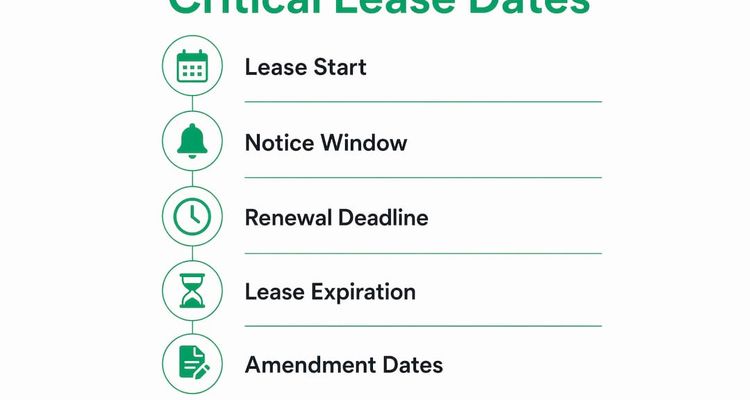
Lease amendments are a common source of tracking errors. An amendment that changes the term length, adds renewal options, or modifies notice requirements invalidates every previously calculated critical date. Lease abstraction must be updated after every amendment to keep your tracking data accurate.
What tools and methods work best for tracking lease dates?
The right tracking method depends on portfolio size, team capacity, and the cost of a missed deadline in your specific context.
Spreadsheet tracking for small portfolios
Spreadsheets remain functional for portfolios under 10–15 leases, provided they are maintained consistently. The key is building formulas that calculate relative dates automatically rather than entering them manually. Recommended columns include “NoticeDeadline” and “DaysUntilDeadline” formulas that compute true liability dates from the expiration date. A formula like =ExpirationDate - NoticePeriodDays calculates the notice deadline and flags it when the value drops below a threshold.

The limitation of spreadsheets is human dependency. Every update requires manual entry. Every amendment requires a manual recalculation. Every alert requires someone to check the file. That dependency is manageable at low volume but breaks down as portfolios grow.
Pro Tip: Color-code your “DaysUntilDeadline” column with conditional formatting. Red for under 30 days, amber for 30–90 days, and green for over 90 days. This turns a static spreadsheet into a visual dashboard that flags risk at a glance.
Dedicated lease tracking systems
Purpose-built lease tracking systems address the failure modes of spreadsheets by automating the calculation, alerting, and escalation steps. The table below compares the two approaches on the dimensions that matter most to operations teams.
| Feature | Spreadsheet tracking | Dedicated tracking system |
|---|---|---|
| Alert automation | Manual calendar reminders | Automated multi-channel alerts |
| Amendment handling | Manual recalculation required | Triggered recalculation on update |
| Portfolio scalability | Suitable for under 15 leases | Scales to hundreds of leases |
| Audit trail | Limited version history | Full activity log |
| Renewal rate impact | ~52.5% average | 70%+ with structured workflows |
Dedicated systems also support calendar integration, data abstraction workflows, and escalation rules that notify managers when a team member has not acted on an alert. That accountability layer is what separates a tracking system from a reminder tool.
How to build a lease expiration tracking workflow
A repeatable workflow removes the dependency on individual memory and creates a process that survives staff turnover, portfolio growth, and lease complexity.
- Abstract every lease. Extract the expiration date, all notice periods, renewal options, termination rights, and rent escalation clauses. Record the raw lease language alongside the calculated dates so you can verify the source when a dispute arises. This step is the foundation. Errors here propagate through every downstream calculation.
- Compute all relative critical dates. Convert notice periods expressed in days or months into absolute calendar dates. A “90-day notice requirement” means nothing until it becomes “notice must be sent by September 15.” Build these calculations into your tracking system so they update automatically when a term changes.
- Load data and configure alert rules. Enter abstracted data into your tracking system and set alert triggers at 120 days, 90 days, 60 days, and 30 days before each critical deadline. An effective communication cadence starts at 120 days and continues through 30 days, reducing vacancy and turnover costs through consistent follow-through.
- Assign ownership. Every critical date needs a named owner who receives alerts and is accountable for action. A shared inbox or unassigned alert is an alert that gets ignored.
- Act at the 60-day mark. Proactive renewal interactions at approximately 60 days out optimize negotiation leverage. Starting too early signals desperation. Starting within 30 days of expiration drops renewal rates by 8–15 percentage points. The 60-day window is the sweet spot for productive negotiation.
- Update after every amendment. Treat every lease amendment as a trigger to re-abstract and recalculate. Build this step into your amendment approval process so it cannot be skipped.
Common lease renewal tracking challenges and how to fix them
The most expensive tracking failures share a common pattern: the team knew the expiration date but missed the notice deadline. Understanding the specific failure modes helps you build controls that prevent them.
- Missed notice windows. A lease with a 90-day notice requirement expires on december 31. The team marks december 31 on the calendar and starts renewal conversations in november. The notice deadline was october 3. The landlord is now in a stronger negotiating position, and the tenant faces potential holdover penalties. The fix is tracking notice deadlines as primary dates, not expiration dates.
- Stale lease abstracts. An amendment extends the lease term by one year. The tracking system still shows the original expiration date. The team believes they have 18 months. They actually have 6. The fix is a mandatory re-abstraction step tied to the amendment approval workflow.
- Single-point-of-failure tracking. One person maintains the spreadsheet. They leave the organization. The spreadsheet is not updated for three months. Two notice deadlines pass unnoticed. The fix is a system with automated alerts that do not depend on any individual to trigger them.
- Timing errors in renewal negotiations. Starting renewal conversations too early or too late both reduce outcomes. Renewal rates drop by 8–15 percentage points when negotiations begin within 30 days of expiration. The fix is a structured alert cadence that prompts action at the right time, not just before the deadline.
Lease tracking failures are rarely caused by ignorance of the expiration date. They are caused by systems that track the wrong date, update too slowly, or depend on individuals who are not always available. The solution is a process that calculates the right dates, alerts the right people, and updates automatically when lease terms change.
Reviewing key contract clauses and risk factors before finalizing any lease also reduces the likelihood of ambiguous notice requirements that create tracking errors downstream.
Key Takeaways
Effective lease expiration tracking requires tracking notice deadlines, not just expiration dates, and acting at the 60-day mark to protect renewal rates and negotiation leverage.
| Point | Details |
|---|---|
| Track notice deadlines first | Notice windows of 60–180 days matter more than the expiration date itself. |
| Update after every amendment | Re-abstract and recalculate all critical dates whenever lease terms change. |
| Act at 60 days out | Starting renewal negotiations at 60 days optimizes leverage and renewal rates. |
| Automate alerts at four intervals | Set reminders at 120, 90, 60, and 30 days to maintain consistent follow-through. |
| Assign named ownership | Every critical date needs one accountable person, not a shared inbox. |
Lease tracking as a revenue function, not a calendar task
I have worked with operations teams across facilities, legal, and procurement, and the pattern I see most often is the same: lease tracking gets treated as a calendar management problem when it is actually a revenue management problem. The teams that get this right are not the ones with the most sophisticated software. They are the ones that understand what they are actually protecting.
The notice window is where money is made or lost. A team that enters renewal negotiations with 90 days of runway has options. They can walk away, negotiate hard, or explore alternatives. A team that enters with 15 days has none of those options. The landlord knows it. The tenant knows it. The outcome reflects that imbalance.
What I find underappreciated is the compounding effect of consistent tracking over time. A portfolio that renews 70% of leases on favorable terms year after year builds a materially different cost structure than one renewing 52.5% under pressure. That difference does not show up in a single quarter. It shows up in three-year budget comparisons and in the operational stability of teams that are not constantly firefighting expired agreements.
Automation matters, but it is not a substitute for process clarity. I have seen teams deploy sophisticated tracking tools and still miss deadlines because no one owned the alert. The technology surfaces the right information. The process determines whether anyone acts on it. Both are required.
— Kuldeep
How Expiryedge supports your lease deadline management
Operations teams that manage lease portfolios across multiple locations need more than a reminder system. They need a platform that calculates critical dates, assigns ownership, and escalates when action has not been taken.

Expiryedge is built specifically for deadline-driven work. It tracks lease expirations, renewal notice deadlines, and compliance obligations from a single dashboard. Automated multi-channel alerts fire at configurable intervals, and escalation rules notify managers when a deadline is approaching without a confirmed response. Teams in operations, facilities, legal, and procurement use Expiryedge to replace manual spreadsheet tracking with a process that updates automatically and holds every deadline accountable to a named owner. If your portfolio has outgrown spreadsheets, start tracking deadlines with a system designed for exactly this kind of work.
FAQ
What is lease expiration tracking?
Lease expiration tracking is the process of monitoring all critical lease deadlines, including notice windows, renewal cutoffs, and termination dates, to ensure timely action and avoid penalties. It goes beyond recording the expiration date to managing every date that triggers a right or obligation.
How far in advance should you start the renewal process?
Starting renewal negotiations at approximately 60 days before expiration optimizes leverage and renewal rates. Beginning within 30 days of expiration drops renewal rates by 8–15 percentage points.
Can spreadsheets handle lease expiration tracking?
Spreadsheets work for portfolios under 10–15 leases when maintained consistently with formulas like “NoticeDeadline” and “DaysUntil_Deadline.” Larger portfolios require a dedicated lease tracking system with automated alerts and amendment handling.
What happens if you miss a lease notice deadline?
Missing a notice deadline can trigger holdover status, financial penalties, and loss of negotiation leverage. The landlord gains the upper hand in renewal terms, and the tenant may be locked into unfavorable conditions.
How often should lease abstracts be updated?
Lease abstracts must be updated after every amendment. Any change to the lease term, notice period, or renewal options invalidates previously calculated critical dates and creates risk if not recalculated immediately.
Recommended
Frequently asked questions
Starting renewal negotiations at approximately 60 days before expiration optimizes leverage and renewal rates. Beginning within 30 days of expiration drops renewal rates by 8–15 percentage points.
Spreadsheets work for portfolios under 10–15 leases when maintained consistently with formulas like "Notice_Deadline" and "Days_Until_Deadline." Larger portfolios require a dedicated lease tracking system with automated alerts and amendment handling.
Missing a notice deadline can trigger holdover status, financial penalties, and loss of negotiation leverage. The landlord gains the upper hand in renewal terms, and the tenant may be locked into unfavorable conditions.
Lease abstracts must be updated after every amendment. Any change to the lease term, notice period, or renewal options invalidates previously calculated critical dates and creates risk if not recalculated immediately.