Why General Task Tools Fail for Expiry Management

Why General Task Tools Fail for Expiry Management

General task tools are inadequate for expiry management because they lack automated alerts, audit trails, and FEFO enforcement. These issues lead to regulatory risks, inventory losses, and inefficient workflows that increase manual reconciliation and error rates. Transitioning to specialized platforms like Expiryedge improves compliance, reduces waste, and streamlines expiry tracking through automation and integrated management features.
General task tools fail for expiry management because they are built for discrete, project-based work, not for the recurring, compliance-sensitive workflows that expiry tracking demands. Poor expiry management costs supply chains $90 billion annually, with manual tracking capturing only 30% of items accurately. Medical clinics alone lose 3–5% of inventory value each year to expired items. These losses are not caused by careless teams. They are caused by the wrong tools. Expiry management requires automated alerts, audit trails, and compliance enforcement. General task platforms provide none of those by design.
Why general task tools fail for expiry management
General task tools are designed to track who does what and when. That works for one-time deliverables. Expiry management is different. It requires recurring actions, date-based triggers, and documented proof that each step was completed on time.
The mismatch shows up quickly in practice. A compliance team tracking 500 product lots cannot rely on manually created tasks for each expiry date. The volume is too high, the margin for error is too low, and the consequences of a missed date include regulatory penalties, product recalls, or patient harm. General task platforms were never designed to carry that weight.
Operations experts confirm that general tools optimize isolated tasks but fail to integrate end-to-end workflows. That gap forces teams to reconcile between the tool and reality, which adds administrative overhead without adding control. The tool becomes a second job rather than a solution.

What operational challenges do general task tools create?
General task tools create a coordination tax that compounds over time. Every expiry date must be manually entered, assigned, and updated. When a date changes or a product is recalled, the update must cascade across every related task by hand.
Context switching between apps reduces actual productive work time by up to 28%. That figure reflects what happens when teams manage expiry data across spreadsheets, task boards, and email threads simultaneously. Each switch costs focus and introduces the risk of a missed update.
The coordination overhead also creates what practitioners call a “second workplace” burden. Staff spend time maintaining the tool rather than acting on the data it contains. In expiry management, that delay between data and action is where losses occur.
Key operational problems that emerge from using general task tools for expiry tracking include:
- Manual data entry at scale. Each SKU, lot number, and expiry date must be entered and maintained by hand, which increases error rates as inventory volume grows.
- No date-based automation. General tools do not trigger alerts or escalations based on approaching expiry dates without manual configuration for every item.
- Fragmented workflows. Teams pull data from multiple sources and reconcile them manually, creating gaps between what the system shows and what is actually on the shelf.
- No confirmation of follow-up. A task marked “done” in a general tool does not confirm that the expired item was removed, quarantined, or replaced.
- Compliance risk from poor visibility. When expiry data lives across disconnected tools, no single view shows which items are at risk right now.
Pro Tip: Run a two-week diagnostic period and measure how much time your team spends updating the task tool versus acting on expiry data. If reconciliation work exceeds action time, the tool is the bottleneck.
How do general task tools lack compliance and audit features?
Compliance in expiry management is not just about knowing a date. It requires documented proof that the right action was taken at the right time by the right person. General task tools do not provide that.
The four compliance gaps that matter most are:
- No automated audit trails. General tools record task completion but do not log who was notified, when they were notified, and what action was confirmed. Regulators require that chain of evidence.
- No expiry-specific data validation. A general task field accepts any text. A compliant expiry system validates date formats, flags duplicates, and rejects entries that fall outside acceptable ranges.
- No FEFO enforcement. First-expire, first-out (FEFO) is the standard inventory rotation method for perishable and regulated goods. General tools cannot enforce FEFO during picking and fulfillment because they have no integration with stock rotation logic.
- No real-time confirmation of corrective action. Sending an alert is not the same as confirming that the alert was acted upon. Task tools provide visibility but not control, and without automated logs on notifications and follow-up, organizations remain exposed to regulatory risk.
The absence of these features is not a gap that workarounds can fill. A spreadsheet column labeled “audit trail” is not an audit trail. A recurring calendar reminder is not FEFO enforcement. Compliance requires the system itself to enforce the rule, not the person using it.
Expiration tracking breaks down specifically when systems do not enforce expiry-based stock rotation during picking and fulfillment. That breakdown is structural, not behavioral. The team cannot fix it by working harder.
What advantages do specialized expiry management solutions offer?
Specialized expiry management platforms are built around a single constraint: every item has a date, and action must happen before that date. That constraint shapes every feature they include.
Automated data capture and validation
Specialized systems capture expiry dates at the point of entry and validate them against defined rules. Automation of expiry date capture can reduce waste and recover revenue by up to 40%. That recovery comes from catching items before they expire rather than after.
FEFO enforcement at scale
Manual FEFO only works at low SKU volumes. At scale, automation is necessary. Specialized platforms embed FEFO rules directly into picking workflows, so the system selects the soonest-to-expire item automatically. Teams do not need to remember the rule. The system enforces it.
Real-time alerts with confirmed follow-up
Specialized platforms send multi-channel alerts as expiry dates approach and require confirmation that action was taken. That confirmation loop is what separates a notification from a compliance record.
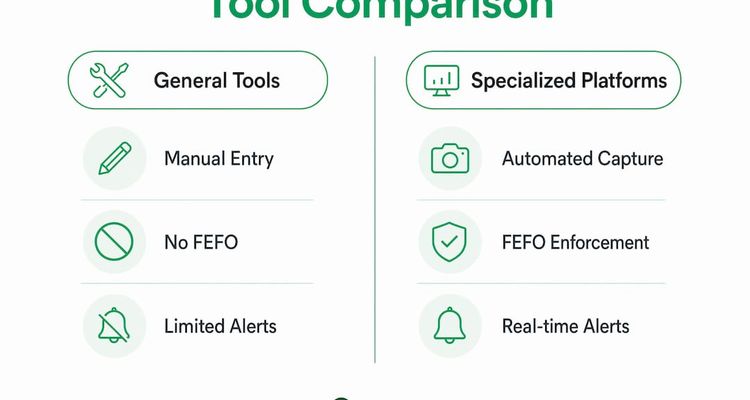
| Feature category | General task tools | Specialized expiry platforms |
|---|---|---|
| Expiry date automation | Manual entry only | Automated capture and validation |
| FEFO enforcement | Not supported | Embedded in workflows |
| Audit trail | Task completion only | Full notification and action log |
| Real-time alerts | Manual configuration | Date-driven, multi-channel |
| Compliance reporting | Not available | Built-in dashboards |
Pro Tip: When evaluating any expiry management platform, ask specifically whether it logs the full notification chain, not just task status. That log is what protects you during a regulatory audit.
Expiryedge is built on exactly this model. It tracks contracts, certifications, licenses, inspections, and inventory expiry dates from a centralized platform, with automated workflows and escalation paths that confirm action before a deadline passes.
How can organizations transition away from general task tools?
Transitioning from a general task tool to a purpose-built expiry management process requires a structured approach. The goal is not to replace one tool with another. The goal is to redesign the workflow around the expiry date as the primary constraint.
- Run a two-week diagnostic. Measure time spent on administrative reconciliation versus time spent on actual expiry decisions. Excessive reconciliation work confirms the tool has become a bottleneck. This diagnostic gives you the data to justify a change to leadership.
- Map your expiry workflows end to end. Identify every touchpoint where an expiry date matters: receiving, storage, picking, fulfillment, and disposal. Most teams discover that their current tool covers only one or two of these touchpoints.
- Involve cross-functional stakeholders. Operations, compliance, procurement, and quality teams each interact with expiry data differently. A solution that works for one team but not the others will recreate the fragmentation you are trying to fix.
- Adopt a platform designed for deadline-driven work. Platforms like Expiryedge are built specifically for work that must be completed before a fixed date. They include the audit trails, FEFO logic, and multi-channel alerts that general tools cannot provide.
- Train staff on FEFO and rotation principles. Technology enforces the rule, but teams need to understand why the rule exists. Staff who understand FEFO make better decisions when exceptions arise.
- Build continuous improvement cycles into the process. Set quarterly reviews to assess compliance rates, near-miss events, and waste figures. Real data from a specialized platform makes those reviews productive rather than speculative.
The transition does not need to happen all at once. Starting with the highest-risk inventory category and expanding from there is a practical approach that limits disruption while delivering measurable results quickly.
Key Takeaways
General task tools fail at expiry management because they lack the date-driven automation, FEFO enforcement, and audit trail capabilities that compliance-sensitive inventory tracking requires.
| Point | Details |
|---|---|
| Wrong tool design | General task tools are built for discrete projects, not recurring compliance workflows. |
| Coordination overhead | Context switching and manual reconciliation reduce productive work time by up to 28%. |
| Compliance gaps | Missing audit trails and FEFO enforcement leave organizations exposed to regulatory risk. |
| Automation impact | Automating expiry date capture can reduce waste and recover revenue by up to 40%. |
| Transition approach | Run a two-week diagnostic, map workflows end to end, and adopt a purpose-built platform. |
Why operations teams need to stop patching the wrong tool
I have worked with operations and compliance teams across healthcare, food distribution, and facilities management. The pattern I see repeatedly is the same: a team starts tracking expiry dates in a general task tool because it is already in use and adding a new system feels like extra work. Six months later, they are spending more time maintaining the tool than managing the actual expiry risk.
The uncomfortable truth is that general task tools create the illusion of control. A task board with 200 expiry items looks organized. But if no one has confirmed that the alerts were acted upon, if there is no audit log, and if FEFO is being applied manually by whoever happens to be on shift, the organization is exposed. The board looks clean. The warehouse is not.
What I find most telling is the diagnostic test. When I ask teams to track their time for two weeks, they are consistently surprised by how much of their day goes to updating the tool rather than acting on what it shows. That ratio is the clearest signal that the tool is working against them.
Recurring expiry obligations are not project tasks. They do not have a start date and an end date. They cycle continuously, they require documented follow-up, and they carry regulatory consequences when they fail. A general task tool cannot carry that responsibility, no matter how many custom fields you add to it.
The teams that make the shift to purpose-built expiry management platforms report two consistent outcomes: less administrative overhead and better audit readiness. Neither outcome is surprising. Both are significant.
— Kuldeep
Expiryedge: built for the work general tools cannot do
Operations and compliance teams managing expiry dates need more than a task list. They need a platform that enforces deadlines, logs every action, and confirms that nothing slips through.

Expiryedge is a deadline tracking platform built specifically for time-sensitive work. It automates expiry alerts across multiple channels, enforces workflow escalations when deadlines approach, and maintains a full audit trail for every item it tracks. Teams managing contracts, certifications, licenses, inspections, and inventory expiry dates can centralize all of it in one place. If your current tool requires manual reconciliation to stay accurate, Expiryedge replaces that overhead with automated, compliance-ready workflows that keep your team ahead of every critical date.
FAQ
Why do general task tools fail at expiry management?
General task tools are designed for discrete, project-based work and lack the date-driven automation, FEFO enforcement, and audit trail features that expiry management requires. Without these capabilities, teams rely on manual processes that introduce errors and compliance risk.
What is FEFO and why does it matter for expiry tracking?
FEFO stands for first-expire, first-out, the inventory rotation method that ensures the soonest-to-expire items are used or shipped first. Manual FEFO only works at low SKU volumes; automation is necessary at scale to prevent waste and maintain compliance.
How much does poor expiry management cost organizations?
Poor expiry management costs supply chains $90 billion annually, with manual tracking capturing only 30% of items accurately. Medical clinics lose 3–5% of inventory value each year to expired items alone.
What features should a specialized expiry management platform include?
A purpose-built platform should include automated expiry date capture, multi-channel alerts with confirmed follow-up, FEFO enforcement in picking workflows, and a full audit trail logging who was notified and what action was taken.
How do I know if my current tool is causing expiry management problems?
Run a two-week diagnostic and measure time spent on administrative reconciliation versus time spent on actual expiry decisions. Excessive reconciliation work confirms the tool has become a bottleneck rather than a help.
Recommended
Frequently asked questions
What is FEFO and why does it matter for expiry tracking?
FEFO stands for first-expire, first-out, the inventory rotation method that ensures the soonest-to-expire items are used or shipped first. Manual FEFO only works at low SKU volumes; automation is necessary at scale to prevent waste and maintain compliance.
How much does poor expiry management cost organizations?
Poor expiry management costs supply chains $90 billion annually, with manual tracking capturing only 30% of items accurately. Medical clinics lose 3–5% of inventory value each year to expired items alone.
What features should a specialized expiry management platform include?
A purpose-built platform should include automated expiry date capture, multi-channel alerts with confirmed follow-up, FEFO enforcement in picking workflows, and a full audit trail logging who was notified and what action was taken.
How do I know if my current tool is causing expiry management problems?
Run a two-week diagnostic and measure time spent on administrative reconciliation versus time spent on actual expiry decisions. Excessive reconciliation work confirms the tool has become a bottleneck rather than a help.