
Healthcare Software Compliance: Common Gaps and Fixes

Healthcare teams rarely fail compliance because they do not “care.” They fail because compliance work gets fragmented across tickets, shared drives, inbox threads, and calendar invites, until a renewal is missed, an audit request arrives, or a security incident forces everything to the surface at once.
This guide breaks down common healthcare software compliance gaps (across providers, payers, and health tech vendors) and the practical fixes that reduce audit pain, security risk, and last-minute fire drills.
Note: This article is informational and not legal advice. Requirements vary by organization, product, data, and jurisdiction.
What “healthcare software compliance” includes (and why scope confusion creates gaps)
Healthcare software compliance usually blends regulatory obligations, security frameworks, and contractual commitments. Teams get into trouble when they manage only one layer (for example, HIPAA policies) while ignoring the others (for example, vendor contract renewals or evidence retention).
In the US, common anchors include:
- HIPAA Security Rule and Privacy Rule for covered entities and many business associates (see the HHS HIPAA Security Rule overview).
- HITECH enforcement dynamics and breach notification expectations (often operationalized via an incident response plan).
- FDA expectations when software functions as a medical device (SaMD) or is part of a regulated device ecosystem.
- CMS, payer, and accreditation requirements, plus contractual requirements flowing down through BAAs and vendor MSAs.
A helpful way to reduce scope confusion is to explicitly tie your obligations to the systems and artifacts that prove them.
| Your context | What typically must be controlled | What auditors and customers ask to see |
|---|---|---|
| Provider organization (hospital, clinic, home health) | Access controls, training, vendor/BAA governance, incident response, retention | Policy approvals, access reviews, vendor risk evidence, breach process evidence |
| Digital health / SaaS vendor handling PHI | Secure SDLC, change control, incident response, vendor risk, customer contract commitments | SOC 2 or similar reports, pen test summaries, IR plan, uptime/security SLAs evidence |
| Device / SaMD-adjacent software team | Quality processes, risk management, change control, traceability | Design history artifacts, validation evidence, release/change records |
Once scope is explicit, most “surprise findings” become predictable process failures.
Gap 1: No reliable inventory of systems, integrations, and PHI data flows
What it looks like
- Nobody can answer “Which systems store or transmit PHI?” without a week of Slack messages.
- Integrations multiply (EHR, billing, scheduling, analytics, call center) and data flows are undocumented.
- The software list exists, but it is not tied to owners, vendors, renewal dates, or evidence.
Why it matters
You cannot protect, monitor, or govern what you cannot enumerate. Inventory gaps lead directly to missed BAAs, unmanaged access, and inconsistent retention.
Fix: build a minimum viable inventory that is operational, not perfect
Start with a “CMDB-lite” that captures just what you need to make work controllable:
- System name
- Business owner
- Technical owner
- Vendor (if applicable)
- Data classification (PHI, PII, financial, internal)
- Key integrations
- Contract/BAA links
- Renewal dates and lead times
Then run a short mapping exercise: pick the top 3 workflows that touch PHI (for example, patient intake, telehealth visit, billing) and document which systems touch the data.

Gap 2: Policies exist, but policy review and approval is not controlled
What it looks like
- Policies are stored in a shared drive, but review cycles slip.
- Multiple “final” versions exist.
- Training references old policy language.
- Leadership sign-off is informal or missing.
Why it matters
Policies are not just documents. They are controls that must be current, approved, and provable. Many audits and customer security reviews look for evidence that policies are maintained on a schedule and acknowledged.
Fix: turn policy management into a lifecycle with deadlines and proof
Define a lightweight, repeatable workflow:
- Assign a policy owner and a backup.
- Set a review cadence (common patterns are annual or semiannual, depending on risk).
- Require an approval step (role-based, not person-based).
- Store evidence of approval (meeting minutes, sign-off record, ticket ID, or e-signature artifact).
- Link training and attestation to the current policy version.
A simple “policy evidence pack” standard reduces scramble later.
| Policy artifact | Minimum proof to retain | Common failure mode to avoid |
|---|---|---|
| Policy document | Approved version (PDF) with version/date | Editable docs with no version control |
| Review record | Reviewer names, date, outcome, changes | Verbal approvals that cannot be shown |
| Training linkage | Training module ID and completion report | Training is “done,” but cannot be tied to a version |
Gap 3: Access controls drift (and nobody notices until an audit or incident)
What it looks like
- Former staff still have accounts.
- Shared accounts exist “temporarily.”
- Admin privileges spread through exception stacking.
- MFA is inconsistent across systems.
Why it matters
Access drift is one of the fastest ways to turn an ordinary mistake into a reportable security incident. It also causes audit findings because it is easy to test and hard to justify.
Fix: implement joiner-mover-leaver plus scheduled access reviews
Two controls do most of the work:
- A joiner-mover-leaver workflow: account creation, role change, termination, and emergency access steps.
- A recurring access review: a scheduled, provable review of who has access to high-risk systems.
To keep it operational, define which systems require reviews and how often.
| System type | Typical review trigger | What “done” looks like |
|---|---|---|
| EHR and core clinical systems | Monthly or quarterly | Exported access list, reviewer sign-off, removals logged |
| File storage with PHI | Quarterly | Group membership reviewed, external shares reviewed |
| Admin consoles (cloud, identity) | Monthly | Admin list reviewed, break-glass accounts validated |
Gap 4: Vendor governance and BAAs are tracked in email, not as obligations
What it looks like
- BAAs are missing for certain vendors, or no one knows where they are.
- Security questionnaires are completed, but not retained.
- SOC 2 reports arrive, are read once, and disappear.
- Renewals auto-run without anyone validating security posture changes.
Why it matters
Healthcare software compliance is heavily influenced by vendors. A strong internal posture can be undermined by a weak vendor, or by a strong vendor relationship that is poorly documented.
Fix: treat vendors like renewable obligations with evidence
For each vendor that touches PHI or supports critical operations, track:
- Contract and BAA effective date
- Renewal and termination notice windows
- Required annual artifacts (SOC 2, pen test summary, insurance COI, subcontractor disclosures)
- Owner and escalation path
- Evidence attachments
For smaller organizations that also need to streamline day-to-day client and vendor operations, a general business platform like Dr. CRM can be useful for managing relationships, tasks, and invoicing, but you still want a compliance-specific system of record for time-bound obligations and audit evidence.
Gap 5: Evidence is scattered, so audits become reconstruction projects
What it looks like
- Proof lives in inboxes, ticketing tools, and local folders.
- The “real” evidence is a screenshot someone took last year.
- You can say you did the work, but you cannot show it quickly.
Why it matters
Audits and customer reviews reward retrievability. If evidence is not linked to the obligation, you lose time and credibility.
Fix: define evidence requirements per control, and attach it at completion time
A practical standard is: every recurring obligation must have a “definition of done” that includes the artifact you will need later.
Examples:
- Annual risk assessment completed: final report attached, reviewer approval noted.
- Incident response tabletop: attendee list, scenario notes, improvement actions attached.
- Vendor review: SOC 2 report stored, exceptions documented, remediation tasks created.
Run a monthly “audit drill” on a small sample: pick 10 obligations and time how long it takes to produce the evidence. If it takes hours, you have a system problem.
Gap 6: Change management is real, but compliance sign-off is optional
What it looks like
- Releases happen fast, but no one can show who approved what.
- Security reviews are inconsistent.
- Emergency changes bypass normal controls and never get reconciled.
Why it matters
Even when HIPAA does not prescribe a specific SDLC, healthcare buyers and regulators expect you to manage change responsibly, especially when software touches clinical workflows or PHI.
Fix: implement a “minimum viable change record” for regulated systems
You do not need bureaucracy, you need traceability:
- What changed
- Why it changed (ticket or requirement)
- Risk impact (PHI exposure, availability impact)
- Who approved it
- When it was deployed
- Rollback plan (for critical systems)
If you cannot produce those elements for critical systems, you will repeatedly fail due diligence questionnaires.
Gap 7: Incident response exists on paper, but deadlines and communications are not operational
What it looks like
- The incident response plan is a PDF no one has practiced.
- Contact lists are outdated.
- Breach notification steps are unclear across legal, compliance, IT, and leadership.
Why it matters
Healthcare incidents are time sensitive. Operational readiness matters as much as policy existence. The HHS OCR breach portal also reinforces a reality most teams already know: incidents happen across organizations of all sizes.
Fix: make incident response a recurring workflow, not a document
Treat IR readiness like any other renewable obligation:
- Quarterly tabletop exercise on a realistic scenario
- Monthly verification of on-call and escalation contacts
- A checklist for first 24 hours (containment, evidence preservation, internal comms)
- A checklist for follow-up (root cause, corrective actions, documentation)
If you only do IR work after an incident, you will miss internal deadlines and burn leadership time.
A practical “gap-to-fix” map you can use immediately
This table summarizes the most common gaps and the operational fixes that close them.
| Common gap | What it causes | The fix (operational control) | Proof you should retain |
|---|---|---|---|
| Incomplete system inventory | Unknown PHI exposure, missed renewals | System register with owners and renewals | Inventory export, last review date |
| Policy drift | Findings, inconsistent training | Policy lifecycle with review cadence | Approved version, review record |
| Access drift | Unauthorized access risk | JML workflow + scheduled access reviews | Access review sign-off, removals |
| Weak vendor governance | Contract and security surprises | Vendor obligations register with renewals | BAA, SOC 2, review notes |
| Scattered evidence | Audit scramble | Attach evidence to each obligation | Evidence pack per obligation |
| Untracked change approvals | Due diligence failures | Minimum viable change record | Approval record, release log |
| Unpracticed incident response | Slow response, confusion | Recurring tabletop + IR checklists | Tabletop notes, action items |
How to close the biggest gaps in 30 days (without boiling the ocean)
A fast, realistic approach is to run a 30-day “compliance operations sprint” focused on repeatability and proof.
| Week | Focus | Deliverable |
|---|---|---|
| 1 | Inventory and ownership | Top systems and vendors listed with owners and renewals |
| 2 | Deadline design | Review cadences set (policies, access reviews, vendor reviews) |
| 3 | Evidence standard | Definition of done and evidence pack template agreed |
| 4 | Drill and refine | 10-item audit drill, fix what took too long |
The goal is not perfection. The goal is a system where recurring work is owned, scheduled, and provable.
Where ExpiryEdge fits: turning compliance into owned, deadline-driven work
Most compliance failures above share one root cause: time-bound obligations are not managed as a system. ExpiryEdge is designed for teams that need compliance operations to be predictable and auditable.
In practice, teams use ExpiryEdge to:
- Track expirations and review cycles with smart expiration tracking across policies, licenses, vendor artifacts, contracts, and recurring checks.
- Assign owners and run automated workflow checklists so “done” is consistent across sites and teams.
- Reduce missed tasks with multi-channel notifications and escalations when deadlines are at risk.
- Keep audits fast by storing proof via document attachment, tied directly to the obligation.
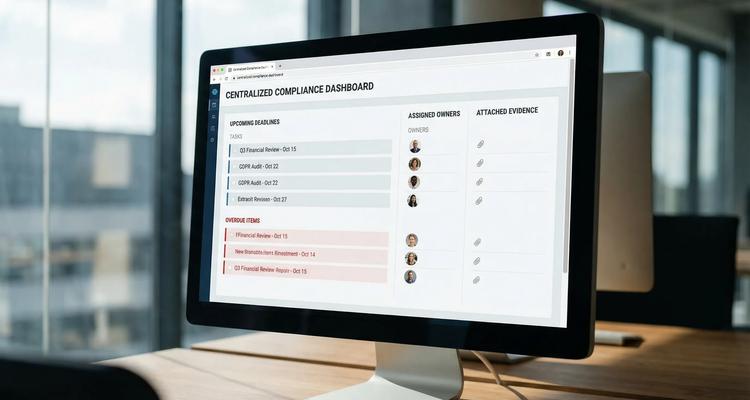
- Create visibility with a centralized expiry dashboard, advanced search, and calendar view.
- Onboard quickly using bulk import expiries and customizable categories.
If you are trying to improve healthcare software compliance, aim for a model where every obligation has: an owner, a renew-by date, a checklist, and attached evidence. That is the point where audits stop being reconstruction and start being retrieval.
Not medical, clinical, or HIPAA compliance advice
This article is for general informational purposes and does not constitute clinical or HIPAA compliance advice. ExpiryEdge is not currently a HIPAA Business Associate. Healthcare organisations handling Protected Health Information should review the specifics of their compliance programme with a qualified privacy officer or HIPAA consultant.