Deadline Monitoring to Prevent Revenue Loss in 2026

Deadline Monitoring to Prevent Revenue Loss in 2026

Deadline monitoring systematically tracks critical due dates to prevent revenue loss, compliance issues, and operational disruption. It emphasizes workflow visibility, clear ownership, and automated alerts, boosting revenue recovery and reducing legal risks. Expiryedge offers a platform that centralizes expiration tracking, automates reminders, and enforces accountability to safeguard organizational obligations.
Deadline monitoring is the systematic tracking and management of critical due dates to prevent revenue loss, maintain compliance, and protect operational continuity. Poor contract obligation management and missed renewals erode an average of 9.2% of annual revenue for organizations. That figure represents real contracts lapsing, rebates going unclaimed, and regulatory fines accumulating while teams scramble to catch up. Operations and compliance professionals who treat deadline tracking as a core discipline, not an administrative afterthought, recover measurable value and reduce financial risk across the entire organization. Expiryedge is built specifically for this work.
How does deadline monitoring prevent revenue loss?
Deadline monitoring prevents revenue loss by creating visibility into every critical date before it becomes a crisis. Without a formal system, contract renewals auto-renew on unfavorable terms, supplier rebates expire unclaimed, and compliance filings arrive late. Each of these failures carries a direct financial cost.

The scale of the problem is larger than most teams realize. Systematic rebate tracking can increase rebate capture to over 95% of available value, compared to the losses that accumulate when deadlines are managed informally. Organizations using effective contract obligation management report recovering 3–5% of total contract value and preventing 55% of losses from silent or unfavorable renewals. These are not marginal gains. They represent budget that was already earned but never collected.
Deadline monitoring, as a formal practice, covers five categories of critical dates: contract renewals, compliance obligations, certifications and licenses, vendor agreements, and regulatory filings. Missing any one of these can trigger penalties, service interruptions, or lost revenue. Tracking all five from a centralized system is what separates reactive teams from proactive ones.
What tools and prerequisites support effective deadline tracking?
Effective deadline tracking requires three foundational elements: a centralized record of all critical dates, clear ownership for each deadline, and automated alerts that fire early enough to allow action.
Manual methods, such as spreadsheets and calendar reminders, fail at scale. They depend on individual discipline, break down during staff transitions, and provide no visibility into workflow status between the start date and the due date. Basic software tools add structure but often lack escalation workflows or integration with ERP and CRM systems. Advanced platforms like Expiryedge combine expiration tracking with automated multi-channel reminders, escalation rules, and dashboard visibility, giving operations teams a single source of truth for every time-sensitive obligation.
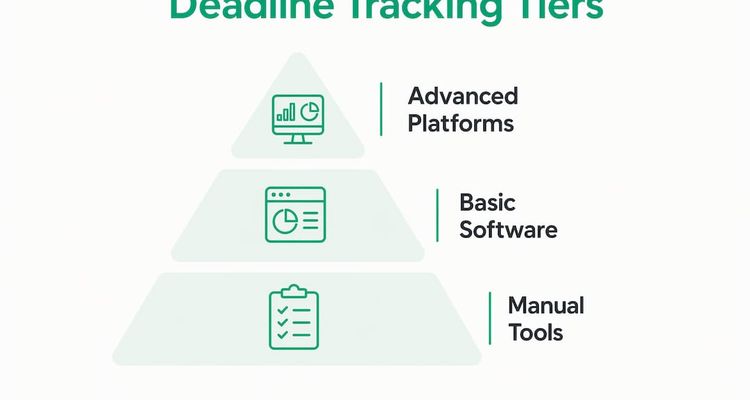
The table below compares feature categories across three tiers of deadline tracking approaches.
| Feature category | Manual tools | Basic software | Advanced platforms |
|---|---|---|---|
| Centralized date registry | No | Partial | Yes |
| Automated alerts and reminders | No | Limited | Multi-channel |
| Escalation workflows | No | No | Yes |
| Ownership and accountability tracking | No | Partial | Yes |
| ERP/CRM integration | No | Rare | Yes |
| Audit-ready reporting | No | No | Yes |
Pro Tip: Before configuring any tracking tool, document every contract term and renewal obligation in writing. Tools can only alert you to what you have defined. Undefined obligations are invisible obligations.
How to implement a step-by-step deadline monitoring process
A repeatable deadline monitoring process follows five stages: identification, assignment, tracking, escalation, and review. Skipping any stage creates gaps that surface as missed deadlines later.
- Identify all critical dates. Audit every contract, license, certification, insurance policy, and regulatory filing in your organization. Include renewal dates, notice periods, and intermediate milestones, not just final due dates.
- Assign clear ownership. Every deadline needs a named owner. Shared ownership is no ownership. Assign a primary responsible party and a backup for each critical date.
- Set tiered alerts. Configure reminders at 90, 60, 30, and 7 days before each deadline. Earlier alerts create time for negotiation, renewal, or escalation. A single reminder the week before a deadline is not a system. It is a last resort.
- Apply idle threshold alerts. Idle threshold strategies flag tasks that have not been updated within a set period, triggering alerts to both the owner and their manager before the situation becomes critical. This is the most underused technique in deadline management. A task can show as “in progress” for weeks while nothing actually moves.
- Conduct regular reviews. Schedule weekly or biweekly reviews of all upcoming deadlines within a 90-day window. Review meetings should cover status, blockers, and ownership changes. Without a review cadence, even well-configured systems drift.
71% of organizations fail to complete projects on time, with communication breakdowns causing 56% of those failures. Centralized dashboards that show ownership and status in real time reduce delays by 14% and increase project success rates by 22%. Those numbers reflect what happens when visibility replaces assumption.
Pro Tip: Track not just the deadline itself but every intermediate workflow stage leading to it. A contract renewal that requires legal review, procurement approval, and executive sign-off has three potential bottleneck points before the final date.
What are the common challenges in deadline monitoring?
The most common challenge in deadline monitoring is not forgetting a date. It is failing to see that a task has stalled weeks before the date arrives.
Deadlines fail due to invisible bottlenecks like drafting delays and review stalls that standard calendars cannot reveal. A calendar shows when something is due. It does not show whether the draft is sitting in someone’s inbox waiting for approval. Tracking workflow stages, not just dates, exposes these gaps before they become crises.
A second challenge is deadline racing culture. Employees under constant deadline pressure show decreased productivity and increased burnout, creating a cycle where urgency becomes the default state and quality suffers. Organizations with proactive planning recover from disruptions 35% faster than reactive ones. The goal of deadline monitoring is to eliminate urgency as a management tool, not to intensify it.
Troubleshooting tips for common deadline monitoring failures:
- Ownership gaps: Audit your deadline registry quarterly and confirm every item has a named owner. Staff changes create orphaned deadlines faster than any other cause.
- Alert fatigue: If teams are receiving too many low-priority alerts, they will ignore high-priority ones. Segment alerts by deadline type and urgency level.
- Incomplete records: Require that every new contract, license, or agreement is entered into the tracking system at signing, not at renewal time.
- No escalation path: Define in advance who receives an alert if the primary owner does not act within 48 hours. Escalation without a defined path is not escalation.
- Review cadence decay: Assign a standing owner for the weekly review meeting. Without accountability for the review itself, it disappears within two months.
How does deadline monitoring connect to regulatory compliance?
Deadline monitoring and regulatory compliance are inseparable in professional and regulated industries. Compliance obligations carry fixed dates set by external bodies, and missing them triggers consequences that no internal process can reverse after the fact.
Missed deadlines trigger allegations of negligence, breach-of-contract claims, and regulatory fines reaching tens of thousands of dollars. In some regulated sectors, penalties extend to license suspension or mandatory reporting to oversight bodies. The financial exposure from a single missed compliance filing can exceed the cost of running a full deadline tracking system for years.
Courts add a layer of nuance that operations teams often overlook. Courts do not always treat missed deadlines as material breaches unless the contract explicitly defines the date as an essential condition. When a deadline is classified as an innominate term rather than a condition, the available remedies may be limited to damages rather than contract termination. Understanding how your contracts classify deadlines directly affects your legal exposure.
The table below maps common financial consequences to prevention measures.
| Risk category | Potential consequence | Prevention measure |
|---|---|---|
| Contract renewal lapse | Auto-renewal on unfavorable terms | 90-day advance alert with owner assignment |
| Regulatory filing missed | Fines, license risk | Compliance calendar with escalation workflow |
| Supplier rebate unclaimed | Direct revenue leakage | Systematic rebate deadline tracking |
| Certification expired | Operational shutdown, liability | Automated expiry alerts with renewal workflow |
| Breach-of-contract claim | Legal costs, damages | Contractual term classification and audit trail |
Audit-ready controls are the operational output of a mature deadline monitoring system. When a regulator or auditor asks for evidence that a compliance obligation was met, a centralized platform with timestamped alerts, owner logs, and completion records provides that evidence in minutes rather than days.
Key takeaways
Proactive deadline monitoring prevents revenue loss by combining centralized tracking, clear ownership, tiered alerts, and workflow visibility across every critical date in your organization.
| Point | Details |
|---|---|
| Revenue erosion is measurable | Missed deadlines erode an average of 9.2% of annual revenue through lapsed contracts and unclaimed rebates. |
| Idle threshold alerts catch stalls early | Flagging tasks unrevised for a set period prevents last-minute crises before they reach the deadline. |
| Ownership is non-negotiable | Every deadline needs a named owner and a defined escalation path, or it is effectively unmanaged. |
| Compliance and financial risk overlap | Missed regulatory deadlines trigger fines, legal claims, and license risk that far exceed the cost of prevention. |
| Workflow visibility beats calendar tracking | Tracking intermediate stages, not just due dates, exposes the bottlenecks that cause most deadline failures. |
Why most teams are solving the wrong deadline problem
After working with operations and compliance teams across multiple industries, the pattern I see most often is this: teams invest in alerts and reminders, then wonder why deadlines still slip. The alerts fired. The reminders went out. And yet the renewal lapsed or the filing arrived late.
The real problem is almost never the deadline itself. It is the workflow between the start date and the due date. A contract renewal that requires three approvals and two external parties has five potential failure points, none of which a calendar reminder addresses. The teams that consistently protect their revenue are the ones tracking stage-level progress, not just final dates.
I also think the industry underestimates the cultural dimension. Deadline racing, where urgency is the permanent operating mode, destroys the judgment that good compliance work requires. When every task feels like a fire, teams stop distinguishing between a 90-day notice period and a 7-day one. Proactive monitoring is not just a technical fix. It is a way of giving your team the time and clarity to do the work correctly.
The shift I expect to see accelerate in 2026 is organizations moving from deadline calendars to deadline workflows. The calendar tells you when. The workflow tells you whether. Both matter, but only one prevents the failures that cost real money.
— Kuldeep
Expiryedge: built for deadline-driven operations
Operations and compliance teams managing contracts, certifications, licenses, and regulatory obligations need more than a shared calendar. They need a system that tracks every critical date, assigns ownership, fires tiered alerts, and escalates automatically when action stalls.

Expiryedge is a deadline tracking platform built specifically for this work. It centralizes expiration tracking across contracts, renewals, compliance requirements, vendor agreements, employee certifications, and more. Automated multi-channel reminders and escalation workflows keep every deadline visible and every owner accountable. Teams get audit-ready records without manual effort. Organizations that move from spreadsheets to Expiryedge stop losing revenue to silent renewals, unclaimed rebates, and missed compliance filings. Sign up at Expiryedge to see how it works for your team.
FAQ
What is deadline monitoring in operations?
Deadline monitoring is the systematic tracking of critical due dates, including contract renewals, compliance filings, and certifications, to prevent missed obligations and the revenue loss or penalties that follow.
How much revenue can missed deadlines cost an organization?
Poor contract obligation management erodes an average of 9.2% of annual revenue. Effective tracking recovers 3–5% of total contract value by preventing silent renewals and unclaimed rebates.
What is an idle threshold alert?
An idle threshold alert flags a task that has not been updated within a defined period, notifying the owner and their manager before the deadline becomes a crisis.
How do missed deadlines create legal risk?
Missed deadlines can trigger breach-of-contract claims and regulatory fines reaching tens of thousands of dollars. Legal exposure depends on whether the contract classifies the deadline as an essential condition or an innominate term.
What is the difference between deadline tracking and deadline monitoring?
Deadline tracking records when something is due. Deadline monitoring actively tracks workflow progress, ownership, and status at every stage leading to the due date, which is what actually prevents failures.
Recommended
Frequently asked questions
How much revenue can missed deadlines cost an organization?
Poor contract obligation management erodes an average of 9.2% of annual revenue. Effective tracking recovers 3–5% of total contract value by preventing silent renewals and unclaimed rebates.
What is an idle threshold alert?
An idle threshold alert flags a task that has not been updated within a defined period, notifying the owner and their manager before the deadline becomes a crisis.
How do missed deadlines create legal risk?
Missed deadlines can trigger breach-of-contract claims and regulatory fines reaching tens of thousands of dollars. Legal exposure depends on whether the contract classifies the deadline as an essential condition or an innominate term.
What is the difference between deadline tracking and deadline monitoring?
Deadline tracking records when something is due. Deadline monitoring actively tracks workflow progress, ownership, and status at every stage leading to the due date, which is what actually prevents failures.