Absentee Owner Risk: Deadlines You Still Must Manage

Absentee ownership is common in modern business, whether you run multiple locations, own a business you don’t operate day-to-day, or split time between roles. The risk is not that people forget a date once. It’s that ownership becomes ambiguous, evidence gets scattered, and “we’ll handle it next week” quietly turns into late fees, lapsed coverage, or a failed audit.
If you’re an absentee owner, you can delegate work, but you can’t delegate outcomes. Certain deadlines still need a reliable system: clear accountability, lead times, escalation, and audit-ready proof.
What “absentee owner risk” really means
Absentee owner risk is the gap between:
- Who is legally and financially on the hook (often the owner, officers, or the entity)
- Who actually sees the deadline coming (often “someone in ops” until they change roles)
In practice, absentee owner risk shows up when a deadline is:
- Not tied to a named owner and backup
- Not tracked with a “renew-by” date (not just an expiration date)
- Not connected to a checklist that proves it was completed
- Not documented in a way an auditor, insurer, bank, or customer will accept
The fix is not more reminders in personal calendars. It is deadline tracking as an operational control.
Deadlines you still must manage (even if you don’t run the day-to-day)
The exact list varies by industry and state, but absentee owners repeatedly get burned by the same categories.
1) Entity and governance deadlines
If the company’s good standing slips, everything downstream becomes harder: banking, contracting, licensing, and sometimes even the ability to sue or defend a claim.
Common examples:
- Annual reports and statements of information (state-level)
- Franchise or entity taxes (varies by state and entity type)
- Registered agent renewals
- Board/member meeting requirements and approvals (especially if required by bylaws or lender covenants)
Good practice: treat these as “tier 1” obligations with early lead times. The goal is not filing on the due date. The goal is filing before you hit the period where you can’t get signatures, approvals, or supporting documents in time.
For official references and filing portals, the SBA’s guide on staying legally compliant is a useful starting point (then confirm your state-specific rules).
2) Tax deadlines that don’t care who was “on vacation”
Tax compliance is unforgiving because penalties compound and notices can lag.
Typical deadlines include:
- Federal and state income tax filings (entity dependent)
- Payroll tax deposits and filings (if you have employees)
- Sales tax filings (especially multi-location or multi-state)
- 1099/contractor reporting
Even if you outsource to a CPA or payroll provider, you still need internal deadlines for:
- Providing complete inputs
- Approving returns
- Confirming submission and payment
- Storing confirmation receipts and copies
The IRS maintains current-year filing guidance and calendars at IRS.gov (verify your specific entity deadlines with your tax advisor).
3) Licenses, permits, and certifications
This is the classic absentee-owner failure mode: operations “seems fine” until an inspection, customer request, or incident reveals something expired.
Examples that frequently require document expiry tracking:
- Business licenses (city, county, state)
- Industry permits (health department, alcohol, signage, fire)
- Professional licenses (trade, healthcare, legal, accounting)
- Equipment operator certifications (depending on role and jurisdiction)
- Facility-related inspections and certificates (elevator, fire suppression, backflow, etc.)
Absentee-owner twist: these often live in a drawer, on someone’s desktop, or in a vendor portal. When that person leaves, the renewal does not.
4) Insurance renewals and proof of coverage obligations
Insurance is not just “renew annually.” It includes continuous obligations to provide proof and keep coverages aligned with contracts.
Common recurring deadlines:
- Policy renewals (GL, property, cyber, professional liability)
- Workers’ compensation policy updates and audits
- Certificates of insurance (COIs) required by customers, landlords, or partners
- Vendor insurance tracking (their COIs expiring, naming you as additional insured)
A missed renewal can create a coverage gap. A missed COI deadline can block a project kickoff, a vendor onboarding, or a customer contract signature.
5) Contract deadlines beyond the end date
Many owners only track “contract ends on X.” The money and risk are often in the dates around it.
High-impact contract renewals include:
- Auto-renewal cancellation windows (often 30 to 90 days)
- Notice periods for termination for convenience
- Price increase notice periods
- Renewal negotiation milestones (legal review, security review, procurement)
- Deliverable acceptance and warranty claim windows
If you are not in the building, you are less likely to hear the early warning signs (service degradation, billing disputes, stakeholder dissatisfaction) that should trigger a renewal review.
6) Vendor and subscription renewals that quietly drain budget
Absentee owners feel this as margin leakage: tools and services renew, rates creep up, and nobody wants to own the cancellation.
Track these like contracts:
- Renewal date and notice window
- True owner (the person who can decide to renew)
- Finance approver
- Evidence (quotes, approvals, invoices)
This is where workflow automation matters. The “work” is not remembering the date. The work is getting a decision, approval, and documentation before the window closes.
7) Safety, inspection, and maintenance cycles
Some deadlines are not paperwork. They’re proof of control.
Depending on your industry, recurring compliance schedules may include:
- Preventive maintenance and calibration
- Safety inspections and drills
- Training renewals
- Incident review and corrective action deadlines
If an auditor, customer, or insurer asks, you need to show what was done, when, by whom, and with what evidence.
8) Customer, platform, and reputational deadlines
Not all “deadlines” are regulated. Some are commercially enforced.
Examples:
- SLAs for response and resolution
- Annual security questionnaires and vendor due diligence renewals
- Platform policy deadlines (marketplaces, app stores, payment processors)
Absentee owners often miss early signals that these are slipping because the signals show up in community channels, not board packets. If your customers talk about issues or alternatives in public forums, it can help to monitor those conversations systematically. Tools like Redditor AI for automating Reddit conversation monitoring and outreach can be useful for staying aware of what prospects and customers are asking while you’re not embedded in daily operations.
The “must-manage” checklist: what to demand for every deadline
Absentee owners do best when they stop asking, “Did we renew it?” and start requiring a consistent control set.
For every tracked obligation, insist on these fields and artifacts:
- What is it? A clear name and category (license, contract, insurance, inspection)
- What are the key dates? Expiration date plus a renew-by date that accounts for internal lead time
- Who owns it? A primary owner, a backup, and an escalation contact
- What is the workflow? A checklist with exit criteria (what “done” means)
- Where is the evidence? Attached documents (renewal confirmation, COI, filed report, paid invoice)
- How will you find it fast? Searchable metadata and a centralized dashboard
Hidden Compliance Contract Deadlines Teams Often Miss
| Deadline type | What to track (minimum) | Recommended lead time | “Done” evidence | Escalate to |
|---|---|---|---|---|
| Business license renewal | Expiration date, issuing authority, fee, login/contact | 60 to 90 days | Renewed license PDF/receipt | GM or COO |
| Insurance renewal | Policy period, broker contact, coverage requirements | 90 days | Binder, COI, invoice paid | Finance lead |
| Contract auto-renewal | Notice window, renew-by date, stakeholder owner | 90 days (or contract-defined) | Signed amendment or cancellation confirmation | Department head |
| Tax filing | Due date, preparer, internal deliverables due date | 30 to 60 days | Filed return + payment confirmation | CFO/controller |
| Inspection/maintenance | Schedule, asset/site, procedure | Varies by regulation | Inspection report, work order closure | Ops lead |
| Customer security review | Questionnaire due date, internal approvers | 30 to 45 days | Submitted responses + approval trail | Security/compliance owner |
The exact lead time should reflect your reality: how long approvals take, how long vendors take to respond, and how long regulators process.
How to manage deadlines when you are not there: a practical operating model
Absentee owners need a system that survives:
- Staff turnover
- Vacation weeks
- Vendor delays
- “Inbox compliance,” where work exists only in email threads
Step 1: Centralize the system of record
A spreadsheet can list dates, but it rarely holds the workflow and proof you need under pressure.
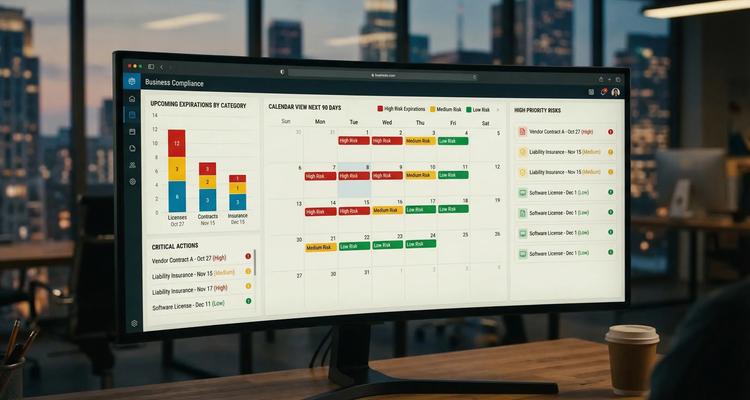
A reliable system should support:
- Smart expiration tracking (so renewals do not depend on memory)
- A centralized expiry dashboard (so you can see risk at a glance)
- Calendar view (so teams can plan workload)
- Advanced search (so you can retrieve evidence quickly)
- Document attachment (so proof is stored with the obligation)
ExpiryEdge is designed around this “single register” approach: track deadlines, attach documents, and make ownership visible across the team.
Step 2: Define ownership like an internal control, not a suggestion
For each category, define:
- The role accountable for outcomes (not just the person doing the task)
- A backup owner
- Who gets notified if it is at risk
If you only set an “assignee,” you will eventually hit a single point of failure. Absentee owners should demand redundancy by design.
Step 3: Use staged reminders and escalation (not one reminder)
One reminder is easy to ignore. A cadence creates urgency at the right time.
A typical pattern for higher-risk items:
- Early notice for planning (for example, 90 days)
- Mid-cycle check-in (60 or 45 days)
- Action required (30 days)
- Escalation window (14 or 7 days)
Multi-channel notifications matter here. When the owner is out, an email buried under vendor noise is not a control.
Step 4: Convert each deadline into a repeatable workflow checklist
Absentee owners should push teams away from “we renewed it” and toward “we executed the renewal process.”
A renewal checklist often includes:
- Confirm requirements (coverage limits, license prerequisites, inspection scope)
- Gather documents
- Obtain approvals
- Submit renewal
- Pay fees
- Confirm acceptance
- Attach evidence and close out
Workflow automation makes this consistent. It also creates an audit trail that does not depend on someone remembering what happened six months ago.
Step 5: Build an “owner away” protocol
If you travel, run multiple businesses, or simply want the company to function without you, define rules for when you are unavailable.
Include:
- What must be escalated to you vs delegated
- Approval thresholds (for example, renewals above a dollar amount)
- Who can sign (and what proof of authority is required)
- A weekly “deadline risk” review cadence
This is less about control and more about speed. When someone knows exactly what to do, they act earlier.
Red flags that your deadlines are not actually under control
If any of these are true, absentee owner risk is already present:
- You cannot answer “what expires in the next 90 days?” without asking multiple people
- Proof of renewal is stored in email threads or local folders
- You find out about renewals when an invoice arrives
- More than one department believes the other department “owns” the same renewal
- Your team relies on one person’s calendar for compliance management
These are solvable problems, but they require treating deadline tracking as business process automation, not personal productivity.
A simple way to start this month (without boiling the ocean)
Absentee owners get the best results by starting narrow and building trust in the process.
Pick one high-impact group:
- Licenses and permits
- Insurance and COIs
- Top 20 contracts by spend or risk
Then implement:
- A centralized register
- Assigned owners and backups
- Staged reminders
- A checklist workflow
- Attached evidence
Once the system works for one category, expand. The goal is to make renewals predictable, inspections uneventful, and audits boring.

Where ExpiryEdge fits for absentee owners
If you are not operating the business day-to-day, you need visibility without micromanagement. ExpiryEdge supports that by helping teams:
- Track expirations across contracts, compliance, subscriptions, and operations
- Automate workflow checklists tied to each obligation
- Send multi-channel notifications so deadlines don’t hide in one inbox
- Store documents with the record for fast retrieval
- Use a centralized expiry dashboard, calendar view, bulk import, and search to keep the register accurate
If you want absentee ownership without absentee risk, the standard is simple: every deadline has an owner, a workflow, and proof.
Not legal advice
This article is for general informational purposes and does not constitute legal advice. Laws, regulations and contract requirements vary by jurisdiction and change over time. Consult a qualified attorney in your jurisdiction before making decisions that depend on the specific legal interpretation discussed here.