Top 5 Insurance Policy Management Software Alternatives 2026

Managing insurance policy expirations and compliance deadlines across multiple products, contracts, and licenses creates tracking gaps and audit risk. Existing tools tie policy tracking to only one line or require manual follow-up, increasing the risk of missed renewals and penalties. This comparison details key features, integration support, and pricing across five expiration tracking platforms so compliance teams can select a fit for their workflow.
Table of Contents
- ExpiryEdge
- Guidewire
- OWLS™ insurance software platform
- BindHQ
- Insuresoft Diamond System
- Comparison of alternatives
ExpiryEdge

At a Glance
Plans start at $47 per month and scale to $274 per month, billed annually, with a 14-day free trial. ExpiryEdge tracks fixed-date work across contracts, renewals, certifications, licenses, subscriptions, inspections, and audits. The platform uses multichannel reminders and automated escalations so teams get alerted before deadlines and maintain audit-ready records.
Core Features
ExpiryEdge provides expiration tracking for licenses, contracts, insurance, permits, and SOPs, and it links documents directly to expiry records for audit exports. The system sends multichannel reminders via email, SMS, WhatsApp, Slack, and Microsoft Teams, and it supports API and webhooks for custom notification flows. Workflow checklists record live progress and automated escalations push missed actions up the chain.
Key Differentiator
Multichannel automated reminders combined with structured SOP workflows and a document-linked audit trail in one product sets ExpiryEdge apart from generic task managers.
Pros
The platform reduces manual follow-up by routing reminders across email, SMS, and messaging apps, so operations teams spend less time chasing renewals. Document storage tied to expiry records creates a single place to produce audit exports and prove compliance during inspections. Role-based access and team management keep responsibility clear, and the product scales from small teams to large enterprises.
Cons
- Complexity can present a learning curve for small teams new to automation.
Notable Integrations
- Slack
- Microsoft Teams
- SMS
- API & Webhooks
Who It's For
Organizations that must manage deadline-driven compliance work will benefit most. Typical users include compliance managers tracking licenses and permits, HR teams managing staff certifications, operations groups overseeing contract renewals, and legal teams auditing documentation. Industries that commonly use the product include healthcare, construction, and corporate compliance functions.
Unique Value Proposition
Document storage linked to expiry records with exportable audit trails gives compliance teams a single source of truth for inspections. That connection shortens audit response time and lowers the risk of missed renewals. Combined with multichannel reminders and workflow checklists, this reduces administrative burden and helps prevent penalties and operational disruption.
Real World Use Case
A healthcare facility tracks staff certifications, medical device inspections, and insurance policies in one system. ExpiryEdge sends reminders to the right person through the platform they already use, and audit exports compile evidence for regulators. That setup helps the facility pass inspections and avoid lapse-related penalties.
Pricing
Pricing follows a flexible subscription model based on the number of expiries and users. Plans range from $47 per month for small teams to $274 per month for large teams, billed annually, and include a 14-day free trial.
Website: https://expiryedge.com
Guidewire
At a Glance
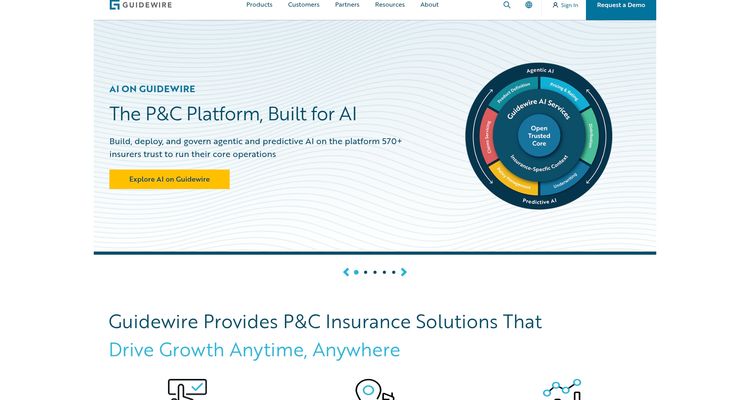
Guidewire reports being trusted by over 570 insurers across more than 40 countries. The platform combines core insurance systems with analytics, digital channels, and AI delivered as a cloud service. That scope positions Guidewire as a backbone for insurers that need integrated policy, claims, billing, and rating capabilities.
Core Features
Guidewire delivers a cloud-based core platform that links policy administration, claims, billing, and rating into a single deployment. The platform embeds AI tools such as ProNavigator inside core workflows and offers a unified pricing engine called PricingCenter to speed product configuration. Guidewire also provides industry-specific modules for commercial, personal, and workers compensation lines and a broad partner and community ecosystem for implementation support.
Key Differentiator
The clearest difference is AI embedded directly into operational workflows rather than offered as a separate add-on. That approach puts ProNavigator prompts and recommendations where underwriters and claims handlers already work. The result is AI that supports decisions inside policy and claims processes instead of creating parallel steps.
Pros
Guidewire combines a full set of core insurance functions with digital and analytics capability, which reduces the need for multiple disconnected systems. That breadth, along with strong vendor experience and awards from Celent and Forrester, supports large transformation programs. Flexible deployment options, including Guidewire Cloud and traditional on-premises installs, let insurers choose the operational model that fits their IT strategy.
Cons
- Significant implementation effort and change management are required. New clients should expect lengthy configuration and testing phases.
- The platform has a steep learning curve for users who are new to integrated core systems. Training and dedicated support resources reduce that burden.
- Pricing and licensing are not publicly listed. Smaller insurers may find total cost substantial compared to lighter alternatives.
Who It's For
Large to mid-sized property and casualty insurers that need an integrated core system with analytics and embedded AI will find Guidewire appropriate. Organizations planning major digital transformation or broad product portfolio consolidation will get the most value.
Real World Use Case
According to the company, Velocity Risk Underwriters reduced costs by 60% and doubled profitability after implementing Guidewire InsuranceNow. That example shows how rapid product launches and consolidated operations can affect expense and margin when the platform is fully adopted.
Pricing
Pricing is not publicly specified. Guidewire typically sells via enterprise licensing and SaaS subscription models, with costs that vary by modules, deployment model, and implementation scope.
Website: https://guidewire.com
OWLS™ insurance software platform
At a Glance
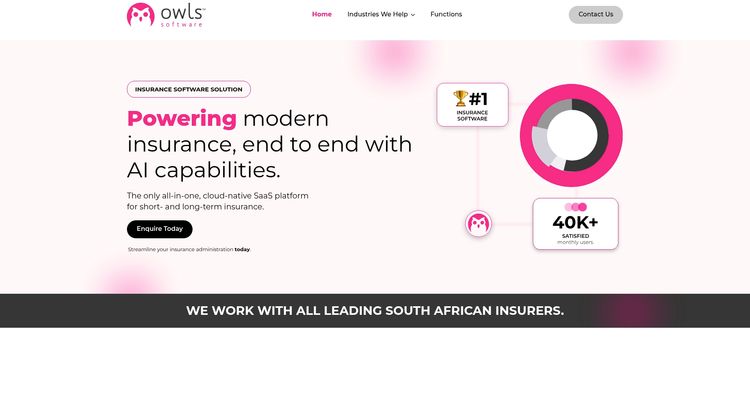
Handles both short term and long term insurance operations across South Africa and other markets. OWLS™ combines policy administration, claims, reinsurance, and finance into a single cloud native system. The platform emphasizes automation and real time reporting to give insurers centralized visibility and tighter control.
Core Features
OWLS™ delivers workflow management and premium collections while tying claims and reinsurance processes into the same ledger. The platform offers real time reporting, SMS and email communication, and a flexible rate engine to model tariffs and pricing scenarios. Built in integration points let teams link SQL scripts, JSON APIs, secure file transfers, banking gateways, CRM systems, and external accounting systems.
Key Differentiator
The product positions itself as an all in one cloud native platform that brings core insurance functions under one roof and exposes them through automated processes and live dashboards. That single system approach reduces handoffs between policy, claims, and finance teams. For vendors and carriers that manage multiple product lines, the unified data model shortens time to reconcile transactions and generate management reports.
Pros
OWLS™ reduces the need for separate point tools by consolidating policy, claims, reinsurance, and finance in one environment. The platform automates routine workflows and centralizes communications via SMS and email, which keeps renewal and collection activity visible. Built in security and compliance features are part of the design, and the available integration methods let IT teams connect banking gateways, CRMs, and accounting systems without rewriting core modules.
Cons
- Complexity creates a steep learning curve according to third party reviews. New administrators may need several weeks of training.
- The scope and feature density make this a better fit for medium and large insurers rather than very small or highly specialized operators.
- Pricing is not publicly listed and looks to follow enterprise SaaS models, which may be a barrier for budget conscious buyers.
When It May Not Fit
OWLS™ may not suit single product startups or micro insurers that prefer simple, low cost policy engines. Organizations without an integration team may find the implementation overhead high. Small brokers seeking a lightweight policy tracker should evaluate simpler tools before committing to an enterprise deployment.
Notable Integrations
- SQL scripts for custom data loads
- JSON APIs for real time exchanges
- Secure file transfers for batch data interchange
- Banking gateways for collections
- CRM systems and external accounting systems for financial reconciliation
Who It's For
Medium to large insurance companies that need a single system to manage policy lifecycle, claims, reinsurance, and finance will benefit most. IT teams that can manage integrations and change control will extract the most value. Risk and operations teams looking for consolidated reporting will find the unified data model helpful.
Real World Use Case
A South African insurer consolidated separate policy, claims, and finance systems into OWLS™ to remove manual reconciliations. The carrier used the flexible rate engine to test pricing across lines and automated premium collections through bank gateway integrations. Daily dashboards replaced weekly manual reports, improving operational visibility across regions.
Pricing
Pricing is not specified by the vendor and appears to follow enterprise SaaS practices. Expect implementation fees and tiered subscription models for larger deployments, with custom quotes provided by sales.
Website: https://owlssoftware.com
BindHQ

At a Glance
BindHQ claims it reduces time to market from years to weeks. That claim targets MGAs, program administrators, and wholesale brokers that need faster program launches. The vendor emphasizes prebuilt templates and configurable underwriting rules as the main drivers of that speed.
Core Features
BindHQ bundles insurance product templates, configurable underwriting rules, and policy forms management with commission scheduling and rating tables. The platform combines accounting, taxes, and reporting tools with API connections for distribution through portals and mobile apps. Administrative workflows and automated compliance checks sit alongside rating engines that support multi variable rates and state overrides.
Key Differentiator
BindHQ focuses specifically on MGAs and program administrators, using templates and automation to cut launch cycles. That claim frames its product strategy and differentiates it from generic policy systems. The configuration-first approach lets specialist programs go live without extensive custom development.
Pros
BindHQ replaces spreadsheets and multiple legacy systems with a single operating system for specialty insurance operations. That consolidation reduces manual handoffs and keeps underwriting rules, forms, and commissions in one place. Built in compliance, taxes, accounting, and reporting help teams manage regulatory and finance tasks while guided onboarding shortens the user learning curve.
Cons
- Pricing is tiered or customized, which may make straight price comparisons difficult for smaller firms.
- Highly customized programs can extend implementation beyond the vendor's standard 45–90 days.
- Large scale integrations with legacy systems can require extra effort and support, possibly adding costs.
When It May Not Fit
Organizations with heavily customized legacy systems may face a lengthy migration and integration project. Firms that need a simple out of the box policy admin for a single product may find the platform more than they require. Teams that cannot allocate integration support or a data migration budget might prefer a lighter weight tool.
Who It's For
Mid sized to large insurance organizations, MGAs, program administrators, and wholesale brokers focused on specialty and E and S lines. Teams that must launch new programs quickly and centralize underwriting, policy issuance, and finance workflows. Organizations willing to invest in configuration and integration to replace legacy systems.
Real World Use Case
The vendor reports a Florida based MGA launched a habitational program in four months, cutting turnaround from days to hours and removing spreadsheet workarounds. That example shows how prebuilt templates and rules speed quoting and issuance. A wholesale brokerage also migrated off legacy systems and built a modern platform in a few weeks, accelerating growth.
Pricing
BindHQ uses tiered subscription models priced by business size, volume, and selected modules. Large enterprises receive custom pricing that reflects integration and feature requirements.
Website: https://bindhq.com
Insuresoft Diamond System

At a Glance
Insuresoft reports a 100% successful implementation track record. The vendor also states more than 150 pre-built third-party integrations and over 33 years in the P&C market. That combination signals a focus on enterprise deployments and deep ecosystem connectivity.
Core Features
Diamond handles policy administration, billing, and claims in a single core with digital engagement and analytics. The platform supports Personal, Commercial, Specialty, Farm, Non-standard Auto, and Workers’ Compensation lines while offering a configuration toolkit and Diamond Composer for user-managed updates. The system uses a cloud-native architecture and supports module-by-module or full-suite deployment.
Key Differentiator
Diamond’s stand-out trait is its all-in-one approach paired with a broad integration ecosystem. Organizations can build bespoke policy and rating rules with the configuration toolkit and then plug into many external services via the vendor’s large library of pre-built connectors. That mix targets insurers who want one central core rather than multiple stitched systems.
Pros
Diamond delivers deep functional coverage across underwriting, billing, claims, and customer channels. The platform’s long market presence supports more mature feature sets and process depth, and client testimonials include references to emphasize responsiveness, scalability, and ongoing support. The availability of 150 pre-built integrations and Diamond Composer helps teams update products without constant vendor intervention.
Cons
- Public pricing is limited and typically customized per client.
- Implementation and configuration require dedicated technical resources or partner support.
- The system’s breadth creates complexity that can demand extensive user training.
When It May Not Fit
Organizations without allocated IT implementation bandwidth will struggle with initial configuration. Smaller carriers seeking a quick out-of-the-box solution may find the onboarding timeline lengthy. Teams that need a lightweight, narrowly scoped policy engine rather than a full enterprise core should look elsewhere.
Notable Integrations
Diamond connects to various third-party insurance services, billing platforms, analytics tools, and communication modules. The vendor advertises a large catalog of pre-built connectors to accelerate data exchange and reduce custom integration work.
Who It's For
Mid-size to large P&C carriers, managing general agents, and third-party administrators that require a unified core system will find Diamond aligned with their needs. It fits organizations planning substantial product configuration, multiple product lines, or enterprise-wide consolidation of policy, billing, and claims workloads.
Real World Use Case
A regional carrier deployed Diamond to replace a fractured set of legacy systems. The carrier centralized policy, billing, and claims on Diamond and used the configuration toolkit to launch new policy forms. That consolidation reduced handoffs and improved customer communications.
Pricing
Pricing is not published and is typically tailored to each client’s scope and deployment approach. Prospective buyers should expect a consultative pricing model that factors modules, integrations, and implementation services.
Website: https://insuresoft.com
Comparison of alternatives
Expanding organizations seek insurance policy management software to streamline compliance processes and ensure operational efficiency. Products available on the market target distinct needs within the insurance field, allowing stakeholders to select solutions that align closely with their requirements.
Multichannel notifications for operational clarity
Some solutions, like ExpiryEdge, focus on notification systems that utilize email, SMS, WhatsApp, and collaboration tools such as Slack to ensure timely action on expirations and renewals. The ability to track and remind also incorporates direct connections to document storage, which aids managing inspections and audit trails.
Appropriate system integration for insurers
Others, like Guidewire, offer complete integration of an insurer's digital operations by embedding AI tools into workflows, providing real-time analysis and customer management capabilities. Similarly, OWLS™ emphasizes real-time reporting with flexibility for financial reconciliation and transaction oversight, and BindHQ streamlines underwriting processes through template-based automation and transparent workflows. Additionally, the Insuresoft Diamond System stands out by delivering customization features supported by 150 pre-built connectors to minimize implementation overhead.
Best fit
- Teams requiring multichannel automated reminders combined with document-linked audit trails will value the clarity facilitated by ExpiryEdge.
- Insurers prioritizing a integrated operation framework and AI-enhanced processing should evaluate Guidewire.
- Organizations focused on financial oversight and real-time reporting might explore OWLS™.
Our pick
ExpiryEdge provides crucial automated reminders, multichannel notifications, and exportable audit functionalities bundled with document management capability. For organizations prioritizing compliance workflow optimization, ExpiryEdge is a reliable solution. However, enterprises looking for embedded AI functionalities for operation-centralized systems might find Guidewire better suited to their scale and strategy.
Evaluate the following options to identify the solution best aligned with your organization's expiration tracking and policy management requirements.
Our pick
| Product | Core Feature | Key Differentiator | Best For | Notable Limitation |
|---|---|---|---|---|
| Expiryedge | Expiration tracking with linked documents | Multichannel reminders and checklist workflows | Compliance teams managing deadlines | Complexity may require a learning curve for new users |
| Guidewire | Integrated insurance systems | Embedded AI within core operational workflows | Large insurers with diverse product portfolios | Implementation effort required for new clients |
| OWLS™ | Policy administration with real-time insights | Centralized function for policy, claims, and finance | Medium to large insurance companies | Steep learning curve for new administrators |
| BindHQ | Templates and underwriting tools | Quick configuration for specialty lines | MGAs and program administrators | Complex integrations may require extra vendor support |
| Insuresoft Diamond | Core systems with expansive integrations | 150+ pre-built third-party connectors | Property and casualty carriers needing centralization | Extensive user training might be needed |
Managing Insurance Policy Deadlines Without Losing Control
Insurance policy management software demands more than just record keeping. Managing contracts, renewals, certifications, and compliance deadlines across multiple teams can lead to costly oversights and operational disruption. Expiryedge specializes in deadline-driven work management tailored for insurance operations, compliance managers, HR teams, and legal groups who track time-sensitive documents and activities.
Expiryedge reduces administrative effort with automated workflows, multichannel reminders by email, SMS, and messaging apps, and escalations before critical due dates. It creates a single platform to link documents to expiration records and generate audit-ready data. This focused approach helps you avoid penalties, missed renewals, and service interruptions.
See why growing insurance operations trust Expiryedge to manage their compliance deadlines. Sign up at Expiryedge to track and automate your insurance policy expirations and maintain full operational visibility today.
FAQ
How does ExpiryEdge support expiration tracking for different types of documents?
ExpiryEdge tracks expiration for licenses, contracts, insurance, permits, and SOPs, ensuring comprehensive management of crucial documents. The platform links documents directly to expiry records for streamlined audit exports. You can maintain organized and compliant records with this all-in-one solution.
What is the difference between ExpiryEdge and Guidewire?
Guidewire offers a broad set of integrated insurance systems with analytics and AI, making it a solid choice for insurers needing complex operations. ExpiryEdge, on the other hand, specializes in expiration tracking with automated reminders suitable for organizations managing compliance work. This specificity can make ExpiryEdge a better choice for teams focused on deadline-driven compliance efforts.
Which platform provides multichannel reminders for expiration alerts?
ExpiryEdge delivers multichannel reminders via email, SMS, WhatsApp, Slack, and Microsoft Teams to keep teams informed about upcoming expirations. This functionality helps minimize missed deadlines and compliance risks. Implementing this system can enhance communication within your team regarding important dates.
Can I use ExpiryEdge if my organization handles multiple types of compliance work?
Yes, ExpiryEdge accommodates various compliance tasks, making it ideal for organizations managing different expiration types like contracts and certifications. Its automated reminders and document storage features streamline the compliance process. Teams across different sectors can benefit from its capabilities.
How does ExpiryEdge’s pricing scale with the number of users?
The plans for ExpiryEdge range from $47 to $274 per month, billed annually, depending on the number of expiries and users. This flexibility allows organizations of different sizes to find a suitable pricing tier that meets their needs. You can start with a 14-day free trial to assess its fit for your team.